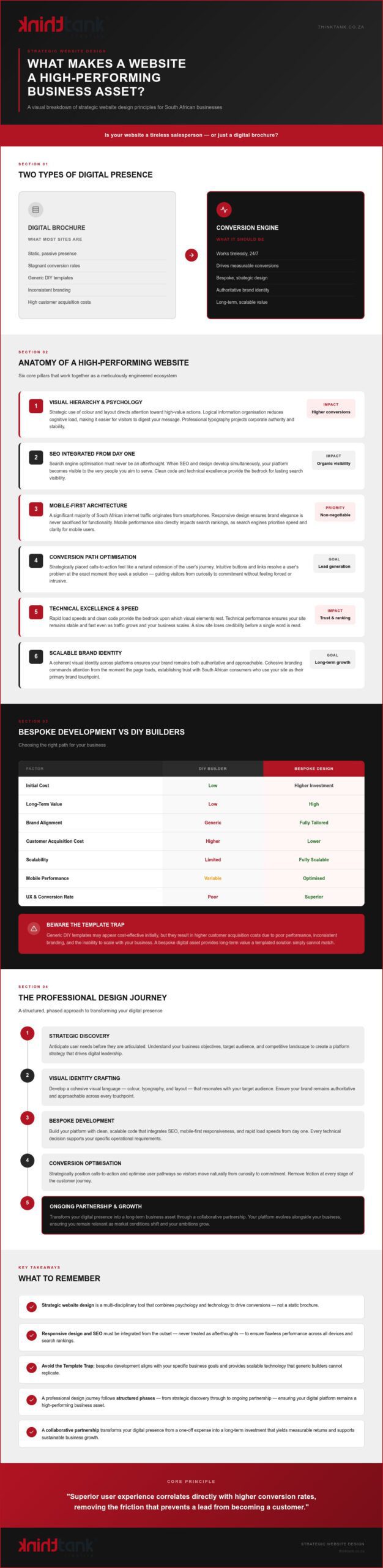
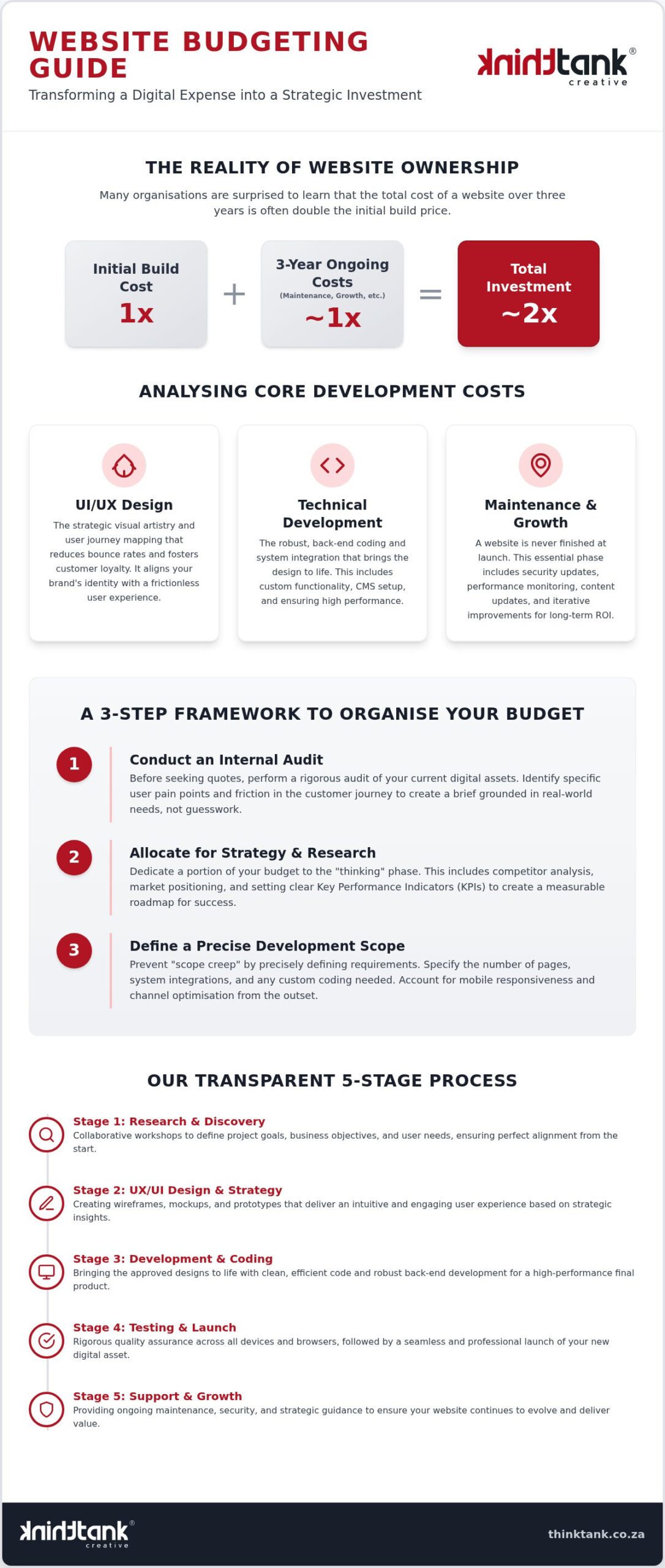
How Long Does It Take to Build a Business Website? A Clear Project Timeline

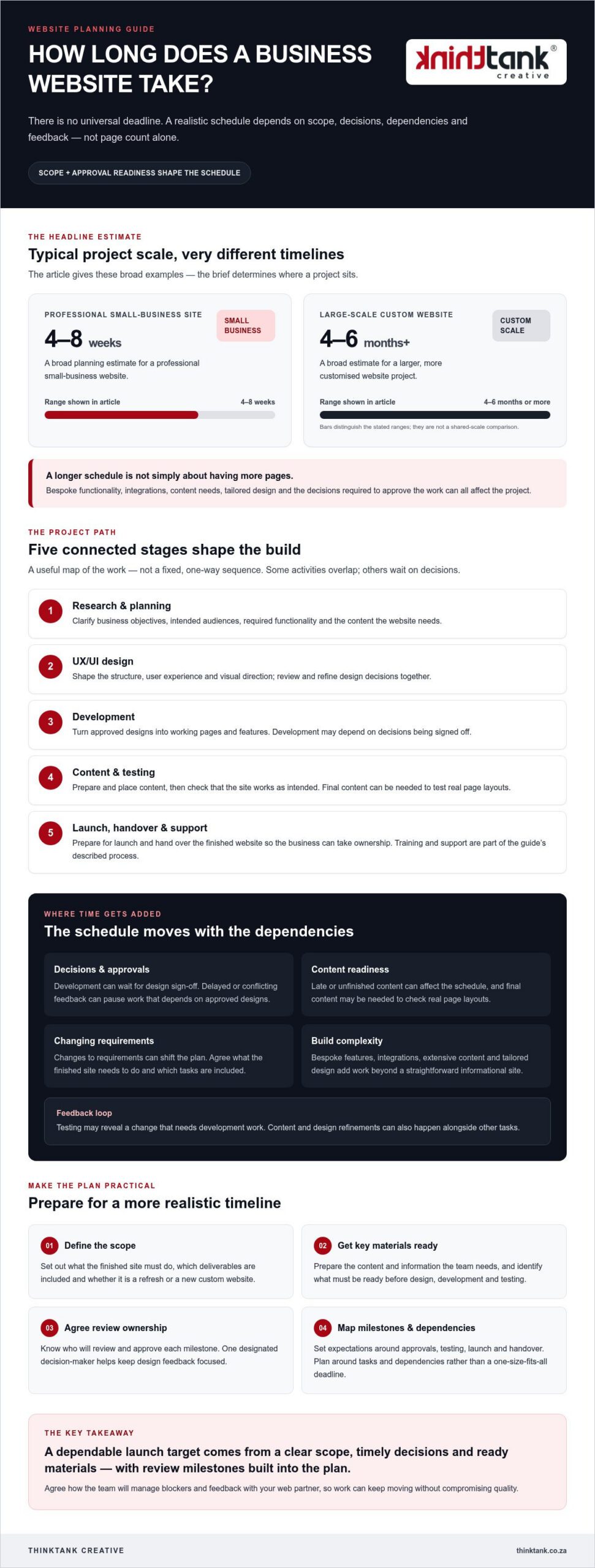
A website timeline depends on decisions, dependencies and feedback, not a universal deadline. If you’re asking how long does it take to build a business website, a professional small-business site may take around 4-8 weeks, while a large-scale custom website can take 4-6 months or more. The difference comes down to more than the number of pages.

It’s understandable to want a clear launch date before work begins. Planning is harder when you’re unsure what needs to happen before design and development, or whether late content and changing requirements could push the schedule back. In practice, timing depends on the project’s scope, how quickly decisions are made and whether key materials are ready when needed.

This guide explains the stages that shape a business website timeline, where the main dependencies sit and what your team can prepare to help prevent avoidable delays. You’ll see how research and planning, design, development, testing and launch fit together, so you can set a realistic schedule with your web partner and keep work moving without compromising quality.

Key Takeaways

  • To answer “how long does it take to build a business website”, clarify the scope, decisions and deliverables that will shape the project plan.
  • Understand how research, design, development, testing and handover connect, and why phases may overlap or need another review.
  • Identify potential blockers, from unfinished content to changing requirements, and agree how your team will manage them.
  • Build a practical timeline around milestones, dependencies and clear review ownership rather than relying on a one-size-fits-all deadline.
  • See how ThinkTank Creative’s collaborative process can guide a website from planning through launch, training and support.

How long does it take to build a business website? Start with the scope

There’s no reliable universal duration for a business website project without understanding its scope and how decisions will be made. A focused informational site has different demands from a custom build with bespoke functionality, integrations or extensive content. To answer “how long does it take to build a business website”, first define what the finished site needs to do and which tasks are included.

Building a website means more than putting pages online. It can include research and planning, UX/UI design, content preparation, coding, testing, launch and handover. Scope and approval readiness shape a website schedule. The more specific the requirements and timely the feedback, the more confidently the work can progress.

For a broader overview of the web development process, including front-end and back-end work, see Wikipedia’s introduction.

For a practical perspective on project timing, watch this video:

What does “building a business website” include?

A site refresh updates an existing website, perhaps by refining its design, content or structure. A new custom website shapes the experience and builds the pages and functionality around the business’s needs. A more complex project may also involve bespoke features or connections to other systems, which add work that a simple informational site doesn’t require.

These activities are distinct, even when they overlap. Design establishes how visitors navigate and interact with the site; coding turns those designs into working pages and features. Content needs to be prepared and placed, while testing checks that the site works as intended before launch. Launch preparation and handover help the business take ownership of the finished website.

Why a single timeline estimate can be misleading

Page count is only one part of the brief. A handful of pages with tailored functionality may need more coordination than a larger set of straightforward informational pages. Integrations, content requirements and the amount of bespoke design also influence the work involved.

Approvals create dependencies, too. Design decisions may need sign-off before development can proceed, and final content may be needed to test real page layouts. An initial website-builder setup is not necessarily a complete, launch-ready business website. The project still needs appropriate content, review, testing and handover. Define these deliverables and agree who will review them before setting a launch target.

Which website project stages shape the build timeline?

A website project is a connected set of activities, not simply a block of design followed by a block of coding. A website timeline links tasks and approval milestones. Some activities can overlap, while others depend on decisions being made. Understanding those connections helps explain how long does it take to build a business website, and where progress may pause while information or approval is outstanding.

The work often moves from research and strategy into design, development, testing, launch and support. That’s a useful way to map a project, but not every build follows a fixed, one-way path. Testing may reveal a change that needs development work, and content or design refinements can happen alongside other tasks.

From research and strategy to approved design

Early planning establishes direction. The project team clarifies business objectives, intended audiences, required functionality and the content the website needs. These decisions inform the structure and user experience, helping design respond to real priorities rather than assumptions.

Design is collaborative. The agency may present a direction for review, discuss choices such as page layouts and visual treatments, then refine the work based on feedback. Clear priorities and one designated decision-maker help keep this stage focused. If feedback is delayed or conflicting, development work that depends on approved designs may have to wait.

From development and testing to launch

Once the direction is sufficiently clear, developers build the website’s pages and functionality. The team can review progress as the work takes shape, resolving issues and making agreed refinements. Testing then checks that key features work, content displays appropriately and the experience is usable across relevant devices and browsers.

Launch requires preparation, not just a final switch-on. The project team needs to confirm readiness, coordinate the release and arrange delivery and any training the business needs to manage its website. Support can continue after launch, so the relationship doesn’t have to end when the site goes live.

For more detail on planning a tailored project, explore this custom website design and development guide. ThinkTank Creative’s website services include UX/UI design, coding, testing, launch, training and support. If you’re considering a project, you can also learn about website design and development and discuss how its stages could fit your requirements.

What makes a business website take longer, or move faster?

A website schedule is shaped by more than the work itself. Prepared content, timely decisions and a stable brief help a project progress; changing requirements, unresolved approvals or external dependencies can interrupt it. If you’re asking how long does it take to build a business website, consider how these factors affect both the work and the decisions it depends on.

A quick first draft isn’t necessarily a quicker route to a reliable launch. Adding functionality or changing direction can mean revisiting the design, updating code and testing the result again. Speed matters, but it needs to be balanced with a website that works as intended.

Helps work move forward Can slow progress
Clear business goals, audiences and page requirements Unclear priorities or new requirements added during the build
One agreed process for gathering and approving feedback Conflicting comments or delayed sign-off
Copy, images and other content prepared for the project Missing or unfinished materials needed for page layouts
Known functionality and confirmed third-party requirements Integrations or external services that need further investigation

Project inputs that are within your control

Before work begins, document the outcomes the website should support, who it needs to serve, which pages it requires and what visitors should be able to do. For example, note whether a page simply explains a service or needs a form to collect enquiries. Organise copy and images, and confirm who is responsible for anything still outstanding.

Choose a decision-maker and agree how feedback will be gathered, consolidated and approved. This gives the project team a clear route to decisions and reduces the risk of overlapping or contradictory requests. Keep review cycles focused on the agreed brief.

Scope and technical dependencies to clarify early

List required integrations, such as connections to an existing business system or an external service, and clarify what each one needs to do. Confirm who will provide access, information or approvals, and whether the third-party service is ready to use. Check domain and hosting arrangements early, including who manages them and what access the project team will need.

Agree how proposed additions or changes will be assessed before they become part of the active scope. The team can then consider the implications for design, development and testing, and decide whether to incorporate the change or plan it separately. To discuss a project brief with a website design and development partner, explore ThinkTank Creative’s website services.
How Long Does It Take to Build a Business Website? A Clear Project Timeline

How to plan a realistic business website timeline

Build the schedule around what needs to be delivered and what each task depends on. A launch date can help focus a project, but it’s more useful when supported by agreed milestones, clear responsibilities and enough room for review. This approach gives you a practical way to assess how long does it take to build a business website without relying on a one-size-fits-all estimate.

Use this planning sequence with your website partner:

  1. Define the outcomes. Clarify what the website should help the business achieve, who it needs to serve and what visitors should be able to do.
  2. Agree the brief and deliverables. Record the required pages, functionality, content responsibilities and what must be complete for the website to be considered ready to launch.
  3. Map dependencies. Identify which decisions, materials or access are needed before related work can proceed, such as approved design before development or final copy before page checks.
  4. Set milestones and owners. Agree checkpoints for research, design review, development review, testing and launch. Name the contact who will consolidate feedback, and identify who has authority to approve key decisions.
  5. Plan for review and revision. Agree review windows and allow time in the schedule for considered feedback and refinements. The amount needed depends on the project and review process, so discuss it with your partner rather than applying an arbitrary standard buffer.

Keep reviews and launch preparation moving

Maintain a shared record of open decisions, content gaps, technical dependencies and proposed changes to the brief. This makes it easier to see what is holding up dependent tasks and who needs to act next. If feedback conflicts, use the agreed decision-maker and approval route to resolve it before revisions spread across the project.

Include user needs in planning conversations, not just the visual preferences of the team. The website user experience guide can help frame design decisions around how visitors will use the site.

Treat testing and launch checks as milestones, not formalities to squeeze in at the end. Confirm that the agreed functionality works, content is in place and launch responsibilities are clear. A realistic schedule leaves room to address issues identified during testing rather than rushing to meet a date at the expense of readiness.

Discuss your website timeline with ThinkTank Creative and agree milestones around your project’s scope and dependencies.

How ThinkTank Creative guides a website from brief to launch

A clear project brief gives the agency and business a shared starting point. ThinkTank Creative’s website process brings research and strategy together with UX/UI design, coding, testing, launch, training and support. The work is coordinated around the project’s requirements, with discussion and communication helping both sides clarify decisions as the project develops.

This collaborative approach can make responsibilities and open questions easier to manage, but it doesn’t guarantee a shorter schedule. The time needed still depends on the agreed scope, the materials available and how promptly decisions can be made. That’s why a useful discussion about how long does it take to build a business website begins with the work involved, not a promised deadline.

A collaborative process from research to delivery

Research and strategy help establish what the website needs to achieve and who it needs to serve. That direction informs design and production, while client input helps keep decisions aligned with the brief. As the site takes shape, development, revision and testing connect the intended experience with how the website actually works.

Clear communication matters whenever a decision, review or approval affects the next task. Testing helps identify issues to resolve before launch, while launch planning, delivery and training prepare the business to take over the finished website. ThinkTank Creative also provides ongoing service after project completion, so launch isn’t necessarily the end of the relationship.

What to prepare before discussing your website project

You don’t need a complete technical specification to begin a scope discussion. Bring what you know and flag what still needs to be decided. Useful starting materials include:

These details help an agency understand the project’s requirements, identify questions that could affect planning and outline the work needed. They also provide a more grounded basis for discussing an estimated cost, which should reflect the specific scope rather than an assumed standard package.

If you’re considering a new website or a substantial update, bring your objectives, requirements and open questions to ThinkTank Creative’s website design and development team. A scope discussion can help clarify the inputs, decisions and milestones to plan for, without presuming a fixed launch date.

Set your website project up for a confident launch

There’s no dependable one-size-fits-all answer to how long does it take to build a business website. The schedule depends on the scope, the work each stage requires and how quickly reviews and decisions move forward. Define the outcomes, prepare key content and agree milestones with clear owners to give your team and web partner a practical plan.

A realistic timeline makes room for design, development, testing and launch preparation, rather than treating a quick first draft as the finish line. It recognises that revisions and dependencies may affect the path, and that quality checks help establish when a website is ready to go live.

Founded in 2001, ThinkTank Creative provides end-to-end website design and development, including testing, launch, training and support, with ongoing service after project completion. Bring your goals, requirements and questions to a project discussion, then work together to clarify the scope and an estimated cost.

Discuss your website project with ThinkTank Creative and take the next step towards a considered, well-planned launch.

Frequently Asked Questions

How long does it take to build a business website?

There’s no universal duration. The schedule depends on the website’s scope, functionality, content readiness, review process and technical dependencies. A clearly defined informational site differs from a custom build with complex requirements. To understand how long does it take to build a business website for your organisation, ask the provider to map deliverables, dependencies and approval points into a schedule tailored to your brief.

What is the longest stage when building a business website?

No single stage takes the longest in every project. Strategy, design, development, content preparation, client reviews or testing may need more attention, depending on the requirements. Ask your website team to identify critical dependencies and explain what must be ready before each activity can proceed. For example, the team may need approved designs before building certain pages, or final content to check how it fits.

Can I speed up the process of building a business website?

You can help the work move smoothly, although no preparation guarantees a particular launch date. Agree the scope, gather copy and brand materials, appoint decision-makers and provide consolidated feedback through an agreed review process. Discuss how changes will be assessed and how testing fits into the schedule. Functionality and external dependencies can still affect progress, so plan these with your provider rather than assuming preparation removes every possible delay.

What can delay a business website project?

Changing requirements, incomplete content, slow approvals and unclear responsibilities can interrupt dependent work. Integrations or other technical requirements may also need further investigation, while testing can uncover issues that need attention before launch. Ask the project team to record open decisions and dependencies, and agree how changes to scope will affect milestones. Addressing questions collaboratively helps everyone understand what is holding up progress and what needs to happen next.

Does website content need to be ready before design starts?

Not always, but the team needs to understand what content the website must support. Final copy and images can influence page structure, design choices and development, so missing materials may affect later work. Agree which content is required, who will provide it and when it needs approval. Then ask your provider which design tasks can begin before everything is final, so early work can progress without relying on assumptions.

What happens after a business website is built?

Depending on the agreed scope, delivery may include testing, launch preparation, handover, training and support. Confirm who is responsible for final checks, what training is included and what support arrangements apply after delivery. ThinkTank Creative offers website maintenance and support, as well as ongoing service after project completion. Discuss the specific requirements for your website with the provider, since launch does not automatically define what happens next.

How should I choose a website agency based on its timeline?

Choose a provider that explains the work behind its proposed schedule, asks about your goals and dependencies, and clarifies who will review and approve decisions. Ask how design, development, testing and launch fit together, and how changes will be handled. A credible timeline should reflect your project’s scope and required deliverables, rather than present a universal deadline. Clear answers help you judge whether the plan is practical for your team.
Responsive Web Design: A Practical Guide for 2026

What if a website looked polished on a large screen but made its most important content harder to use on a phone? That’s the real test of responsive web design: not whether a page simply shrinks, but whether its layout, navigation and calls to action continue to work as screen sizes change.

If you’re unsure how responsive design differs from a mobile-friendly site or a separate mobile website, you’re not alone. It can also be difficult to picture how content will rearrange across phones, tablets and desktops, or how a design team checks that the experience feels clear on each one.

This practical guide explains the principles behind adaptable layouts, how to plan a website around user needs and what to check across different screens. You’ll also learn what to look for when commissioning a professional build, from the connection between UX/UI design and development to testing and support. With a clear framework, you can make informed decisions and create a website that offers a cohesive experience as people move between devices.

Key Takeaways

  • Understand how responsive web design adapts layouts to available space while keeping content and key actions usable.
  • Learn why a page that looks right at one phone width may still need adjustments on other screens.
  • Use a practical planning and testing workflow to check real content across varied viewport widths before launch.
  • Assess a web design partner by how they connect audience needs, usability, visual design, testing and post-launch support.
  • Know what to review across mobile, tablet and desktop to make a more informed decision about your website.

What Is Responsive Web Design, and What Should It Do for Your Website?

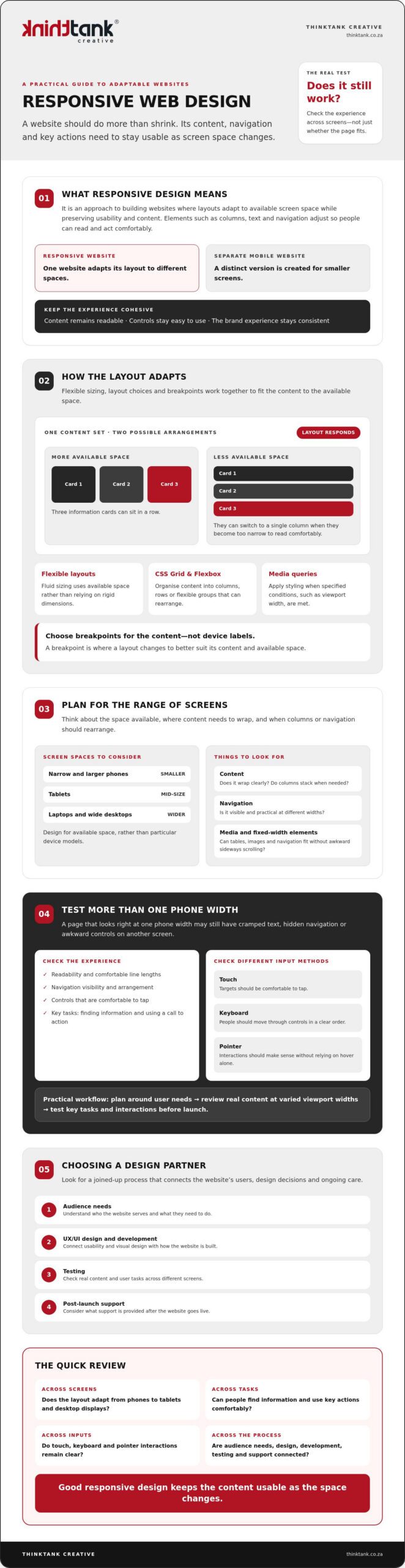
Responsive web design is an approach to building websites in which layouts adapt to the available screen space while preserving usability and content. Rather than forcing a fixed-width page onto every screen, the design adjusts elements such as columns, text and navigation so visitors can read and act comfortably. A separate mobile-only website uses a distinct version for smaller screens; a responsive site adapts the same website to different spaces.

The goal is more than making a page fit. Content should remain readable, controls easy to use and the brand experience consistent, whether someone is browsing on a phone or a wide desktop display. For a foundational overview of the approach and its history, see Responsive web design (RWD).

For a practical visual introduction, watch this guide to responsive web design:

How Is Responsive Design Different from Mobile-Friendly Design?

“Mobile-friendly” describes a user experience goal: a website should be practical to use on a mobile device. It doesn’t prescribe a particular technical method. Responsive layouts can adjust fluidly as space changes or switch arrangement at chosen breakpoints, where the design changes to better suit the content and available width.

A page that looks fine at one phone width may still have cramped text, hidden navigation or awkward controls on a narrower phone or larger tablet. Check how the layout behaves across widths, rather than relying on one mobile check.

Which Screens and User Contexts Should a Website Support?

Plan for a range of available spaces: narrow and larger phones, tablets, laptops and wide desktop displays. Focus on where content needs to wrap, columns should stack or navigation needs a different arrangement, rather than designing for particular device models.

Consider how people interact, too. Touch targets should be comfortable to tap; keyboard users should be able to move through controls in a clear order; and pointer interactions should be understandable without relying on hover alone. Review key tasks, such as finding information or using a call to action, at different widths and with different input methods. This helps a cohesive design serve people, not just screens.

How Responsive Web Design Works: Flexible Layouts, Breakpoints, and Media

Responsive web design relies on coordinated decisions. Layouts must accommodate changing space, typography should remain readable, images and other media need to fit their containers, and navigation and controls should stay usable as the page rearranges.

A breakpoint is a point at which a layout changes to better suit its content and the available space. For example, a row of three information cards might work on a wide screen, then switch to a single column when each card becomes too narrow to read comfortably.

Choose breakpoints when the layout needs to change, not because a screen belongs to a particular device category. This content-led approach helps the design adapt to the space it actually has. MDN Web Docs explains how responsive layouts work, including the role of flexible layouts and media queries.

How Do Flexible Grids and CSS Layouts Adapt?

Fluid sizing lets elements use a proportion of the available space instead of relying on rigid, fixed dimensions. CSS Grid and Flexbox can organise content into columns, rows or flexible groups that rearrange as space changes. The right choice depends on the content and purpose of the page: a comparison may need aligned columns, while a set of service cards may work well as a flexible row that wraps.

Fixed-width elements can cause trouble when the viewport is narrower than expected. A wide table, image or navigation bar may overflow its container, forcing visitors to scroll sideways or making content difficult to reach. Flexible proportions help prevent this, but still need sensible limits so text doesn’t stretch across an uncomfortably wide line.

How Do Responsive Images, Typography, and Media Queries Help?

Media queries apply styling when specified conditions, such as available viewport width, are met. They can support a layout change, adjust spacing or refine typography. The aim isn’t to shrink every element uniformly; it’s to preserve clarity and hierarchy as the composition changes.

Responsive images can display or serve suitable image options for the space available. In either case, media should stay within its container rather than creating unwanted overflow. Text needs similar care: body copy should remain legible, headings should wrap cleanly and line lengths should feel comfortable on both narrow and wide screens.

Treat these choices as one design system, not a collection of isolated fixes. If you’re planning a site and want to see how layout, visual design and development can work together, explore custom website design and development.

Responsive Web Design Misconceptions: What a Smaller Screen Test Can Miss

A page that appears to work on one phone isn’t necessarily ready for every screen. A slightly narrower viewport might squeeze navigation, wrap a heading awkwardly or push a button beyond the visible area. Responsive web design needs to be checked across a range of layouts, not approved after a single small-screen test.

Shrinking a desktop page without changing its structure can create dense text and controls that are difficult to use. Some content may need to move, stack or be prioritised so visitors can complete essential tasks without struggling through a cramped version of the desktop experience.

Assumption Practical reality
“It works on my phone.” Check narrower and wider viewports, and look for clipped content, awkward wrapping and overflow.
“Everything should stay in place, just smaller.” Navigation and page sections may need to rearrange to preserve clarity and key tasks.
“Responsive means accessible and fast.” Adaptable layouts help, but accessibility and performance need their own checks.

Does Responsive Design Mean Making Everything Smaller?

No. Scaling every element down can weaken readability and visual hierarchy, leaving important information and actions hard to distinguish. A navigation bar might become a more compact menu, while a multi-column section could stack into a clear reading order.

Decide what visitors need to accomplish, then preserve those tasks as the layout changes. The aim isn’t to squeeze every desktop element onto a narrow screen; it’s to make the right content and controls easy to find and use.

Can a Responsive Website Still Be Difficult to Use?

Yes. A page can adapt to its viewport and still have small tap targets, clipped text, horizontal scrolling or unclear keyboard focus states. Check content, interaction and accessibility as well as layout. Google’s responsive design basics offer further context, but responsiveness alone doesn’t guarantee accessibility, speed, search rankings or conversions.

Test key actions with touch, keyboard and pointer input. Confirm that focus is visible, text remains readable and visitors aren’t forced to scroll sideways to reach essential content. For a broader usability perspective, read the guide to improving website user experience.

Responsive Web Design: A Practical Guide for 2026

How to Plan and Test a Responsive Website Before It Goes Live

Plan responsive behaviour from the start, then test whether people can complete key tasks as the layout changes. A useful test checks real content and essential tasks across varied viewport widths, rather than relying on one preferred device preset.

  1. Identify user needs. List the main things visitors need to do, such as find a service, submit an enquiry or locate contact details. Use these tasks to guide page priorities.
  2. Organise content and structure. Decide what information belongs on each page and what visitors should notice first. Consider how sections should reorder or stack when space is limited.
  3. Make UX/UI decisions. Plan the navigation, page hierarchy, typography, calls to action and layout together. Keep important actions easy to find without giving every element equal prominence.
  4. Build and review at varied widths. Use actual page content, including long headings, forms and images. Check narrow and wider viewports, not only standard presets, and refine layouts wherever text wraps awkwardly or elements compete for space.
  5. Test interactions, then refine. Move through the site with a keyboard and check touch interactions where relevant. Confirm focus states are clear, controls work as expected, and content isn’t clipped or pushed into horizontal scrolling.

What Should You Check Across Viewport Sizes?

At narrow widths, review the order of page content, navigation, calls to action, forms and other key information. Make sure images keep their proportions and fit within their containers. Look for cut-off labels, overlapping elements and unexpected sideways scrolling.

Repeat the checks at wider widths, too. A layout that works on a phone can feel sparse or stretched on a large display. Use both touch and keyboard input to check that controls remain understandable and the essential journey is easy to follow.

How Should a Team Build Responsive Design into Its Process?

Start with audience needs and page content, then connect UX/UI design to visual refinement and coding. Testing should inform improvements before launch, rather than being left until the end. A considered project process can also include launch, training and support, so the work continues beyond the initial design and build.

For broader project-planning context, explore custom website design strategy. If you’re ready to plan a responsive website around your organisation and its users, discuss your website design and development project.

Choosing a Responsive Web Design Partner: From Strategy to Ongoing Support

A strong responsive website starts with more than a visual style. It should reflect your organisation, audience, content and the tasks visitors need to complete. Choose a partner who can explain how those priorities shape design and development, and how the work will be tested and supported beyond launch.

What Should You Ask Before Commissioning Responsive Website Design?

Use early conversations to understand the team’s process and how you’ll work together. Ask questions such as:

Clear answers help you assess whether the process suits your organisation, not just whether a portfolio looks appealing. They also set shared expectations, so the project’s priorities and responsibilities are understood from the outset.

How ThinkTank Creative Connects Design, Development, and Support

ThinkTank Creative is a South African agency founded in 2001, offering custom website design and development. Its website process brings UX/UI design together with coding, testing and launch, followed by training and support. That connection matters: design decisions need to carry through development, while testing gives the team an opportunity to review the finished experience before it goes live.

For a responsive build, collaboration should keep your organisation’s identity, audience and user tasks in view throughout the project. ThinkTank Creative also offers ongoing service after project completion, providing continuity as your website moves beyond launch.

Every project has its own needs and timeline. Discussing both helps establish the scope, and an estimated cost is provided after that discussion rather than relying on a fixed price. To explore whether the approach fits your plans, discuss your website design and development needs.

Build a Website That Moves Your Business Forward

Make responsiveness part of a wider commitment to a clear, considered online experience. The strongest responsive web design choices begin with what your audience needs to do, then bring content, visual identity and development together around those priorities. Reviewing the site across screen sizes helps reveal where the experience needs refinement before launch.

Choosing the right partner matters, too. ThinkTank Creative has been helping businesses with website design and development since 2001. Its process includes UX/UI design, coding, testing, launch, training and support, with ongoing service after project completion. That continuity can help keep your website aligned with your organisation as its needs evolve.

If you’re planning a new website or considering improvements to an existing one, start with a conversation about your goals and timeline. Discuss your website design and development needs with ThinkTank Creative.

Frequently Asked Questions

What is responsive web design?

Responsive web design is an approach to creating websites that adapt their layouts to available screen space while keeping content and key actions usable. Columns may stack on a narrow screen, for example, while navigation adjusts to remain accessible. The goal isn’t simply to make a desktop page smaller. It’s to provide a clear, consistent experience across phones, tablets and larger displays, shaped around what visitors need to find or do.

How does responsive web design work?

Responsive web design combines flexible layouts, suitable typography, adaptable media and considered interaction choices. A layout can change at breakpoints, which are points where the arrangement shifts to suit the content and available space. For example, a row of information panels might become a single column when the panels no longer fit comfortably. Designers and developers then test the page at different widths and refine anything that feels cramped, unclear or difficult to use.

Is responsive web design the same as mobile-friendly design?

Not exactly. “Mobile-friendly” describes the broad goal of making a website practical to use on mobile devices; it doesn’t specify one technical method. Responsive design is one way to meet that goal by adapting a layout to different screen widths. A site that appears usable on one phone may still have awkward navigation or crowded content on another, so check it across a range of sizes rather than relying on one mobile test.

Does responsive web design improve SEO?

Responsive design can support a positive search experience by making pages easier to use across screen sizes, but it doesn’t guarantee higher rankings. Google primarily uses a website’s mobile version for indexing, so important content and functions should remain available and clear on smaller screens. Search visibility also depends on other factors, including content relevance and technical performance. Treat responsive design as part of sound website planning, not a standalone SEO solution.

How do I test whether a website is responsive?

Review important pages at varied viewport widths, including narrow and larger phones, tablets and desktop sizes. Check that text remains readable, navigation and calls to action work, images fit their containers, and no content is clipped or causes unwanted horizontal scrolling. Try completing key tasks, such as finding contact details or submitting a form. Also test keyboard navigation and touch interactions where relevant, since a layout can adapt visually yet remain awkward to use.

Can an existing website be redesigned to be responsive?

Yes. An existing website can be redesigned to adapt to different screens, although the right approach depends on its current layout, content and technical structure. A review can identify which pages, navigation patterns and user tasks need attention before design and development begin. The project may involve refining the visual experience, reorganising content, coding and testing the updated site. Plan for checks across screen sizes before launch, followed by suitable training and support.

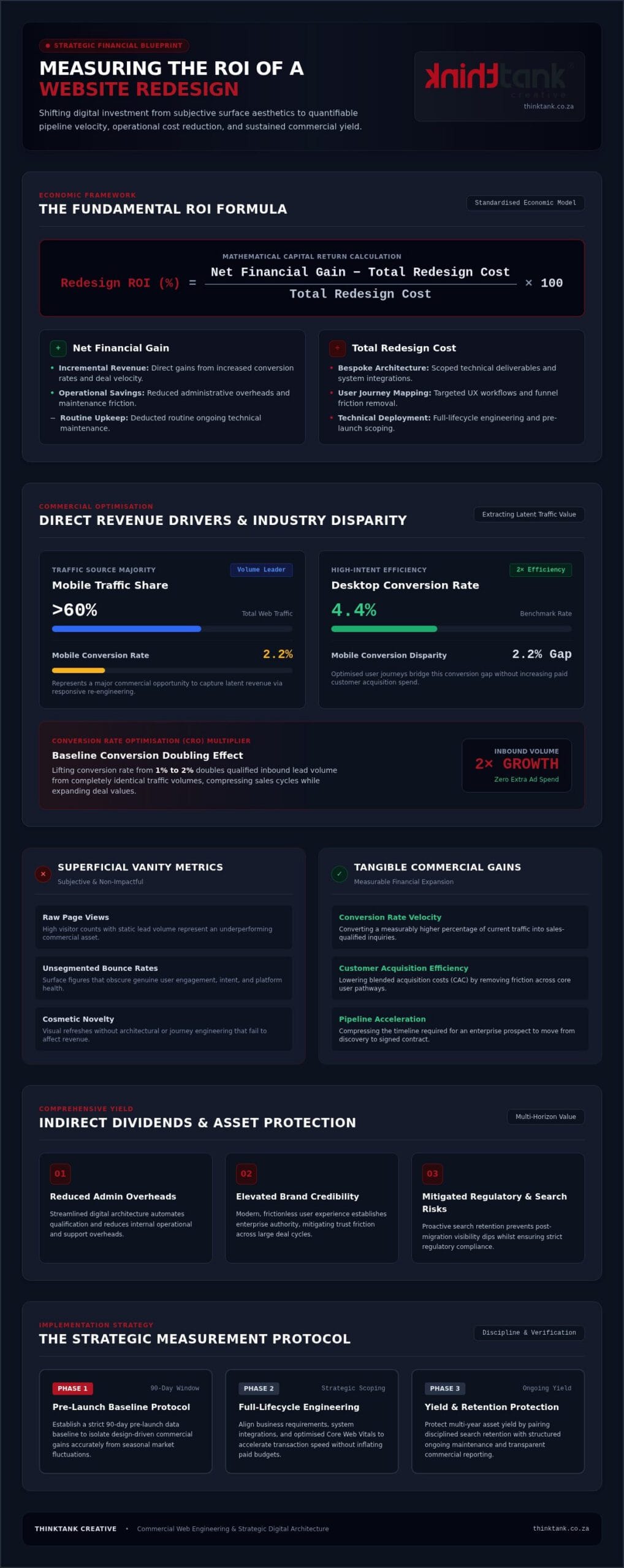
Measuring the ROI of a Website Redesign: Strategic 2026 Framework

Treating an enterprise digital overhaul as a mere cosmetic face-lift is the quickest way to squander capital. When internal stakeholders view web development as an operational overhead rather than a hardworking commercial asset, measuring the roi of a website redesign becomes an exhausting uphill battle. It's entirely reasonable to dread post-migration search visibility dips, or to feel frustrated whilst trying to link modern user experience design directly to closed pipeline revenue.

True commercial returns stem from conversion velocity and technical efficiency, never surface-level decoration alone. In this strategic guide, you'll discover how to quantify tangible financial gains, operational savings, and measurable conversion growth across both immediate and multi-year horizons. We'll walk through the definitive ROI formula, critical Core Web Vitals benchmarks, and the reporting models required to build an airtight business case that earns unshakeable executive backing.

Key Takeaways

  • Master the commercial formula for measuring the roi of a website redesign, balancing net conversion revenue and operational savings against project outlay.
  • Discover how technical speed, responsive mobile architecture, and optimised Core Web Vitals accelerate transaction velocity without increasing paid acquisition spend.
  • Quantify indirect dividends such as reduced internal administrative overheads, elevated brand credibility, and mitigated regulatory risks.
  • Implement a disciplined 90-day pre-launch baseline protocol to isolate design-driven commercial gains accurately from seasonal market fluctuations.
  • Protect long-term asset yield by pairing full-lifecycle development engineering with proactive search retention and structured ongoing maintenance.

The Financial Case: Defining Website Redesign ROI Beyond Surface Aesthetics

Executive teams frequently commit capital to digital projects expecting transformative growth, only to judge the finished work through subjective visual preferences. A corporate website isn't a static digital brochure; it's an active commercial engine designed to drive pipeline velocity. Surface refreshes alone never justify significant capital outlays. Successfully measuring the roi of a website redesign requires shifting attention from visual novelty toward quantifiable financial expansion, structural cost reduction, and sustained customer lifetime value.

To grasp how behavioural user experience choices influence commercial returns before committing development resources, watch this strategic breakdown from Nielsen Norman Group:

The Fundamental Formula for Calculating Website Redesign Return

Standardising your economic model simplifies board-level justification. At its core, applying a structured return on investment (ROI) calculation establishes the exact commercial yield produced by your capital allocation:

$$text{Redesign ROI (%)} = left(frac{text{Net Financial Gain} - text{Total Redesign Cost}}{text{Total Redesign Cost}}right) times 100$$

Here, net financial gain represents incremental revenue from conversion lifts combined with operational cost reductions, minus routine upkeep. Initial capital expenditure covers bespoke architecture, user journey mapping, and technical deployment. Transparent digital partners establish this outlay systematically. For example, ThinkTank Creative calculates an estimated cost only after conducting an in-depth strategic scoping of business requirements and system integrations, ensuring financial expectations match technical deliverables from day one.

Distinguishing Tangible Commercial Gains from Vanity Metrics

Superficial metrics like raw page views or unsegmented bounce rates obscure genuine business health. An aesthetically pleasing platform that attracts substantial traffic yet yields static lead volumes represents an underperforming asset. Conversely, deliberate UX engineering streamlines user funnels, accelerating lead qualification whilst significantly reducing customer acquisition costs (CAC). When measuring the roi of a website redesign, focus on indicators that alter your commercial ledger:

Direct Revenue Drivers: Measuring Conversion Velocity and Commercial Value

Direct commercial returns materialise when your platform extracts greater transaction value from existing traffic volumes. Global data reveals that over 60% of web traffic originates from mobile devices, yet mobile conversion rates hover around 2.2% compared to 4.4% on desktop environments. This disparity highlights an immediate commercial opportunity. By re-engineering responsive layouts and user pathways, a conversion-focused overhaul captures latent revenue without inflating paid acquisition budgets.

Conversion Rate Optimisation (CRO) and Lead Value Modelling

Lifting your baseline conversion rate from 1% to 2% doubles qualified inbound volume from identical traffic. When modelling pipeline velocity, multiply projected conversion lift against your historical lead-to-close ratio and average contract valuation. Research from Nielsen Norman Group on calculating ROI for design projects demonstrates that structured usability enhancements directly compress sales cycles while expanding deal values. Prioritise improving website user experience across key landing environments to eliminate friction, ensuring visitors navigate seamlessly toward commercial action.

E-commerce Checkout Velocity and Cart Abandonment Reduction

Every unnecessary checkout step or sluggish payment integration actively suppresses transaction completion. Akamai and Portent benchmarks show that a single 1-second delay in mobile loading time degrades conversions by approximately 7%. Conversely, accelerating interface responsiveness and deploying frictionless checkout funnels yields an immediate 5% to 15% rebound in completed sales. Measuring the roi of a website redesign requires tracking this recaptured revenue against prior abandonment baselines:

Organisations deploying bespoke lead generation strategies for South African businesses consistently discover that streamlined digital touchpoints turn casual browsing into measurable pipeline growth. If you're assessing whether your current architecture supports this commercial velocity, a collaborative discovery session with ThinkTank Creative can pinpoint where structural friction restricts your conversion potential.

Indirect Dividends: Operational Efficiencies, Brand Equity, and Search Retention

Revenue expansion tells only half the commercial story. When measuring the roi of a website redesign, indirect dividends represent substantial cost avoidances that protect your operating cash flow. An engineered digital platform reduces internal administrative friction, shields existing organic traffic equity, and establishes the executive credibility required to command premium market pricing.

Quantifying Administrative Time and Technical Support Savings

Legacy websites bleed operational resources through manual interventions. Outdated systems force personnel to re-enter leads manually, answer repetitive customer service queries, and triage frequent technical glitches. Strategic redevelopment replaces these labour sinks with automated CRM synchronisation, structured self-service customer portals, and unified database workflows.

Protecting Organic Capital: Search Engine Visibility Retention

Your existing organic search positions represent hard-earned balance sheet equity. A poorly executed migration can instantly erase keyword rankings, forcing you to replace lost qualified visitors through costly paid search auctions. Protecting this equity demands meticulous pre-launch URL mapping, canonical preservation, and comprehensive 301 redirection frameworks. Engaging specialists in search engine optimisation in South Africa ensures algorithmic equity transitions cleanly into your new environment, defending your customer acquisition pipelines without unexpected ad spend spikes.

Elevating Brand Perception and Corporate Credibility

Visual credibility carries real commercial weight. Landmark findings from the Stanford Web Credibility Research show that 75% of a website's perceived business credibility stems directly from design aesthetics and structural professionalism, whilst 94% of initial user impressions are visual. In high-stakes B2B markets, a tired interface signals institutional stagnation. A bespoke, cohesive digital identity projects market leadership, reassuring institutional buyers and validating premium pricing structures. Measuring the roi of a website redesign means factoring in how elevated corporate perception shortens enterprise sales deliberations and insulates your market share against newer entrants.

Measuring the ROI of a Website Redesign: Strategic 2026 Framework

The Measurement Protocol: Establishing Pre-Launch Baselines and Tracking Windows

Accurate financial attribution collapses if you launch without establishing clean comparative data. Without disciplined pre-launch controls, separating design-led performance improvements from seasonal swings or paid campaign shifts becomes impossible. Measuring the roi of a website redesign requires a staged measurement methodology that tracks system health from early deployment through mature commercial operation.

Step 1 & 2: Pre-Launch Audits and Analytics Calibration

Lock down an uncompromised 90-day baseline before altering a single template. Capture conversion rates by device, assisted conversion paths, organic click-through rates, and exact Core Web Vitals thresholds. Ensure technical readiness by validating Google's responsiveness benchmark, Interaction to Next Paint (INP), targeting 200 milliseconds or less, alongside Largest Contentful Paint (LCP) under 2.5 seconds. Configure server-side tracking and test event triggers to confirm that lead submissions, transaction values, and customer actions record with absolute precision.

Step 3 & 4: 30-Day Technical Stabilisation and 90-Day Performance Reviews

Dedicate the initial 30 days to technical verification. Monitor crawl error logs, indexation coverage, and redirection chains to confirm search bots process the new architecture without friction. Once technical stability is established, use the 90-day review to analyse commercial shifts against your historic baseline. Normalise this data against macroeconomic conditions to isolate genuine conversion velocity gains from external seasonal lift.

Step 5: Annual Total Cost of Ownership (TCO) Assessment

Evaluate your full economic return across a 12-month operating window. Compare incremental top-line revenue and recaptured administrative savings against the total cost of ownership. This calculation must incorporate the initial project investment, established via tailored scoping rather than arbitrary fixed fees, alongside ongoing managed hosting and maintenance. Factoring routine support into lifetime returns confirms whether your platform remains an appreciating asset.

Ready to establish rigorous tracking baselines and deploy a high-yielding digital engine? Partner with an experienced team and request a strategic website consultation with ThinkTank Creative to model your commercial upside.

Maximising Investment Yield: Partnering for Strategic Web Engineering

Maximising capital yield requires treating web redevelopment as a rigorous engineering project rather than an isolated aesthetic sprint. When measuring the roi of a website redesign over multi-year cycles, collaborative strategic alignment consistently outperforms transactional agency engagements. Partnering with a consultative team ensures that every structural layout, code choice, and user interface component actively contributes to conversion volume and operational resilience.

The ThinkTank Creative Methodology: De-risking Digital Capital Investments

Operating across South Africa since 2001, ThinkTank Creative deploys a battle-tested delivery framework that replaces commercial guesswork with structured execution. Our award-winning in-house web and graphic designers work in close harmony with systems developers, methodically balancing intuitive usability with deep back-end stability. Rather than providing arbitrary off-the-shelf quotations, we supply an accurate estimated cost only after conducting thorough strategic scoping aligned with your bespoke organisational goals.

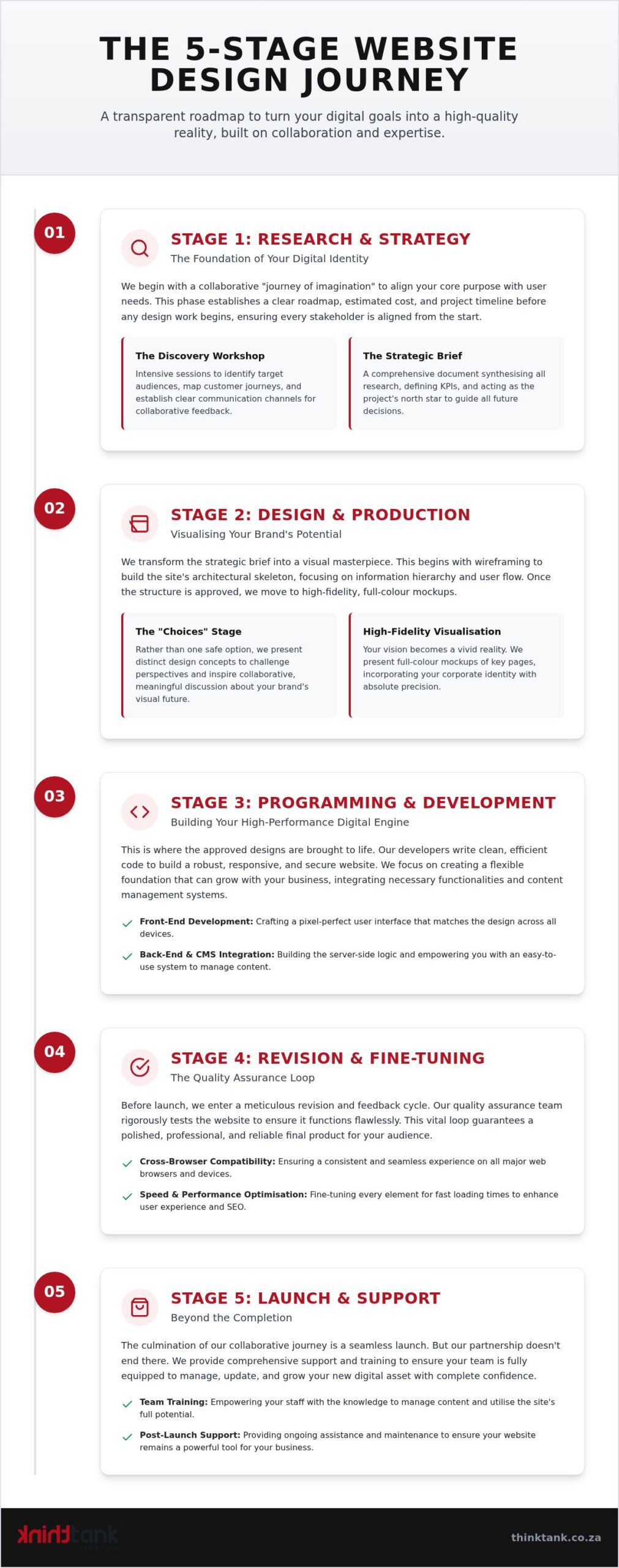
This transparent model guides your investment through a proven five-stage development journey:

Long-Term Support: Protecting Asset Performance Beyond Launch Day

A digital asset begins deprecating the moment it launches unless actively maintained. HTTP Archive benchmarks reveal that only 48% of mobile websites successfully pass all three Core Web Vitals metrics, illustrating how quickly neglected codebases lose their competitive edge. Ongoing maintenance, technical enhancements, and system security updates are vital safeguards that preserve your initial capital efficiency.

Eliminating multi-vendor friction further protects your commercial yield. By uniting bespoke custom website design in South Africa with integrated SEO, search advertising, and branding services, your organisation maintains complete technical cohesion. When measuring the roi of a website redesign across its full lifecycle, continuous optimisation ensures your digital footprint consistently drives pipeline growth. Take the definitive step toward commercial expansion and partner with ThinkTank Creative to engineer an enduring digital asset.

Engineering Your Platform for Measurable Commercial Growth

Capturing the full economic return of a digital overhaul requires looking far beyond cosmetic enhancements. By balancing direct conversion velocity against internal labour savings and search visibility retention, measuring the roi of a website redesign transforms from subjective speculation into an airtight commercial asset. When you establish clean pre-launch baselines and hold development teams accountable to Core Web Vitals, your platform actively compounds balance sheet value.

Securing these dividends demands a committed, highly capable partner. Established across South Africa since 2001, ThinkTank Creative unites award-winning designers with experienced system developers through a proven five-stage methodology. Operating with transparent strategic discovery, our team provides an accurate estimated cost aligned directly with your bespoke operational requirements. We safeguard your technical integrity at every milestone, ensuring your new digital architecture delivers sustained competitive differentiation. Maximise your digital investment with ThinkTank Creative and build a digital flagship engineered for long-term commercial triumph.

Frequently Asked Questions

How long after a website redesign can a business expect to see positive ROI?

B2B organisations and professional service firms typically realise full capital payback within 4 to 14 months following launch. Early indicators such as reduced mobile bounce rates and increased enquiry volume often emerge within the first 60 days. However, long-term commercial returns continue compounding across an average two- to three-year asset lifespan as search rankings solidify and sales teams close leads generated by the streamlined interface.

What is the standard formula used for measuring the roi of a website redesign?

When measuring the roi of a website redesign, the standard economic equation divides net commercial gain by total project expenditure:

$$text{Redesign ROI (%)} = left(frac{text{Net Financial Gain} - text{Total Investment}}{text{Total Investment}}right) times 100$$

Net financial gain combines gross revenue from new conversion lift and quantified operational labour savings, minus ongoing technical maintenance costs. This formula provides executive leadership with a clear percentage yield relative to capital outlay.

Can a business measure website redesign ROI without selling products online?

Yes, non-transactional businesses measure return by tracking pipeline acceleration and lead values. By establishing baseline lead-to-opportunity ratios and average client contract values, each form submission or consultation booking carries a precise monetary figure. A platform that lifts inbound qualified enquiries from 20 to 40 per month delivers quantifiable financial return directly to the sales ledger, even without an integrated transactional payment portal.

Will our organic search traffic drop immediately following a website redesign launch?

Temporary algorithmic fluctuations can occur for two to four weeks whilst search engines crawl and re-index new site structures. However, severe or permanent drops only happen when technical migrations are mishandled. Implementing exhaustive 301 redirection maps, preserving high-performing URL structures, and maintaining on-page metadata ensures search equity transfers intact. Proactive search engine optimisation safeguards existing rankings and quickly accelerates organic visibility post-launch.

How do operational cost savings factor into overall website redesign return calculations?

Operational cost savings represent direct cash preservations that factor alongside top-line revenue gains. When modern system integrations automatically synchronise form submissions with internal CRMs, staff spend fewer administrative hours on manual data entry. Similarly, comprehensive digital self-service resources reduce inbound customer service tickets. Multiplying the hours saved across operational teams by standard labour rates provides a concrete financial saving to add into overall return calculations.

What pre-launch data must be recorded to accurately assess redesign performance later?

Accurate attribution requires capturing an uncompromised 90-day baseline prior to redevelopment. Key metrics include device-specific conversion rates, organic search traffic volumes, top-performing commercial landing pages, and average lead acquisition costs. Additionally, technical benchmarks such as Core Web Vitals (including Interaction to Next Paint and Largest Contentful Paint) must be documented. Without this baseline, proving that subsequent growth stems from design engineering rather than external market shifts is virtually impossible.

How does ThinkTank Creative ensure a website redesign generates measurable commercial value?

ThinkTank Creative applies an established five-stage development framework spanning strategic planning through post-launch delivery and support. Operating nationwide across South Africa since 2001, our award-winning in-house web designers and developers reject generic templates. We calculate an estimated cost only after conducting rigorous commercial discovery, aligning user experience architecture directly with measurable business objectives. This disciplined engineering ensures every deployed asset protects organic equity whilst accelerating transaction velocity.

How to Choose a CMS for Your Website: 2026 Strategic Guide

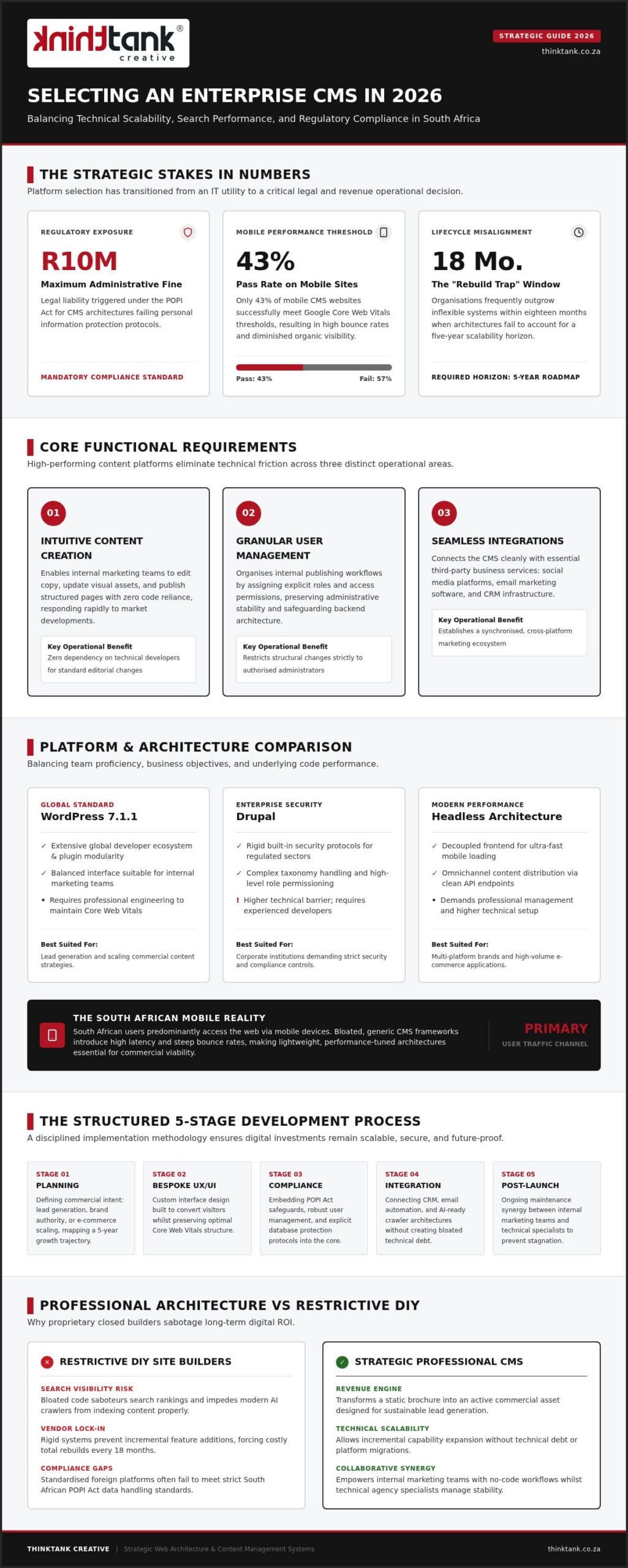
Could the platform you use to publish a simple blog post actually trigger a R10 million administrative fine? As we move through 2026, understanding how to choose a cms for your website has evolved from a simple comparison of features into a high-stakes strategic decision that impacts both your legal standing and your bottom line. You likely recognise that a website should be a dynamic engine for revenue, yet the fear of technical lock-in or failing POPIA compliance keeps many leaders awake at night. It's exhausting to feel caught between restrictive DIY builders that sabotage your search rankings and professional systems that seem unnecessarily opaque.

This guide promises to demystify the selection process, helping you secure a system that ensures technical scalability whilst driving measurable growth. We'll examine why only 43% of mobile CMS sites pass modern Core Web Vitals thresholds and how to navigate the transition to WordPress 7.1.1 or headless architectures. By the end of this article, you'll have a clear roadmap to a professional digital presence that justifies your investment and simplifies your daily operations. We'll move from high-level strategic concepts to the concrete methodology required to elevate your brand in a competitive digital marketplace.

Key Takeaways

  • Transform your website from a static brochure into a dynamic revenue engine by aligning your platform choice with specific business objectives like lead generation or e-commerce scalability.
  • Master how to choose a cms for your website by evaluating your internal team's technical proficiency against the flexibility of global standards like WordPress or the robust security of Drupal.
  • Protect your organisation from significant legal risks by prioritising POPI Act compliance and secure architecture within your content management system's core design.
  • Optimise your search engine visibility and user engagement through bespoke UX/UI design that converts visitors into loyal customers whilst maintaining high Core Web Vitals scores.
  • Discover how a structured 5-stage development process—from planning to post-launch support—ensures your digital investment remains scalable and future-proof.

Understanding the Role of a CMS in Your Digital Strategy

Your website is no longer a digital brochure; it's the central nervous system of your brand's growth. At its core, content management systems serve as the foundational architecture that allows you to control your digital narrative without technical barriers. Mastering how to choose a cms for your website starts with recognising that this software is the bridge between your high-level strategy and your customer's experience. It transforms your online presence from a collection of static pages into a dynamic, content-driven revenue engine that evolves alongside your business.

Adopting a "set and forget" mindset is a dangerous gamble for South African businesses. A website that remains stagnant quickly loses relevance in search rankings and fails to meet the shifting expectations of your audience. Instead, view your CMS as a sophisticated collaborative tool. It creates a synergy between your internal marketing team, who understand your brand's voice, and your creative agency, who ensure the technical framework remains robust and scalable. This partnership ensures that every update contributes to a cohesive, professional digital presence whilst maintaining the integrity of the original design.

The Core Functions of a Modern CMS

A high-performing CMS empowers your team by removing technical friction. It provides a centralised environment where you can manage critical areas of your digital footprint:

Why Your Choice in 2026 Matters More Than Ever

The digital landscape has shifted toward AI-driven search and multimodal engagement. Understanding how to choose a cms for your website requires looking beyond the immediate interface to the underlying technical potential. Your CMS structure now dictates how easily AI engines can crawl and understand your content, which is a vital component of modern search engine optimisation. Performance is non-negotiable. For South African users, who predominantly access the web via mobile devices, a bloated system leads to slow loading times and high bounce rates. By selecting the right platform now, you reduce long-term maintenance costs and avoid the technical debt that plagues businesses using rigid, outdated architectures.

Assessing Your Business Requirements and Scalability

Align your digital architecture with your long-term commercial objectives to ensure your platform serves as a catalyst for growth rather than a technical bottleneck. Mastering how to choose a cms for your website requires a shift from technical checklists to strategic foresight. You must begin by defining the primary intent of your digital presence. Whether you are focused on aggressive lead generation, complex e-commerce transactions, or high-level brand awareness, your choice must mirror these goals. Avoid the common "rebuild trap" where businesses outgrow their systems within eighteen months because they failed to account for a five-year growth trajectory. A scalable system allows you to add features incrementally, preserving your initial investment whilst expanding your reach.

Honest evaluation of your internal team's technical proficiency is equally vital. An interface that is too complex for your marketing staff leads to content stagnation and an over-reliance on external developers for minor updates. Conversely, a system that is too simplistic may lack the sophisticated controls needed for high-level search engine optimisation. You need to balance user-friendly dashboards with robust custom functionality. Following best practices outlined in Google's SEO Starter Guide ensures that your chosen architecture supports essential crawlability and indexing requirements from day one.

Determining Your Content Complexity

Consider the depth and variety of the information you intend to share. A simple blog requires far less architectural support than a multi-layered resource centre or a multilingual corporate portal. If you require multi-site management or need to publish updates daily across various regional subdomains, your system must handle these high-frequency demands without compromising performance. Identifying these needs early prevents the frustration of discovering your platform cannot support essential content types or complex navigational structures as your site expands.

Integration and Ecosystem Needs

Your CMS should function as a collaborative hub within your broader marketing stack. It's essential to ensure seamless connectivity with CRM systems like HubSpot or Salesforce to track leads accurately from the first click to the final sale. Even if you aren't selling products online today, planning for future e-commerce requirements prevents a costly migration later. Partnering with a specialist for website design and development ensures these technical choices align with your broader brand vision and existing digital strategy, creating a unified ecosystem that supports measurable growth.

Comparing the Top CMS Platforms for 2026

Selecting the right platform requires a deep understanding of the current technological ecosystem and your specific business trajectory. In 2026, the market is no longer a one-size-fits-all environment. Understanding how to choose a cms for your website involves balancing immediate ease of use with the long-term technical integrity required to stay competitive. Whether you opt for a globally recognised open-source system or a modern decoupled architecture, your choice dictates your ability to pivot as market demands shift.

WordPress: The All-Rounder for Most Businesses

WordPress remains the dominant force in the digital space, powering over 42% of all websites globally. The stable release of WordPress 7.1.1 has further refined the block-editing experience, making it a favourite for South African marketing teams who value autonomy. Its vast ecosystem of plugins allows for rapid feature deployment, but this flexibility requires a disciplined approach to maintenance. Research indicates that unmaintained third-party add-ons accounted for more than 90% of breach vectors on DIY setups in 2025. To avoid these pitfalls, professional brands should move away from generic templates in favour of custom website design. This bespoke approach ensures high performance and clean code, which are essential for passing Google’s Interaction to Next Paint (INP) thresholds and providing a superior user experience.

Headless and Hybrid CMS: For the Forward-Thinking Brand

The rise of headless or decoupled systems represents a significant shift for brands requiring ultimate design freedom. By separating the content management layer from the front-end presentation, a headless CMS allows you to deliver structured data to web browsers, mobile apps, and customer portals simultaneously. This market is expanding rapidly, with valuations projected to exceed $4.4 billion by the early 2030s. A hybrid approach often provides the best of both worlds, offering the structured content benefits of headless with the user-friendly editing interfaces of traditional platforms. These systems are inherently more secure and performant, which is vital for maintaining compliance with the Protection of Personal Information Act. For enterprise-level needs, Drupal 11.4.7 continues to be a robust choice, especially with Drupal 12 scheduled for launch in late 2026, providing the high-security architecture needed for complex data environments.

Ultimately, the decision between open-source and proprietary systems rests on your desire for control versus convenience. Open-source platforms provide a community-driven roadmap and no licensing fees, whilst proprietary systems offer a more controlled, managed environment. Your choice should reflect your internal technical capacity and your vision for brand transformation. By focusing on a system that supports your unique workflows, you ensure that your digital presence remains an asset rather than a liability.

How to Choose a CMS for Your Website: 2026 Strategic Guide

Critical Factors: Security, SEO, and POPI Act Compliance

Security is a non-negotiable pillar of modern brand trust. When you evaluate how to choose a cms for your website, you are essentially selecting the fortress that protects your intellectual property and customer data. With over 11,334 documented vulnerabilities across CMS plugins and extensions in the last year alone, your choice of platform determines your resilience against cyber threats. A secure digital environment requires more than just a strong password; it demands an architecture that supports automated security headers, encrypted database connections, and a rigorous schedule for patches. Failing to prioritise these technical safeguards leaves your business vulnerable to breaches that can dismantle years of reputation building in hours.

SEO-Friendliness Out of the Box

Your CMS architecture directly influences your search engine optimisation. Google's 2026 ranking evaluation prioritises Interaction to Next Paint (INP) scores of 200 milliseconds or less. A bloated CMS with excessive JavaScript and unoptimised CSS will struggle to meet these performance thresholds, especially for the mobile-first South African audience. You need a system that allows for granular control over metadata, automated schema markup generation, and clean URL structures without requiring developer intervention for every minor adjustment. Clean code and fast loading speeds are no longer optional extras; they are the baseline for visibility in an AI-driven search landscape.

Data Privacy and POPI Act Requirements

For South African organisations, the Protection of Personal Information (POPI) Act is a critical operational framework. The Information Regulator is empowered to issue administrative fines of up to R10 million for serious non-compliance, making your CMS's data handling capabilities a high-stakes business priority. Your chosen platform must integrate "privacy by design," featuring robust cookie management systems that restrict script loading prior to user consent. It must also provide secure, encrypted storage for any customer information collected through lead generation forms or user portals. Compliance is not a one-time task; it requires a system that can adapt to evolving regulatory interpretations and provide automated tools for data subject access requests.

Maintaining a secure and compliant digital presence requires a commitment to regular updates and proactive monitoring. A managed approach ensures your digital presence stays ahead of both security risks and regulatory changes. If you are concerned about your current platform's resilience or compliance status, our team offers professional website maintenance and support to keep your system peak-performing and secure. By choosing a partner who understands the local regulatory landscape, you ensure your technology investment remains an asset rather than a liability.

The ThinkTank Approach: Why Professional Development Beats DIY

Whilst understanding how to choose a cms for your website is a vital first step, the actual execution of that choice defines your brand's future success. DIY builders often promise rapid simplicity, yet they frequently deliver hidden technical debt and generic aesthetics that fail to resonate with a sophisticated audience. At ThinkTank Creative, we believe your digital presence deserves the precision of bespoke craftsmanship. We've refined a structured 5-stage development process—Planning, Design, Program, Development, and Revise—to ensure every technical decision aligns with your commercial vision. This methodical approach removes the guesswork, allowing you to focus on your core operations whilst we handle the complex architecture of your growth.

From Research to Final Delivery

Our award-winning designers prioritise the synergy between aesthetic appeal and technical functionality. Professional UX/UI design isn't just about surface-level visuals; it's about creating an intuitive journey that converts casual visitors into loyal customers. During the initial strategy phase, we deep-dive into your brand identity to ensure the chosen CMS supports your specific internal workflows. The program and development stages are where your vision takes a concrete form, built on clean code that ensures speed and scalability. Before any site goes live, our exhaustive testing phase ensures every link, form, and page is flawless, providing a stable foundation for your digital operations from day one.

Beyond the Launch: Support and Growth

The partnership doesn't end when your website goes live. In fact, that's where the real journey of brand transformation begins. Ongoing service and maintenance are essential for security retention and maintaining your hard-earned search rankings in an ever-changing digital landscape. As an all-rounder agency, we pride ourselves on being a strategic partner that manages everything so you don't have to. Our expertise ensures you never have to worry about how to choose a cms for your website in isolation, as we guide you toward the system that best supports your long-term objectives. We provide an estimated cost only after a thorough evaluation of your specific needs and timeline, ensuring our solution is tailored rather than templated. By embarking on a journey of imagination with us, you secure a professional digital presence that justifies the investment and scales effortlessly as your business evolves.

Elevating Your Brand Through Strategic Architecture

Your choice of platform is the foundation upon which your entire digital marketing ecosystem rests. We've explored how to choose a cms for your website by balancing technical scalability with the strict requirements of the POPI Act. A well-selected system ensures that your team remains autonomous whilst your brand stays secure and visible in an AI-driven search environment. It's about moving beyond the limitations of DIY builders to embrace a system that grows alongside your ambitions.

Since 2001, ThinkTank Creative has partnered with South African businesses to navigate these complex technological shifts. Our award-winning design team utilises a comprehensive 5-stage development process to ensure your website is more than just a tool; it's a high-performance asset designed for longevity. We're ready to help you transform your digital vision into a measurable engine for growth. The potential for your brand's elevation is limitless when you have the right strategic partner by your side.

Book your 2026 website strategy session with ThinkTank Creative

Frequently Asked Questions

What is the best CMS for a small business in South Africa?

WordPress is frequently the most versatile choice for South African small businesses due to its perfect balance of intuitive editing and long-term scalability. It allows you to begin with essential features and expand into complex e-commerce or lead-generation systems as your revenue grows. ThinkTank Creative specialises in custom WordPress development to ensure your site remains professional and unique, avoiding the restrictive templates that often hinder brand identity and search engine visibility.

Can I change my CMS later if my business grows?

Whilst you can migrate to a different platform as your organisation expands, it is a complex technical undertaking that requires careful planning to protect your data integrity and search rankings. A more efficient strategy is to select a scalable system from the outset. Understanding how to choose a cms for your website involves planning for a five-year growth trajectory to ensure your digital presence remains an asset through every stage of your business evolution.

Is WordPress secure enough for a professional business website?

WordPress is an exceptionally secure foundation for professional websites when managed with a focus on technical excellence and regular maintenance. Most security risks originate from unmaintained third-party add-ons or poor development practices rather than the core software. Our comprehensive 5-stage development process includes rigorous testing and proactive support to ensure your site remains a fortress against cyber threats. Professional management transforms this flexible platform into an enterprise-grade solution that protects your intellectual property.

How much does it cost to implement a new CMS?

The investment required to implement a new system depends on your specific functional requirements, design complexity, and the level of integration your marketing stack demands. We provide an estimated cost only after a detailed discussion of your commercial objectives and timeline to ensure our solution is perfectly tailored to your brand. This bespoke approach ensures you receive a high-quality system that justifies the investment by driving measurable growth and providing long-term technical stability.

Do I need a developer to manage my CMS daily?

No, a professionally designed CMS empowers your marketing team to manage daily content updates, such as publishing blog posts or adjusting product details, without needing technical intervention. We prioritise usability in our UX/UI design to ensure your internal workflows are intuitive and efficient. Whilst we provide ongoing website maintenance for technical security, your staff will have the autonomy to keep your digital narrative current and responsive to shifting market trends and customer needs.

What is the difference between a CMS and a website builder?

A CMS is a robust software application designed to manage complex content and data across multiple channels, offering deep customisation and scalability. Website builders are typically simpler, proprietary tools that trade flexibility for ease of use, often resulting in technical debt as your business grows. Understanding these differences is vital when learning how to choose a cms for your website, as a professional CMS provides the architectural freedom needed for bespoke brand transformation and high-performance SEO.

How does my choice of CMS affect my Google search rankings?

Your platform choice dictates the technical foundation of your SEO, influencing critical factors like site speed, mobile responsiveness, and clean URL structures. A bloated or poorly coded system can lead to slow loading times that penalise your visibility in search results. By selecting a CMS that supports clean code and fast interaction speeds, you ensure that your content is easily crawlable and indexed, providing a significant competitive edge in an increasingly AI-driven search landscape.

What is a Headless CMS and do I need one in 2026?

A headless CMS decouples the back-end content management from the front-end presentation layer, allowing you to deliver structured data to multiple devices via APIs. This architecture offers ultimate design freedom and enhanced security, making it ideal for brands with complex multi-channel needs. Whilst not every business requires a headless setup in 2026, it is a powerful option for those seeking high performance and a future-proof solution that scales effortlessly across diverse digital touchpoints.

Strategic Website Design Process: A 2026 Client Guide

What if the most daunting aspect of your brand’s digital transformation isn't the technology itself, but the perceived "black box" of the creative journey? Many ambitious business leaders approach a new build with a mix of excitement and quiet anxiety, often fearing that a lack of technical expertise might lead to project delays or misaligned outcomes. We understand that the website design process for clients should never feel like a series of hurdles or a dense thicket of jargon. Instead, it ought to be a collaborative partnership where your vision acts as the primary catalyst for every strategic decision we make together.

You deserve a relationship built on transparency and meticulous planning, where the path from initial concept to a polished launch is clearly illuminated. This guide promises to strip away the uncertainty, offering you a definitive roadmap of what to expect when you entrust your digital presence to a seasoned agency. We will walk through our proven five-stage methodology, covering everything from the strategic "Choices" phase to the final presentation, whilst ensuring you gain the confidence to provide feedback that moves the needle. Prepare to discover how a structured, forward-looking approach can turn your digital goals into a high-quality reality.

Key Takeaways

  • Discover how a collaborative "journey of imagination" aligns your brand's core purpose with user needs to create a sophisticated digital foundation.
  • Master the "Choices" stage of the design journey, where bespoke concepts are presented to spark meaningful debate and refine your brand's visual potential.
  • Gain a transparent roadmap of the website design process for clients, providing clarity on milestones and the time required to build a robust, responsive presence.
  • Learn why a meticulous revision and quality assurance loop is vital for ensuring cross-browser compatibility and speed optimisation before your site goes live.
  • Understand the value of post-launch support and training, ensuring your team is fully equipped to manage and grow your new digital asset with confidence.

Stage 1: Research & Strategy – The Foundation of Your Digital Identity

Elevate your brand beyond a mere digital presence. In 2026, a website isn't just a brochure; it's a dynamic engine for growth. We begin by defining your core purpose, ensuring your digital evolution aligns with shifts in user behaviour and technological advancements. This initial phase of the website design process for clients is less about technical constraints and more about a collaborative "journey of imagination" where we map your business goals to real-world user needs. It's a period of intense synergy where your vision meets our twenty-five years of expertise in the South African market.

Understanding your unique position within the South African landscape is vital for national success. We scrutinise your competitors and local market trends to identify specific gaps your brand can fill. During this stage, we establish a clear roadmap, including an estimated cost and a projected project timeline based on your specific strategic requirements. This ensures every stakeholder understands the investment and the journey ahead before a single pixel is moved. We ground high-level concepts in a web design process that prioritises precision and long-term brand elevation.

The Discovery Workshop

Success relies on constant communication from the very first day. We host intensive workshops to identify your diverse target audiences and their specific requirements. Our focus includes:

By anticipating user needs, we transform a simple visit into a meaningful brand interaction. We explore every touchpoint to ensure the digital experience feels bespoke and intuitive whilst remaining firmly grounded in your commercial objectives.

The Strategic Brief

Once the research is complete, we synthesise our findings into a comprehensive strategic brief. This document serves as a roadmap that balances innovative creativity with technical functionality. We define specific key performance indicators (KPIs) to measure the effectiveness of your new site, ensuring every creative choice has a measurable business purpose. For those looking to scale, our Small Business Website Design South Africa: The 2026 Strategic Guide provides additional context on navigating these early decisions. This brief becomes our north star, guiding the project through every subsequent phase of development with quiet assurance.

Stage 2: Design & Production – Visualising Your Brand Potential

Transforming a strategic brief into a visual masterpiece requires a delicate balance of artistry and logic. This phase of the website design process for clients begins with wireframing, where we construct the architectural skeleton of your site. By stripping away colours and imagery, we focus exclusively on the hierarchy of information and the logical flow of the user journey. It's a meticulous exercise in structural integrity that ensures your digital foundation is built for purpose before we apply the aesthetic layer.

Once the skeleton is approved, our focus shifts to the integration of your logo and corporate identity. We ensure every digital touchpoint reflects your brand's essence with absolute precision. This is where we introduce the "Choices" stage, a unique milestone in our methodology. Rather than presenting a single safe option, we provide distinct design concepts that challenge your perspective and inspire deep, collaborative discussion. We believe that great work emerges when we push boundaries together, moving beyond "good" marketing into the realm of exceptional brand storytelling.

High-Fidelity Visualisation

We move from structural wireframes to high-fidelity, full-colour mockups of your key pages. This is the moment your vision becomes a vivid reality. We plan for custom video posts and specific content creation at this stage, ensuring every element supports the broader narrative. To understand how these visual choices impact long-term engagement, you might find our guide on improving website user experience particularly insightful. It's about crafting a user experience that prioritises both usability and high-register visualisation.

The Presentation Phase

Our award-winning in-house design team doesn't just send files; we host a structured presentation. We walk you through the strategic reasoning behind every colour palette, typeface, and interactive element. This session is an invitation to explore how our design choices prioritise your brand's visual impact whilst adhering to rigorous UX/UI principles. If you're ready to see how bespoke craftsmanship can elevate your digital presence, our team is here to commence your brand's transformation. We ensure the final design isn't just beautiful, but a powerful tool for commercial growth.

Stage 3: Programming & Development – How Long Does it Take to Build a Business Website?

Breathe life into your vision. Once the aesthetic layers are finalised, we transition from static design concepts to a fully functional, responsive environment. This is the heavy lifting phase of the website design process for clients, where our developers translate visual synergy into robust code. Building a high-performance business site isn't an overnight task. It requires a structured, multi-week programme to ensure every back-end solution is secure, scalable, and meticulously engineered for your brand's future growth.

We integrate essential services during this build to ensure your site is a hard-working asset from day one. This includes sophisticated SEO foundations, automated email responders, and comprehensive FAQ setups. By embedding these systems early, we avoid the "bolted-on" feel of lesser builds, creating a seamless experience for both your team and your end-users. Our focus remains on precision, ensuring that the complex technology supporting your site remains invisible whilst delivering exceptional performance.

The Technical Build Milestones

We prioritise client empowerment through the setup of a user-friendly Content Management System (CMS). This allows your team to manage updates with ease, whilst we handle the technical complexities under the bonnet. In the South African context, mobile-first optimisation is non-negotiable. We ensure your site performs flawlessly across all devices, catering to the specific browsing behaviours of the local market. Security is equally paramount. We implement strict data handling protocols to ensure full POPI Act compliance, protecting your brand and your customers' privacy in an increasingly regulated digital space.

Content Integration

The final layer involves populating your site with professionally crafted copy and bespoke imagery. This isn't a simple copy-paste exercise; it's a strategic alignment of your brand voice with the new architectural flow. To help you prepare for this, our guide on how to write effective website copy offers a strategic framework for creating high-impact messaging. We conclude this phase by finalising channel optimisation and social media links, ensuring your new digital hub is perfectly connected to your wider marketing ecosystem.

Strategic Website Design Process: A 2026 Client Guide

Stage 4: Revision, Feedback, and Fine-Tuning – The Quality Assurance Loop

Excellence isn't found in the first draft; it's forged in the refinement. This stage is a collaborative debate where we polish the "Presentation" discussed in Stage 2. It's where the website design process for clients transitions from creation to calibration. We conduct meticulous testing across all environments. This includes rigorous speed optimisation and cross-browser compatibility checks to ensure your brand performs flawlessly for every user. We leave nothing to chance. Our technical team scrutinises the code to ensure the responsive behaviour is consistent across every device used in the South African market.

User Acceptance Testing (UAT) is the final gate. This stage of the website design process for clients provides you with the quiet assurance that every click, hover, and form submission behaves exactly as intended. We don't just ask if you like it; we verify that it works for your business. This phase is about fine-tuning the synergy between aesthetics and utility. It's the moment your vision becomes a reliable tool. You'll have the opportunity to navigate the staging environment, providing feedback that ensures the final product aligns perfectly with the strategic brief established at the outset.

How to Provide Constructive Feedback

Effective feedback focuses on business objectives rather than subjective preferences. Whilst personal taste is important, we prioritise decisions that move the needle for your target audience. Understanding the distinction between "fine-tuning" and "scope creep" is essential for maintaining your project timeline. Our Project Managers act as the steady hand here. They ensure that revisions enhance the strategic vision without derailing the launch date. This collaborative synergy ensures that the project remains on track whilst reaching the highest possible standard of execution.

The Pre-Launch Checklist

Before the site goes live, we execute a comprehensive audit. We implement final meta-data and perform a thorough SEO sweep to ensure you're visible from day one. Every form, auto-responder, and third-party integration is tested to failure. We also ensure your digital launch aligns perfectly with any physical printing solutions or corporate identity updates. If you're ready to experience a meticulous website design and development journey, our team is prepared to lead the way. This meticulous attention to detail is what separates a standard site from a strategic digital asset. We take pride in delivering a product that is not just finished, but perfected.

Stage 5: Launch, Delivery, and Post-Launch Support – Beyond the Completion

Launching your site is a momentous occasion, yet it represents the commencement of your digital growth rather than the conclusion of our partnership. We manage the transition to the live environment with surgical precision, ensuring minimal downtime whilst your brand makes its debut. This final stage of the website design process for clients is where we hand over the keys to your new digital asset. We provide comprehensive documentation and tailored training sessions, ensuring your team feels elite in their ability to navigate and manage the site's daily operations with quiet assurance.

Our commitment doesn't evaporate once the site is live. We believe in an invitation-based approach to ongoing success, offering meticulous maintenance and support to keep your platform performing at its peak. By monitoring your site's health and security, we provide the stability needed for a long-standing enterprise to flourish in the South African market. We track your return on investment through detailed SEO and digital paid advertising reporting, turning raw data into strategic insights that fuel your next move. It's a partnership built on the philosophy that we do it all so you don't have to.

The Handover & Training

We empower your team to take ownership of your content. Our training modules are designed to be approachable yet thorough, covering everything from basic text updates to complex system management. For businesses focused on conversion, our Lead Generation Website Design South Africa: The 2026 Strategic Guide explores how to maintain a site that consistently captures high-quality leads. We set up bespoke reporting dashboards, giving you a clear view of your long-term growth trajectory at a glance. This transparency ensures you remain in control of your digital destiny whilst we handle the technical heavy lifting.

Continuous Digital Marketing

A high-performing website is the central hub of a wider marketing ecosystem. We help you leverage your new site through integrated social media marketing, PPC advertising, and email marketing campaigns. This "all-rounder" advantage ensures that your brand maintains a consistent presence across both digital and print marketing collateral for maximum national impact. Our 25 years of experience in the local market allows us to guide you in scaling your presence effectively. We ensure your website remains a bespoke craftsmanship piece that evolves alongside your business, rather than a templated solution that fades over time.

Forge Your Path to Digital Excellence

Your brand deserves more than a templated solution; it requires a bespoke digital ecosystem engineered for 2026 and beyond. By understanding each milestone of the website design process for clients, you've taken the first step toward a transformative partnership that prioritises commercial growth over mere aesthetics. We've explored how a collaborative journey of imagination moves from rigorous strategic research and visual storytelling to technical precision and dedicated post-launch support.

As a top all-rounder agency in South Africa since 2001, our award-winning in-house design team is committed to your long-term success. We provide a comprehensive end-to-end strategic process that ensures your vision remains the catalyst for every pixel and line of code. This is an invitation to move beyond the ordinary and embrace a digital presence that reflects your brand's commitment to excellence and innovation. Our quiet assurance comes from twenty-five years of navigating the evolving digital landscape whilst delivering high-quality outcomes for our partners.

Start your journey of imagination with ThinkTank Creative today. We look forward to building your future together and transforming your digital presence into a powerful engine for growth.

Frequently Asked Questions

How long does it take to build a business website from start to finish?

The timeline for a professional build typically spans several weeks, as we follow a meticulous five-stage development process. Whilst a simple site might be completed sooner, a comprehensive business platform requires a structured programme for planning, design, and robust coding. We prioritise high-quality work over frantic speed, ensuring every technical milestone is met with precision. We provide a projected timeline during the research phase to ensure your expectations align with our strategic delivery.

What is required from the client during the website design process?

Successful outcomes rely on a collaborative "journey of imagination" between your team and our designers. During the website design process for clients, we require your active participation in discovery workshops and the "Choices" stage. You'll provide the initial vision, brand assets, and professionally crafted copy, whilst engaging in constructive debate during the revision cycles. This partnership ensures the final digital product reflects your brand's core purpose and meets specific user needs.

How much does a professional website design cost in South Africa?

We provide an estimated cost after a thorough discussion of your strategic requirements and project scope. Because we build bespoke digital assets rather than templated solutions, pricing varies based on the complexity of the system development and branding needs. This tailored approach ensures you only invest in the functionality your business requires to grow. We focus on delivering a high-quality return on investment through a website that acts as a hard-working commercial tool.

Can I update the website myself after the project is complete?

Yes, we empower your team to manage content through a user-friendly Content Management System (CMS). As part of our final delivery stage, we provide the necessary training and documentation so you can update text, imagery, and blog posts with confidence. This self-sufficiency allows your brand to remain agile in a fast-moving market. However, our team remains available for more complex technical support or structural changes whenever your business evolves and requires expert intervention.

What happens if I need changes after the website has been launched?

We offer ongoing website maintenance and support even after the project is officially complete. If you require functional updates or aesthetic fine-tuning post-launch, our team is ready to assist through a continued partnership. We don't believe in "one-and-done" handovers. Instead, we provide a steady, reassuring presence to ensure your digital platform continues to perform optimally as your business goals and the broader South African market landscape shift over time.

Is SEO included in the standard website design process?

Search Engine Optimisation (SEO) is a fundamental component of our website design process for clients. We implement essential technical SEO foundations, including meta-data and site speed optimisation, during the development and testing phases. For brands seeking long-term visibility, we also offer targeted ongoing SEO services and digital paid advertising. This ensures your site doesn't just look smart, but actively attracts and engages your specific target audience across national search results.

How do you ensure my website is compliant with South African laws like the POPI Act?

Security and legal compliance are integrated into our coding and development stages. We implement robust data handling protocols and secure system development to ensure your site adheres to the current POPI Act requirements for 2026. This protects your brand and your customers' privacy, which is vital for maintaining trust in the digital space. We stay energised by these evolving standards, ensuring your business remains compliant with South African regulations whilst delivering a seamless user experience.

Do you provide hosting and domain registration as part of the process?

We provide a complete end-to-end solution that encompasses domain registration and hosting as part of our comprehensive service offering. Our goal is to handle the technical heavy lifting so you don't have to. By managing these foundational elements, we ensure your site resides in a secure, high-performance environment tailored to its specific technical requirements. This integrated approach simplifies your digital management and ensures maximum uptime for your brand's national presence.

21 Essential Questions to Ask a Web Designer Before Hiring in 2026

What if your most expensive digital asset was actually your biggest liability? In 2026, a website that simply looks "nice" is no longer enough to compete in a market where 75% of consumers judge your entire company's credibility based on design alone. To avoid the common pitfalls of hidden costs and restrictive proprietary systems, you need a rigorous vetting process. Knowing the right questions to ask a web designer before hiring is the difference between securing a strategic partner and being locked into a platform you don't actually own.

We recognise that the technical jargon of CMS transitions and SEO architecture can feel overwhelming whilst you're focused on scaling your business. You deserve a transparent relationship where excellence is the standard and your digital assets remain firmly in your control. This guide provides a comprehensive checklist designed to strip away the confusion and reveal the true competence of any prospective agency. We'll explore everything from post-launch support to the reason why estimated costs are only provided after a thorough needs discussion. At ThinkTank Creative, we do it all so you don’t have to, starting with this roadmap to your next successful digital transformation.

Key Takeaways

  • Align your digital presence with commercial goals by ensuring your designer conducts deep industry research before the creative process begins.
  • Discover the essential questions to ask a web designer before hiring to clarify platform choices and prevent being tied to a system you don't fully own.
  • Safeguard your brand's future by confirming total ownership of all code, creative assets, and intellectual property upon project completion.
  • Optimise for long-term growth by vetting a partner's methodology for SEO integration and technical performance from day one.
  • Eliminate the risk of hidden costs by requesting a transparent breakdown of fees and a structured plan for ongoing maintenance and support.

The Strategic Foundation: Questions About Business Alignment

A high-performing website is built on logic, not just aesthetics. Before any creative work begins, your partner must dissect your business model to understand what actually drives growth. Identifying the right questions to ask a web designer before hiring ensures your project starts with a strategic blueprint rather than just a visual mood board. If a designer is more interested in your favourite colours than your quarterly revenue targets, they're designing for themselves, not for your bottom line.

One of the first queries you should pose is: "What kind of research will you conduct on our industry and target audience?" A competent agency won't simply glance at your competitors; they'll analyse their conversion funnels and user behaviour. This research phase is vital because it informs the site's architecture, ensuring the final product isn't just a digital brochure but a tool that solves specific business challenges. At ThinkTank Creative, we believe this depth of enquiry is what separates a template from a bespoke asset.

To better understand this vetting process, watch this helpful video:

Follow this by asking: "How will you ensure the website makes our customers feel smart and empowered?" There is a profound difference between good marketing and great marketing. Good marketing focuses on how impressive the company is, whilst great marketing makes the customer feel capable and intelligent for choosing your solution. Your website should provide a frictionless experience that rewards user intuition, reinforcing their decision to engage with your brand at every click.

Defining Your Business Objectives

Every successful project at ThinkTank Creative begins with a rigorous planning phase, the first step in our award-winning 5-stage development process. We believe the fundamentals of web design require a total alignment with your Key Performance Indicators (KPIs). Whether you aim to increase lead volume or reduce customer support enquiries, every design choice must serve those objectives. Because every business is unique, estimated costs are provided after these needs are discussed, ensuring the solution is tailored to your specific goals across South Africa.

Understanding the Target Audience Journey

Mapping the journey from visitor to lead is a non-negotiable part of the strategic foundation. Your designer must identify user pain points and create a path that resolves them instantly. By anticipating the questions a user might have, the interface becomes a guide rather than a barrier. This methodology ensures your website acts as a reliable partner for long-term growth. We do it all so you don’t have to, transforming complex technical requirements into a polished, high-performing asset that resonates with your audience.

Technical Excellence: CMS, Customisation, and UX

Technical integrity determines whether your site functions as a high-performing engine or a slow-moving burden. When evaluating the questions to ask a web designer before hiring, you must look beneath the surface of the design. A beautiful interface is useless if the underlying code is inefficient or if you are locked into a proprietary system you don't actually own. Open-source or flexible systems are usually the superior choice because they offer full asset ownership and the freedom to manage your digital ecosystem without being tethered to a single vendor.

Ask your potential partner: "Which Content Management System (CMS) do you recommend and why?" Be wary of agencies that only offer their own in-house CMS; this is one of the red flags to watch for during the vetting process. A flexible, widely supported platform ensures that your business remains agile. You should also enquire: "How do you approach User Experience (UX) and User Interface (UI) design?" Effective UX is about more than just aesthetics; it's about reducing friction and guiding the visitor toward a meaningful conversion. Because every project is unique, estimated costs for these tailored solutions are provided after a thorough discussion of your technical needs.

Custom Build vs. Template: Making the Right Choice

The choice between a custom build or a template is one of the most vital questions to ask a web designer before hiring. Templates often arrive with "bloated" code, containing scripts and features your business will never use. This extra weight slows down page load speeds and creates unnecessary security vulnerabilities. A custom build provides a lean, secure, and bespoke foundation tailored to your exact needs. This approach eliminates technical debt, allowing your site to scale as your brand grows. If you're looking for a partner that prioritises performance, our team at ThinkTank Creative offers bespoke website design and development that avoids the limitations of generic themes.

Mobile-First Design and Technical Performance

With over 60% of all web traffic now originating from mobile devices, a mobile-first approach is no longer optional. In South Africa, where network speeds can be inconsistent, technical performance is a critical differentiator. Research indicates that 53% of mobile visitors will abandon a page if it takes longer than three seconds to load. Your designer should utilise rigorous testing protocols to ensure your site passes Google's Core Web Vitals across all browsers. Testing isn't an afterthought; it's a fundamental stage of our award-winning development process to ensure your site remains a high-performing asset.

Process and Partnership: The Methodology of Success

A successful website isn't an accident; it's the result of a disciplined, repeatable methodology. When considering the questions to ask a web designer before hiring, you must look beyond the portfolio to the project management structure. One critical query is: "Do you handle all work in-house or do you outsource to third parties?" Many agencies outsource development to lower-cost regions, which can lead to fragmented communication and inconsistent quality. At ThinkTank Creative, we've spent 25 years refining our in-house, award-winning talent pool to ensure that every stage of your brand transformation is handled by a team that shares a single, cohesive vision.

Clarity in the workflow prevents scope creep and ensures every milestone is met with precision. This is why we encourage clients to use a comprehensive list of questions during the initial consultation. It establishes a foundation of transparency that is essential for a long-term creative partnership. By understanding the "how" behind the "what," you gain a partner who is deeply invested in your journey rather than just a vendor delivering a file.

The 5 Stages of a Professional Design Process

Our award-winning 5-stage development process provides a structured roadmap from concept to completion, ensuring nothing is left to chance. This methodical approach includes:

Project Management and Communication

Effective communication is the heartbeat of any collaborative project. You should always ask: "Who will be my primary point of contact during the project?" Having a dedicated lead ensures that your feedback isn't lost amongst technical departments. We prioritise a steady, reassuring cadence that keeps you informed whilst respecting your time. This includes setting realistic timelines and defining how revisions are managed to keep the project on track. Because every project requires unique strategic depth, estimated costs are only provided after we've discussed your specific needs. We do it all so you don’t have to, providing a seamless experience that allows you to focus on your business whilst we handle the technical intricacies.

This level of professional oversight is one of the most important questions to ask a web designer before hiring. It ensures that your project remains a priority and that the final delivery matches the initial vision perfectly.

21 Essential Questions to Ask a Web Designer Before Hiring in 2026

Ownership, SEO, and Long-Term Viability

Your website should be a permanent investment, not a temporary rental. One of the most vital questions to ask a web designer before hiring is who retains the intellectual property rights once the final invoice is settled. Full ownership of your digital assets ensures that your brand remains independent and secure. At ThinkTank Creative, we believe in total transparency, providing you with full access to your CMS and hosting environment from the moment of delivery. Because every project requires a unique strategic depth, estimated costs for these secure foundations are only provided after we've discussed your specific needs.

A site that doesn't rank is a site that doesn't work. You should enquire: "How do you ensure the website is built with SEO best practices from day one?" Search engine optimisation should be baked into the architecture, not sprinkled on at the end. This includes clean code, logical URL structures, and mobile optimisation. Beyond search, your site must integrate with your broader social media marketing and email automation systems to act as a consistent lead-generation engine rather than just a static gallery.

Intellectual Property and Asset Ownership

Confirm that you will own the code, custom graphics, and photography upon project completion. It's a common pitfall for agencies to register domain names in their own name, which essentially holds your brand hostage. You must ensure you have the keys to your digital kingdom. This includes every element of your corporate identity design, from logos to bespoke icons. We ensure our clients have full autonomy, whilst remaining a reliable partner for any future growth or brand elevation.

POPI Act and South African Regulations

Operating nationally across South Africa requires strict adherence to the POPI Act. Your designer must understand how to handle user data securely and implement necessary privacy protocols. This isn't just a legal requirement; it's a foundation of trust with your audience. We ensure every project complies with local regulations, protecting both your business and your customers from the risks of data mismanagement. This specialised knowledge is a key reason to vet your partner's understanding of the local legal landscape.

Maintenance and Ongoing Support

Launch is not the finish line. Technology evolves rapidly, and a site left without updates quickly becomes a security risk. A truly strategic partner offers ongoing website maintenance and support to handle security patches, backups, and performance tweaks. Training your team to manage internal content is equally important, allowing you to stay agile in a fast-moving market. We do it all so you don’t have to, providing the stability of a long-standing enterprise with the fluid energy of a creative agency. This commitment to long-term viability is one of the most important questions to ask a web designer before hiring to ensure your asset continues to deliver value for years to come.

The Final Vetting: Budget and Credibility

Viewing your website as a multi-year investment rather than a one-off expense is the hallmark of a savvy business leader. When you finalise your list of questions to ask a web designer before hiring, the focus must shift to financial transparency and proven results. You should ask: "Can you provide a detailed breakdown of the estimated cost?" A vague quote is often a precursor to unexpected expenses. At ThinkTank Creative, we believe that estimated costs should only be provided after a comprehensive needs discussion, ensuring every Rand is allocated to a specific strategic outcome.

Credibility is established through performance, not promises. Enquire: "Can you share case studies or client examples relevant to my needs?" An agency with 25 years of experience should have a vast portfolio demonstrating their ability to handle complex requirements. You also need to understand their protocol for "scope creep." Ask: "How do you handle additional feature requests during the build?" A structured process for revisions, like our award-winning 5-stage development methodology, ensures that your project remains on schedule and within the agreed parameters whilst allowing for creative evolution.

Understanding the Quote and Estimated Costs

A fixed, low-cost price for a complex project is often a significant red flag. These "bargain" solutions frequently omit essential elements like SEO integration or responsive testing across all South African mobile networks. A complete solution should encompass your entire corporate identity, from logo design to printing solutions, ensuring brand consistency across every touchpoint. When reviewing a proposal, look for clarity on potential hidden fees such as premium plugin licences, high-performance hosting, or stock imagery rights. We do it all so you don’t have to, providing a holistic view of the investment required to transform your brand.

Reviewing Credentials and Creative Fit

The relationship with your web partner should feel like a collaborative journey of imagination. Beyond technical skill, you must evaluate the creative fit and the agency's award-winning history. Trust your intuition; you're looking for a partner deeply invested in your success, not just a vendor ticking boxes. Our in-house team focuses on bespoke craftsmanship, moving away from generic templates to create something truly unique for your business. This level of synergy is what turns a digital brochure into a high-performing lead-generation asset. By choosing an established leader with a national footprint across South Africa, you secure the stability and expertise needed for long-term digital growth. These questions to ask a web designer before hiring serve as the final filter, ensuring your next partner is as committed to your brand's transformation as you are.

Secure Your Digital Future with Strategic Clarity

Navigating the complexities of a website build requires more than just technical insight; it demands a partner who recognises your digital presence as a multi-year investment. By mastering the questions to ask a web designer before hiring, you ensure that every line of code and every pixel serves your commercial objectives whilst protecting your intellectual property. You've seen how business alignment, technical excellence, and transparent ownership form the bedrock of a high-performing site that generates leads and remains fully within your control.

At ThinkTank Creative, we've spent 25 years refining our award-winning 5-stage development process to deliver bespoke solutions across South Africa. As a full-service all-rounder agency, we handle everything from corporate identity to SEO, ensuring your brand transformation is seamless and scalable. We do it all so you don’t have to, providing estimated costs after a thorough needs discussion to ensure your solution is perfectly tailored to your vision. Partner with ThinkTank Creative for a strategic web design journey and watch your brand reach new heights. We're ready to turn your digital challenges into your greatest competitive advantages.

Frequently Asked Questions

How much should a professional business website cost in South Africa?

Professional website costs vary significantly based on functional requirements and strategic depth. Whilst industry averages exist, we provide bespoke estimated costs only after a thorough needs discussion to ensure your investment aligns with your objectives. This approach prevents hidden fees and ensures that every South African business receives a tailored solution. We focus on delivering a strategic asset rather than a generic template that might fail to scale with your growth. This methodology ensures total transparency.

Do I need to provide all the content and images for the website?

Whilst you understand your business best, you aren't required to handle everything alone. We offer comprehensive creative design and SEO services to help craft compelling narratives and visual assets. Providing your own high-resolution imagery and core text can speed up the process, but our team is equipped to assist with professional copywriting and asset creation. We do it all so you don’t have to, ensuring your content is perfectly aligned with your brand's digital identity.

How long does it typically take to design and launch a new site?

A standard professional website typically takes approximately 4 to 8 weeks from the initial planning phase to the final launch. More complex e-commerce platforms or large-scale custom projects can extend to 16 weeks or more. Our structured 5-stage development process ensures that milestones are met efficiently whilst maintaining the highest standards of quality. Timely delivery often depends on the promptness of client feedback and the availability of necessary business content during the production cycle.

What is the difference between web design and web development?

Web design focuses on the visual aesthetics and user experience (UX) of the site, whilst web development involves the technical coding that makes it function. Think of design as the architectural blueprint and interior styling, whereas development is the structural engineering and plumbing. Both disciplines are essential for a high-performing site. Our in-house team combines award-winning creative talent with technical expertise to ensure your site is as powerful as it is beautiful and functional.

Can I update the website myself once it is live?

Yes, we build sites using flexible Content Management Systems (CMS) that allow your team to manage content internally. One of the key questions to ask a web designer before hiring is whether they provide training on how to use the platform. We ensure you have full ownership and the confidence to update text, images, and blog posts. For more technical updates, we offer ongoing website maintenance and support to keep your digital asset secure and functional.

Will my website be mobile-friendly and work on all devices?

Every website we develop utilises a responsive, mobile-first approach to ensure it performs perfectly on all devices. With over 60% of web traffic now coming from mobile devices, this is a non-negotiable standard for modern digital assets. We conduct rigorous testing across various browsers and screen sizes to guarantee a seamless experience for your South African audience. This ensures your brand remains accessible and professional, regardless of how your customers choose to browse your services.

What happens if I want to move my website to a different host later?

Because we prioritise full ownership of digital assets, you retain the freedom to move your website to a different hosting provider if you choose. We avoid locking clients into proprietary systems that limit their independence. This flexibility is a vital part of our commitment to your long-term success. We provide all the necessary files and database exports to ensure a smooth transition, whilst remaining available as a reliable partner should you require migration or support.

Does a new website automatically rank on the first page of Google?

Ranking on the first page of Google is not automatic; it requires a sustained strategy involving SEO and high-quality content. Whilst we build every site with technical SEO best practices from day one, organic visibility grows over time through consistent optimisation and authority building. This is one of the essential questions to ask a web designer before hiring to manage expectations. We offer ongoing SEO and PPC advertising services to help accelerate your path to the top.

Hidden Website Design Costs: 2026 Strategic Budgeting Guide

What if that "budget-friendly" website ends up costing your business more in lost revenue and emergency repairs than a premium solution would have in the first place? It's a frustratingly common scenario in the South African market, where a low initial quote often masks a mountain of technical debt. You likely understand that a digital presence is vital, yet the sting of unexpected monthly invoices for plugins or the sudden realisation that your site doesn't actually rank on Google can make the process feel like a financial trap. We agree that transparency is the foundation of any successful partnership, and you shouldn't have to choose between a bespoke design and a predictable budget.

This 2026 strategic guide uncovers the hidden costs of website design that often lurk beneath the surface of a standard proposal. By reading on, you'll learn how to secure a high-performing website that prioritises ROI whilst avoiding the "cheap" shortcuts that lead to long-term failure. We provide a transparent breakdown of total ownership costs, covering everything from POPIA compliance to technical infrastructure, ensuring your next digital move is grounded in strategic depth rather than financial surprises.

Key Takeaways

  • Shift your focus from the initial price tag to the Total Cost of Ownership (TCO) to ensure long-term financial stability for your digital assets.
  • Recognise how premium technical infrastructure and robust security measures protect your brand from the expensive fallout of performance failures and downtime.
  • Uncover the hidden costs of website design associated with poor search engine optimisation and confusing user journeys that silently drive potential clients away.
  • Ensure your digital presence remains compliant with South African POPIA regulations to avoid significant legal penalties and maintain professional integrity.
  • Leverage a transparent, 5-stage development methodology to eliminate budget surprises and transform your website into a high-performing engine for ROI.

The Initial Quote vs the Total Cost of Ownership (TCO)

Invest in a high-performing digital asset rather than a static online flyer. When businesses evaluate a proposal, they often focus exclusively on the initial project fee, yet this figure rarely reflects the long-term capital required to maintain a competitive edge. To build a sustainable presence, you must understand the Total Cost of Ownership (TCO). This financial metric accounts for every expense throughout the website's lifecycle, from the primary build to the ongoing maintenance, security patches, and iterative improvements that drive growth.

A low-entry quote often signals high-exit costs. Selecting the cheapest provider frequently uncovers the hidden costs of website design later, such as the need to rebuild unoptimised code or the loss of revenue caused by poor user journeys. At ThinkTank Creative, we view your website as a sophisticated business tool rather than a one-off expense. Our methodology focuses on long-term stability; we provide an estimated cost only after a deep-dive strategy session to ensure your budget aligns with your specific commercial objectives and the technical requirements of the South African market.

The Anatomy of a Transparent Web Design Quote

Professional quotes should never be a single, ambiguous line item. A transparent breakdown begins with a dedicated Research and Strategy phase, where we map out user behaviour and technical requirements before a single pixel is moved. The budget then differentiates between Creative Design, which focuses on your brand's visual impact, and Development, where the functional architecture is built. We believe post-launch support must be part of the initial conversation; ignoring the need for Website Maintenance and Support during the budgeting phase is a recipe for technical debt that can cripple your site within months of launch.

Why "Free" Templates Often Cost the Most

The allure of a free or low-cost template often fades when you encounter the hard limits of its customisation. Generic designs rarely align with a bespoke Logo and Corporate Identity Design, leading to a diluted brand presence that fails to resonate with your target audience. Beyond aesthetics, templates are frequently bloated with unoptimised code that slows down your site and hurts your search engine rankings. This technical debt requires expensive manual fixes later, making the "free" option significantly more costly than a tailored solution designed for performance from day one.

Technical Infrastructure: Hosting, Security, and Software

Secure your digital foundation with a robust infrastructure that prioritises performance over initial savings. Many businesses fall into the trap of selecting the cheapest hosting special, only to find their site buckles under moderate traffic or suffers from excessive latency. High-quality hosting is the silent engine of your online presence; it affects everything from load speeds to your Google ranking. If your server takes too long to respond, potential customers will abandon your site before they even see your offering.

Security is equally non-negotiable. Beyond a basic SSL certificate, which protects user data, you need active monitoring to prevent breaches. When researching average website costs in 2026, it becomes clear that security is a recurring investment rather than a one-time setup fee. Failing to account for these protections leaves your business vulnerable to data theft and the significant legal penalties associated with POPIA non-compliance in South Africa.

One of the most common hidden costs of website design is the "subscription trap" of premium plugins and themes. Modern websites rely on these tools for advanced functionality, yet many require annual licensing fees to receive security patches and updates. If these expire, your site may break or become a security risk. Regular backups add another layer of protection; the cost of a daily backup service is negligible compared to the thousands of Rand required for emergency data recovery after a server failure.

Premium Hosting and Local Reliability

Performance depends heavily on server proximity. For South African audiences, hosting your site on local servers reduces the physical distance data must travel, resulting in snappier interactions and better user engagement. We manage our infrastructure to prioritise this local reliability, moving beyond basic shared hosting to more robust VPS solutions that offer dedicated resources. This approach ensures constant uptime and a seamless experience for your clients, regardless of their connection speed.

The Ongoing Requirement for Website Maintenance

Software updates are the lifeblood of a secure CMS. Neglecting these leads to "version lag", where your site becomes incompatible with new browser technologies or security standards. Website maintenance is the proactive preservation of digital performance. Our team handles the technical troubleshooting and broken link monitoring so you don't have to. You can explore our Website Maintenance and Support options to ensure your digital asset remains in peak condition and continues to deliver a high return on investment.

The Performance Penalty: SEO and User Experience Gaps

Elevate your digital strategy by recognising that a visually stunning website is worthless if your target audience never finds it. One of the most significant hidden costs of website design is the performance penalty incurred when Search Engine Optimisation (SEO) and User Experience (UX) are treated as afterthoughts. When these elements are missing, your business pays a daily tax in the form of missed leads and abandoned shopping carts. A site that looks professional but fails to convert traffic is a liability rather than an asset.

Confusing navigation and cluttered layouts do more than just frustrate users; they actively drive revenue to your competitors. Conversion Rate Optimisation (CRO) ensures that the traffic you've worked hard to attract actually translates into measurable business growth. Neglecting mobile responsiveness is equally perilous. With mobile devices accounting for approximately 60% of web traffic in South Africa, a site that fails to scale correctly is essentially closing its doors to more than half of its potential market. This oversight results in a high cost of customer acquisition with a very low return on investment.

Search Engine Optimisation as a Foundation

Effective SEO is woven into the very fabric of a site's code rather than being a layer of keywords applied at the end. Many budget-conscious designers focus purely on visual on-page elements whilst neglecting technical SEO factors like schema markup, crawlability, and logical site architecture. Retrofitting these foundational elements onto a completed website is a complex and expensive process that often requires significant structural changes. We believe in a holistic approach where custom website design South Africa integrates these strategic requirements from day one, protecting you from the high cost of future technical corrections.

Speed and Performance Optimisation

Speed is a critical currency in the digital economy. A mere 3-second delay in load time can lead to a drastic increase in bounce rates, effectively nullifying your marketing spend. High-end design prioritises clean, lightweight code over the bloated scripts found in many pre-made templates. By investing in professional image optimisation and advanced server-side caching, you ensure your platform remains agile. This commitment to technical excellence minimises the hidden costs of website design by preventing the performance decay that typically plagues unoptimised digital assets. Clean code isn't just about aesthetics; it's about the long-term viability of your business tool.

Infographic titled The Hidden Costs of Website Design; contrasts initial quote with total cost of ownership and maps project stages and risks to avoid.

Content, Creative, and Regulatory Compliance

Transform your digital presence from a simple directory into a persuasive brand narrative by investing in high-calibre creative assets. Whilst technical infrastructure provides the foundation, your content is what ultimately converts a visitor into a loyal client. One of the most persistent hidden costs of website design is the creative burden that many businesses underestimate during the initial budgeting phase. Professional copywriting and bespoke imagery aren't just aesthetic choices; they're strategic investments that establish authority and build trust amongst your audience.

Consistency across your digital and physical touchpoints is vital for brand recognition. A disjointed visual identity, where your website looks disconnected from your Logo and Corporate Identity Design, creates cognitive dissonance for the user. This lack of synergy often results in a lower conversion rate, as potential clients hesitate to trust a brand that feels fragmented. By aligning your Creative design with your broader marketing goals, you ensure that every interaction reinforces your professional standing.

The Cost of Content Creation

Project timelines often stall because the "Client Provides Content" clause is taken too lightly. High-quality content creation involves more than just filling space; it requires a strategic blend of storytelling and Search Engine Optimisation. When content is delayed, the entire launch is compromised, leading to missed opportunities and extended overheads. We recommend integrating custom video posts and social media assets into your initial budget to ensure a cohesive launch that commands attention. If you're looking to elevate your brand's voice, our team can assist you in developing a comprehensive Creative design strategy that resonates with your target market.

Legal and Regulatory Compliance

Operating in the South African digital space requires strict adherence to the Protection of Personal Information Act (POPIA). This isn't a simple tick-box exercise; it involves the implementation of robust privacy policies, secure data handling procedures, and clear cookie consent mechanisms. You must account for the cost of professional legal drafting for your Terms and Conditions to avoid the significant financial penalties associated with non-compliance. Additionally, adhering to modern accessibility standards is becoming a legal necessity, ensuring your site is usable by all individuals whilst protecting your business from potential litigation and improving your overall market reach.

Strategic Budgeting with ThinkTank Creative

Master the complexities of your digital investment by partnering with a team that values transparency as much as technical excellence. Since 2001, we've refined a methodology designed to mitigate risk and maximise impact, ensuring your brand transformation is both inspirational and grounded in commercial reality. One of the most significant advantages of our 5-stage development process is its ability to eliminate the hidden costs of website design that typically plague less structured projects. By identifying technical requirements and strategic goals during the initial phases, we provide a clear roadmap that protects your budget from the friction of unexpected expenses.

Choosing an "all-rounder" agency offers a level of synergy that fragmented vendor models simply cannot match. When your Website Design and Development, Logo and Corporate Identity Design, and even your Printing Solutions are handled under one roof, you ensure absolute brand consistency whilst reducing the administrative overhead of managing multiple partners. We operate under the philosophy that "We Do It All So You Don’t Have To," allowing you to focus on your core business whilst we handle the intricate layers of your digital presence. This holistic approach ensures that your marketing efforts make your customers look smart for choosing your brand, reinforcing your position as a leader in your industry.

Our Collaborative Journey

Our process moves methodically from Research and Strategy through to the final launch, with constant communication serving as the foundation of our partnership. We prioritise usability, functionality, and visualisation at every step, ensuring that the final product is a high-performing business tool rather than just a static expense. This collaborative rhythm allows us to address potential technical debt early, resulting in a bespoke digital asset that is built for longevity and performance. We don't just deliver a site; we deliver a platform for growth that remains energised by new possibilities and innovative creativity.

Securing Your Digital Future

Every business journey is unique, which is why we provide an estimated cost tailored specifically to your commercial objectives and technical needs. Our award-winning team is deeply invested in your long-term success, offering ongoing Website Maintenance and Support to ensure your digital future remains secure and profitable. By moving beyond the "Final Delivery" stage and into a relationship of dependable support, we help you avoid the technical decay that often follows a project's completion. We invite you to embark on a journey of imagination with us, where our seasoned expertise and your strategic vision converge to create high-quality outcomes that elevate your brand to new heights.

Elevating Your Brand Beyond the Initial Quote

Securing a high-performing digital asset requires a shift from viewing a website as a one-off purchase to understanding it as a living investment. You've seen how the hidden costs of website design, from unoptimised technical infrastructure to regulatory compliance gaps, can silently erode your marketing budget. Prioritising the Total Cost of Ownership ensures that your platform remains a powerful engine for ROI rather than a source of technical debt. It's about building for longevity and impact.

As a trusted South African agency since 2001, we provide full-service digital and print solutions that bridge the gap between creative vision and technical precision. Our award-winning design team is ready to help you navigate these complexities with a transparent, 5-stage process that leaves no room for financial surprises. We invite you to Request an estimated cost for your bespoke website design today and take the first step towards a digital presence that truly reflects your corporate excellence. Your journey of brand transformation is just beginning, and we look forward to building a future of mutual success together.

Frequently Asked Questions

What are the most common hidden costs in a website design project?

The most frequent hidden costs of website design include premium hosting, SSL certificates, software licensing, and professional copywriting. Beyond the initial build, you must budget for technical SEO and ongoing security monitoring. These elements are often omitted from low-entry quotes but are essential for a high-performing digital asset. Failing to account for these invisible layers results in a site that depreciates rather than delivering a consistent return on investment.

How much does website maintenance typically cost per year?

Annual maintenance costs vary depending on the complexity of your platform and the level of support required. A professional maintenance plan typically covers CMS updates, security patches, daily backups, and technical troubleshooting. Whilst DIY options exist, they often lead to expensive emergency repairs when things go wrong. Investing in a structured support plan ensures your site remains secure and functional, protecting your brand from the fallout of avoidable downtime or performance decay.

Is it cheaper to use a DIY website builder or hire a professional agency?

While a DIY builder offers a low upfront cost, hiring a professional agency provides a significantly higher return on investment through bespoke strategy and clean code. DIY platforms often carry hidden costs of website design related to limited customisation, poor SEO performance, and slow load speeds. A professional team builds a scalable business tool that avoids technical debt, ensuring your digital presence grows alongside your enterprise rather than becoming a bottleneck for success.

What are the ongoing fees for hosting and domain registration in South Africa?

Ongoing fees for a .co.za domain registration and renewal are relatively modest, typically ranging from R150 to R300 per year. Hosting costs depend on whether you choose shared, VPS, or dedicated servers, with local South African hosting offering better latency for your target audience. You should also factor in the cost of domain privacy protection and SSL certificates. These recurring expenses are foundational to your site's availability and security in the local market.

Can I add new features to my website later, or will it cost more to rebuild?

You can certainly add new features later, provided your website was built on a scalable and flexible architecture from the outset. If a site is constructed with poor-quality code or restrictive templates, adding complex functionality often necessitates a costly rebuild. This is why we prioritise a Research and Strategy phase to anticipate future needs. Building a robust foundation now prevents the high cost of technical restructuring as your business requirements evolve.

Why is professional copywriting considered a "hidden" cost?

Professional copywriting is often considered a hidden cost because many businesses assume they can provide their own content, only to discover it lacks strategic depth. Expertly crafted copy does more than fill space; it drives search engine rankings and converts visitors into leads. Neglecting this investment often leads to project delays and a site that fails to resonate with its audience. High-quality content is a core driver of digital performance and brand authority.

What legal compliance costs should I budget for under POPIA?

Budgeting for POPIA compliance involves the professional drafting of privacy policies, cookie consent banners, and secure data handling protocols. These legal requirements are mandatory for any business operating in South Africa and handling personal information. Whilst there is a cost associated with professional legal review, it is negligible compared to the significant fines and reputational damage resulting from a data breach. Compliance is a proactive measure that safeguards your business and its clients.

How does poor website performance affect my long-term business costs?

Poor website performance, such as slow load times or broken navigation, results in a high bounce rate that wastes your marketing spend. When a site fails to engage visitors, your cost per lead increases and your brand's digital reputation suffers. Over the long term, the cost of lost opportunities far outweighs the initial investment in a high-performing, professionally designed platform. A well-optimised site is a prerequisite for sustainable growth and a competitive digital edge.

Professional Website Design for South African Businesses

Does your current website function as a tireless, high-performing salesperson, or is it merely a digital brochure that fails to resonate with your audience? Most South African business owners recognise that a digital presence is essential, yet many feel the frustration of stagnant conversion rates and the growing gap between restrictive DIY templates and professional excellence. It's natural to feel concerned about technical obsolescence whilst struggling to maintain a cohesive brand identity across various platforms. We understand that your digital storefront should be an investment that yields measurable returns, not a recurring expense that causes confusion.

Discover how strategic website design transforms your digital presence into a high-converting business asset through expert craftsmanship and technical excellence. This guide details the methodology behind creating a bespoke digital platform that generates quality leads and provides a scalable foundation for your future growth. We'll explore how to align your visual identity with sophisticated technology to ensure your brand remains both authoritative and approachable in a competitive market. By the end of this article, you'll understand how to turn your online presence into a powerful tool for brand transformation.

Key Takeaways

  • Learn why strategic website design is a multi-disciplinary tool that combines psychology and technology to drive conversions rather than acting as a static brochure.
  • Understand the critical importance of integrating responsive design and SEO from the outset to ensure your site performs flawlessly across all mobile and desktop devices.
  • Discover how to avoid the "Template Trap" by choosing bespoke development that aligns with your specific business goals and scalable technology requirements.
  • Explore the structured phases of a professional design journey, from strategic discovery to crafting a visual identity that resonates with your target audience.
  • Identify the benefits of a collaborative partnership that transforms your digital presence into a long-term business asset rather than a one-off expense.

Beyond Aesthetics: Why Strategic Website Design Matters in 2026

Modern website design has evolved far beyond the superficial boundaries of "looking good." In 2026, it represents a sophisticated intersection of cognitive psychology and advanced technology. Think of your site not as a static digital brochure but as a high-performance conversion engine that works tirelessly to facilitate business growth. For South African consumers, a digital presence often serves as the primary touchpoint for establishing brand trust. If your platform feels outdated or cluttered, you risk losing credibility before a single word is read. We believe in crafting digital experiences that don't just occupy space but command attention and drive action through meticulous planning.

We adopt a "Strategic Visionary" approach, which means anticipating user needs before they even articulate them. This proactive methodology ensures that every click feels intuitive and every interaction reinforces your brand's authority. It's about moving from a reactive stance to one of digital leadership, where your platform sets the standard for your industry and encourages meaningful engagement from the moment the page loads.

The Psychology of Visual Hierarchy

Your visitors make split-second decisions based on subconscious cues. Strategic use of colour and layout directs attention toward high-value actions, such as signing up for a newsletter or requesting a quote. By organising information logically, we reduce the cognitive load on the visitor, making it easier for them to digest your message. Professional typography also plays a vital role here; it isn't just about legibility but about projecting corporate authority and stability. When these elements align, they create a synergy that guides the user journey with quiet, persuasive confidence.

Design as a Revenue Driver

Investing in high-end website design is a direct commitment to your bottom line. Superior user experience (UX) correlates directly with higher conversion rates, as it removes the friction that often prevents a lead from becoming a customer. Whilst generic templates might seem cost-effective initially, they often result in higher customer acquisition costs due to poor performance and inconsistent branding. A bespoke digital asset, tailored to your specific operational requirements, provides long-term value that a templated solution simply cannot match. It’s an investment in a scalable technology that grows alongside your business, ensuring you remain relevant as market conditions shift.

The Anatomy of a High-Performing Business Website

Build a digital foundation that supports your business objectives with surgical precision. A high-performing site isn't just a collection of pages; it's a meticulously engineered ecosystem. This requires the simultaneous development of website design and search visibility to ensure your brand is both seen and respected. If search engine optimisation (SEO) is an afterthought, your platform remains invisible to the very people you aim to serve. Technical excellence, including rapid load speeds and clean code, provides the bedrock upon which your visual elements rest. Our approach to website design integrates these technical requirements from day one so that your site remains stable and fast, even as your traffic grows and your business scales.

Conversion path optimisation ensures that your visitors aren't just browsing but are actively moving toward a partnership. This involves strategically placed calls-to-action (CTAs) that feel like a natural extension of the user's journey. Instead of aggressive pop-ups, we focus on intuitive buttons and links that resolve a user's problem at the exact moment they seek a solution. This methodical placement guides the visitor from curiosity to commitment without ever feeling forced or intrusive.

Mobile-First Architecture for a National Audience

Developing with a mobile-first mindset is no longer optional for South African enterprises. With a significant majority of local internet traffic originating from smartphones, your site must provide a seamless experience on smaller screens. Responsive design ensures that your brand’s elegance isn't sacrificed for functionality. We optimise touch-points to be accessible whilst maintaining the sophisticated look of your desktop interface. Mobile performance also impacts your search rankings, as search engines prioritise sites that cater to the mobile user's need for speed and clarity.

The Synergy of Branding and Website Design

Your website serves as the ultimate expression of your corporate identity. It's where your logo, colour palette, and brand voice converge to create a lasting impression. We ensure that every custom graphic and layout choice reflects your unique heritage and future aspirations. This consistency builds a visual legacy that resonates with your target audience, fostering a sense of reliability and elite craftsmanship. By integrating professional logo and corporate identity design into the development process, you create a cohesive brand story that stands out in a crowded digital landscape. This collaborative approach ensures that your digital platform isn't just a separate tool, but a central pillar of your brand's growth strategy.

Bespoke Development vs DIY Builders: Choosing the Right Path

Generic templates offer a seductive promise of speed and low cost, yet they often lead to a "Template Trap" that dilutes your brand's unique value. When your digital presence looks identical to a hundred other businesses, you lose the ability to project true authority. Bespoke development avoids this dilution by tailoring every element to your specific operational requirements. This approach to website design ensures that your platform is a unique reflection of your corporate identity rather than a repurposed layout. We focus on building a scalable architecture that accommodates your growth, allowing for custom integrations that DIY builders simply cannot support.

Complete ownership of your digital asset is a critical business consideration. Platform-dependent builders often lock your data and design into their proprietary systems, making it difficult to migrate or scale as your needs evolve. A custom-built site provides the flexibility to adapt to changing market conditions whilst maintaining rigorous security standards. Professional development ensures your site complies with local data protection regulations, such as POPIA in South Africa, providing peace of mind for both you and your clients. This level of technical excellence is rarely achievable through a one-size-fits-all platform.

When to Invest in Professional Agency Services

Established businesses with complex user journeys require a strategic partner, not just a tool. If your objectives involve sophisticated lead generation or integrated digital marketing, a no-code solution will likely fall short. We act as your strategic visionary partner, combining branding expertise with technical precision to ensure your site delivers measurable results. This collaborative process involves deep discovery to understand your brand story, ensuring the final product resonates with your target audience on a profound level.

The Hidden Costs of "Free" Website Builders

The allure of a free or low-cost builder often masks significant long-term expenses. You may encounter unexpected platform fees, high costs for essential plugins, and significant SEO hurdles that limit your visibility. There is also a substantial opportunity cost associated with a site that fails to convert visitors into quality leads. Professional website design and ongoing website maintenance and support protect your investment, ensuring your platform remains secure, fast, and competitive in an ever-evolving digital landscape.

Professional Website Design for South African Businesses

Achieving a world-class digital presence requires more than just technical skill; it demands a disciplined, phase-based methodology. Our approach to website design ensures that every decision is backed by strategic reasoning rather than mere whim. We begin with comprehensive discovery to align the project with your business objectives and user needs. This is followed by the creative concept phase, where we craft a visual identity that tells your brand's unique story with sophistication. Once the vision is clear, we move into development to build the high-performance engine that powers your site's functionality. Finally, we conduct rigorous testing before launch to ensure a flawless user experience that meets our elite standards of craftsmanship.

During the technical integration phase, we focus on creating a scalable architecture that supports your long-term goals. This involves clean coding practices and seamless integration of any required third-party tools or custom functionalities. We don't just select colours; we curate a visual language that communicates authority and reliability to your specific audience. This methodical progression ensures that the final product is not only beautiful but also robust and fit for purpose.

The Discovery Phase: Aligning Design with Business Goals

The discovery phase serves as the essential foundation for all high-performing websites. During this stage, we identify key user personas and their primary objectives to ensure the site resolves their specific pain points. Mapping out the site architecture at this juncture allows for optimal navigation, preventing the confusion that often plagues templated builds. By defining these goals early, we create a blueprint that guides every subsequent design and development choice. This collaborative effort ensures that the professional website design we deliver is perfectly attuned to your market position.

Post-Launch Excellence: Maintenance and Support

A website is a living asset that requires consistent care to maintain its competitive edge. Regular security updates and performance monitoring are necessary to protect your digital investment from evolving cyber threats. Ongoing support ensures your site evolves alongside your business, allowing for new features or content updates as your market presence expands. In the South African market, where digital security is a paramount concern, professional maintenance provides a necessary layer of protection. This proactive stance prevents technical obsolescence and maintains the high standard of excellence your clients expect.

Partnering with a seasoned team ensures your project moves from concept to reality with precision. Learn more about our website design and development services to begin your brand's digital transformation.

Elevating Your Brand with ThinkTank Creative’s Custom Solutions

Secure your brand's legacy with a partner who understands the nuances of the South African digital market. Since our inception in 2001, we've dedicated ourselves to the art of bespoke digital development, moving beyond the limitations of templated solutions. Our heritage of excellence is built on over two decades of creative expertise, allowing us to deliver website design that serves as a robust engine for business growth. We don't just build sites; we craft tailored experiences that reflect your brand's unique DNA. This commitment to quality ensures that every pixel serves a purpose and every interaction reinforces your professional authority.

We operate as your strategic visionary partner, working collaboratively to ensure your digital platform aligns perfectly with your long-term objectives. This synergy between our team and yours fosters an environment where innovation thrives and brand transformation becomes a reality. By choosing a partner invested in your journey, you gain access to a level of meticulous craftsmanship that elevates your business above the noise of a crowded marketplace. It's a relationship built on quiet assurance and elite execution.

Comprehensive Digital Transformation

Success in the modern market requires a unified strategy that integrates branding, design, and marketing into a single, cohesive force. We provide a full suite of services, including professional logo and corporate identity design, to ensure your messaging remains consistent across all touchpoints. This holistic approach removes the fragmentation often found when working with multiple vendors, providing a seamless transition from your visual identity to your search visibility. By aligning your website design with expert SEO and PPC strategies, we build a digital platform that supports national business growth and establishes your brand as an industry leader.

Partnering for Future Success

Our dedication to meticulous execution and professional integrity defines every project we undertake. We favour an invitation-based approach that focuses on mutual long-term success rather than aggressive sales tactics. This ensures that we remain deeply invested in your brand's evolution, providing the steady, reassuring cadence required for sustainable growth. We invite you to Contact ThinkTank Creative to begin your brand transformation and discover the potential of a truly bespoke digital presence.

Architecting Your Future Digital Success

Your digital presence represents the heartbeat of your brand's authority and market reach. We've explored how moving beyond superficial aesthetics to embrace strategic website design ensures your platform functions as a high-performing business asset. By choosing bespoke development over restrictive templates, you invest in a scalable technology that grows with your ambitions whilst maintaining a cohesive corporate identity. This transition from a simple online presence to a sophisticated conversion engine is the foundation of long-term brand transformation.

ThinkTank Creative has remained at the forefront of this evolution since 2001, providing the meticulous craftsmanship and full-service marketing expertise necessary to navigate a competitive landscape. We invite you to transform your digital presence with ThinkTank Creative and experience the benefits of a collaborative, visionary partnership. Our commitment to excellence ensures that your journey toward digital leadership is both purposeful and rewarding. Let's build a visual legacy that resonates with your audience and drives measurable growth for years to come.

Frequently Asked Questions

What is the difference between web design and web development?

Web design focuses on the visual aesthetics and user experience of a site, whilst web development involves the technical coding that brings those visuals to life. Designers use creative tools to establish a brand's look and feel, ensuring the layout is intuitive and engaging. Developers then use various coding languages to build the functional architecture. We integrate these disciplines to ensure your digital platform is both beautiful and technically robust.

How much does professional website design cost in South Africa?

The cost of professional website design varies significantly based on the complexity of your requirements and the specific functionality your business needs. Factors such as custom integrations, the number of pages, and the depth of strategic planning all influence the final investment. Whilst entry-level solutions exist, established businesses typically invest in bespoke platforms that offer long-term scalability and lead generation. We recommend a consultation to define your specific objectives and provide an accurate proposal.

How long does it take to design and launch a custom business website?

A custom project typically moves from initial discovery to launch over several weeks, depending on the scope and collaborative feedback cycles. Simpler sites may be completed relatively quickly, whilst complex platforms with custom integrations require a more methodical development phase. We prioritise thoroughness and precision to ensure a flawless user experience, maintaining a steady cadence that respects your business timelines without compromising on the high standard of craftsmanship we deliver for every client.

Do I need a new corporate identity before redesigning my website?

It isn't strictly necessary to create a new corporate identity, but aligning your visual brand with your new digital platform ensures a cohesive user experience. If your current logo or branding feels outdated, a redesign provides the perfect opportunity for a complete brand transformation. We often work as a creative partner to refresh visual elements alongside the development process, ensuring your digital storefront accurately reflects your brand's authority and future aspirations in the market.

Will my new website design be mobile-friendly and SEO-optimised?

Every professional website design we produce includes responsive architecture and integrated search engine optimisation as standard features. In the South African market, ensuring your site performs seamlessly on smartphones is critical for capturing mobile-first traffic. We also build search visibility into the technical foundation of the site from day one. This proactive approach ensures your brand is both visible to your target audience and respected for its high-performance digital presence across all devices.

Can I update the content of my website myself after it is designed?

Yes, we build our bespoke platforms with intuitive content management systems that allow you to update text and images with ease. This empowers your team to keep your digital presence current without requiring technical coding knowledge for everyday changes. We provide the necessary guidance to ensure you feel confident navigating your new system. For more complex technical updates or security patches, our professional maintenance and support services remain available to protect your digital investment.

Why should I choose a bespoke website over a template-based builder?

A bespoke website offers unique functionality and a tailored visual identity that a generic template simply cannot replicate. Template-based builders often lead to brand dilution, where your site looks identical to your competitors' sites. Custom development provides the scalability and security required for a growing enterprise. It allows for precise control over the user journey, ensuring your digital platform serves as a high-converting business asset rather than just a static digital brochure.

What kind of maintenance does a professional website require after launch?

Professional websites require regular security updates, performance monitoring, and software patches to remain secure against evolving cyber threats. This ongoing maintenance ensures your site stays fast and functional as browser technologies and search engine algorithms change. We offer comprehensive support to manage these technical requirements, allowing you to focus on your core business operations. Consistent care prevents technical obsolescence and preserves the elite standard of your brand’s digital storefront over the long term.

How to Budget for a New Website: A Strategic Guide for 2026

Your digital presence is a high-performance asset, yet many organisations still treat its creation as a static expense rather than a strategic investment. Research indicates that the total cost of owning a website over a three-year period is often double the initial build cost, a reality that catches many business leaders off guard. If you've ever felt overwhelmed by receiving wildly different quotes for the same brief, you're not alone. Understanding how to budget for a new website requires looking beyond the launch date to ensure your capital is allocated where it generates the highest return.

It's natural to feel a sense of hesitation when faced with the choice between a restrictive template and a bespoke development path, especially whilst fearing hidden costs that might surface post-launch. We believe that clarity is the foundation of a successful partnership. This guide offers a professional framework to calculate your investment accurately, helping you avoid common pitfalls whilst aligning your digital spend with long-term growth. We do it all so you don't have to, providing the expertise needed to transform your brand's digital trajectory.

In the following sections, we'll provide a comprehensive checklist of what to include in your 2026 budget and explain how our 5-stage development process ensures total transparency. You'll gain the confidence to evaluate agency proposals and a deeper understanding of the genuine ROI of professional web design.

Key Takeaways

  • Transform your digital presence from a simple expense into a strategic brand asset by aligning your spend with measurable business growth and customer engagement.
  • Learn how to budget for a new website by conducting a thorough audit of your current digital pain points and defining the specific system functionalities required for success.
  • Distinguish between the visual artistry of UI/UX design and the robust technical coding needed to ensure a high-performance, professional final product.
  • Recognise that a website is never truly finished at launch and discover how to allocate funds for essential monthly maintenance and iterative growth.
  • Leverage a proven 5-stage development process and an all-rounder agency partnership to ensure budget transparency whilst we do it all so you don't have to.

Understanding the Strategic Value of Your Digital Presence

Your website serves as the definitive online stamp for your brand amongst an increasingly crowded field of global competitors. It's often the first point of contact for a prospect, meaning your digital presence must project the same quiet assurance as your best sales representative. Shifting from a cost-centre mindset to an investment-growth mindset is the first step in understanding how to budget for a new website. Professional branding and a cohesive corporate identity are not mere aesthetics; they are the bedrock of trust that directly impacts your bottom line. Whilst good marketing makes your business look smart, great marketing makes your customer look smart by facilitating a frictionless journey toward their goals.

The ROI of Bespoke Design vs. Generic Templates

Custom UX/UI design is a strategic choice that pays dividends by significantly reducing bounce rates and fostering long-term loyalty. When you opt for bespoke development, you avoid the hidden costs of technical debt associated with rigid DIY site builders. These platforms often lack the flexibility required for true brand transformation as your business scales. A professional agency offers a comprehensive solution that freelancers typically cannot match, blending creative vision with technical precision. By understanding the web development process as a holistic journey, you ensure that every design choice supports user engagement. We follow a meticulous 5-stage process to ensure your investment remains transparent and effective from the initial research to the final launch. We do it all so you don't have to, ensuring that the transition from a concept to a high-performance asset is seamless.

Aligning Your Budget with Business Objectives

Clarity precedes success. Every successful project begins with a clear definition of its primary purpose. Whether you're focused on e-commerce, lead generation, or building brand authority, your budget must reflect these specific objectives. The required functionality changes drastically depending on whether your target audience consists of retail end-users or industrial dealers. We encourage a "challenging interaction" during the planning phase to refine these goals. A strategic visionary partner will interrogate your requirements to ensure the scope is lean yet powerful. This collaborative depth ensures that your digital spend is perfectly aligned with your long-term business trajectory. By viewing the project through the lens of business benefits rather than just technical specs, you can allocate your resources with confidence, knowing that every pound spent is an investment in your future growth.

A Step-by-Step Framework to Organise Your Website Budget

Organising your financial resources requires more than a cursory glance at your bank balance. It demands a rigorous internal audit of your current digital assets to identify exactly where the friction lies. Before you can determine how to budget for a new website, you must uncover the specific pain points your users encounter daily. This meticulous preparation ensures that your brief is grounded in reality rather than guesswork, allowing for a more accurate allocation of capital.

Phase 1: Research and Strategy Allocation

Allocate a specific portion of your budget to the "thinking" phase. Many businesses rush into the "doing", but the strategic reasoning behind your site's architecture is what ultimately drives conversion. We analyse competitor behaviour to identify gaps in the market that your brand can uniquely fill. By setting clear KPIs at this stage, you create a measurable roadmap for success. This ensures that the final product is not just a digital brochure, but a high-performance tool tailored to your specific market position.

Phase 2: Defining the Scope of Development

Precision in scoping prevents the "scope creep" that can derail projects. Determine the exact number of pages and the complexity of required integrations, such as advanced system development or custom video posts. Whilst existing CMS frameworks provide a solid foundation, bespoke custom coding is often necessary to achieve a truly unique user experience. Your budget must also account for comprehensive mobile responsiveness and channel optimisation to ensure a seamless brand experience across all devices. Understanding how to budget for a new website means accounting for these technical layers early in the process.

A successful project timeline allows ample room for thorough testing and fine-tuning. We provide estimated costs only after a deep-dive discussion into your bespoke needs, ensuring that our proposal reflects the actual requirements of your business. When evaluating partners, review their award-winning design portfolios to ensure their creative vision aligns with your brand's aspirations. Our end-to-end process is designed so that we do it all so you don't have to, moving you from a complex brief to a polished, professional reality with quiet assurance.

Analysing the Core Components of Website Development Costs

Every high-performance website is built upon four distinct pillars: creative visualisation, technical architecture, authoritative content, and search engine visibility. When you evaluate how to budget for a new website, it's essential to understand that these components work in synergy. A beautiful design fails if the technical coding is sluggish, whilst a robust system is useless if your target audience cannot find it through search engines. This holistic view ensures that your capital is allocated to areas that drive genuine business transformation.

UI/UX design is more than just "looking smart"; it's about crafting an intuitive journey that guides users toward conversion. This is followed by technical development, the complex "under the hood" coding and system development that ensures your site is secure and scalable. Content creation and copywriting then build the professional authority needed to turn visitors into advocates. Finally, integrated Search Engine Optimisation (SEO) ensures your investment is discoverable amongst your competitors from the moment it goes live.

Creative Branding and Identity Costs

Your website shouldn't just host your brand; it should be the ultimate expression of it. Integrating your logo and corporate identity into the web design requires a meticulous eye for detail to ensure consistency across all digital and physical marketing collateral. We believe in the power of bespoke craftsmanship. Choosing high-quality custom imagery and video over generic stock assets creates an immediate sense of elite quality. Our award-winning design team works to ensure that your visual presence is as unique as your business model, reinforcing your brand's quiet assurance in every pixel.

Technical Infrastructure: Hosting, Security, and Compliance

A strategic budget must also account for the invisible but vital foundations of your digital presence. When considering how to budget for a new website, choosing professional hosting is a non-negotiable step to guarantee the uptime and speed your users expect. Slow load times are a silent conversion killer. Additionally, budgeting for SSL certificates and advanced security protocols is essential for protecting both your data and your reputation.

In the South African context, meeting regulatory requirements such as the Protection of Personal Information Act (POPIA) is a critical compliance factor. Your site must be designed with data privacy as a core feature rather than an afterthought. By addressing these technical infrastructure needs early, you avoid the costly retrofitting that often plagues poorly planned projects. We do it all so you don't have to, managing these complexities to ensure your site is secure, compliant, and ready for growth.

How to Budget for a New Website: A Strategic Guide for 2026

Factoring in Ongoing Maintenance and Growth Strategies

The launch of your digital platform marks the beginning of its performance lifecycle, not the conclusion of your strategic journey. A professional website is a living asset that requires consistent refinement to remain effective amongst evolving market conditions. Research from 2026 indicates that a site left without post-launch investment can lose between 20% and 35% of its organic traffic within just 18 months. Understanding how to budget for a new website involves looking at the total cost of ownership over a three-year horizon, ensuring that your initial capital outlay is protected by a robust growth strategy.

Allocating funds for monthly website maintenance and support is a non-negotiable requirement for any serious enterprise. Beyond technical stability, your budget must also account for the digital marketing engines that drive traffic to your new site. Integrating social media management and email marketing into your monthly spend ensures that your brand remains at the centre of your customers' digital behaviour. This holistic approach transforms your website from a static brochure into a dynamic lead-generation machine that compounds in value over time.

Post-Launch Technical Support

Technical excellence requires vigilance. Your budget must accommodate regular software updates and security patches to defend against emerging vulnerabilities and ensure cross-browser compatibility. Industry benchmarks for 2026 suggest that annual maintenance costs for a corporate or e-commerce site typically range between $12,600 and $50,400, depending on the complexity of the technical infrastructure. We believe in providing ongoing service even after a project is complete, offering the peace of mind that comes with professional oversight. This includes ongoing training for your internal team to ensure they can manage content with confidence, maintaining the precision and excellence of your digital presence.

Marketing and Visibility Budgeting

Visibility is the oxygen of your digital presence. A strategic allocation for PPC advertising and SEO digital marketing ensures that your brand is visible to those who are actively searching for your expertise. By utilising sophisticated reporting and analytics, we help you refine your strategy over time, reallocating spend to the channels that deliver the highest ROI. Consistent content creation serves as the heartbeat of your digital presence, steadily compounding your domain authority whilst providing fresh value to your audience. If you are ready to secure your digital future with a partner who values long-term synergy, explore our comprehensive Website Maintenance and Support services. We do it all so you don't have to, allowing you to focus on your core business whilst we elevate your brand.

Collaborating with an All-Rounder Agency for Long-Term Success

Choosing a partner is as critical as the budget itself. An all-rounder agency provides a level of synergy that single-service vendors simply cannot replicate, ensuring every touchpoint of your brand works in harmony. When you are determining how to budget for a new website, consider the immense value of a partner that understands the entire lifecycle of your digital presence. Our in-house, award-winning designers work alongside technical specialists to ensure that your creative vision is never compromised by technical limitations. By consolidating your branding, printing, and digital marketing under one roof, you achieve a level of consistency that builds deep market trust. We do it all so you don't have to, allowing you to focus on high-level strategy whilst we handle the intricate details of your brand transformation.

The ThinkTank Creative 5-Stage Development Process

Transparency is the cornerstone of our collaborative approach. Our structured 5-stage development process moves from initial research and planning through to final support, ensuring total budget clarity at every milestone. This methodology allows for rigorous revision and feedback, ensuring the final result perfectly aligns with your expectations. Having been founded in 2001, we offer the dependability of a seasoned enterprise that has navigated the evolution of the digital world for over two decades. This long-standing expertise allows us to provide a reliable framework for how to budget for a new website without the risk of post-launch financial surprises. We provide estimated costs only after a thorough discussion of your bespoke needs to ensure our proposal is as unique as your vision.

Embarking on a Journey of Imagination Together

Innovation thrives on healthy debate and rigorous discussion. We view our clients as creative partners, using collaborative dialogue to generate ideas that push boundaries and challenge the status quo. This journey of imagination allows businesses to scale effectively, moving from the simplicity of a single flyer to the complexity of an international web-company. We are deeply invested in your journey, offering a polished, invitation-based approach that emphasises mutual success. Precision matters in every pixel and every line of code. Contact ThinkTank Creative today for a strategic website consultation and let us help you turn your digital aspirations into a tangible, high-performance business asset.

Elevate Your Brand with a Visionary Digital Strategy

Transforming your online presence requires moving beyond a simple price tag to embrace a lifecycle of continuous growth. By understanding how to budget for a new website, you've taken the first step toward creating a high-performance asset that compounds in value over time. Strategic clarity leads to business confidence. Remember that the initial build is only the foundation; true success lies in ongoing technical maintenance and the seamless integration of branding and digital marketing to keep your brand ahead of the curve.

Since 2001, our award-winning design team has functioned as a full-service all-rounder agency in South Africa, guiding partners through every stage of their digital evolution. We provide estimated costs only after a thorough discussion of your bespoke needs to ensure total transparency. We do it all so you don't have to, providing the quiet assurance that your brand is in expert hands. Partner with ThinkTank Creative for your bespoke website project and let's begin a journey of imagination together.

Frequently Asked Questions

How much does a new website normally cost in South Africa?

Costs vary significantly based on complexity and bespoke requirements. A simple template site differs vastly from a custom-coded system with advanced integrations. We provide estimated costs only after a thorough discussion of your specific business goals to ensure accuracy. This collaborative approach prevents the inaccuracies often found in generic price lists, ensuring your investment aligns with the high-quality outcomes your brand deserves.

What are the hidden costs of building a new website?

Common oversights include domain registration, SSL certificates, professional hosting, and regulatory compliance like POPIA. Additionally, businesses often forget to allocate funds for content creation, professional photography, and ongoing technical support. By understanding how to budget for a new website as a holistic lifecycle, you can avoid these financial surprises. Our 5-stage process is designed to bring these requirements to the surface early, ensuring total transparency from the start.

Should I budget for SEO during the website development phase?

Integrating SEO from the beginning is far more cost-effective than attempting to retrofit it later. Technical SEO, such as site structure and Core Web Vitals compliance, should be part of the initial build. Budgeting for professional copywriting and keyword strategy during development ensures your site is discoverable from launch day. This proactive approach protects your investment and ensures that your digital presence starts generating ROI immediately.

How often should I budget for a full website redesign?

Most professional websites require a significant redesign every three to five years to remain competitive. Rapid shifts in user behaviour and technological standards mean that a site can quickly feel dated or lose functionality. However, consistent monthly maintenance and iterative updates can often extend this lifecycle. When planning how to budget for a new website, viewing it as a rolling investment rather than a one-off expense ensures long-term brand relevance.

Is website maintenance a necessary monthly expense?

Maintenance is essential as it protects your site from security vulnerabilities and ensures peak performance. Regular software updates, security patches, and backups are necessary to prevent costly downtime or data breaches. A site without ongoing support can lose significant organic traffic within 18 months. We provide comprehensive maintenance services so you don't have to worry about the technical complexities, allowing your team to focus on core business growth.

Can I use my existing branding for a new website budget?

You can certainly use existing branding, provided it is high-quality and technically suitable for digital applications. If your logo or corporate identity feels dated, we may suggest a brand refresh to ensure it translates well across modern screens. Integrating your existing identity is a standard part of our creative process. However, if you require new creative design or printing solutions, these should be factored into your total project allocation.

How long does it take to build a professional business website?

A bespoke project typically takes between eight and twelve weeks, depending on the complexity of the functionality. This timeline allows for our rigorous 5-stage process, including research, design, development, and thorough testing. Rushing the process often leads to technical debt and compromised quality. We prioritise a steady, methodical pace to ensure that the final product meets the elite standards required for brand transformation and long-term stability.

What is the difference between an estimated cost and a fixed quote?

An estimated cost provides a realistic range based on your initial brief and bespoke needs. It allows for flexibility as we explore innovative ideas during the planning phase. A fixed quote is typically issued once the full scope of work is finalised and every technical requirement is documented. We provide estimated costs after our initial discussions to ensure you have a clear framework for your budget whilst allowing for strategic refinement.