PAIA Manual for Website South Africa: The 2026 Compliance Guide

What if your beautifully designed digital presence is actually a legal liability waiting to be flagged by the Information Regulator? While you focus on growth and user engagement, the requirement for a compliant paia manual for website south africa has evolved from a back-office task into a critical pillar of digital trust. We understand that the overlapping demands of POPIA and PAIA often feel like a complex maze of terminology and technical hurdles. It's completely natural to feel overwhelmed by the prospect of integrating rigid legal mandates into a fluid, creative web design.

This guide promises to transform that confusion into clarity, providing you with the exact framework needed to achieve total compliance in 2026. You'll discover how to master the latest regulatory standards whilst ensuring your legal documents are seamlessly integrated into your site’s architecture. We'll explore the essential components of the updated template, the registration of Information Officers, and our signature methodology for embedding these requirements into a high-performance website that protects your brand and your peace of mind. By the end of this article, you'll have a clear roadmap to navigate these complexities with quiet assurance and strategic precision.

Key Takeaways

  • Understand why a compliant paia manual for website south africa is a non-negotiable legal requirement for transparency and corporate accountability in 2026.
  • Learn to harmonise your PAIA manual with POPIA protocols to ensure your digital presence addresses both information access and data protection effectively.
  • Identify the essential statutory fields and Information Officer details required to satisfy the latest Information Regulator templates and mitigate the risk of enforcement action.
  • Gain a methodical framework for drafting and publishing your manual, ensuring it remains a functional and accurate reflection of your business records.
  • Discover how a structured 5-stage development process seamlessly integrates complex legal requirements into your website design whilst maintaining a premium brand identity.

What is a PAIA Manual and Why is it Mandatory for Your Website?

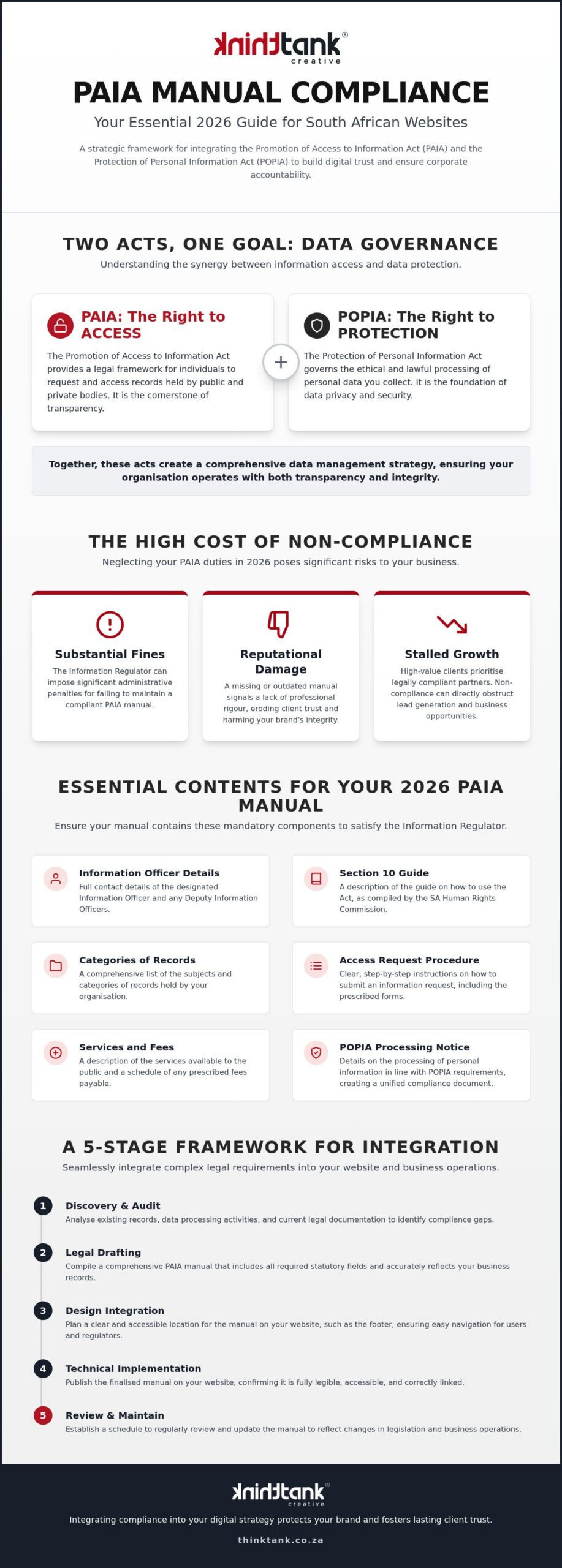
Transparency is the bedrock of a modern, democratic economy. The Promotion of Access to Information Act (PAIA) serves as the legislative engine that drives this principle, ensuring that information is accessible to those who need it to protect their rights. It isn't just a legal hurdle; it's a commitment to corporate accountability that resonates with your audience. By providing a clear path for information requests, you're signaling that your business operates with integrity and openness.

Your PAIA manual is the instructional guide for this process. It outlines the categories of records your business maintains and the specific steps a requester must take to view them. For any modern enterprise, a paia manual for website south africa is a vital digital asset. Because your website is your most visible storefront, the law requires that this manual be easily accessible to any visitor. This accessibility ensures that your business remains transparent whilst providing a clear roadmap for legitimate information requests.

To better understand how this framework functions in a corporate environment, watch this helpful video:

We view compliance as a synergistic effort. PAIA works amongst POPIA regulations to create a comprehensive data management strategy. Whilst POPIA focuses on the protection and ethical processing of personal data, PAIA ensures that the right to information remains unhindered. This balance is crucial for maintaining the integrity of your digital operations. It's about creating a culture of accountability that resonates with your clients and stakeholders alike.

The Legal Necessity for South African Private Bodies

Section 51 mandates that every private body must compile and maintain this document. A private body is officially defined as any natural person who carries on a trade, profession, or business, as well as any partnership or juristic person. The Information Regulator has shifted toward a more proactive enforcement model in 2026. They now actively monitor digital platforms to ensure that manuals are updated and reflect the latest statutory requirements. It's no longer enough to have a static document; it must be a living reflection of your current record-keeping practices.

Consequences of Non-Compliance in 2026

The cost of neglecting these requirements extends far beyond mere paperwork. Administrative fines can be substantial, but the damage to your brand’s reputation is often more difficult to repair. A missing or outdated manual signals a lack of professional rigour, which can directly stall your lead generation strategies for South African businesses. High-value clients seek partners who demonstrate meticulous attention to detail and legal compliance. Without professional oversight, you risk leaving your business vulnerable to both regulatory scrutiny and a loss of market trust.

PAIA vs POPIA: Understanding the Compliance Synergy

Achieving digital compliance requires a nuanced understanding of how different legislative frameworks intersect to protect both the business and the consumer. Whilst many organisations treat them as separate silos, PAIA and POPIA are actually two sides of the same transparency coin. POPIA, the Protection of Personal Information Act, focuses on the protection and ethical handling of data you collect. In contrast, PAIA is about access, providing a legal mechanism for individuals to request records held by your body. Implementing a paia manual for website south africa is the necessary counterpart to your privacy policy, ensuring you address both the right to privacy and the right to information.

Your website must present these documents with absolute clarity. A common mistake is burying legal links in obscure corners, which can frustrate users and signal a lack of transparency to regulators. We recommend organising these protocols within your site's footer, grouped logically under a "Legal" or "Compliance" heading. This structure allows the Information Officer to manage requests efficiently through a dedicated interface, bridging the gap between statutory requirements and user experience. Following the Information Regulator's PAIA guidelines ensures that your "Access" protocols are as robust as your "Protection" ones.

The Dual Mandate of the Information Regulator

The Information Regulator oversees both Acts through a unified eServices portal, streamlining the administrative burden for businesses. You must register your Information Officer on this portal before your manual is officially published. This registration is a prerequisite for submitting annual reports and ensures your organisation is recognised as a compliant entity. By centralising these functions, the Regulator makes it easier to facilitate the "Right to Access" seamlessly, provided your website is built to support these digital interactions. It's a methodical process that rewards thoroughness and strategic planning.

Integrating Compliance into Custom Website Design

Legal documentation should never feel like an afterthought. High-quality custom website design South Africa must account for statutory requirements from the initial wireframing stage. We avoid the "tacked-on" look by ensuring your PAIA manual and privacy pages reflect your brand's visual identity and tone. This integration turns a dry legal necessity into a seamless part of the brand journey, reinforcing trust at every touchpoint. Mobile-first accessibility is equally critical; your legal downloads must be as easy to read on a smartphone as they are on a desktop. If you're looking to refine your digital footprint, our team is ready to assist with website maintenance and support to keep your legal pages current and functional.

What Must Your 2026 PAIA Manual Contain?

Precision is the hallmark of a compliant PAIA manual. It's not merely a list of contact details; it's a comprehensive map of your organisation's data infrastructure. To ensure your paia manual for website south africa meets the 2026 standards, it must clearly identify the Information Officer and the head of the private body. This section acts as the primary point of contact for the Information Regulator and any person seeking access to records. Additionally, the manual must include a reference to the Regulator's official guide on how to use the Act, providing a clear pathway for citizens to exercise their constitutional rights.

A robust manual details every subject on which the body holds records, ranging from internal corporate governance to external client interactions. This categorisation is essential because it informs the public about what is actually available for request. You must also outline the exact procedure for making a request, including the submission of Form 2 and the payment of prescribed fees. This level of detail transforms the document from a static requirement into a functional tool for transparency. It ensures that your business remains beyond reproach whilst facilitating legitimate requests for information.

Standard Categories of Records for SA Businesses

Modern businesses generate vast amounts of data, and your manual should reflect this digital reality. Standard categories typically include financial records, human resources documentation, and operational data. However, a digital-first approach requires you to account for website-specific records, such as user logs and digital transaction histories. Clearly distinguish between records that are automatically available, such as your public-facing marketing materials, and those that require a formal request. This distinction reduces unnecessary administrative work for your team whilst ensuring you remain fully compliant with the law.

Prescribed Forms and Fee Structures

Efficiency in compliance is driven by accessible documentation. Your website should host a downloadable version of Form 2, the official Request for Access to Record, to facilitate a smooth user experience. Transparency regarding fee structures is equally important. Whilst you cannot waive the statutory request and access fees, presenting them clearly within your manual demonstrates professional integrity. Ensure your manual is updated annually to reflect the current fee schedules in ZAR as determined by the Information Regulator. This meticulous approach ensures your business is never caught off guard by regulatory shifts or outdated documentation.
PAIA Manual for Website South Africa: The 2026 Compliance Guide

Publishing Your Manual: A Step-by-Step Implementation Guide

Executing the publication of a paia manual for website south africa requires a blend of legal precision and technical foresight. Start by drafting the document using the latest Information Regulator templates, ensuring every statutory field is populated with exactitude. A meticulous review phase follows, where you validate the content against 2026 regulations to ensure no recent legislative shifts have been overlooked. This isn't just about compliance; it's about building a foundation of trust with your digital audience through transparent record-keeping practices.

Once finalised, the manual should be integrated into your site as a searchable PDF or a dedicated HTML page. We recommend placing the link strategically within your footer, ensuring it doesn't get lost amongst other common website design mistakes to avoid. A clear, accessible link demonstrates that you value transparency and take your regulatory obligations seriously. This placement also ensures that the document is easily reachable from any page on your site, satisfying the Regulator's requirement for permanent accessibility.

Technical Hosting Requirements

Visibility is paramount for statutory documents. Optimise your PDF file names using descriptive, keyword-rich titles to enhance search engine visibility and accessibility for screen readers. You must ensure the manual is indexed by Google so that it's discoverable by the public, whilst maintaining robust security protocols to protect your server from malicious bots. We emphasise the importance of persistent URLs. A broken link in the Regulator's records can trigger a compliance audit, so your file structure must remain stable during any site updates or migrations. This stability reflects the reliability of your brand's digital infrastructure.

The Information Officer Registration Process

Registration is the final hurdle before your manual goes live. Use the Regulator’s eServices portal to register your Information Officer, a process that requires specific corporate details and a commitment to data stewardship. Once registered, link the resulting Information Officer's certificate to your internal digital compliance folder for easy retrieval during inspections. This requires constant communication between your web development team and your legal officer to ensure the public-facing manual matches the Regulator's database exactly. If you find the technical heavy lifting daunting, our team can streamline the process through expert website design and development tailored to South African standards.

Aligning your digital presence with national regulations shouldn't come at the expense of your brand's aesthetic or functional excellence. At ThinkTank Creative, we treat the implementation of a paia manual for website south africa as a core component of your site’s architecture rather than a secondary addition. Since our founding in 2001, we've refined an end-to-end 5-stage development process that ensures compliance is woven into the Planning phase from day one. This proactive methodology allows us to anticipate regulatory requirements whilst honouring the creative vision that makes your brand unique. We believe that technical precision and creative design should exist in perfect synergy.

Our award-winning design team works in close collaboration with our technical developers to ensure that your legal documentation is presented with the same bespoke craftsmanship as your primary landing pages. We adopt a "We Do It All So You Don’t Have To" approach, handling the technical heavy lifting of document hosting, SEO optimisation, and secure file management. This allows you to focus on your core business objectives whilst we ensure your digital assets remain stable and compliant. Our commitment extends beyond the initial launch; we provide ongoing website maintenance and support to ensure your manual stays updated as South African laws continue to evolve.

Beyond Compliance: Building Trust Through Transparency

A well-organised PAIA manual is a powerful signal of corporate maturity. It tells your customers and partners that you are a reliable, "smart" organisation that respects the constitutional right to information. When you integrate these protocols into a broader website launch marketing plan, you're not just checking a box; you're elevating your brand's reputation. Moving from "good marketing" to "great marketing" requires prioritising user rights and data transparency. By making your compliance documents easy to find and simple to navigate, you foster a culture of trust that differentiates you from competitors who treat legal mandates as an afterthought.

Getting Started with ThinkTank Creative

Your journey toward a fully compliant and high-performing digital presence begins with a strategic conversation. We invite you to contact our team for a comprehensive audit of your current statutory documents and website structure. Whether you're launching a new venture or refreshing an established brand, we can provide an estimated cost for a compliance-first website redesign that meets the rigorous standards of 2026. We lead with expertise and follow with meticulous execution, guiding you from the initial imagination phase to a secure, legally protected digital storefront. Let's work together to transform your regulatory obligations into a strategic advantage for your business growth.

Elevate Your Digital Integrity for 2026

Mastering your regulatory obligations is far more than a simple legal checkbox; it's a strategic investment in your brand's long-term digital integrity. By harmonising the access requirements of PAIA with the protection protocols of POPIA, you create a robust ecosystem that respects user rights whilst shielding your business from enforcement risks. Compliance builds trust. This synergy ensures your digital storefront remains both welcoming to users and resilient against regulatory scrutiny.

Ensuring you have a meticulously drafted paia manual for website south africa is the definitive step toward achieving total peace of mind. Established in 2001, our expert all-rounder team utilises a comprehensive 5-stage development process to integrate these complex statutory requirements into your web architecture with absolute precision. We handle the technical heavy lifting so you can focus on scaling your vision. Secure your digital compliance with ThinkTank Creative today and transform your mandatory legal obligations into a powerful foundation for growth. We're ready to build a more transparent digital future alongside you.

Frequently Asked Questions

Is a PAIA manual mandatory for small businesses in South Africa in 2026?

Yes, a PAIA manual is mandatory for almost all private bodies in 2026, including small businesses and sole proprietors. The previous exemptions for smaller entities lapsed on 31 December 2021; this means that regardless of your turnover or staff count, you must maintain this document. Having a paia manual for website south africa ensures your business remains compliant with Section 51 of the Act whilst promoting constitutional transparency and accountability.

What is the difference between a PAIA manual and a POPIA privacy policy?

PAIA focuses on the right of access to information, whereas POPIA governs the protection and ethical processing of personal data. Your privacy policy explains how you collect and use data, whilst the PAIA manual provides the roadmap for individuals to request records held by your organisation. Both are essential components of a compliant digital presence, working in synergy to ensure you meet the dual mandate of the Information Regulator effectively.

How often should I update my website's PAIA manual?

You should review and update your manual at least once a year or whenever significant changes occur within your business structure. This includes changes to your Information Officer’s contact details, new categories of records, or updates to the prescribed fee structures set by the Regulator. Regular maintenance ensures your manual remains an accurate reflection of your organisation, preventing administrative delays when formal information requests are submitted by the public or regulatory bodies.

Where is the best place to link my PAIA manual on my website?

The most effective location is within your website's footer, grouped clearly with other legal documents like your terms and conditions. This ensures the link is accessible from every page on your site, satisfying the Regulator's requirement for permanent availability. Avoid burying it in sub-menus; a transparent approach makes your brand look more professional and reliable to both customers and regulatory inspectors who monitor digital compliance and corporate stewardship.

Can I use a generic template for my PAIA manual?

Whilst you can start with the official 2021 template provided by the Information Regulator, it must be meticulously customised to reflect your specific business operations. A generic document that doesn't accurately list your record categories won't satisfy a compliance assessment. We incorporate this customisation into our 5-stage development process, ensuring your documentation is both legally sound and professionally presented within your site's unique architecture to foster trust with your audience.

What are the fees associated with a PAIA request in 2026?

Requesters are typically required to pay a standard request fee when submitting Form 2, followed by an access fee if the request is granted. These fees are determined by the Information Regulator and cover the costs of searching for and preparing the requested records. You must clearly state these fees in your manual to maintain transparency. Ensure your manual reflects the current ZAR fee schedules to avoid disputes during the request process.

Does the Information Regulator check websites for PAIA compliance?

Yes, the Information Regulator has significantly strengthened its oversight and now conducts regular compliance assessments, which include reviewing company websites for accessibility. Failure to publish a compliant paia manual for website south africa can trigger a formal investigation or physical inspection of your records. Proactive digital compliance is essential to avoid administrative fines and protect your corporate reputation in an era of increased regulatory transparency and active enforcement.

Who should be appointed as the Information Officer for my company?

By default, the head of a private body, such as the Managing Director or CEO, is the designated Information Officer. However, you can officially delegate these responsibilities to a Deputy Information Officer who possesses the technical knowledge to manage requests. This person must be registered through the Regulator’s eServices portal. Appointing a meticulous individual ensures that your organisation handles information requests with the strategic depth and reliability required by South African law.
15 Critical Signs You Need a New Website in 2026: The Strategic Checklist

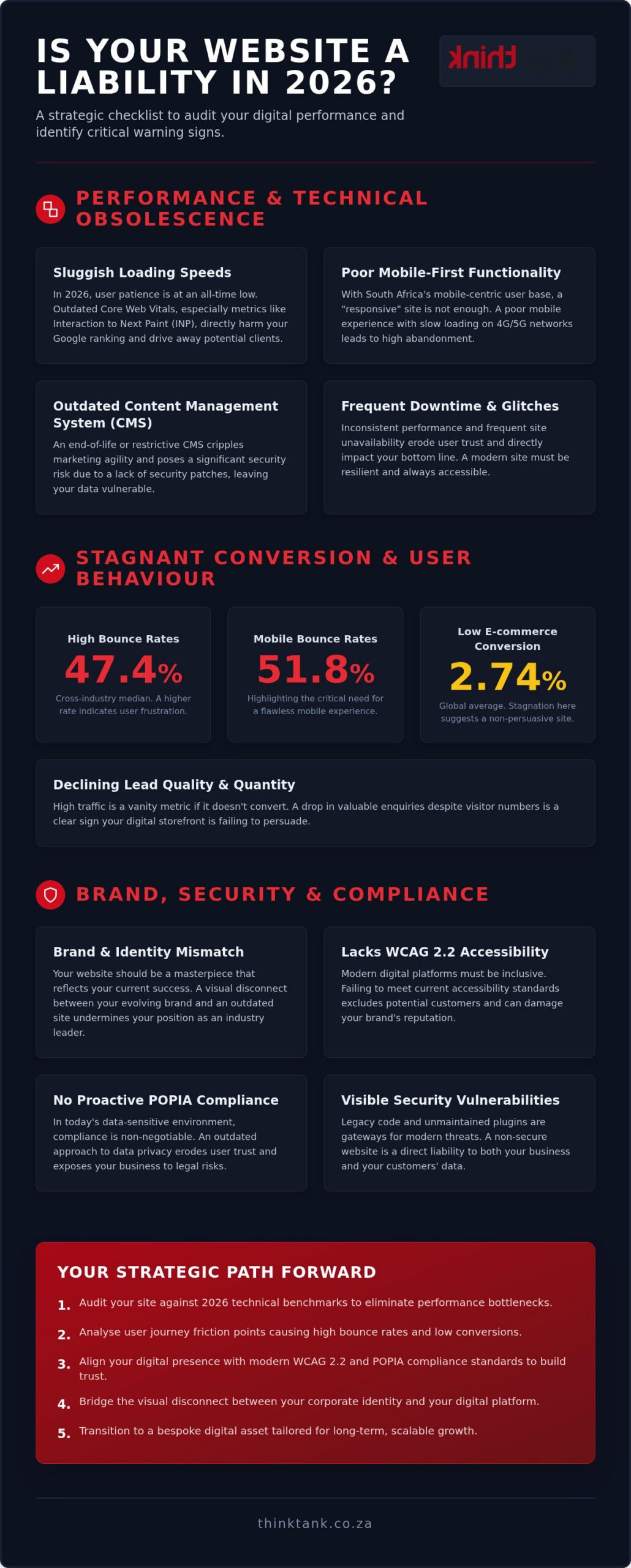
If your website were an employee on your sales team, would you be celebrating their targets today, or would they be facing a performance review? It is a confronting thought, but in the sophisticated digital environment of 2026, a platform that felt revolutionary a few years ago can quickly become a silent liability. You likely recognise the frustrating signs you need a new website, such as a dip in lead quality or a bounce rate that has climbed toward the current industry median of 47.4 per cent. It is common to feel a growing misalignment between your ambitious brand vision and a digital presence that no longer reflects your excellence.

We believe your website should be a bespoke masterpiece that evolves alongside your success. This guide provides a strategic checklist to help you audit performance bottlenecks and identify where your current site falls short of modern expectations. We will explore fifteen critical indicators, including WCAG 2.2 accessibility standards and the latest proactive POPIA compliance requirements, to give you total clarity on your next steps. This journey will move you from technical uncertainty to a position of quiet assurance, ready to craft a digital experience that truly resonates with your audience and restores your competitive edge.

Key Takeaways

  • Audit your digital performance against 2026 technical benchmarks to ensure that sluggish loading speeds and outdated Core Web Vitals are not driving potential clients toward your more modern competitors.
  • Recognise the critical signs you need a new website by identifying friction points in your customer journey that lead to declining lead quality and high bounce rates.
  • Align your digital presence with the latest WCAG 2.2 accessibility standards and proactive POPIA compliance to protect your brand reputation and foster trust amongst your users.
  • Bridge the visual disconnect between your evolving corporate identity and your current site, ensuring your online platform accurately reflects your status as an industry leader.
  • Master the strategic transition to a new platform using a collaborative five-stage development process designed to create a bespoke digital asset tailored for long-term growth.

Performance and Technical Obsolescence

Performance is the silent heartbeat of your brand's digital presence. In 2026, user patience has reached an all-time low. If your pages hesitate for even a few seconds, you're effectively handing your leads to a more agile competitor. This technical friction is one of the most undeniable signs you need a new website. Often, the culprit is a gradual build-up of technical obsolescence. Legacy code and unmaintained plugins behave like digital anchors, dragging down server response times and creating a fragile architecture prone to glitches.

Evaluating your site against 2026 Core Web Vitals is no longer optional. Google's focus on metrics like Interaction to Next Paint (INP) means that stability and responsiveness are now primary ranking signals. Frequent downtime isn't just a nuisance; it's a direct hit to your bottom line and brand authority. We've seen how inconsistent performance erodes the trust you've worked hard to build. A modern site must be resilient, ensuring your brand is always available when your customers need you most. This quiet assurance in your technical foundation allows your business to scale without the constant fear of a digital breakdown.

Mobile-First Functionality for ZA Users

South Africa's digital landscape is uniquely mobile-centric. Whilst global mobile traffic averages 59.6 per cent, local users frequently access the web via mobile data networks where every kilobyte counts. The cross-industry median bounce rate for mobile is currently 51.8 per cent, highlighting how quickly users abandon sites that don't perform. A site that is simply "responsive" often fails the 2026 mobile-first test. True mobile excellence requires bespoke craftsmanship, focusing on thumb-friendly navigation and generous touch-target spacing. If your mobile experience feels like a cramped version of your desktop site, you aren't meeting the needs of your audience. Fast loading on 4G and 5G networks is essential for maintaining engagement in a competitive market.

Outdated Content Management Systems

Your CMS should be a catalyst for growth, not a barrier to entry. Many businesses remain tethered to end-of-life platforms or restrictive systems that make content updates a technical ordeal. With WordPress powering 42.4 per cent of the web in 2026, the standard for ease-of-use is high. An outdated CMS isn't just difficult to manage; it's a security risk. End-of-life systems lack the patches needed to defend against modern threats, leaving your data vulnerable. Recognising that your platform limits your marketing agility is one of the key signs you need a new website. If updating a simple blog post requires a developer's intervention, your team's ability to react to market trends is being compromised.

Stagnant Conversion and User Behaviour

High traffic volume is a vanity metric if it fails to catalyse meaningful business growth. If your analytics show a steady stream of visitors but your inbox remains quiet, you are witnessing a classic disconnect between visibility and value. This stagnation is one of the most pressing signs you need a new website because it suggests your digital storefront is no longer persuasive. Great marketing isn't just about shouting louder; it is about making your customers look smart for choosing you. With global e-commerce conversion rates averaging just 2.74 per cent in 2026, every percentage point represents a significant shift in revenue. When a site feels intuitive and professional, it validates the user's decision to engage, whilst a clumsy interface creates immediate doubt.

Analysing where these friction points occur requires a methodical approach. By consulting a strategic checklist for a new website, you can begin to pinpoint whether the issue lies in your messaging, your layout, or a fundamental breakdown in user experience. We often find that businesses possess excellent products but present them through a digital lens that feels dated or difficult to navigate. This misalignment prevents you from reaching your full digital potential and keeps your conversion rates anchored to the floor. Recognising these signs you need a new website early allows you to pivot before the gap between you and your competitors becomes insurmountable.

High Bounce Rates and Low Engagement

Your bounce rate acts as a direct feedback loop from your audience. In 2026, the cross-industry median bounce rate sits at approximately 47.4 per cent, but a figure significantly higher than this often indicates user frustration. Cluttered layouts and confusing navigation menus force visitors to work too hard to find what they need. We recommend using heatmaps to observe exactly where users lose interest or encounter barriers. If people are dropping off before they even scroll, your "above the fold" content isn't doing its job. A clean, purposeful design respects the user's time and encourages deeper exploration of your brand's story.

Friction in the Customer Journey

A seamless path from discovery to enquiry is the hallmark of elite digital craftsmanship. If your calls-to-action are buried at the bottom of long paragraphs or use uninspiring language, you are missing vital opportunities to convert. Every click should feel like a natural progression toward a solution. This is where a sophisticated custom website design South Africa strategy becomes invaluable. It ensures that your user experience (UX) is not an afterthought but a core component of your business logic. By removing technical and cognitive hurdles, you empower your visitors to move confidently through your sales funnel. If you suspect your current journey is more of a maze than a motorway, it might be time to reimagine your digital presence with a partner who understands the nuances of conversion-driven design.

Brand Evolution and Identity Mismatch

Your business is a living entity that matures, adapts, and reaches new milestones. If your online presence remains frozen in a version of your company from five years ago, you are projecting an identity mismatch that confuses potential clients. This visual disconnect is one of the subtle yet profound signs you need a new website. When a prospect meets your high-calibre team or sees your polished corporate identity but finds a dated, uninspired website, their trust in your capabilities begins to waver. A professional redesign isn't merely a cosmetic upgrade; it is a strategic realignment that ensures your digital home reflects the excellence you've achieved today.

Evaluating your site's appeal to your primary target audience is a vital exercise in brand health. As markets shift, the visual language that once resonated may now feel disconnected from the expectations of your ideal customer. A professional redesign elevates your credibility amongst competitors, positioning you as a forward-thinking leader rather than a legacy player. We believe in a collaborative approach that treats your website as a dynamic asset capable of expressing your brand's full potential. By closing the gap between who you are and how you appear online, you create a foundation for sustained growth and deeper client relationships.

Outgrowing Your Digital Identity

Success often brings a diversification of services that your original site was never built to accommodate. If you find yourself struggling to showcase new offerings because the layout is too rigid, you've outgrown your digital architecture. Our award-winning design team specialises in creating a bespoke visual language that captures the unique essence of your brand. By integrating sophisticated logo and corporate identity design into your platform, we move away from templated solutions toward a tailored experience. This synergy between your physical brand and your digital presence ensures you never miss an opportunity to demonstrate your full range of expertise.

The Good vs Great Marketing Gap

Great marketing makes your customers look smart for choosing you. It shifts the narrative from a company-focused "about us" page to a customer-focused journey of transformation. Whilst good marketing tells people what you sell, great marketing uses customer-centric storytelling to build deep, lasting trust. Your website must act as a true reflection of your brand's excellence, positioning you as a collaborative partner in your client's success. If your current site feels like a static brochure rather than an engaging experience, it is one of the clear signs you need a new website. We focus on bridging this gap, ensuring that every interaction on your site reinforces your status as an industry visionary.

15 Critical Signs You Need a New Website in 2026: The Strategic Checklist

Accessibility, Security, and POPI Compliance

Integrity in the digital age is measured by how well you protect your users and how inclusive you make their experience. In 2026, failing to meet modern accessibility and security standards isn't just a technical oversight; it's a significant risk to your brand's reputation. As the South African Information Regulator moves toward proactive enforcement of the POPI Act, ensuring your data collection methods align with current regulations has become a business imperative. A platform that feels like a 'black box' regarding privacy or excludes users with disabilities is one of the most serious signs you need a new website. True brand transformation requires a foundation built on trust, excellence, and meticulous attention to legal requirements.

Protecting your brand reputation through robust security measures is a collaborative effort that begins with your site's architecture. We've seen how legacy platforms become targets for sophisticated threats, often due to outdated protocols or unsupported plugins. Beyond the technical fixes, there is an ethical necessity to ensure your digital presence is welcoming to all. By aligning your site with 2026 technical benchmarks, you project a personality that is both elite in its execution and deeply invested in the user's journey. This quiet assurance in your site's safety allows you to focus on growth whilst we handle the complexities of digital defence.

Meeting 2026 Accessibility Standards

Inclusive design has evolved from a tick-box exercise into a competitive business advantage. Meeting WCAG 2.2 AA standards ensures that your site is navigable for everyone, including those using screen readers or alternative input devices. This focus on clarity and structure provides a significant boost to your search engine optimisation South Africa strategy, as search engines increasingly reward sites that offer superior user experiences. By prioritising high colour contrast and logical heading structures, you invite a wider audience to engage with your brand whilst demonstrating an ethical commitment to digital equity.

Security Vulnerabilities and POPI Compliance

Security is the quiet guardian of your professional relationships. For South African enterprises, the proactive monitoring by the Information Regulator means that standard SSL certificates are no longer the finish line. Your site must handle personal data according to the eight conditions for lawful processing, particularly following the new health information regulations that came into force on 6 March 2026. If your current platform lacks robust security safeguards or relies on unsupported legacy code, these are critical signs you need a new website. We believe that ongoing maintenance and support are essential to prevent breaches before they occur, protecting both your data and your hard-earned credibility. To ensure your digital presence is both secure and compliant, we invite you to partner with our expert development team and secure your brand's future.

Transformation begins with a single, decisive step toward clarity. Once you recognise the signs you need a new website, the focus shifts from diagnosing the problem to architecting a solution that elevates your brand. We approach every project through a meticulous five-stage development process: strategy and planning, creative design, technical development, testing, and the final launch. This methodical cadence ensures that every pixel and line of code serves a specific business purpose. Our philosophy of 'We Do It All So You Don’t Have To' means you can focus on your core operations whilst we handle the intricate details of your digital evolution.

Defining Strategic Objectives

Setting measurable goals for traffic, leads, and brand engagement transforms your website from a digital brochure into a high-performing asset. We collaborate with you to define objectives that challenge the status quo, ensuring your new platform isn't just an iteration of the old one but a bold leap forward. Research and strategy form the bedrock of this phase, allowing us to align your brand identity with the technical requirements of the 2026 digital space. Identifying these signs you need a new website is simply the catalyst for a much larger transformation. This phase is about looking beyond the immediate horizon to see what your brand could truly become with the right tools and a clear roadmap.

Selecting a Collaborative Creative Partner

Synergy between design and code is most effectively achieved with an integrated, multidisciplinary team. Our award-winning team of in-house graphic and web designers work alongside our developers to ensure the vision we create together is executed with precision. We've been refining this collaborative approach since 2001, positioning ourselves as a partner in your journey of imagination. This elite level of craftsmanship avoids the 'templated' feel of many modern sites, offering instead a bespoke solution that feels as unique as your business. The relationship doesn't end at launch; we highlight the importance of ongoing support and maintenance to ensure your site remains a top-tier performer in an ever-changing market. Because every business has unique requirements, an estimated cost is provided only after we've discussed your bespoke needs and strategic goals. This ensures the value we provide is perfectly tailored to your specific journey of growth.

Elevate Your Digital Presence for 2026

Your website is more than a digital placeholder; it's the primary engine of your business growth. By identifying the technical and strategic signs you need a new website, you've taken the first step toward reclaiming your competitive advantage. Whether you're addressing stagnant conversion rates or ensuring your platform meets the latest POPIA and accessibility standards, the path forward requires a blend of technical precision and inspired creative vision. We believe every brand deserves a bespoke digital home that reflects its true excellence and maturity.

ThinkTank Creative has been guiding South African businesses through this journey of imagination since 2001. With 25 years of expertise, our all-rounder team utilises a proven 5-stage development process to ensure your project moves smoothly from concept to a high-performing launch. We invite you to discuss your vision with our award-winning design team and discover the potential for your brand's transformation. The future of your digital presence is a collaborative journey, and we're ready to partner with you to achieve extraordinary outcomes.

Frequently Asked Questions

How often should a business website be redesigned?

Most businesses should consider a redesign every two to three years to keep pace with rapid technological shifts and evolving user expectations. In 2026, the acceleration of AI-driven design and performance standards means a platform can feel dated faster than in previous cycles. Regular audits help you identify the technical signs you need a new website before your competitors gain a significant lead. This steady cadence ensures your brand remains a modern, authoritative leader.

What are the most common signs that my website is outdated?

Sluggish loading times, high bounce rates, and a visual disconnect from your current brand identity are the primary indicators of obsolescence. If your site is difficult to update or fails to convert mobile traffic effectively, these are undeniable signs you need a new website. You might also notice that your platform lacks modern accessibility features or fails to meet proactive POPIA compliance standards, creating both ethical and legal risks for your South African enterprise.

Can a slow website affect my search engine rankings in South Africa?

Performance is a critical ranking signal for search engines, especially considering South Africa's mobile-first user base. With mobile devices accounting for 59.6 per cent of global traffic in 2026, a slow site directly impacts your visibility. Search engines reward platforms that offer superior Core Web Vitals and stable user experiences. A sluggish site leads to higher bounce rates, signalling to algorithms that your content might not be the best result for users.

What is the difference between a website refresh and a full redesign?

A refresh focuses on cosmetic updates like new imagery or typography, whilst a full redesign involves a complete structural and technical overhaul. Think of a refresh as a new coat of paint and a redesign as rebuilding the foundation for better performance. If your current architecture is technically obsolete or fails to support your strategic goals, a full redesign is essential. This process allows for deeper integration of modern security protocols and bespoke user journeys.

How does the POPI Act affect my website design?

POPIA requires your website to handle personal data with transparency and robust security safeguards. Your design must include clear privacy policies and active consent mechanisms for data collection. Following the new health information regulations that came into force on 6 March 2026, the Information Regulator has intensified enforcement. A compliant design ensures that user data is processed according to the eight conditions for lawful processing, protecting your brand's hard-earned reputation and credibility.

Is it better to use a DIY builder or a professional agency for a redesign?

DIY builders offer speed but often lack the bespoke craftsmanship and strategic depth required for high-level brand transformation. A professional agency provides an integrated team of designers and developers who ensure technical excellence and brand alignment. This collaborative approach results in a tailored digital asset that scales with your business. For enterprises seeking a sophisticated, secure, and compliant presence, the expertise of a seasoned partner is a vital investment in long-term success.

What should I prepare before contacting a web design agency?

Clear strategic objectives and an understanding of your target audience are excellent starting points. Gather your current brand assets, such as logos and corporate identity guidelines, to help your partner understand your visual language. It's also helpful to identify specific pain points in your current user journey or performance bottlenecks you've observed. Coming prepared with measurable goals allows us to move efficiently into the research and strategy phase of our collaborative 5-stage development process.

How long does a professional website redesign typically take?

A bespoke redesign usually takes between 12 to 24 weeks depending on the project's complexity and your specific requirements. This timeframe allows for our thorough methodology, ensuring that every phase from initial strategy to final testing is handled with precision. We avoid rushing the journey of imagination to ensure the final product is a stable, high-performing asset. A methodical pace guarantees that your new site is built for long-term endurance in a competitive digital market.