What to Do After Your New Website Goes Live: Checklist

A website launch is a beginning, not a finish line. If you’re wondering what to do after your new website goes live, start by checking that it works as intended, then set a regular rhythm for monitoring and improvement. A site can look polished but still have broken links, forms that fail to submit or pages that search engines can’t find.

It’s natural to want to promote your new website straight away. First, run a few practical checks to catch issues early and make the experience smoother for visitors. You don’t need to do everything at once. A clear order makes the next steps easier to manage.

This checklist covers testing key pages and functions, checking search visibility, setting up performance tracking and planning ongoing maintenance. It also explains how promotion and regular review can help your website support your business over time. Treat launch as the handover, then use what you learn from real visitors to shape what comes next.

Key Takeaways

  • Use a structured checklist for what to do after your new website goes live, starting with the pages and tasks visitors rely on most.
  • Connect your site to search and analytics tools to monitor visibility and understand which actions visitors complete.
  • Promote useful pages through channels that suit your audience, and give your efforts time to build momentum.
  • Assign responsibility for updates, backups and access to keep your website maintained after launch.
  • Use search reports, enquiries and customer feedback to prioritise one worthwhile improvement at a time.

What to check immediately after your new website goes live

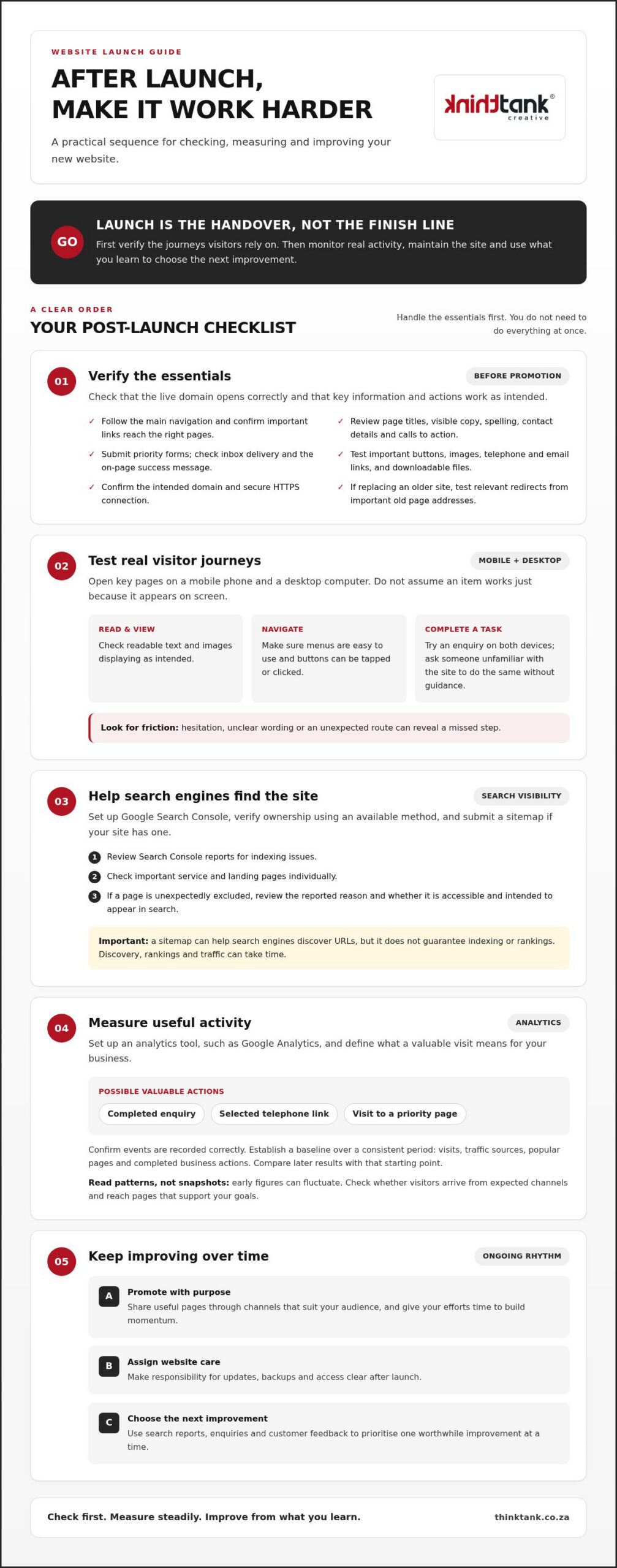
Start with the essentials: does the live domain open correctly, can visitors find the pages they need, and do the main actions work? Test common journeys, such as finding a service, calling your business or sending an enquiry. A polished homepage is only part of the picture. A broken contact form or an unclear route to key information can undermine the whole experience.

Use this first review to catch launch-critical issues, not to perfect every detail. Check page titles, visible copy, spelling, contact details and calls to action. These checks also help establish a clear foundation for Search engine optimization, which makes a site easier for search engines and people to understand.

How to test the live website across devices

Open your key pages on a mobile phone and a desktop computer. Check that text is readable, images display as intended, menus are easy to use, and buttons can be tapped or clicked. Test telephone and email links, along with downloadable files. Don’t assume something works just because it appears on the page.

Launch principle: verify critical visitor journeys before promoting the site. A quick, independent test can reveal unclear wording or a missed step that’s easy to overlook when you already know how the website is meant to work.

What to verify before sharing the new website

Submit each important form yourself. Confirm that the message reaches the intended inbox and that the visitor sees a clear success message after sending it. Check that the confirmation explains what happens next without promising a response time your business hasn’t committed to.

If the new site replaces an older one, test redirects from important old page addresses where relevant. Confirm that the website uses its intended domain and loads securely over HTTPS. Then review this pre-promotion checklist:

Once these essentials are in place, you’ll have a more reliable base for sharing the website and learning from visitor behaviour. If you’re working with a web partner, include these checks in the launch handover so responsibilities and outstanding issues are clear.

How to help search engines find your new website and measure visits

After the live site passes its essential checks, set up ways to monitor how search engines access it and what visitors do. Search visibility and audience activity are different signals. One helps you understand whether pages are appearing in search, while the other shows how people use the website after arriving.

How to submit and monitor a new website

Set up Google Search Console and verify ownership using one of the methods currently offered during setup. If your site has a sitemap, submit it through the platform and review its reports for indexing issues. A sitemap can help search engines discover URLs, but it doesn’t guarantee that every page will be indexed.

Check important pages individually, especially core service pages and key landing pages. If a page is unexpectedly excluded, review the reason reported in Search Console and investigate whether the page is accessible and intended to appear in search. Follow Google’s current guidance, as its interface and verification options may change.

Remember: submitting a sitemap helps search engines discover pages, but it doesn’t promise rankings. Search engines decide whether and where pages appear, and discovery, rankings and traffic can take time. Keep monitoring rather than treating submission as a one-off guarantee.

Which early website metrics are worth tracking?

Set up an analytics tool, such as Google Analytics, and decide what counts as a valuable visit for your business. Depending on your goals, useful actions might include a completed enquiry, a selected telephone link or a visit to a priority page. Confirm that these events are recorded correctly before using them to assess marketing activity.

Establish a baseline by recording visits, traffic sources, popular pages and completed business actions over a consistent period. Then compare later results with that starting point. Early figures can fluctuate, so avoid drawing firm conclusions from a brief snapshot. Look for patterns: are visitors arriving from the channels you expected, and are they reaching the pages that support your goals?

For a helpful introduction to interpreting reports, explore the existing guide, Understanding your website analytics report. Apply its principles to your own objectives rather than tracking every available metric. A short, relevant set of measures is easier to review and more likely to guide a practical next step.

These tools work best as part of an ongoing process. If you’d like support connecting search visibility with website performance, explore SEO and website support.

How to promote a new website without expecting instant results

Promotion works best when it connects the right audience with a useful next step. Instead of sharing every page everywhere, choose channels that match your customers, your offer and the time you can consistently devote to them. A focused plan is easier to manage and gives you clearer signals about what’s working.

How to bring the right visitors to a new website

Start with audiences you already reach. Share a relevant service or landing page through your social channels or an email update, and explain what visitors can do next, such as exploring an offering or sending an enquiry. A useful link with a clear purpose is more helpful than simply announcing that the website is live.

Use customer questions to shape ongoing content. If people often need help comparing options or understanding how a service works, create a page or post that answers those questions and points to a relevant next step. A considered publishing schedule can keep your content useful. The guide How to Create a Content Marketing Plan can help you organise topics over time.

Choose channels according to your objectives and capacity:

You don’t need to use every channel at once. Select one or two that fit your plan, then review the response before expanding your activity. This makes it easier to learn without creating more work than your team can sustain.

How to set realistic expectations after launch

Publishing a website or sharing a page doesn’t guarantee immediate rankings, enquiries or sales. Search visibility takes time to develop, and campaign results depend on factors such as audience fit, the offer and the visitor experience. Set a clear objective for each activity, then measure it against meaningful actions, not attention alone.

For example, a social post might aim to bring people to a service page, while an email campaign might encourage readers to complete an enquiry. Review which channels attract relevant visits and which lead to actions your business values. Use those findings to refine your approach rather than judging success by a single short-term result.

If you’d like support aligning promotion with your goals, explore digital marketing support, including SEO, social media marketing, email marketing and PPC advertising.
What to Do After Your New Website Goes Live: Checklist

How to protect and maintain your website after launch

A live website needs clear ownership as well as technical upkeep. Decide who is responsible for software updates, backups, access permissions and reporting issues. If a web partner is involved, make sure the handover explains what they manage and what your team needs to handle. Knowing who to contact and what information to provide can make problems easier to resolve.

What should a website maintenance routine include?

Set a routine that reflects how your website is built, how often it changes and the guidance for its platform and components. Include update checks, backup reviews, functional testing and monitoring for availability, speed and broken links. Keep a simple record of completed checks, outstanding work and who is responsible. This makes maintenance manageable without assuming every site needs identical tools or timing.

Backups are most useful when they can be restored. Confirm that copies are being created as intended and periodically check that the restoration process works, following the relevant platform or provider guidance. After significant updates, test key pages and functions so you can identify problems. Agree where issues should be reported and how they’ll be prioritised instead of leaving escalation unclear.

How to keep website content and security current

Maintenance also covers the information visitors rely on. Review important service details, contact information, opening hours and calls to action when business details change. Remove or update content that no longer reflects what you offer. Keep an organised record of who can edit the site, and remove accounts that are no longer needed.

Use strong, unique credentials for website accounts and grant access according to each person’s role. Check current recommendations from your platform and relevant security providers before changing technical settings, as requirements can vary depending on how the site is configured. Avoid sharing login details informally, and make sure everyone involved understands the agreed process for access and reporting issues.

To plan ongoing care, you may also find Annual Website Maintenance: Budgeting in ZAR for 2026 useful if it’s published. A maintenance plan should reflect your site’s needs and responsibilities, not an arbitrary checklist. Knowing what to do after your new website goes live includes assigning an owner for routine care and improvements.

For support with ongoing website care, explore website maintenance and support.

How to improve your website using post-launch feedback and data

Choose your website’s next improvements using evidence, not guesswork. Bring analytics, search reports, enquiries and customer feedback together to understand what visitors need and where their experience may be falling short. A drop-off on a key page, repeated questions from prospective customers or feedback that an important detail is hard to find can each point to an opportunity.

How to turn early feedback into website improvements

Look for patterns rather than reacting to a single comment or short-term change in traffic. Are visitors reaching a priority page but not taking the next step? Are similar questions appearing in enquiries? Ask customers or colleagues where the site feels unclear, and listen for moments when they hesitate or can’t find what they need. The guide Improving Website User Experience: 2026 Strategic Guide can help you consider the experience from a visitor’s perspective.

Prioritise possible changes with three practical questions: could this make an important task easier for customers, is there evidence supporting the change, and do you have the resources to implement it well? For example, if visitors struggle to find a contact option and feedback confirms the issue, clarifying that route may be more valuable than changing several design details at once.

Use a simple cycle: review the evidence, prioritise one change, then measure its effect. Before making an update, note the issue you’re addressing and the relevant measure, such as completed enquiries or visits to a key page. After implementation, compare the same measure over a suitable period and record what changed. This helps you assess whether the adjustment appears useful and gives future decisions a clear reference point.

When to get ongoing website support

Consider support when maintenance, technical issues or planned changes exceed your team’s capacity. ThinkTank Creative’s website work includes testing, launch, training and support, with ongoing website maintenance and support available after project completion. That continuity can help you plan changes while keeping the site’s upkeep in view.

As you decide what to do after your new website goes live, keep the process manageable: use visitor evidence to select a priority, make a considered change and review what follows. If you’d like to discuss website support or improvements, share your needs and timeline with ThinkTank Creative so the conversation can focus on the right next steps.

Build lasting value from your website launch

A successful launch is the starting point for stronger digital performance. First, verify that essential pages and visitor journeys work. Then help search engines discover your site, promote relevant pages through suitable channels and establish a manageable maintenance routine.

Knowing what to do after your new website goes live also means paying attention to what happens next. Review search and analytics data alongside enquiries and customer feedback, then prioritise one useful improvement and measure its effect. An evidence-led approach helps you refine the experience without trying to change everything at once.

ThinkTank Creative was founded in 2001, and its website process includes testing, launch, training and support. If you’d like a collaborative partner for your website’s next stage, discuss your website’s next steps with ThinkTank Creative.

Your website is live. Keep learning from it and improving it, using each considered step to create room for what comes next.

Frequently Asked Questions

What should I do first after my new website goes live?

Start by checking that your live website works for visitors. Open key pages on mobile and desktop, follow the navigation, test important links and submit an enquiry form to confirm it reaches the right inbox. Check the details visitors rely on, including contact information and calls to action. These practical checks come before promotion in what to do after your new website goes live.

How do I get Google to find my new website?

Set up Google Search Console and verify that you own the website using a method currently supported by Google. If a sitemap is available, submit it through Search Console, then review its reports for indexing issues. You can also inspect important page addresses individually. Submission helps Google discover URLs, but it doesn’t guarantee that every page will be indexed or appear prominently in search results.

How long does it take for a new website to appear on Google?

There’s no guaranteed timeframe for a new website or page to appear in Google Search. Discovery and indexing can take time, and being indexed doesn’t guarantee a particular ranking or amount of traffic. Use Search Console to check the status of important pages and investigate unexpected exclusions. Make sure pages you want found are accessible and follow Google’s current guidance, then continue monitoring rather than repeatedly resubmitting without cause.

Do I need Google Analytics when my website launches?

Google Analytics isn’t essential for a website to function, but an analytics tool can help you understand how visitors use it. Set one up if you want to monitor visits, traffic sources, popular pages or actions such as completed enquiries. Check that important events are being recorded correctly before relying on the reports. Choose measures that relate to your business goals rather than tracking figures without a clear purpose.

Can I start promoting my new website straight away?

Yes, you can start promoting once you’ve checked that key pages and visitor journeys work. Share relevant landing pages through suitable social channels or email, and make the next step clear to visitors. Choose channels that suit your audience, offer and available capacity. Promotion can bring visitors, but publishing alone doesn’t guarantee rankings, leads or sales. Monitor whether each channel attracts relevant visits and meaningful actions.

What happens if I do not maintain my website after launch?

Without ongoing maintenance, updates may be missed, backups may go unchecked and website issues can go unnoticed. Outdated content can also leave visitors with inaccurate information. The specific risks depend on how your site is built and managed, so establish who is responsible for updates, access, backup checks and reporting problems. A suitable routine helps you spot issues and keep essential functions and information current.

How often should I update my new website?

There isn’t one schedule that suits every website. Review software and component updates according to the platform’s current guidance, and check key functions, backups and content as part of a routine that reflects your site’s needs. Update business details promptly when they change. A simple maintenance record can help you track what was checked, what needs attention and who is responsible without making the process unnecessarily complicated.

For help planning your website’s next steps, contact ThinkTank Creative to discuss your website needs and timeline.
How Long Does It Take to Build a Business Website? A Clear Project Timeline

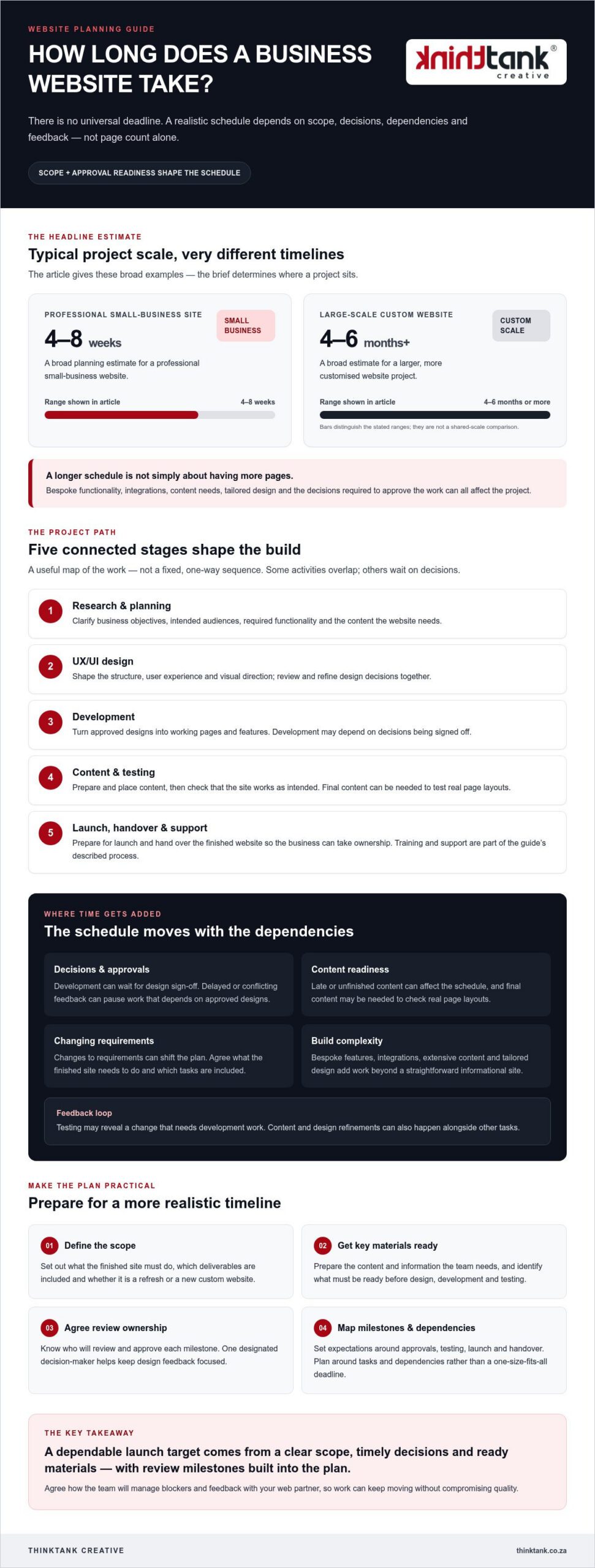
A website timeline depends on decisions, dependencies and feedback, not a universal deadline. If you’re asking how long does it take to build a business website, a professional small-business site may take around 4-8 weeks, while a large-scale custom website can take 4-6 months or more. The difference comes down to more than the number of pages.

It’s understandable to want a clear launch date before work begins. Planning is harder when you’re unsure what needs to happen before design and development, or whether late content and changing requirements could push the schedule back. In practice, timing depends on the project’s scope, how quickly decisions are made and whether key materials are ready when needed.

This guide explains the stages that shape a business website timeline, where the main dependencies sit and what your team can prepare to help prevent avoidable delays. You’ll see how research and planning, design, development, testing and launch fit together, so you can set a realistic schedule with your web partner and keep work moving without compromising quality.

Key Takeaways

  • To answer “how long does it take to build a business website”, clarify the scope, decisions and deliverables that will shape the project plan.
  • Understand how research, design, development, testing and handover connect, and why phases may overlap or need another review.
  • Identify potential blockers, from unfinished content to changing requirements, and agree how your team will manage them.
  • Build a practical timeline around milestones, dependencies and clear review ownership rather than relying on a one-size-fits-all deadline.
  • See how ThinkTank Creative’s collaborative process can guide a website from planning through launch, training and support.

How long does it take to build a business website? Start with the scope

There’s no reliable universal duration for a business website project without understanding its scope and how decisions will be made. A focused informational site has different demands from a custom build with bespoke functionality, integrations or extensive content. To answer “how long does it take to build a business website”, first define what the finished site needs to do and which tasks are included.

Building a website means more than putting pages online. It can include research and planning, UX/UI design, content preparation, coding, testing, launch and handover. Scope and approval readiness shape a website schedule. The more specific the requirements and timely the feedback, the more confidently the work can progress.

For a broader overview of the web development process, including front-end and back-end work, see Wikipedia’s introduction.

For a practical perspective on project timing, watch this video:

What does “building a business website” include?

A site refresh updates an existing website, perhaps by refining its design, content or structure. A new custom website shapes the experience and builds the pages and functionality around the business’s needs. A more complex project may also involve bespoke features or connections to other systems, which add work that a simple informational site doesn’t require.

These activities are distinct, even when they overlap. Design establishes how visitors navigate and interact with the site; coding turns those designs into working pages and features. Content needs to be prepared and placed, while testing checks that the site works as intended before launch. Launch preparation and handover help the business take ownership of the finished website.

Why a single timeline estimate can be misleading

Page count is only one part of the brief. A handful of pages with tailored functionality may need more coordination than a larger set of straightforward informational pages. Integrations, content requirements and the amount of bespoke design also influence the work involved.

Approvals create dependencies, too. Design decisions may need sign-off before development can proceed, and final content may be needed to test real page layouts. An initial website-builder setup is not necessarily a complete, launch-ready business website. The project still needs appropriate content, review, testing and handover. Define these deliverables and agree who will review them before setting a launch target.

Which website project stages shape the build timeline?

A website project is a connected set of activities, not simply a block of design followed by a block of coding. A website timeline links tasks and approval milestones. Some activities can overlap, while others depend on decisions being made. Understanding those connections helps explain how long does it take to build a business website, and where progress may pause while information or approval is outstanding.

The work often moves from research and strategy into design, development, testing, launch and support. That’s a useful way to map a project, but not every build follows a fixed, one-way path. Testing may reveal a change that needs development work, and content or design refinements can happen alongside other tasks.

From research and strategy to approved design

Early planning establishes direction. The project team clarifies business objectives, intended audiences, required functionality and the content the website needs. These decisions inform the structure and user experience, helping design respond to real priorities rather than assumptions.

Design is collaborative. The agency may present a direction for review, discuss choices such as page layouts and visual treatments, then refine the work based on feedback. Clear priorities and one designated decision-maker help keep this stage focused. If feedback is delayed or conflicting, development work that depends on approved designs may have to wait.

From development and testing to launch

Once the direction is sufficiently clear, developers build the website’s pages and functionality. The team can review progress as the work takes shape, resolving issues and making agreed refinements. Testing then checks that key features work, content displays appropriately and the experience is usable across relevant devices and browsers.

Launch requires preparation, not just a final switch-on. The project team needs to confirm readiness, coordinate the release and arrange delivery and any training the business needs to manage its website. Support can continue after launch, so the relationship doesn’t have to end when the site goes live.

For more detail on planning a tailored project, explore this custom website design and development guide. ThinkTank Creative’s website services include UX/UI design, coding, testing, launch, training and support. If you’re considering a project, you can also learn about website design and development and discuss how its stages could fit your requirements.

What makes a business website take longer, or move faster?

A website schedule is shaped by more than the work itself. Prepared content, timely decisions and a stable brief help a project progress; changing requirements, unresolved approvals or external dependencies can interrupt it. If you’re asking how long does it take to build a business website, consider how these factors affect both the work and the decisions it depends on.

A quick first draft isn’t necessarily a quicker route to a reliable launch. Adding functionality or changing direction can mean revisiting the design, updating code and testing the result again. Speed matters, but it needs to be balanced with a website that works as intended.

Helps work move forward Can slow progress
Clear business goals, audiences and page requirements Unclear priorities or new requirements added during the build
One agreed process for gathering and approving feedback Conflicting comments or delayed sign-off
Copy, images and other content prepared for the project Missing or unfinished materials needed for page layouts
Known functionality and confirmed third-party requirements Integrations or external services that need further investigation

Project inputs that are within your control

Before work begins, document the outcomes the website should support, who it needs to serve, which pages it requires and what visitors should be able to do. For example, note whether a page simply explains a service or needs a form to collect enquiries. Organise copy and images, and confirm who is responsible for anything still outstanding.

Choose a decision-maker and agree how feedback will be gathered, consolidated and approved. This gives the project team a clear route to decisions and reduces the risk of overlapping or contradictory requests. Keep review cycles focused on the agreed brief.

Scope and technical dependencies to clarify early

List required integrations, such as connections to an existing business system or an external service, and clarify what each one needs to do. Confirm who will provide access, information or approvals, and whether the third-party service is ready to use. Check domain and hosting arrangements early, including who manages them and what access the project team will need.

Agree how proposed additions or changes will be assessed before they become part of the active scope. The team can then consider the implications for design, development and testing, and decide whether to incorporate the change or plan it separately. To discuss a project brief with a website design and development partner, explore ThinkTank Creative’s website services.

How Long Does It Take to Build a Business Website? A Clear Project Timeline

How to plan a realistic business website timeline

Build the schedule around what needs to be delivered and what each task depends on. A launch date can help focus a project, but it’s more useful when supported by agreed milestones, clear responsibilities and enough room for review. This approach gives you a practical way to assess how long does it take to build a business website without relying on a one-size-fits-all estimate.

Use this planning sequence with your website partner:

  1. Define the outcomes. Clarify what the website should help the business achieve, who it needs to serve and what visitors should be able to do.
  2. Agree the brief and deliverables. Record the required pages, functionality, content responsibilities and what must be complete for the website to be considered ready to launch.
  3. Map dependencies. Identify which decisions, materials or access are needed before related work can proceed, such as approved design before development or final copy before page checks.
  4. Set milestones and owners. Agree checkpoints for research, design review, development review, testing and launch. Name the contact who will consolidate feedback, and identify who has authority to approve key decisions.
  5. Plan for review and revision. Agree review windows and allow time in the schedule for considered feedback and refinements. The amount needed depends on the project and review process, so discuss it with your partner rather than applying an arbitrary standard buffer.

Keep reviews and launch preparation moving

Maintain a shared record of open decisions, content gaps, technical dependencies and proposed changes to the brief. This makes it easier to see what is holding up dependent tasks and who needs to act next. If feedback conflicts, use the agreed decision-maker and approval route to resolve it before revisions spread across the project.

Include user needs in planning conversations, not just the visual preferences of the team. The website user experience guide can help frame design decisions around how visitors will use the site.

Treat testing and launch checks as milestones, not formalities to squeeze in at the end. Confirm that the agreed functionality works, content is in place and launch responsibilities are clear. A realistic schedule leaves room to address issues identified during testing rather than rushing to meet a date at the expense of readiness.

Discuss your website timeline with ThinkTank Creative and agree milestones around your project’s scope and dependencies.

How ThinkTank Creative guides a website from brief to launch

A clear project brief gives the agency and business a shared starting point. ThinkTank Creative’s website process brings research and strategy together with UX/UI design, coding, testing, launch, training and support. The work is coordinated around the project’s requirements, with discussion and communication helping both sides clarify decisions as the project develops.

This collaborative approach can make responsibilities and open questions easier to manage, but it doesn’t guarantee a shorter schedule. The time needed still depends on the agreed scope, the materials available and how promptly decisions can be made. That’s why a useful discussion about how long does it take to build a business website begins with the work involved, not a promised deadline.

A collaborative process from research to delivery

Research and strategy help establish what the website needs to achieve and who it needs to serve. That direction informs design and production, while client input helps keep decisions aligned with the brief. As the site takes shape, development, revision and testing connect the intended experience with how the website actually works.

Clear communication matters whenever a decision, review or approval affects the next task. Testing helps identify issues to resolve before launch, while launch planning, delivery and training prepare the business to take over the finished website. ThinkTank Creative also provides ongoing service after project completion, so launch isn’t necessarily the end of the relationship.

What to prepare before discussing your website project

You don’t need a complete technical specification to begin a scope discussion. Bring what you know and flag what still needs to be decided. Useful starting materials include:

These details help an agency understand the project’s requirements, identify questions that could affect planning and outline the work needed. They also provide a more grounded basis for discussing an estimated cost, which should reflect the specific scope rather than an assumed standard package.

If you’re considering a new website or a substantial update, bring your objectives, requirements and open questions to ThinkTank Creative’s website design and development team. A scope discussion can help clarify the inputs, decisions and milestones to plan for, without presuming a fixed launch date.

Set your website project up for a confident launch

There’s no dependable one-size-fits-all answer to how long does it take to build a business website. The schedule depends on the scope, the work each stage requires and how quickly reviews and decisions move forward. Define the outcomes, prepare key content and agree milestones with clear owners to give your team and web partner a practical plan.

A realistic timeline makes room for design, development, testing and launch preparation, rather than treating a quick first draft as the finish line. It recognises that revisions and dependencies may affect the path, and that quality checks help establish when a website is ready to go live.

Founded in 2001, ThinkTank Creative provides end-to-end website design and development, including testing, launch, training and support, with ongoing service after project completion. Bring your goals, requirements and questions to a project discussion, then work together to clarify the scope and an estimated cost.

Discuss your website project with ThinkTank Creative and take the next step towards a considered, well-planned launch.

Frequently Asked Questions

How long does it take to build a business website?

There’s no universal duration. The schedule depends on the website’s scope, functionality, content readiness, review process and technical dependencies. A clearly defined informational site differs from a custom build with complex requirements. To understand how long does it take to build a business website for your organisation, ask the provider to map deliverables, dependencies and approval points into a schedule tailored to your brief.

What is the longest stage when building a business website?

No single stage takes the longest in every project. Strategy, design, development, content preparation, client reviews or testing may need more attention, depending on the requirements. Ask your website team to identify critical dependencies and explain what must be ready before each activity can proceed. For example, the team may need approved designs before building certain pages, or final content to check how it fits.

Can I speed up the process of building a business website?

You can help the work move smoothly, although no preparation guarantees a particular launch date. Agree the scope, gather copy and brand materials, appoint decision-makers and provide consolidated feedback through an agreed review process. Discuss how changes will be assessed and how testing fits into the schedule. Functionality and external dependencies can still affect progress, so plan these with your provider rather than assuming preparation removes every possible delay.

What can delay a business website project?

Changing requirements, incomplete content, slow approvals and unclear responsibilities can interrupt dependent work. Integrations or other technical requirements may also need further investigation, while testing can uncover issues that need attention before launch. Ask the project team to record open decisions and dependencies, and agree how changes to scope will affect milestones. Addressing questions collaboratively helps everyone understand what is holding up progress and what needs to happen next.

Does website content need to be ready before design starts?

Not always, but the team needs to understand what content the website must support. Final copy and images can influence page structure, design choices and development, so missing materials may affect later work. Agree which content is required, who will provide it and when it needs approval. Then ask your provider which design tasks can begin before everything is final, so early work can progress without relying on assumptions.

What happens after a business website is built?

Depending on the agreed scope, delivery may include testing, launch preparation, handover, training and support. Confirm who is responsible for final checks, what training is included and what support arrangements apply after delivery. ThinkTank Creative offers website maintenance and support, as well as ongoing service after project completion. Discuss the specific requirements for your website with the provider, since launch does not automatically define what happens next.

How should I choose a website agency based on its timeline?

Choose a provider that explains the work behind its proposed schedule, asks about your goals and dependencies, and clarifies who will review and approve decisions. Ask how design, development, testing and launch fit together, and how changes will be handled. A credible timeline should reflect your project’s scope and required deliverables, rather than present a universal deadline. Clear answers help you judge whether the plan is practical for your team.

Website Launch Marketing Plan: The Ultimate 2026 Checklist for South African Businesses

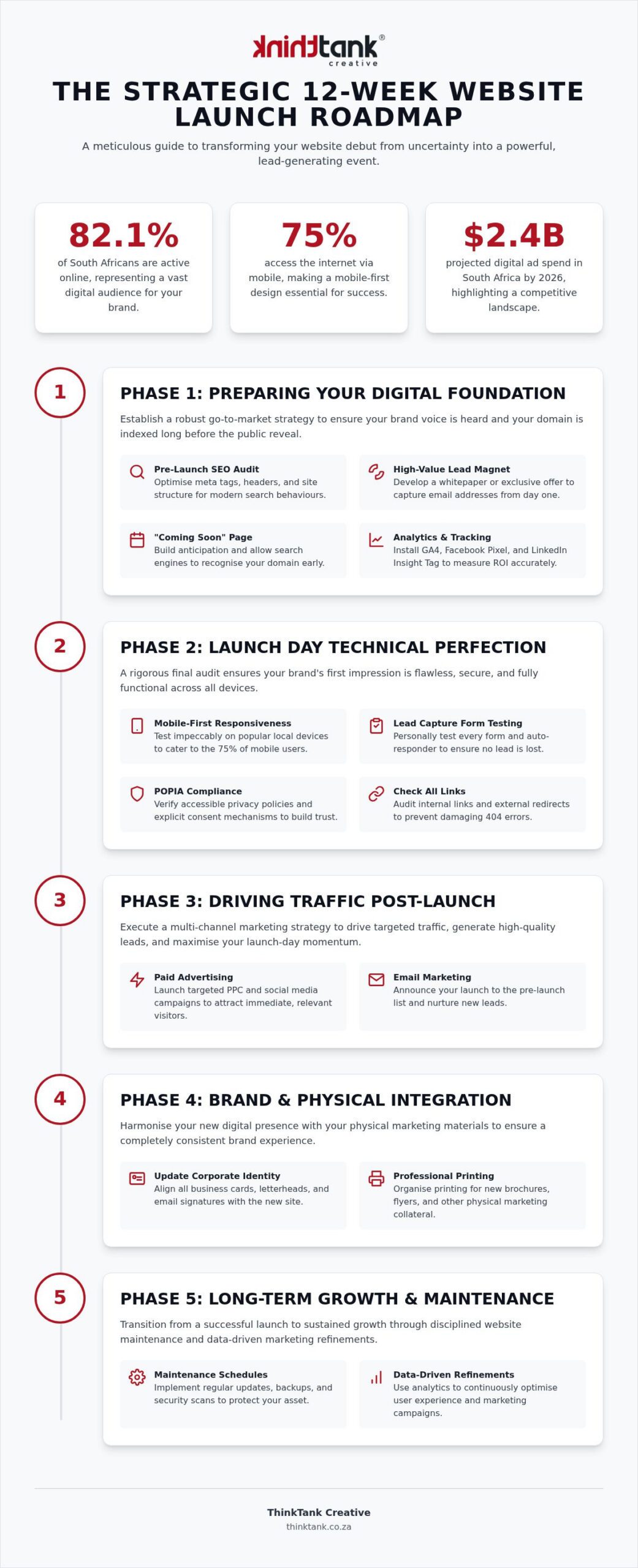
Did you know that as of May 2026, 82.1% of South Africans are active online, yet many local brands still debut their digital presence to nothing but silence? It's a common anxiety to fear that your significant investment will result in "launching to crickets" or that technical bugs will mar your brand's first impression. You've likely spent months perfecting your vision; the thought of fragmented social media messaging or a lack of immediate leads is genuinely daunting. At ThinkTank Creative, we believe a successful debut requires more than just pushing a button.

This guide provides the clarity you need to transform that uncertainty into a strategic advantage by using a meticulous website launch marketing plan. We'll walk you through a clear, 12-week roadmap that integrates our proven 5-stage development process to ensure your brand identity remains consistent across every channel. Whilst every project is unique and a tailored cost estimate is provided after our initial discussion, this checklist ensures you're equipped to handle POPIA compliance and AI-driven search trends. By the end of this article, you'll possess a bespoke strategy to drive growth and convert South African leads the moment your site goes live.

Key Takeaways

  • Secure your digital foundation by conducting pre-launch SEO audits and developing lead magnets that capture high-value enquiries from the moment you go live.
  • Execute a seamless debut with a strategic website launch marketing plan that spans twelve weeks of preparation, execution, and post-launch optimisation.
  • Eliminate technical anxiety with a rigorous launch day checklist, focusing on mobile-first responsiveness and fully functional lead-capture forms.
  • Harmonise your digital and physical presence by updating corporate identity materials and organising professional printing for a consistent brand experience.
  • Transition from a successful launch to long-term growth through disciplined maintenance schedules and data-driven marketing refinements.

Phase 1: Preparing Your Digital Foundation Before the Reveal

Precision is the hallmark of a successful debut. A robust website launch marketing plan begins long before the public reveal, acting as the strategic bridge between technical development and commercial success. By establishing a solid go-to-market strategy, you ensure that your domain starts indexing early and your brand voice is heard above the noise. This phase is about setting the stage for growth, ensuring that when the curtain rises, every technical and creative element is poised for high-performance engagement.

Start by conducting a meticulous pre-launch SEO audit to ensure meta tags, header hierarchies, and site structures are optimised for modern search behaviours. Simultaneously, develop a high-value lead magnet, such as an industry whitepaper or exclusive discount, to capture email addresses from your very first visitor. A "Coming Soon" landing page is vital; it builds anticipation amongst your audience and allows search engines to recognise your domain whilst your full site is under construction. With South African digital ad spend projected to reach US$2.40 billion in 2026, you must organise your marketing budget to include initial PPC and social media spend as part of your broader website launch marketing plan. Whilst every project varies, we provide a detailed estimated cost after a thorough discussion of your specific requirements.

To better understand the synergy between development and marketing, watch this helpful video:

The 5-Stage Development Alignment

Our 5-stage development process creates a seamless transition from concept to conversion. During Research & Strategy, we uncover the deep insights that inform your launch marketing, ensuring your messaging resonates with South African audiences. The Design & Production stage prioritises conversion-ready elements and bespoke aesthetics that turn casual visitors into loyal leads. Finally, the Program and Development phases support the exceptional loading speeds and mobile-first architecture essential for 2026 SEO rankings. We do it all so you don't have to, providing a meticulously crafted foundation for your digital brand.

Setting Up Analytics and Tracking

Data is the fuel for strategic decision-making and brand elevation. Install Google Analytics 4 and configure specific conversion goals to track user journeys from the very first click. It's essential to verify that the Facebook Pixel and LinkedIn Insight Tag are firing correctly to enable precise retargeting and audience segmentation. Tracking every interaction is the only way to measure your return on investment with absolute certainty.

Phase 2: The Launch Day Checklist for Technical Perfection

Launch day is the culmination of your creative journey, but it's also the moment where technical precision matters most. Your website launch marketing plan must include a rigorous final audit to ensure that your brand's first impression is flawless. With over 75% of South Africans accessing the internet via mobile devices, your site's mobile-first responsiveness isn't just a feature; it's a prerequisite for commercial survival. Test your site across a range of popular local devices to ensure the layout remains impeccable and functional for every user, regardless of their screen size.

Don't leave your lead generation to chance. Test every contact form and auto-responder personally to confirm that no potential client is lost in a technical void. In the 2026 regulatory environment, the Information Regulator has intensified compliance monitoring, making POPIA alignment mandatory for every data collection point. Verify that your privacy policy is accessible and that your consent mechanisms are explicit. Beyond POPIA, ensure your PAIA manual for website South Africa is correctly published and accessible, as the Information Regulator's increased scrutiny extends to this often-overlooked legal requirement. This level of detail prevents legal friction and builds immediate trust with your audience. Before you flip the switch, check all internal links and external redirects to prevent frustrating 404 errors that could damage your SEO equity.

Technical Stability and Speed

Security and performance are the pillars of digital authority. Ensure your SSL certificate is active to provide a secure HTTPS connection, which remains a fundamental ranking signal for search engines. Page load speeds should be measured against South African server benchmarks; aim for a median mobile speed that exceeds the national average of 66.15 Mbps to keep your visitors engaged. High bounce rates often stem from easily avoidable errors, so consult our guide on 7 Web Design Mistakes to Avoid to ensure your debut is technically sound. If you'd prefer a partner to manage these complexities, our website maintenance and support services provide the ongoing peace of mind you need.

The "Big Bang" Social Media Debut

A coordinated multi-channel announcement creates the "Big Bang" effect your brand deserves. Focus your efforts on LinkedIn, Facebook, and Instagram, using short-form video posts to showcase the new site's unique functionality and aesthetic. Video content continues to dominate social algorithms in 2026, making it the most effective medium for capturing attention quickly. Encourage your entire team to share the launch amongst their professional networks to amplify your organic reach and foster a sense of collective success. This synergy between technical perfection and social momentum ensures your website launch marketing plan delivers the impact your brand transformation requires.

Phase 3: Driving Traffic and Generating Leads Post-Launch

Momentum defines the success of your new digital presence. Whilst the initial launch creates a spark, a sustained website launch marketing plan ensures that spark becomes a steady flame of high-quality leads. You shouldn't wait for search engines to discover you naturally. Instead, take a proactive stance by initiating a targeted PPC campaign to drive immediate traffic to your most critical service pages. This immediate influx of visitors allows you to monitor user behaviour through heatmaps, identifying potential friction points before they impact your conversion rates.

Don't overlook the goldmine within your existing database. Launch an automated email marketing sequence to announce your new features, inviting loyal clients to experience your brand's transformation firsthand. This direct line of communication, combined with a consistent SEO content schedule, builds both immediate engagement and long-term organic authority. By providing valuable insights from day one, you position your brand as a dependable industry leader that understands the evolving needs of the South African market.

Strategic PPC and Paid Advertising

Google Ads serves as the essential bridge whilst your organic SEO matures, providing visibility for high-intent keywords that South African service-based businesses rely on. With the local digital ad market projected to reach US$2.40 billion in 2026, competition is fierce; precision in your targeting is non-negotiable. For a deeper dive into these methodologies, explore our Lead Generation Strategies for South African Businesses. We provide an estimated cost for managing these bespoke campaigns after a collaborative discussion about your specific growth targets.

Content Marketing and Social Growth

Plan a 90-day content calendar that addresses the specific pain points your clients face daily. This structured approach ensures your social media marketing remains purposeful and aligned with your new site's objectives. Utilise active community management to engage with users who comment on your launch posts, fostering a sense of partnership and trust. Social proof, such as client testimonials and case studies, acts as the final persuasive push that converts a curious visitor into a committed lead. It's this synergy between paid visibility and organic credibility that drives sustainable growth.

Website Launch Marketing Plan: The Ultimate 2026 Checklist for South African Businesses

Phase 4: Brand Continuity and Physical Marketing Integration

True brand transformation extends far beyond the confines of a browser window. Whilst your digital presence is the engine of modern growth, your physical touchpoints act as the tangible anchors of your professional reputation. A comprehensive website launch marketing plan must harmonise these two worlds to ensure a seamless experience for your clients. This phase focuses on the meticulous alignment of your offline collateral with your new digital identity, preventing the brand fragmentation that often dilutes market impact.

Begin by auditing all existing physical assets to reflect your updated URL and visual language. Organise professional printing for new business cards, letterheads, and "leave-behind" materials that mirror the sophistication of your new site. Distributing these promotional materials to your key clients serves a dual purpose; it celebrates your evolution whilst providing a physical reminder of your renewed commitment to excellence. This synergy between digital and print channels reinforces your authority as a cohesive, forward-thinking enterprise.

Logo and Corporate Identity Alignment

A website launch provides the ideal catalyst for a strategic brand refresh. If your visual identity feels dated, it will undermine the modern functionality of a 2026-standard website. High-quality logo and corporate identity design ensures that your brand remains legible and impactful across every medium, from a smartphone screen to a printed banner. The tactile quality of premium printing solutions shouldn't be underestimated; it communicates a level of meticulousness that digital pixels alone cannot replicate. For businesses seeking a partner capable of managing this complex synergy, understanding how to choose a web design agency in South Africa is the first step toward achieving a unified brand vision.

The Power of Print in a Digital World

Physical materials remain a potent tool for driving high-intent traffic to your new digital home. Printed company profiles and brochures can be transformed into interactive gateways by incorporating QR codes that lead directly to specific landing pages. This is particularly effective in B2B service-based sales, where "leave-behind" materials provide a lasting impression after a face-to-face meeting. These physical cues guide potential leads back to your website launch marketing plan's primary conversion points, bridging the gap between a handshake and a digital enquiry. By integrating these channels, you create a robust ecosystem that supports lead generation at every possible touchpoint.

Ready to elevate your brand's physical presence alongside your new digital home? Explore our bespoke printing solutions and let us bring your corporate identity to life with precision and excellence.

Phase 5: Long-Term Growth and Maintenance Strategy

Evolution is the engine of digital longevity. A sophisticated website launch marketing plan is a living strategy that requires consistent refinement to remain effective in the competitive South African market. We view the launch not as a final destination, but as the beginning of a collaborative journey toward market leadership. To maintain the momentum generated during your debut, you must transition from initial excitement to disciplined, data-driven growth. This ensures your brand remains a relevant and authoritative voice in an ever-shifting digital environment.

Success in the long term depends on your ability to adapt. Establish a monthly maintenance schedule to keep the site secure, functional, and aligned with the latest browser standards. Review your analytics reports every thirty days to refine your marketing strategy based on actual user behaviour rather than assumptions. By implementing ongoing SEO optimisations, you can protect and improve your search rankings as algorithms evolve. We recommend scheduling regular feedback sessions with your agency to discuss "Fine-Tuning" and "Revision" phases, ensuring your platform grows alongside your business objectives. Whilst every growth path is unique, a bespoke estimated cost for these ongoing services is provided after a detailed discussion of your specific goals.

Ongoing Website Maintenance and Support

The "set and forget" mentality is perhaps the most dangerous strategy a business can adopt after a successful debut. In 2026, the digital space is too volatile for static assets; security updates and plugin management are essential to prevent vulnerabilities and performance degradation. As part of our 5-stage development process, ThinkTank Creative provides dedicated ongoing service to ensure your platform remains elite in its execution. This meticulous care protects your corporate identity and ensures that the user experience stays as polished as it was on launch day. Meticulous maintenance is the hallmark of a brand that values its reputation and its customers' security.

Measuring Success and ROI

Precision in measurement leads to excellence in outcomes. Identify the key performance indicators that matter most for your first six months, such as lead conversion rates, organic traffic growth, and the median time spent on key service pages. Adjust your marketing plan based on actual user conversion data to eliminate friction and amplify what truly resonates with your audience. This methodical approach allows you to pivot with confidence, turning raw data into a strategic roadmap for expansion. Ultimately, we believe that exceptional marketing makes the customer look smart by solving their problems with effortless precision. By positioning yourself as a dependable partner through consistent performance, you secure not just a sale, but a lasting professional relationship.

Elevate Your Brand with a Strategic Digital Debut

A successful digital transformation requires moving beyond the "launch and leave" mentality. By integrating technical precision with a robust website launch marketing plan, you ensure your brand resonates with South African audiences from the very first click. Our award-winning design team, established in 2001, has refined a 5-stage development process that bridges the gap between creative vision and commercial performance. Whether you're aligning your corporate identity across print and digital or navigating the complexities of 2026 search trends, a meticulous approach is your greatest asset.

You don't have to manage this complex transition alone. As South Africa's premier all-rounder agency, we're deeply invested in your journey from the initial research phase to long-term maintenance and support. Whilst every project is unique, an estimated cost is provided after a collaborative discussion about your specific needs. Partner with ThinkTank Creative for a seamless website launch and strategic growth. Get your estimated cost today. We're ready to help you turn your digital presence into a powerful engine for sustainable growth and brand elevation.

Frequently Asked Questions

How long should a website launch marketing plan take to execute?

A comprehensive website launch marketing plan typically requires a twelve-week lead time to ensure strategic alignment across all channels. This duration allows for our meticulous 5-stage development process, moving from initial research and strategy through to testing and the final reveal. By starting three months in advance, you can build anticipation amongst your audience whilst ensuring every technical element is polished. This timeline provides the necessary space for SEO auditing and setting up tracking before the public launch.

What is the most important thing to do on the day my website goes live?

The most critical action on launch day is performing a final, live verification of all lead-capture mechanisms and technical functions. You must personally test every contact form, auto-responder, and checkout process to ensure no potential enquiry is lost. Simultaneously, check your site's mobile responsiveness on various devices popular in South Africa. Ensuring a flawless user experience from the first minute prevents brand friction and establishes immediate trust with your new visitors.

How do I ensure my new website is compliant with the POPI Act?

Ensuring POPIA compliance involves implementing explicit consent mechanisms and a transparent privacy policy at every data collection point. You must clearly state why you're collecting personal information and how it will be protected, especially since the Information Regulator has intensified enforcement in 2026. Verify that your cookie banners and email signup forms are updated to meet current legal standards. It's also essential to publish a compliant PAIA manual for your website in South Africa, as this is a distinct legal obligation that operates alongside POPIA and is increasingly scrutinised by regulators. It's essential to have a documented process for handling data subject rights to avoid significant penalties.

Should I run Google Ads immediately after my website launch?

Initiating a targeted PPC campaign immediately after launch is highly recommended to bridge the visibility gap whilst your organic SEO matures. Google Ads provides instant visibility on search engine results pages, allowing you to capture leads from day one. This proactive approach also generates valuable data on user behaviour, which helps us refine your broader website launch marketing plan. By targeting specific high-intent keywords, you ensure your brand is seen by the right audience immediately.

How often should I update the content on my new website?

You should aim to update your website content at least once a month to maintain search engine relevance and user engagement. Regular updates, such as blog posts or case studies, signal to search engines that your site is active and authoritative. This consistent content creation is a core part of our ongoing maintenance and support services. Fresh content addresses evolving client pain points whilst improving your long-term organic rankings in a competitive national landscape.

What is the difference between a website launch and a website redesign marketing plan?

A website launch focuses on establishing a brand's first digital foundation, whilst a redesign marketing plan prioritises the seamless transition of existing traffic and SEO equity. For a new launch, the emphasis is on building buzz from zero and indexing a new domain. In contrast, a redesign requires careful management of redirects and communicating new features to an established database. Both strategies utilise our 5-stage methodology to ensure consistent corporate identity across all digital touchpoints.

How much does a professional website launch marketing plan cost in South Africa?

The investment for a professional website launch marketing plan varies based on the complexity of your requirements and business size. At ThinkTank Creative, we provide a tailored estimated cost after a collaborative discussion about your specific goals and timeline. This ensures you receive a bespoke solution that aligns with your growth objectives. Whether you're a small enterprise or a large organisation, we offer comprehensive packages that cover everything from SEO to high-quality printing solutions.