7 Web Design Mistakes to Avoid: South African Guide

With nearly 73% of South Africa's web traffic originating from mobile devices, your digital storefront is being judged on a screen that fits in the palm of a hand. It's disheartening to watch business growth stall due to common website design mistakes to avoid, especially when you've poured your expertise into crafting world-class services. You might be struggling with high bounce rates or finding it difficult to organise complex offerings into a layout that feels intuitive rather than overwhelming for your visitors.

We believe your online presence should be a bespoke masterpiece that functions as a high-performing lead generation engine. In this guide, we'll identify the critical pitfalls currently hindering local brands and provide a clear, strategic roadmap to transform your site into an authoritative digital asset. By moving beyond templated thinking, you'll discover how to elevate your user experience, improve search engine rankings, and build the deep trust your clients deserve. We'll explore the essential shifts needed to turn your website from a static page into a dynamic partner in your professional success.

Key Takeaways

  • Adopt a mobile-first strategy to engage the 73% of South African users who primarily access the web via smartphones.
  • Master the art of visual hierarchy to guide potential clients effortlessly toward your most valuable service offerings.
  • Identify and resolve the common website design mistakes to avoid that compromise your site's loading speed and search engine visibility.
  • Strengthen digital trust by integrating clear calls to action and ensuring your platform meets the latest local legal compliance standards.
  • Transition from rigid templates to a bespoke, 5-stage strategic framework designed for long-term business scalability and brand growth.

Overlooking Mobile-First Functionality and Navigation Flow

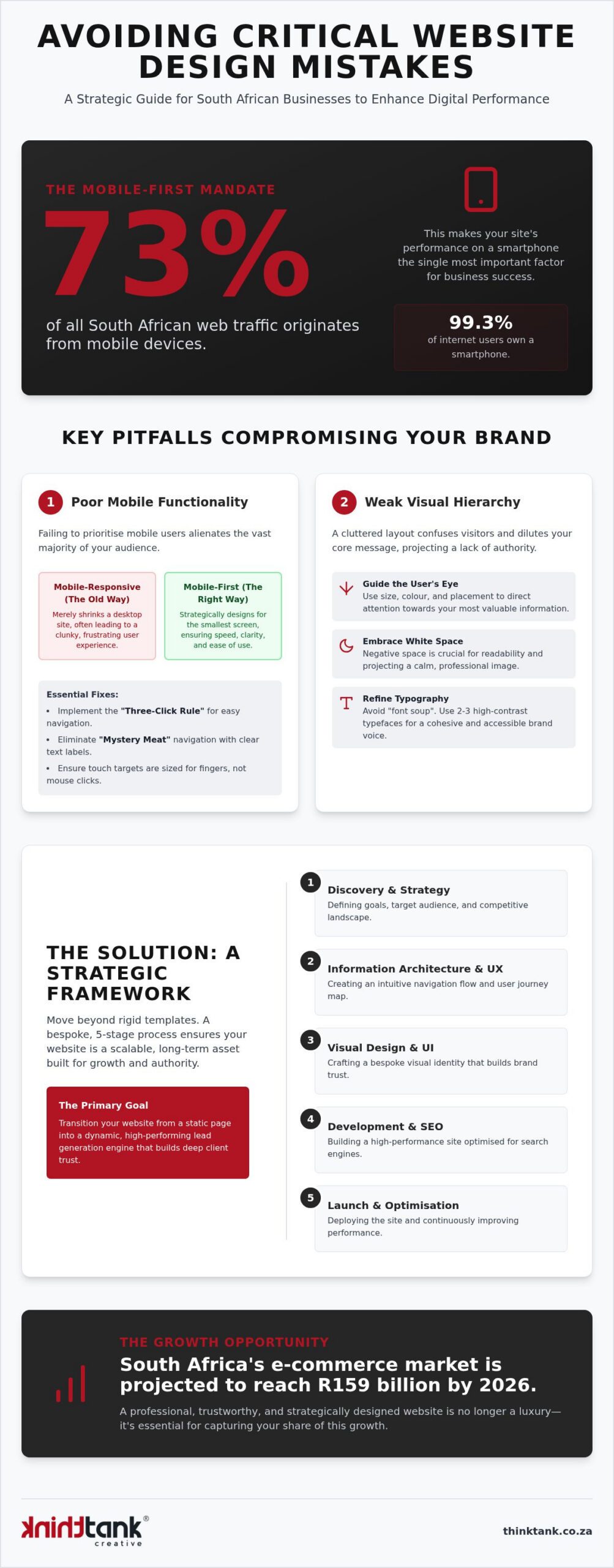
South African digital landscapes are uniquely mobile-centric. With 72.7% of all web traffic in the country originating from mobile devices, your site's performance on a smartphone is the single most important factor for business survival. Neglecting this reality is one of the most common website design mistakes to avoid if you intend to capture a market where 99.3% of internet users are smartphone owners. A desktop-first mindset creates friction; it alienates users who expect immediate, intuitive interactions whilst they're on the move.

Success begins with a robust Information Architecture. Think of this as the strategic blueprint that maps out how a visitor moves from initial curiosity to a final enquiry. When navigation feels clunky or illogical, it triggers a psychological disconnect, causing users to abandon the site in favour of a competitor who offers a smoother journey. Building trust requires a seamless flow that respects the user's time and intent.

To better understand how these design choices impact your brand, watch this helpful video:

The Pitfalls of Complex Navigation Menus

Service-based businesses often fall into the trap of over-complicating their menus. One frequent error is "mystery meat" navigation, where minimalist icons are used without text labels, leaving users guessing where a link might lead. We advocate for the "three-click rule": a visitor should be able to find any piece of critical information within three taps. By organising content for specific audience segments, you ensure that every visitor finds what they need without unnecessary cognitive load.

Mobile-First vs. Mobile-Responsive

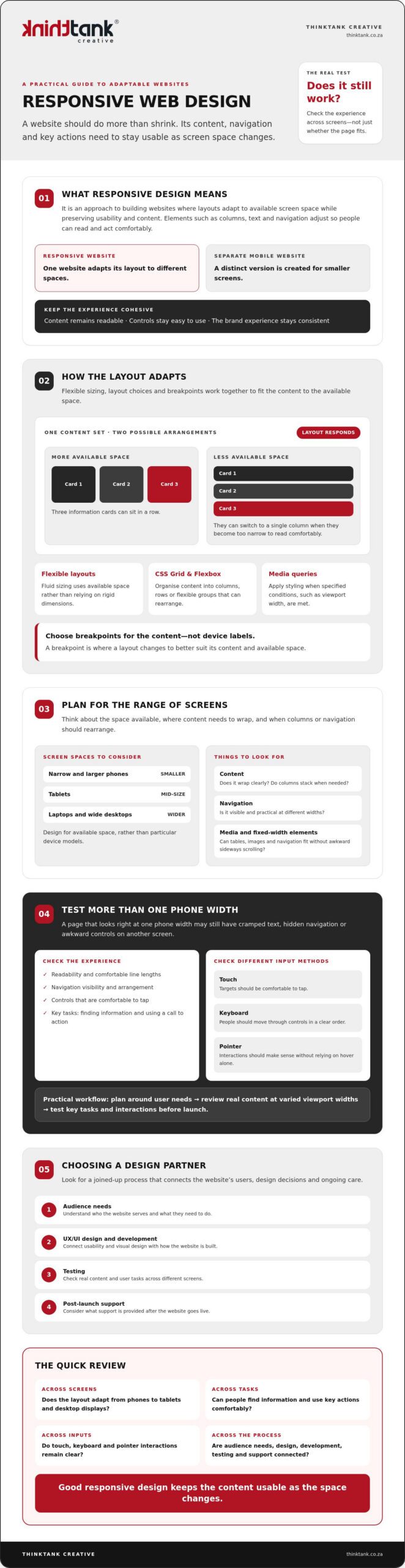
Whilst "responsive" design merely shrinks a desktop layout to fit a smaller screen, mobile-first design is a strategic prioritisation of core content for the most common user device. This methodology forces us to identify what truly matters to your client. It ensures that touch targets, such as buttons and links, are appropriately sized for human fingers rather than precision mouse clicks. By designing for the smallest screen first, we eliminate the clutter that often plagues traditional sites, creating a refined experience that prioritises speed and clarity.

Compromising Visual Clarity with Poor Hierarchy and Imagery

Visual clarity serves as the bridge between a visitor's initial curiosity and their eventual trust in your brand. It's not merely about "looking good"; it's about the strategic arrangement of elements to guide a potential client through your professional story. One of the most common website design mistakes to avoid is treating every piece of content with equal importance. When everything shouts for attention, nothing gets heard. By utilising size, colour, and placement, we establish a visual hierarchy that directs the eye toward your primary value proposition and most critical business information.

We often encounter businesses that view white space as "wasted" real estate, yet negative space is an active and essential design element. It provides the breathing room necessary for your message to resonate. A cluttered layout increases cognitive load, making it difficult for users to organise your service offerings in their minds. Conversely, a clean, well-spaced design projects a sense of calm authority and meticulous craftsmanship. It suggests that your business is organised, dependable, and focused on quality.

The Impact of Typography and Readability

Effective communication relies heavily on how your text is presented across various devices. Avoiding the "font soup" mistake is vital; we recommend limiting your selection to two or three typefaces to maintain a cohesive brand voice. High contrast is equally important for accessibility, ensuring your content remains readable even for mobile users in bright, outdoor South African conditions. Your choice of typography influences the perceived personality of your brand, moving from the traditional stability of a serif to the modern, fluid energy of a sans-serif font.

Using Authentic Visuals to Build Trust

Generic stock imagery often dilutes brand authenticity, making a professional enterprise feel like a templated afterthought. In a maturing e-commerce market projected to reach R159 billion by 2026, standing out requires a unique visual signature. Custom graphics and professional photography demonstrate a level of investment that generic visuals simply cannot match. For national brands, a custom logo and corporate identity design are non-negotiable components of a high-performing digital presence. For deeper bespoke branding insights, you can explore our guide on custom website design south africa.

Establishing this level of visual consistency creates a sense of reliability that mirrors the stability of a long-standing enterprise. If you're looking to refine your brand's aesthetic, our creative design experts can help you move from a generic online presence to a tailored digital experience that truly reflects your excellence.

Prioritising Aesthetics Over Technical Performance and SEO

A visually striking website is a source of pride for any business owner, yet its value vanishes if it remains hidden from your target audience. We often see brands fall into the trap of over-designing, where heavy scripts and high-resolution assets create a significant barrier to entry. This is a critical oversight amongst common website design mistakes to avoid, as it directly impacts your search engine visibility and user retention. Technical performance is the foundation upon which all creative design must sit.

Google's March 2026 Core Update introduced holistic Core Web Vitals scoring, which now aggregates performance metrics into a composite score. If your site suffers from the "Speed Gap" caused by unoptimised animations or bulky code, you risk being penalised in the rankings. In a market where 72.7% of traffic is mobile, even a three-second delay can lead to an immediate loss of potential leads. We focus on balancing sophisticated aesthetics with the lean, efficient code required to satisfy modern search algorithms.

Designing for Search Engine Optimisation

Structure is as vital as style. We use H1-H6 tags to define a clear content hierarchy that search engines can easily crawl and index, rather than using them merely for font styling. A frequent error involves using "images-as-text" or hidden content, which renders your site's value invisible to Google's bots. Building a strong internal linking strategy is equally important for establishing topical authority and guiding users through your service ecosystem. For a comprehensive look at these technical requirements, you can read our strategic guide on search engine optimisation south africa.

Optimising for Local Connectivity Challenges

South African internet users often face connectivity fluctuations or high data costs. We prioritise data efficiency by utilising modern image formats like WebP and advanced compression techniques to maintain visual quality without the heavy file size. By implementing robust caching and Content Delivery Networks (CDNs), we ensure your digital presence is delivered with consistent speed across the country. This methodical approach ensures your site remains accessible to all users, regardless of their connection type or location, whilst maintaining the polished professional image your brand deserves.

7 Web Design Mistakes to Avoid: South African Guide

Your digital presence acts as your most tireless sales representative. Yet, many businesses struggle with the "Invisible Call to Action", where visitors browse but never actually engage. This often stems from a lack of clarity in the user's primary journey. If a visitor cannot understand your value proposition within five seconds of landing, you've likely lost a potential lead. Great marketing isn't about making your company look smart; it's about making your customer look smart by providing immediate, elegant solutions to their specific challenges.

Compliance is another critical area where oversight leads to severe consequences. As of September 2026, the Information Regulator has increased enforcement of the Protection of Personal Information Act (POPIA) and the Promotion of Access to Information Act (PAIA). With recent fines of R5 million imposed for non-compliance, private enterprises must be equally vigilant. Neglecting these legal frameworks is one of the most common website design mistakes to avoid, as it erodes client trust and invites significant regulatory scrutiny. We believe that transparency in data handling is a cornerstone of professional credibility. Ensuring your site includes a fully compliant PAIA manual for website South Africa is an essential step in meeting these obligations and protecting your business from regulatory risk.

Strategic Placement of Calls to Action (CTAs)

Effective conversion relies on both visual prominence and persuasive language. We utilise contrasting colours to ensure buttons stand out against the page background, instinctively guiding the user's eye toward the next step. It's essential to understand the distinction between "hard" conversions, like a direct enquiry, and "soft" conversions, such as signing up for an industry newsletter. Balancing these options allows you to nurture leads at different stages of the buying cycle. To refine your conversion funnel, explore our lead generation strategies for south african businesses.

Trust Signals and Compliance

Building digital trust requires meticulous attention to detail. Every site should include essential security features like SSL certificates, clear privacy policies, and transparent cookie consents. These technical trust signals are reinforced by social proof, such as verified testimonials and detailed case studies that validate your expertise. Ensure your contact details are prominent and easily accessible; users feel more secure when they know exactly how to reach a human being. This transparency is vital for establishing a long-term professional partnership.

If you're unsure whether your current platform meets these rigorous standards, our team can provide a comprehensive website maintenance and support audit to ensure you remain compliant and competitive.

Executing Without a Strategic Design and Development Framework

Designing a digital platform without a rigorous strategy is akin to constructing a complex architectural marvel without a blueprint. One of the most common website design mistakes to avoid is "designing in a vacuum", where aesthetics are chosen based on personal preference rather than data-driven user behaviour. Whilst DIY templates might seem like a cost-effective entry point, they frequently fail to scale as your business requirements evolve. These templated solutions often result in a fragmented user experience that lacks the synergy and precision of a bespoke digital asset.

We believe that excellence is achieved through a disciplined, 5-stage development process. This structured methodology, comprising Planning, Design, Program, Development, and Revise, ensures that every creative choice is grounded in strategic reasoning. By positioning ourselves as an all-rounder partner that does it all so you don't have to, we allow you to focus on your core operations whilst we handle the technical precision of your digital transformation. This end-to-end approach moves your project from a high-level concept to a concrete, high-performing reality.

The Importance of Research and Strategy

Successful design begins long before the first pixel is placed. We immerse ourselves in understanding your target audience, identifying their specific pain points and motivations to prevent design errors before they even manifest. This collaborative phase involves challenging ideas through healthy debate, which often leads to the most innovative creative solutions for your brand. Final delivery is never the end; it's preceded by a meticulous phase of testing and fine-tuning to ensure the platform performs flawlessly under real-world conditions.

Ongoing Support and Maintenance

The "launch and leave" mentality is a significant risk to the functional longevity of any site. Digital environments are fluid, requiring regular maintenance to ensure security remains robust and features continue to operate as intended. A well-considered website launch marketing plan ensures your debut is strategic, consistent, and positioned to generate immediate leads rather than launching to silence. We provide comprehensive website maintenance and support to protect your investment and ensure your platform remains a high-performing lead generation engine. Because every project possesses unique complexities and bespoke requirements, we provide an estimated cost after discussing your individual project needs during our initial consultation.

Elevate Your Digital Future

Your website is more than a digital brochure; it's the engine of your brand's growth in a competitive South African market. Identifying and resolving the common website design mistakes to avoid ensures your platform functions as a high-performing lead generation engine rather than a static page. Prioritising a seamless mobile journey and strict POPIA compliance aren't just technical requirements; they're essential steps in building the lasting trust your audience deserves.

Transforming your online presence requires a partner who understands the synergy between bespoke artistry and technical precision. Since 2001, ThinkTank Creative has empowered brands through our award-winning in-house creative team and a meticulous 5-stage development process. We're ready to help you move beyond generic templates toward a tailored solution that reflects your professional excellence. Partner with ThinkTank Creative for a strategic website redesign and let's build a digital platform that truly drives your business forward. The potential for your brand's transformation is immense, and we're here to help you capture it.

Frequently Asked Questions

What are the most common website design mistakes for small businesses?

Small businesses often overlook mobile-first functionality and fail to define a clear call to action. These common website design mistakes to avoid can lead to high bounce rates and lost revenue. Many enterprises also rely on generic stock imagery that dilutes their brand authenticity. By focusing on a structured hierarchy and custom visuals, you ensure your site represents your professional standards whilst guiding visitors toward a meaningful conversion.

How does poor website design affect my SEO rankings in South Africa?

Search engines prioritised user experience significantly in 2026, especially regarding Core Web Vitals and mobile performance. Since over 72% of South African web traffic is mobile, a site that loads slowly or lacks a responsive layout will be penalised in rankings. Poor technical structure, such as improper heading tags or unoptimised images, makes it difficult for search bots to crawl your content, ultimately pushing your business off the first page.

Is a DIY website builder a mistake for a growing company?

DIY builders often lack the scalability required as business requirements evolve. Whilst they offer a low entry barrier, they frequently result in "designing in a vacuum" without a robust research and strategy phase. A growing company benefits more from a bespoke 5-stage development process that ensures the platform is secure, functional, and tailored to specific audience needs. Investing in custom development prevents the technical debt and limitations inherent in templated solutions.

How can I tell if my website navigation is too complicated?

High bounce rates and low time-on-page metrics are primary indicators that your navigation is confusing. You should apply the "three-click rule", ensuring any critical information is accessible within three taps. If your menu relies on "mystery meat" icons without labels or lacks a logical hierarchy, visitors will likely feel overwhelmed. Testing your site with real users can reveal friction points where they struggle to organise your complex service offerings.

What legal requirements must a South African website follow in 2026?

Every South African website must strictly adhere to the Protection of Personal Information Act (POPIA) and the Promotion of Access to Information Act (PAIA). As of September 2026, the Information Regulator has significantly increased enforcement, with fines reaching R5 million for non-compliant entities. Your site must include a transparent privacy policy, clear cookie consents, and secure data handling protocols to protect user privacy whilst ensuring your business remains legally compliant and trustworthy. Understanding the full requirements of a PAIA manual for website South Africa is a critical component of meeting these 2026 standards.

How often should I redesign my website to avoid design decay?

Most professional websites require a significant refresh or redesign every two to three years to keep pace with evolving technology and design trends. However, consistent website maintenance and support can extend this lifecycle by ensuring your platform remains secure and functionally modern. Design decay occurs when a site feels dated or fails to support new business goals. Regular audits help you identify when a strategic overhaul is necessary to maintain your competitive edge.

Does website speed really impact my conversion rates?

Speed is a critical driver of conversion; even a one-second delay can lead to a measurable drop in enquiries. In South Africa, where many users face connectivity fluctuations, an unoptimised site that consumes excessive data will be abandoned quickly. Ensuring fast loading times through caching and efficient coding is essential for retaining mobile users. Technical performance serves as the vital foundation that allows your creative design to actually convert visitors into loyal clients.

What is the difference between good marketing and great marketing in web design?

We believe good marketing makes the company look smart, but great marketing makes the customer look smart. Good design might focus on flashy aesthetics, whilst great design prioritises the user's journey by solving their problems with elegance and ease. By removing friction and providing clear solutions, you empower your visitors. This customer-centric approach transforms a simple website into a high-performing lead generation engine that fosters long-term professional relationships.

Improving Website User Experience: 2026 Strategic Guide

A website that merely functions is no longer a competitive advantage; it's the bare minimum for survival in an increasingly sophisticated digital economy. You might see healthy traffic numbers in your analytics, yet feel the frustration of high bounce rates as visitors slip away whilst searching for clarity. Understanding how to improve website user experience is the defining factor that separates an overlooked brand from a market leader. It's a delicate balance between bold creative vision and the technical precision required to keep a visitor engaged across every device they own.

We believe your digital presence should be a seamless extension of your professional identity, not a source of friction or developer jargon. This strategic guide provides a clear roadmap for your next optimisation project, detailing how to harmonise imaginative design with meticulous functionality. You will discover the actionable steps needed to elevate your brand and appreciate the significant ROI that follows a well-executed UX investment. By following our proven methodology, you can transform your website into a polished, high-performing asset that resonates with your audience and drives consistent conversions.

Key Takeaways

  • Distinguish between the aesthetic layers of UI and the strategic depth of UX to ensure your digital presence serves a clear business purpose.
  • Master how to improve website user experience by adopting a mobile-first mindset and optimising performance for the unique connectivity landscape of South Africa.
  • Utilise sophisticated visual storytelling techniques, such as the purposeful application of white space and consistent corporate identity, to enhance brand authority.
  • Establish a methodical audit framework using analytics and usability testing to identify and resolve the specific friction points that hinder your conversion rates.
  • Understand the value of a collaborative 5-stage development journey that moves seamlessly from initial planning through to rigorous testing and delivery.

Understanding User Experience: Why UX is the Engine of Business Growth

User experience is the invisible architecture that supports every successful digital transaction. It represents the strategic alignment between your customer's deepest needs and your core business objectives. Whilst many view it as a mere technical requirement, we see it as a journey of imagination where precision meets creativity. Understanding how to improve website user experience begins by recognising that UX isn't just a feature; it's the very engine of your brand's growth and long-term sustainability.

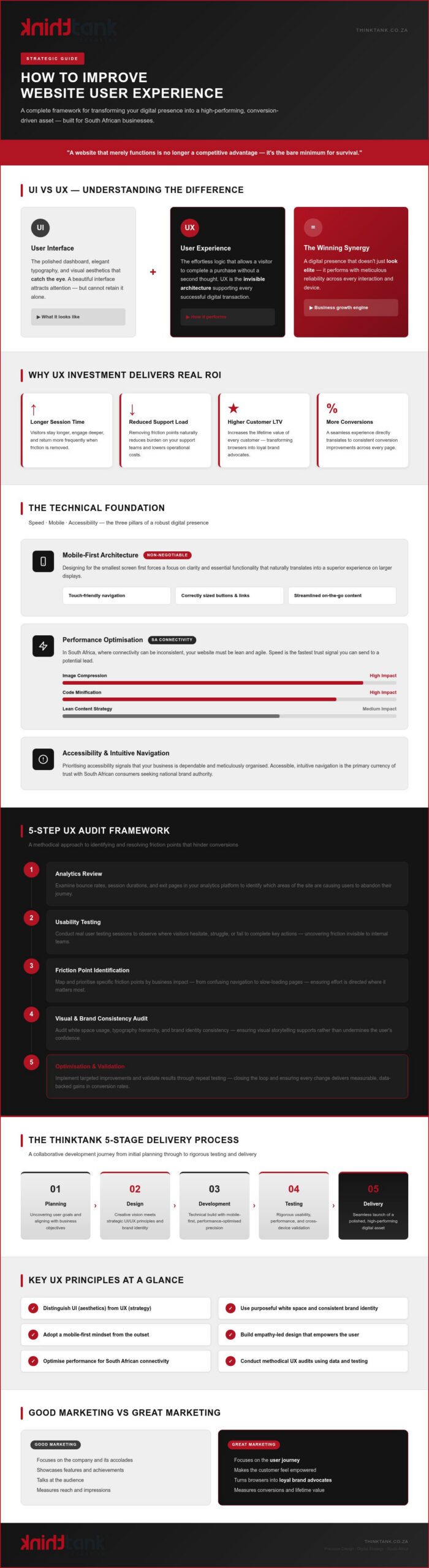
To gain clarity, one must distinguish between User Interface (UI) and User Experience (UX). If UI is the polished dashboard and elegant typography that catches the eye, UX is the effortless logic that allows a visitor to complete a purchase without a second thought. A beautiful interface might attract attention, but only a superior experience retains it. This synergy ensures that your digital presence doesn't just look elite; it performs with meticulous reliability across every interaction.

Investing in UX yields a tangible return that extends far beyond aesthetics. By removing friction points, you naturally reduce the burden on your support teams and increase the lifetime value of every customer. When a website is easy to use, visitors stay longer, engage deeper, and return more frequently. It's a calculated business strategy that transforms your site from a static brochure into a high-performing asset.

The Distinction Between Good and Great Marketing

Good marketing focuses on the company and its accolades; great marketing focuses on the user journey and makes the customer feel empowered. Our approach transforms your digital presence into a space where visitors feel understood and capable. This empathy-led design is what turns a casual browser into a loyal brand advocate. We prioritise a collaborative process that uncovers your users' true goals, ensuring every click feels like a step toward their own success rather than a hurdle to overcome.

UX as a Competitive Advantage in the South African Market

A polished digital presence is no longer optional for those seeking national brand authority amongst South African consumers. Trust is the primary currency of the web, and a seamless experience is the fastest way to earn it. By prioritising accessibility and intuitive navigation, you signal that your business is dependable and meticulously organised. For those looking to lead their industry, integrating these principles with custom website design South Africa provides the strategic context needed to dominate the local landscape and build lasting professional relationships.

Optimising the Technical Foundation: Speed, Mobile, and Accessibility

A flawless user experience is built upon a robust technical foundation. You cannot inspire confidence with a website that falters on a smartphone or takes an eternity to load over a standard mobile connection. When considering how to improve website user experience, you must begin with the mechanics that ensure your site is accessible to every South African, regardless of their device or data speed. This technical rigour provides the stability your brand needs to project an image of effortless professionalism and reliability.

The Mobile-First Architecture

Designing for the smallest screen first is a non-negotiable strategy for the modern digital landscape. By prioritising the mobile interface, you force a focus on clarity and essential functionality that naturally translates into a better experience on larger displays. Navigation must be touch-friendly, with buttons and links sized meticulously to avoid user frustration. Streamlining your content for on-the-go consumption ensures that your message remains impactful, even when viewed during a quick commute or a busy workday.

Performance Optimisation for National Reach

Speed is a critical component of trust. In a country where connectivity can be inconsistent, your website must be lean and agile to serve users effectively. Simple actions like image compression and the minification of code can have a profound impact on loading times, preventing potential leads from bouncing before your content even appears. These technical refinements are also deeply intertwined with your broader search engine optimisation South Africa strategy, as search engines increasingly penalise sluggish performance. Lighthouse scores are an automated metric provided by Google that assess your site's performance, accessibility, and best practices to ensure a high-quality digital experience in 2026. Maintaining these standards requires a commitment to excellence that often benefits from professional website maintenance and support.

Accessibility is the final, vital pillar of your technical foundation. Implementing inclusive design standards ensures your brand reaches a diverse audience, including those with visual or motor impairments. By utilising high-contrast colours, screen-reader-friendly layouts, and keyboard navigation, you demonstrate a level of corporate maturity that resonates with all users. This commitment to inclusivity doesn't just expand your reach; it solidifies your reputation as a forward-thinking industry leader that values every individual's journey.

Visual Storytelling and Brand Consistency

Visual appeal is the first handshake your brand offers a potential client. It acts as the emotional bridge between technical functionality and user engagement, transforming a cold digital interface into a space of professional resonance. When exploring how to improve website user experience, you must treat your visual assets as a unified language that speaks to your brand's authority and meticulous attention to detail. A site that looks fragmented or inconsistent suggests a lack of care, whilst a cohesive visual narrative projects stability and excellence.

Applying a consistent corporate identity across every page is fundamental to building trust. This includes the precise use of logos, specific colour palettes, and typography that reflects your brand's unique personality. Beyond these core elements, the strategic use of white space is essential for reducing cognitive load. By giving your content room to breathe, you direct user attention toward your most important messages and prevent the mental fatigue that often leads to high bounce rates. This deliberate organisation ensures that your visitors feel guided rather than overwhelmed.

The Power of Professional Brand Identity

A professional brand identity serves as the foundation of your digital reputation. When a visitor encounters a custom logo and stationery design that feels deliberate and high-quality, they immediately perceive a higher level of competence and reliability. Maintaining this cohesive vibe from your social media advertisements through to your website landing pages ensures a seamless transition for the user. The psychological impact of your chosen colour schemes and typography is profound; these elements subtly influence user behaviour and emotional response before a single word of copy is read. Pairing a strong visual identity with how to write effective website copy ensures that your messaging resonates just as powerfully as your design.

Information Architecture and Navigation

Strategic information architecture organises your content into a logical flow that leads users toward a specific, desired outcome. You can reduce friction significantly by limiting the number of clicks required to reach essential information. Our methodology incorporates specific "Choices" and "Feedback" stages during the design process to refine this navigation, ensuring every interaction feels intuitive and rewarding. Consider the following elements when refining your site's visual hierarchy:

By harmonising these visual components, you create a digital environment that is both beautiful and functional, reinforcing your position as a dependable partner in your client's success.

Improving Website User Experience: 2026 Strategic Guide

How to Conduct a UX Audit: A 5-Step Optimisation Framework

Transformative growth requires an honest assessment of your current digital performance. A UX audit is not merely a checklist of technical glitches; it is a meticulous strategic review designed to align your website with the evolving expectations of your audience. Learning how to improve website user experience is a continuous cycle of observation and refinement that ensures your brand remains relevant and resilient. By following a structured framework, you can move from guesswork to data-driven precision, identifying exactly where your digital presence excels and where it requires elevation.

Analysing User Behaviour

Data doesn't lie. It reveals the quiet frustrations of your visitors through metrics like bounce rates and exit pages. You don't need to be a data scientist to identify "rage clicks", those moments where a user clicks repeatedly on an unresponsive element, or confusing navigation paths that lead to dead ends. Heatmaps provide a vivid visual representation of user interaction, allowing you to see exactly where engagement thrives and where your most valuable content is being ignored. If you are ready to identify the hidden obstacles in your user journey, our team can help you conduct a professional UX audit that aligns with your long-term growth objectives.

Content and Conversion Review

A successful website guides the visitor toward a clear decision. Your calls to action (CTAs) must be noticeable, consistent, and focused entirely on the benefits provided to the user. We often find that removing even a single unnecessary form field can significantly increase lead generation by reducing the cognitive effort required to convert. This process of fine-tuning, based on authentic user feedback, ensures your website remains a polished and effective tool for business development. It's about creating a journey that feels less like a transaction and more like a collaborative success. For businesses seeking to maximise every visitor interaction, exploring lead generation website design South Africa strategies can provide the conversion-focused architecture needed to turn traffic into high-quality enquiries. Complementing this with proven lead generation strategies for South African businesses ensures your optimised UX is supported by a comprehensive framework for attracting and converting high-quality prospects.

The ThinkTank Process: Delivering Excellence Through Partnership

Excellence is never an accident; it's the result of a disciplined, collaborative process that values strategic depth over quick fixes. Achieving a superior digital presence requires more than just knowing how to improve website user experience; it demands a partner capable of executing that vision with surgical precision. We apply the standards of an international web-company to every project, ensuring that your site is as robust as it is beautiful. Our "all-rounder" capability means your branding, development, and marketing strategies are harmonised under one roof, reducing your stress whilst elevating your brand's authority.

Our methodology follows a comprehensive cycle designed to eliminate uncertainty and drive results. This proven path includes several critical phases:

From Imagination to Launch

Our designers prioritise usability and functionality as core tenets of every creative decision. We view the design phase as a collaborative journey of imagination where healthy debate and discussion lead to more refined UX outcomes. By favouring bespoke solutions over restrictive templates, we ensure your website is tailored to your specific business needs. This custom approach allows for greater flexibility and ensures your technical foundation can scale alongside your ambitions without the limitations of pre-packaged software.

Post-Launch Support and Evolution

A website is a living asset that requires constant attention to remain competitive. UX is never truly finished because user behaviour and technological standards are in a state of perpetual evolution. Our dedicated website maintenance and support services ensure your site remains secure, functional, and optimised for peak performance. We handle the technical complexities of your digital presence so you can focus on your core business operations with total confidence. Amplifying your site's authority through proven local link building strategies South Africa businesses rely on is an essential complement to ongoing UX refinement, ensuring your optimised experience is discoverable by the right audience. Embark on a journey of imagination with ThinkTank Creative today.

Elevating Your Brand Through Strategic Design

Mastering the digital landscape requires more than a functional website; it demands a meticulous commitment to the user journey. By harmonising technical performance with evocative visual storytelling, you transform your platform from a simple tool into a powerful engine for business growth. Understanding how to improve website user experience is a continuous process of auditing, refining, and innovating to meet the sophisticated expectations of your audience. Whether you are optimising for mobile-first connectivity or defining a bespoke corporate identity, every detail contributes to a cohesive and authoritative brand presence.

ThinkTank Creative has been a trusted partner in this journey since 2001, providing an elite end-to-end service that covers everything from initial research to ongoing support. Our award-winning in-house design team is ready to help you navigate these complexities with quiet assurance and creative excellence. It's time to move beyond the template and embrace a digital strategy that truly reflects your professional standard. Partner with ThinkTank Creative for a Bespoke UX Strategy and begin your brand's transformation today. We're excited to collaborate on your next milestone.

Frequently Asked Questions

What is the difference between UX and UI design?

UI is the visual interface, encompassing colours, buttons, and typography, whilst UX is the strategic logic governing how a user interacts with those elements. Think of UI as the beautiful finish on a vehicle and UX as the engine and handling that determine the drive's quality. Both must work in synergy to ensure your brand's digital presence is both aesthetically pleasing and meticulously functional for every visitor who engages with your brand.

How long does it typically take to improve a website's user experience?

The timeframe depends on the scope of the project, but initial high-impact optimisations can often be implemented within a few weeks. A comprehensive overhaul following our 5-stage development process typically spans several months to ensure every detail is tested and refined. We prioritise a methodical approach that balances rapid improvements with the strategic depth required for long-term brand transformation and sustainable growth across all digital channels.

Can I improve my website UX without a full redesign?

Yes, you can certainly implement incremental changes that yield significant benefits without a complete overhaul. Small refinements, such as optimising navigation menus, improving page load speeds, or clarifying your calls to action, can immediately enhance how to improve website user experience. These targeted adjustments allow you to resolve specific friction points identified in a UX audit whilst maintaining your existing brand structure and technical foundation.

How does website speed affect user experience and SEO?

Website speed is a fundamental pillar of both user satisfaction and search engine rankings. A sluggish site frustrates visitors, leading to higher bounce rates and lost conversions, whilst search engines like Google penalise slow-loading pages in their results. By prioritising performance through image compression and efficient coding, you create a seamless experience that encourages longer engagement and signals to search engines that your site is a high-quality resource.

What are the most common UX mistakes South African businesses make?

Many local businesses fail to account for the mobile-first reality of the South African market and the varying connectivity speeds across the country. Another frequent error is ignoring how to improve website user experience by using technical jargon that alienates the user. Overly complex forms and a lack of consistent corporate identity across different devices also create friction that prevents visitors from trusting a brand or completing a transaction.

Is mobile-first design really necessary for my B2B business?

Mobile-first design is absolutely essential for B2B enterprises because professional decision-makers increasingly research partners on their smartphones during transit or between meetings. If your site is difficult to navigate on a small screen, you risk appearing out of touch and unreliable. A responsive, mobile-optimised interface ensures your brand projects a consistent image of excellence, regardless of the device your potential partners choose to use.

How do I measure if my UX improvements are actually working?

You can measure success by monitoring key performance indicators such as conversion rates, average session duration, and bounce rates in your analytics. Qualitative feedback from usability testing and a reduction in customer support enquiries also provide clear evidence of a smoother user journey. These metrics allow you to see the tangible ROI of your UX investment and guide your future efforts for continuous digital evolution.

What is the estimated cost for a professional UX audit and redesign?

We provide an estimated cost only after discussing your specific business needs and the complexity of your current digital presence. Every project is unique, requiring a bespoke strategy that aligns with your brand's goals and technical requirements. By focusing on tailored solutions rather than templated packages, we ensure that your investment is directed toward the high-impact areas that will drive the most significant growth for your business.