What if the reason your website remains invisible isn't a lack of quality content, but a fundamental breakdown in your digital plumbing? It's a common frustration for many entrepreneurs who find their beautiful pages ignored by search engines whilst competitors with less flair seem to climb the rankings. You've likely felt the sting of a wasted investment, where sophisticated copy and bespoke designs fail to move the needle because the underlying architecture is flawed. This is where a technical seo checklist for small business becomes your most vital strategic asset, ensuring that Google and AI agents can actually find, trust, and surface your brand.
We understand that the technicalities of modern search can feel overwhelming, but you don't need a massive team to achieve elite results. This guide will help you ground your site for the AI-driven search landscape of 2026, focusing on the precision of Core Web Vitals and the synergy of structured data. We'll explore how to refine your site's performance and security, ensuring your online behaviour aligns with the latest standards for excellence. We Do It All So You Don't Have To, allowing you to focus on your vision whilst we handle the complexity of the digital infrastructure.
Launch day often brings a sense of relief, but it's usually followed by a confusing silence. Many entrepreneurs believe the myth that once a site is live, Google automatically finds and ranks it. Search engines aren't psychic; they require a structured roadmap and explicit permission to explore your pages. Visibility is earned through technical precision, not just existence. Understanding the foundations of Search Engine Optimization (SEO) reveals that visibility is a deliberate outcome of strategic configuration rather than a lucky accident.
To better understand this concept, watch this helpful video:
A quick reality check involves the "site:yourdomain.co.za" test. By typing this into a search bar, you'll see exactly which pages Google has committed to its memory. If the results are sparse or non-existent, your business is effectively invisible. In 2026, the most common hurdle for small enterprises is the "crawled - currently not indexed" status. This indicates that while Google's bots have visited your site, they haven't deemed the technical health or content structure worthy of being served to users. Implementing a robust technical seo checklist for small business starts with verifying this indexation status to ensure your foundations are secure.
Your journey toward visibility requires the right diagnostic tools. Setting up Google Search Console provides the only honest view into your search performance, offering direct feedback from the algorithm itself. You must submit a clean XML sitemap to ensure every service page is discovered and prioritised. Additionally, audit your Robots.txt file. A single accidental "disallow" rule can hide your entire site from the world, turning your digital investment into a ghost ship. At ThinkTank Creative, We Do It All So You Don't Have To, ensuring these technical gatekeepers are always working in your favour.
When a site fails to appear, the culprit is often found in the code. A common oversight is the presence of "noindex" tags, often left over from the development staging site by mistake. Security issues or manual actions can also lead to sudden de-indexing, requiring a professional eye to resolve. Duplicate content caused by multiple URL versions, such as the conflict between www and non-www addresses, confuses search bots and dilutes your authority. Addressing these overlaps is a critical step in any technical seo checklist for small business, as it ensures search engines see one clear, authoritative version of your brand.
Aesthetic appeal often masks structural decay. Whilst a visually stunning menu might impress your visitors, it offers little value to a search engine if the underlying hierarchy is convoluted or illogical. Search engines don't see the colours or the sleek animations; they follow link equity to determine which pages are important. If a page isn't linked properly within your site's framework, it effectively doesn't exist to the bots that decide your ranking. As noted in foundational guides regarding SEO for Small Business, your site structure is the skeleton that supports all your other marketing efforts.
Adopting a flat site architecture is a strategic move that allows smaller brands to compete with national players. We recommend the "Three-Click Rule," which ensures every critical service or product page is reachable within three clicks from the home page. When your architecture is deep and buried, link authority dissipates before it reaches your high-value content. By keeping your structure shallow, you ensure that search engines can crawl your site efficiently and index your most important offerings without getting lost in a digital labyrinth. Including this structural audit in your technical seo checklist for small business ensures your site remains accessible and authoritative.
Precision in your hierarchy helps both users and bots understand the relationship between your pages. Breadcrumbs act as an essential orientation tool, providing a clear path back to the home page whilst signalling page depth to search engines. You must also identify and fix "orphan pages," which are those isolated sections of your site with no internal links pointing to them. These pages are invisible to crawlers and provide zero SEO value. Additionally, ensure your URL slugs are descriptive and clean. A slug like /services/website-design-development/ provides immediate context, whereas a generic string of numbers offers no strategic benefit. If you're unsure where your site structure stands, our team can help you organise your digital presence for maximum impact.
Internal linking is the mechanism that distributes authority across your domain. Use keyword-rich anchor text to link from your high-traffic blog posts to your core service pillars, building topical authority as you go. This practice tells Google exactly what the target page is about whilst helping visitors discover more of your expertise. Internal link equity serves as the primary currency of your website architecture, distributing authority from your most popular pages to those that drive conversions. By meticulously mapping these connections, you create a web of relevance that is difficult for competitors to ignore. This level of detail is a cornerstone of any comprehensive technical seo checklist for small business, transforming a simple website into a powerful lead-generation tool.
Many small business owners believe that a slightly sluggish website is merely a minor inconvenience for their visitors. This perception is a dangerous myth that can cripple your search presence before you've even begun. Google prioritises user experience above all else, treating site speed as a direct and non-negotiable ranking factor. If your site doesn't load quickly, it doesn't matter how high the quality of your copy is; you'll be penalised and pushed down the rankings. Following a comprehensive technical SEO guide for small business helps you move past the "Content is King" mantra to realise that performance is the actual foundation of your digital authority.
Google's metrics have evolved to measure real-world user behaviour with extreme precision, focusing on how a page feels rather than just how it loads. The Largest Contentful Paint (LCP) requires your main content to appear in under 2.5 seconds, whilst current 2026 standards suggest a target of 2.0 seconds for those aiming for elite status. Interaction to Next Paint (INP) measures the delay of every user interaction, ensuring your site reacts instantly to a click or a tap. Finally, Cumulative Layout Shift (CLS) prevents the annoying "jumping" of content as images load. These aren't just abstract numbers; they're the technical benchmarks that stop Google from ignoring your hard-earned traffic.
In our national context, performance is not just about pleasing an algorithm; it's about accessibility and resilience. Our digital landscape is defined by high mobile data costs and the persistent challenge of load shedding, which can impact server uptime and connection stability. A lightweight, efficient site performs better for users on limited data plans or those trying to access your services between power cuts. Choosing a server location with national proximity is a strategic decision that reduces latency and ensures your site remains responsive when your customers need it most. This focus on the end-user is a vital component of any technical seo checklist for small business.
Modern image optimisation is another pillar of a successful strategy. Moving beyond outdated JPEGs to next-gen formats like WebP can reduce file sizes by up to 30% without sacrificing visual quality, which is essential for a mobile-first world. However, technical performance isn't a one-time fix. It requires high-quality website maintenance and support to ensure your plugins remain updated and your code stays clean. We handle these intricate details with a sense of quiet assurance, ensuring your brand remains fast, responsive, and ready for growth in any environment.
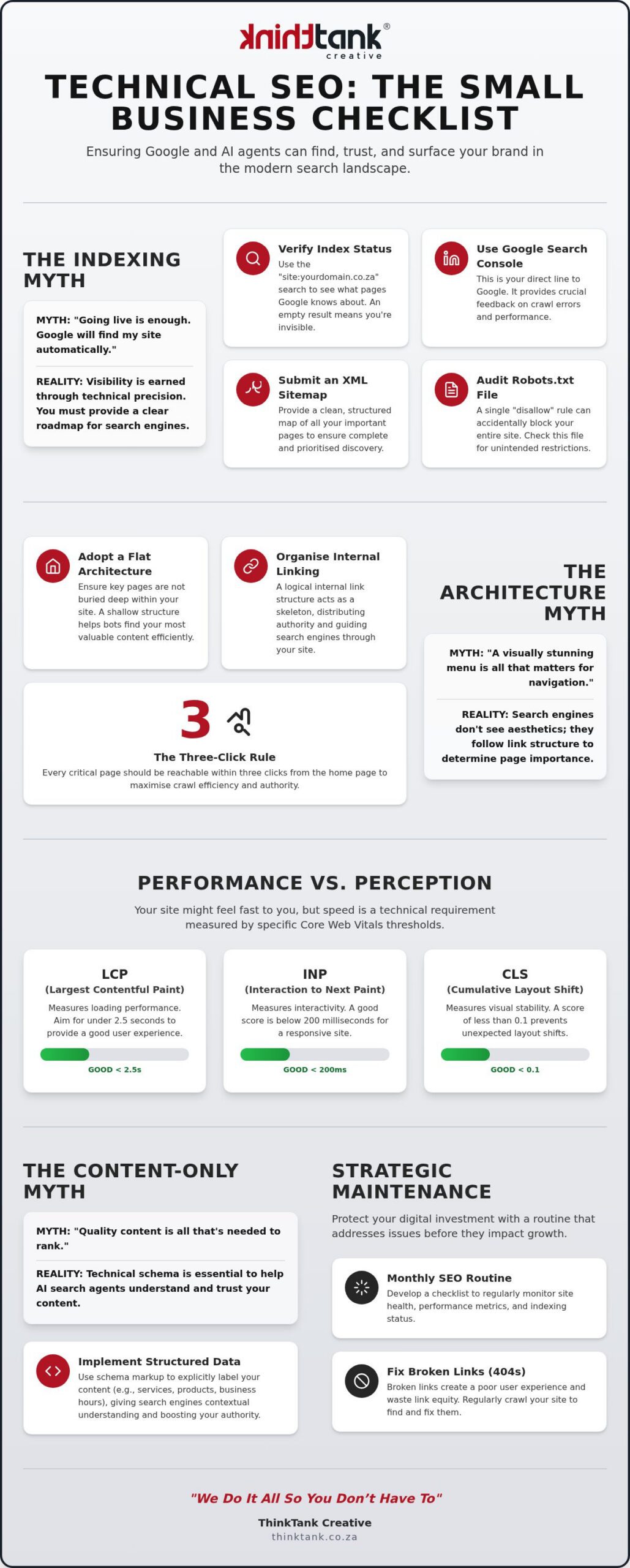
Many business owners believe that high-quality prose is the final frontier of search visibility. Whilst compelling copy engages human readers, AI agents like ChatGPT and Google Gemini require a different kind of clarity to function effectively. These systems rely on structured data to ground their responses in verifiable facts, ensuring that the information they provide is accurate and sourced from reliable domains. If your site lacks this technical layer, even your most insightful articles may remain invisible to the generative engines that define the search landscape of 2026.
Technical SEO has evolved from simply ranking in a list to becoming the cited source in an AI-generated answer. Small businesses can win this race by being the most readable and reliable source of truth within their specific niche. By following a robust technical seo checklist for small business, you provide the structural clarity these machines crave, moving your brand from the shadows into the spotlight of modern search. This approach transforms your website from a static brochure into a dynamic data source that search engines can trust and surface with confidence. Understanding what makes a good business website in 2026 means recognising that technical precision and content quality must work together as a unified strategy.
Precision in your structured data allows you to claim digital space that competitors often overlook. Organisation Schema is the first step, defining your brand identity, logo, and national contact details for search engines. Service Schema goes further, telling the algorithm exactly what you sell and who your target audience is. Whilst Google retired visual FAQ rich results in May 2026, implementing FAQ Schema remains a vital strategy; it helps AI systems understand the depth of your expertise and can still capture valuable real estate in "People Also Ask" sections. Including these elements in your technical seo checklist for small business ensures your brand is not just indexed, but deeply understood.
The transition toward generative engine optimisation requires a meticulous approach to your site's underlying code. AI crawlers prefer clean HTML that allows them to parse text without getting stuck in bloated scripts or outdated tags. Security also plays a vital role in this new era, as HTTPS and valid SSL certificates serve as essential trust signals for AI grounding. Schema acts as the translator between your bespoke business language and complex machine logic, ensuring your data is surfaced accurately across all platforms. To ensure your site is ready for this evolution, partner with our SEO experts to build a future-proof foundation that handles the complexity whilst you focus on your growth.
Achieving a high ranking is a significant milestone, but maintaining that position requires constant vigilance and precision. There's a common misconception that SEO is a project with a definitive finish line, yet the reality of the digital space is far more fluid. Technical decay is an inevitable byproduct of a growing site; broken links, bloated plugins, and outdated code accumulate naturally as your business evolves. By adopting a proactive mindset, you protect your digital assets from the slow erosion of performance that often leads to a sudden loss in visibility. Investing in a consistent routine is always more cost-effective than an emergency SEO rescue after your traffic has already plummeted.
A disciplined technical seo checklist for small business transforms maintenance from a chore into a strategic advantage. This routine allows you to catch minor issues before they escalate into systemic failures that alienate both users and search engines. We recommend a methodical approach to your monthly health checks:
Factoring in these recurring tasks prevents the accumulation of technical debt, ensuring your website remains a stable platform for your marketing efforts.
Whilst routine checks are manageable, certain digital bottlenecks require the intervention of a seasoned partner. Complex issues such as redirect loops, server-side performance drags, or database optimisations can be difficult to diagnose without specialised tools and deep technical expertise. If your rankings have plateaued despite producing high-quality content, it's often a sign that deeper architectural issues are hindering your progress.
At ThinkTank Creative, we provide a meticulous end-to-end process that spans from initial research to launch and comprehensive ongoing support. We believe in building long-term relationships where we handle the intricate plumbing of your digital presence whilst you focus on your core vision. We Do It All So You Don't Have To, ensuring your brand remains elite, dependable, and perfectly positioned for the AI-driven search landscape of 2026. By combining our award-winning design with technical excellence, we help you turn search invisibility into a thing of the past.
Securing a prominent position in the digital landscape requires more than just high-quality content; it demands a foundation built on technical excellence and structural integrity. By implementing a robust technical seo checklist for small business, you ensure that your architecture is logical, your performance is optimised for Core Web Vitals, and your data is perfectly translated for AI agents. This strategic approach transforms your website from a quiet digital brochure into a powerful, visible asset that search engines can trust and surface with confidence. It's about moving beyond simple visibility to achieve a state of digital authority that lasts.
As a top all-rounder agency in South Africa since 2001, ThinkTank Creative brings over 25 years of experience to every project. Our award-winning design and development team is dedicated to handling the complex digital plumbing that keeps your brand moving forward. We provide bespoke solutions where estimated costs are provided after a detailed discussion of your unique needs. We Do It All So You Don't Have To, allowing you to focus on your vision whilst we secure your growth. Partner with ThinkTank Creative for a comprehensive SEO strategy and begin your journey toward lasting search visibility today.
Your site may not be showing up because search engines haven't crawled your pages or have been blocked by technical barriers. This often happens if you haven't submitted an XML sitemap or if a "noindex" tag was accidentally left in the code from the development stage. Google needs a clear roadmap to find you. Without these essential signals, your professional website remains invisible to the very customers you're trying to reach.
Technical SEO changes usually take between a few days and several weeks to reflect in search results. The timeline depends entirely on how often Google crawls your specific domain. Whilst smaller sites might see a slower response, larger sites with high authority are indexed more frequently. You can accelerate this process by manually requesting indexation through Google Search Console after you've implemented critical fixes to your site's infrastructure.
You absolutely need a technical seo checklist for small business even when using closed platforms like Wix or Shopify. Whilst these systems handle basic hosting and server security, they don't automatically organise your site hierarchy or implement bespoke schema markup. You're still responsible for managing URL structures, internal linking, and image optimisation. Relying solely on a platform's default settings often leads to a generic, underperforming presence that fails to compete.
On-page SEO focuses on the visible content and keywords your visitors read, whilst technical SEO handles the invisible infrastructure that search engines crawl. Think of on-page SEO as the beautiful interior design of a house and technical SEO as the essential plumbing and foundations. Both must work in synergy to achieve success. If your foundations are cracked, even the most compelling copy won't be enough to secure a top ranking.
A sluggish website can definitely prevent your business from appearing in top search results. Google prioritises user experience, and their Core Web Vitals update directly penalises sites that fail to load quickly on mobile devices. If your page takes too long to respond, visitors will bounce back to the search results, signalling to the algorithm that your site is not a high-quality destination for national users on limited data plans.
Technical SEO is not a one-time investment but an ongoing commitment to your site's health. Digital infrastructure naturally decays as plugins update, links break, and search algorithms evolve. Regular maintenance prevents these minor issues from turning into major ranking drops. At ThinkTank Creative, we provide continuous support to ensure your site remains fast and secure, protecting your long-term marketing investment from the risks of technical obsolescence.
The POPI Act impacts technical SEO by making website security and data privacy essential trust signals. Implementing SSL certificates and secure data handling isn't just a legal requirement; it's a technical necessity that tells search engines your site is safe for South African users. Google's algorithms increasingly prioritise secure domains, meaning that a failure to comply with privacy standards can indirectly damage your search visibility and brand reputation.
Schema markup is a specific vocabulary of code that helps search engines and AI agents understand the context of your content. By using this structured data, you provide a clear "translator" for machine logic, allowing AI systems to ground their answers in your business facts. This is vital for appearing in AI-driven search results, as it ensures your services and contact details are surfaced accurately across the modern digital landscape. To build a truly high-performance platform, it helps to first understand what makes a good business website at a foundational level, combining technical rigour with strategic design.


