Brand consistency builds trust and recognition

Recognition grows when every customer touchpoint feels part of the same story. Brand consistency for businesses means presenting a recognisable identity and message across channels while adapting details to each context. That includes visual elements, tone of voice and the experience people have when interacting with a business.

Consistency matters because a familiar logo or voice can help customers recognise a brand, but it must also feel relevant wherever they encounter it. Repetition without flexibility can feel rigid; variation without a clear foundation can cause confusion.

This article explains what brand consistency involves and how it can support trust, recognition, customer loyalty, revenue and more effective marketing. It also covers how brand guidelines, organised assets and thoughtful adaptation help create a coherent identity across a business’s communications.

Key Takeaways

  • Align your visual identity, messaging, tone and customer experience so each interaction feels recognisably part of the same brand.
  • Make brand guidelines and approved assets easy for everyone working on your marketing to find and use.
  • Adapt your communications to each channel without losing the identity customers recognise and trust.
  • Review your website, social media and marketing materials to spot inconsistencies that could weaken recognition or confuse customers.
  • Explore how coordinated website design, social media marketing and creative design can bring your brand identity to life.

What is brand consistency?

Brand consistency means presenting a recognisable identity across visual design, messaging, tone and customer experience. A South African business might express the same values through its website, social posts, printed materials and customer interactions.

A brand identity beyond visual elements

A brand identity is the combined impression created by visual elements, messaging, tone, values and customer experience. A logo and colour palette help people recognise a business, but its words and the way it treats customers shape that recognition too. For example, a business promising clear, practical advice should communicate plainly and make its service experience equally straightforward.

Build consistency by connecting each customer-facing element to the same principles. A brand guide can set out logo use, colours, typography, tone of voice and key messages, then show how to apply them to a website or social media post. This gives staff and collaborators a shared reference instead of leaving each person to interpret the identity independently.

Consider the full customer journey. A prospective customer may first see a social media post, visit the website, then speak with a staff member. If the post is warm and helpful, but the website is formal and the conversation feels dismissive, those experiences tell different stories. Consistent behaviour across touchpoints makes the brand promise more credible and can support customer loyalty.

Relevance within a core identity

Relevance within a core identity means adapting how a brand communicates without changing the values and character people recognise. A business can adjust its message for a new audience or platform while keeping its visual identity and central promise intact. This balance matters: an unchanged approach can feel out of step, while constant reinvention can weaken recognition.

For example, a professional services firm might use a concise LinkedIn post to explain an industry update, then offer fuller context on its website. The formats differ, but the same visual style, voice and commitment to useful guidance can connect them. In South Africa, a campaign may also need to reflect local language and audience context without losing the business’s distinctive character.

Use brand values as the decision point when reviewing a new design, campaign or channel. Ask whether the change expresses the same promise in a way that suits its audience. A refreshed layout may improve readability, while familiar typography, colours and wording preserve recognition. This lets a brand evolve with purpose rather than follow every passing trend.

For brand consistency for businesses, the goal isn’t identical content everywhere. It’s a clear identity people can recognise across a website, social media, print and customer interactions, even as each message suits its setting.

Centralising brand assets with digital asset management

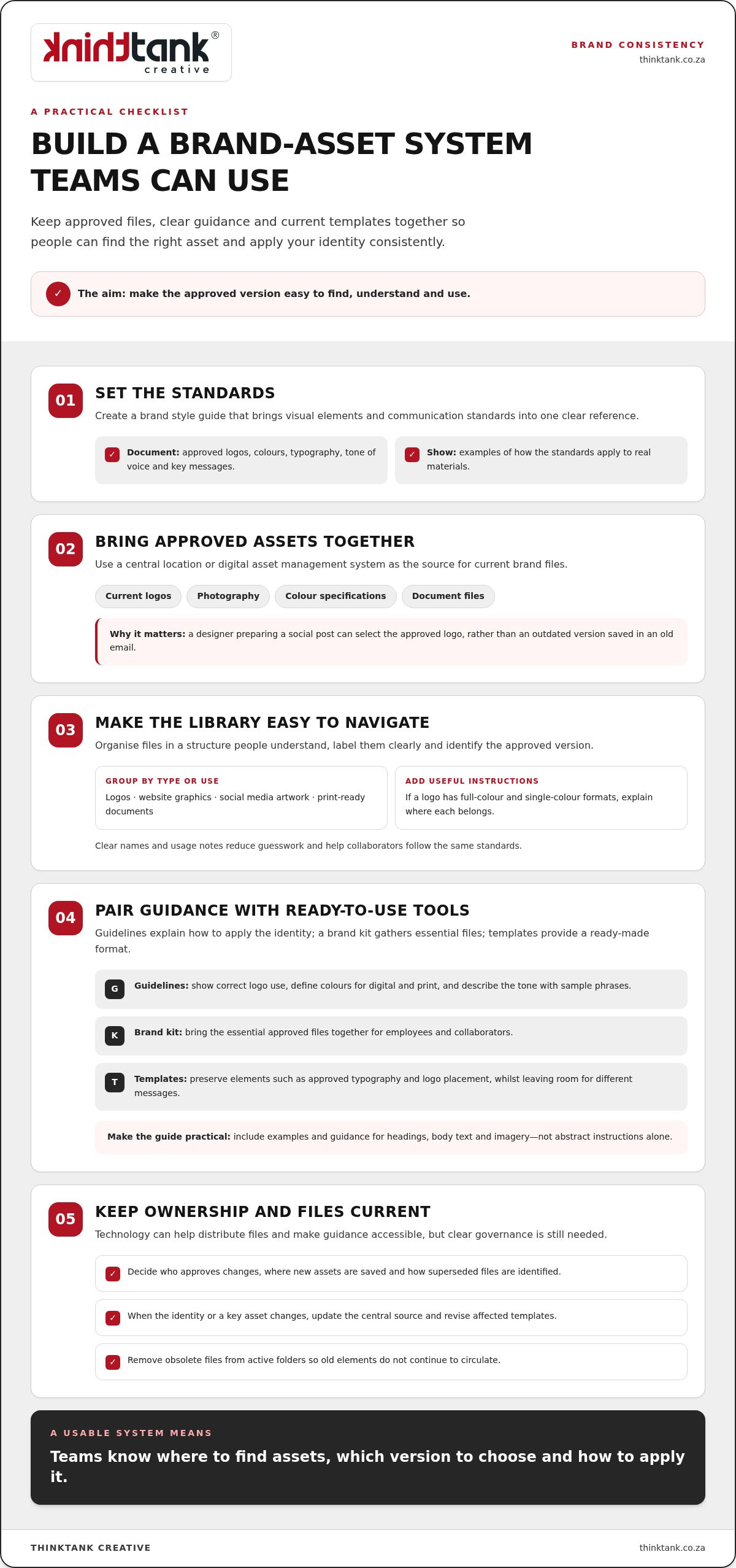
A brand style guide brings visual elements and communication standards into one clear reference. Create it by documenting approved logos, colours, typography, tone of voice and messaging, then add examples showing how each applies to real materials.

Centralising approved brand assets

Digital asset management brings approved brand files together in a central location, making it easier for teams to find and use the right source. Store current logos, photography, colour specifications and document files alongside usage notes. For example, a designer preparing a social post can use the approved logo rather than an outdated version from an old email.

Give the central library a structure people can understand. Group files by type or use, such as logos, website graphics, social media artwork and print-ready documents. Label each asset clearly and identify the approved version. If a logo has full-colour and single-colour formats, explain where each belongs. Clear naming and instructions reduce guesswork and help collaborators follow the same standards.

Guidelines, kits and templates

Brand guidelines explain how to apply identity elements, while a brand kit gathers essential files and a template provides a ready-made format. Together, they help employees, agencies and freelancers produce connected materials. A branded letterhead template, for instance, can preserve approved typography and logo placement while leaving room for different business messages.

Keep the document practical. Show examples of correct logo use, define the brand’s colours for digital and print applications, and describe the tone with sample phrases. Include guidance for headings, body text and imagery, so the standards are easier to apply than abstract instructions alone. An accessible guide is useful only when people can locate it and understand what to do.

Technology can support this process, but it can’t replace clear governance. A shared drive or digital asset management system can hold approved files, distribute them to teams and make the latest guidance easier to access. Set simple ownership rules: decide who approves changes, where new assets are saved and how superseded files are identified. This prevents competing versions from circulating across departments.

Review the library whenever the identity or a key asset changes. Update the central source, remove obsolete files from active folders and revise templates that still use old elements. For a website, aligning approved graphics and brand details with website maintenance and support can help keep published pages in step with current standards. The result is a usable system: teams know where to find assets, which version to choose and how to apply it.

Trust, customer loyalty, brand recognition, and revenue

Consistent branding helps customers connect familiar signals with a dependable experience. Its effects can extend from first recognition to repeat purchasing and revenue.

Consistency across customer touchpoints

Consistency across customer touchpoints means people encounter a coherent identity and experience wherever they interact with a business. A website, social media page, phone call and printed brochure should feel connected, even when each serves a different purpose. A gap between a campaign’s promise and the service experience can undermine confidence.

Map the journey from discovery to purchase, then review what each touchpoint communicates. For example, a South African retailer might use the same approved product descriptions and service details on its website, social posts and printed materials. Staff conversations should reflect those messages too. The words need not be identical, but the facts, tone and expectations should align.

Look for practical friction as well as visual differences. If customers see one set of opening hours on a social profile and another on the website, they may question which is current. Clear ownership of updates and a shared source for approved information help prevent these avoidable inconsistencies.

Recognition and customer loyalty

Brand recognition is the ability to identify a business through familiar visual and verbal cues; consistency reinforces those cues over time. A recurring logo, colour palette and phrase can help customers distinguish one business from another when comparing options. Familiarity makes an identity easier to recall when a need arises.

Familiarity alone doesn’t create loyalty. The customer experience must support what the brand signals. If a business presents itself as responsive but enquiries receive unclear or conflicting answers, repetition won’t fix the mismatch. Aligning materials with actual service behaviour gives customers a reason to return, not just remember the name.

Trust is also linked to purchasing behaviour: 81% of people must trust a brand before making a purchase, and customers who trust a brand are 88% more likely to buy again. These figures underline why consistency should extend beyond design. Reliable information, recognisable presentation and a customer experience that matches the brand promise work together.

Trust and revenue

Consistent brand presentation across all channels can increase business revenue by approximately 23%. This is a reported relationship, not a guaranteed result for every organisation. Consistency can support performance by helping customers recognise a business, understand its offer and feel confident moving towards a purchase.

Trust can also influence retention. Acquiring a new customer can cost up to five times more than retaining an existing customer, so a dependable experience has commercial relevance beyond the first sale. Review whether each interaction reinforces the same promise, from the first advertisement to after-sales communication.

Measure customer response alongside brand presentation. Track repeat purchases, feedback and points where people abandon an enquiry. If customers recognise a campaign but misunderstand the offer, refine the messaging. If the promise is clear but the experience varies, focus on the relevant touchpoints. This makes consistency a practical part of customer retention and revenue planning.
Brand consistency builds trust and recognition

Marketing and advertising effectiveness

In competitive markets, a clear, repeated identity helps each campaign build on the last. More than 70% of companies believe inconsistent brand use creates confusion in the market. Consistency helps audiences connect an advertisement with the business behind it, rather than treating each message as a separate introduction.

Repetition also gives marketing a stronger cumulative effect. Customers may need to see a brand and its message at least 7 times before committing to a purchase decision. If each appearance changes its visual identity, tone or core promise, those encounters may not reinforce one another. A recognisable system lets a business adapt creative work for different channels while retaining familiar cues.

That doesn’t mean publishing identical content everywhere. A social post can introduce an idea, while an email explains it in more detail and a website supports the next step. The format and emphasis change, but the central message and visual identity remain connected. For example, Nike has kept its “Just Do It” slogan and swoosh logo consistent for decades.

Make campaigns easier to manage

A defined marketing strategy reduces repeated decisions during campaign production. Teams can start with approved visual elements, tone and key messages, then tailor each execution to its audience and channel. This helps a campaign feel coherent across paid advertising, email and social media without forcing every touchpoint into the same format.

Use this marketing leader checklist before a campaign goes live:

Efficiency comes from making good decisions repeatable. Content management systems and social media schedulers can help teams coordinate messaging across channels. Shared campaign templates can preserve design standards, leaving staff to focus on the audience and message rather than rebuilding each asset.

Measure the system as well as the campaign. Audit websites, social media and marketing materials quarterly to identify outdated logos, off-brand colours or inconsistent messaging. Only 25% of companies actively enforce their brand guidelines, so clear ownership matters. Assign responsibility for review, record corrections and update the approved source, allowing the next campaign to begin with accurate materials.

Definition and business importance of brand consistency

Brand consistency connects a business’s identity and message across its audience-facing platforms. In South Africa, use brand names and visual assets you own or have permission to use, and keep advertising claims accurate and supportable.

Meaning of a consistent brand

A consistent brand presents its values, visual identity and messaging in recognisable ways across different contexts. Customers can more readily connect a campaign, service interaction and business to the same organisation. Consistency doesn’t require identical content everywhere; each expression should reflect the same central identity.

For example, a business promising straightforward advice can use clear language in an advert, on its website and in customer emails. Its tone may shift to suit each platform, but the promise remains recognisable. This alignment helps make the brand memorable for the right reasons, rather than relying on a logo alone.

Business importance of consistency

Consistency gives a business a coherent foundation for communicating with its audience. When brand assets, messages and customer experiences point in the same direction, each interaction can reinforce the last. This supports recognition and helps customers understand what the business stands for, especially when they encounter it through different channels.

It also makes internal decisions more focused. A team planning a campaign can compare its proposed design and language with the brand’s values and positioning. If an idea attracts attention but contradicts the business’s core promise, the team can refine it before publication. That discipline supports long-term success without ruling out fresh creative work.

Review consistency in real customer materials, not just a brand document. Compare a recent advert, website page and customer email. Check whether each uses current assets, describes the same offer and communicates a compatible tone. This simple comparison can reveal gaps between the identity a business intends to present and what its audience actually sees.

Branding and advertising rules

South African businesses should use their own branding or assets they’re authorised to use, and avoid advertising that could mislead customers. Keep claims clear and supportable, including statements about a product’s features, performance or benefits. These principles help protect customer understanding and reduce the risk of building a campaign around confusing or unsupported promises.

Before publishing an advertisement, match each claim to evidence the business can substantiate, and check that images and logos are approved for use. For instance, explain a promotion clearly and avoid visuals that suggest a benefit the business doesn’t provide. Consistent brand standards work best when creative choices and claims are reviewed together.

Brand consistency for businesses is both a communication discipline and a decision-making framework. Define what must stay recognisable, then adapt the delivery to each platform. That balance helps a brand remain distinctive as its audience, channels and marketing needs evolve.

ThinkTank Creative: Website Design and Development

ThinkTank Creative helps businesses bring their brand identity together through Website Design and Development, creative design, and Logo and Corporate Identity Design. Turn to these services when your website or visual materials no longer reflect a clear, unified identity, or when you’re shaping a new direction for your business.

A coherent website gives your messaging and visual identity a consistent home, while Social Media Marketing carries that identity into social channels. The work can be shaped around your brand’s priorities, from refining its visual foundations to aligning its digital presence.

If you’re ready to strengthen how your brand appears across your website and marketing, contact ThinkTank Creative or visit thinktank.co.za.

Shape a brand people recognise and remember

Make your next brand decision with the long view in mind. The choices you make today can create a clearer foundation for future campaigns, new channels and changing customer expectations. A deliberate approach to brand consistency for businesses helps keep that foundation coherent while leaving room for considered growth.

Start with the point where your brand feels least connected. Perhaps your website no longer reflects your current identity, or your social content has developed a different tone. A focused improvement can bring those pieces into closer alignment without requiring a complete brand overhaul.

ThinkTank Creative offers Website Design and Development, Social Media Marketing and creative design to help businesses develop a joined-up brand presence. If you’re ready to explore how your website and marketing can better reflect your brand, contact ThinkTank Creative to discuss your brand.

Build with clarity, and give your brand room to grow with purpose.

Frequently Asked Questions

Why is consistency important?

Consistency helps customers understand what to expect from a business. It also makes internal decisions easier: a team can assess a new campaign against established standards instead of debating every design choice from scratch. For example, a consistent service promise in an advertisement and an enquiry response reduces the chance of mismatched expectations. This supports clearer communication and a more dependable customer journey.

What is brand consistency and why does it matter for businesses?

Brand consistency is the disciplined use of a business’s identity and promises across its communications and actions. It matters because customers form impressions from separate interactions, not from a brand guide alone. A café, for example, should make its menu descriptions, online ordering information and staff communication feel connected. When those signals align, the business is easier to understand and distinguish from alternatives.

Which brand elements should stay consistent across channels?

Keep the core identity, logo treatment, colour palette, typography, imagery style, tone of voice and essential claims aligned. Maintain consistency in practical details too, such as product names, service descriptions and contact information. A business can vary a message’s length for different platforms, but a changed offer or conflicting detail can create uncertainty. Define what must stay fixed and where creative flexibility is appropriate.

How can businesses maintain brand consistency across social media, websites and print?

Use one approved source for brand files and current business information, then assign someone to review materials before publication. Compare a social post, website page and printed brochure for consistent details, visual treatment and tone. Use layouts suited to each channel rather than forcing one design everywhere. When an offer changes, update every active version, including scheduled posts and print files awaiting production.

What tools help manage brand assets and ensure consistent branding?

A shared, access-controlled folder can work well for a small team, while a digital asset management platform can help organise a larger library. Store approved logos, templates, photography and usage instructions together, with clear file names and version dates. A content management system and social media scheduler can support publishing. Set permissions and ownership so collaborators know which files are current and who approves changes.

How can a business measure brand consistency and its impact on customer trust or sales?

Measure the process and customer response separately. Audit a sample of current materials for correct logos, messages, tone and business details, then track indicators such as branded search activity, repeat enquiries, conversion rates and customer feedback. Compare performance across campaigns with similar audiences and objectives. These patterns are useful, although sales results can also reflect pricing, seasonality, product changes and campaign targeting.

What are common brand consistency mistakes and risks?

Common mistakes include using outdated logos, letting different teams make conflicting claims, and treating a style guide as a file nobody consults. Another risk is copying the same creative unchanged across channels, even when the format or audience differs. These choices can make a business seem disorganised or difficult to understand. Review live materials regularly and remove obsolete files from shared folders.

How should a business adapt its branding for different audiences without losing consistency?

Adapt the examples, language, format and level of detail to the audience, while keeping the brand’s central promise and character intact. A business might explain a technical service in simpler terms for first-time customers, then provide greater detail for experienced buyers. In South Africa, language and cultural context can shape how a message is received. Review each version for accuracy, respect and a recognisable brand voice.

Corporate Identity Design Services in South Africa: A Practical Guide

A polished logo can still leave a business looking disconnected if its website, documents and marketing materials use different visual styles. A coherent corporate identity brings these customer touchpoints together, turning business strategy into a consistent, recognisable expression. If you’re searching for corporate identity design services za, start by looking for a system that works across the materials your business actually uses.

It’s worth understanding what’s included before choosing a design approach. The value lies not just in attractive visuals, but in work that reflects your business objectives and can be applied consistently as your communications develop.

This guide explains what corporate identity design can cover, how to compare an agency’s approach and how to prepare a useful brief. It also offers practical ways to organise feedback and approvals, so the process stays collaborative and the final identity works across the places customers encounter your business.

Key Takeaways

  • A coherent corporate identity helps your business present a recognisable, professional image across customer touchpoints.
  • Corporate identity design services za can be tailored to your objectives, with elements such as logo design, stationery and company profiles.
  • Compare design approaches by looking beyond visual appeal to strategic thinking, creative rationale, communication and practical applications.
  • Prepare for a productive project by clarifying your business objectives, audiences and the communication challenge your identity needs to address.
  • ThinkTank Creative brings strategy, creative design, digital work and print production together in a collaborative process, with ongoing service after project completion.

What do corporate identity design services do for business?

Corporate identity is the visual system a business uses to present itself. It brings together recognisable design choices across customer, supplier and staff communications, helping the organisation look consistent wherever people encounter it. A considered identity can make a proposal, website and printed document feel as if they belong to the same business, rather than to separate organisations.

Identity and reputation are related, but they are not the same. Identity is what a business deliberately presents; reputation is shaped by people’s experiences, conversations and expectations. Thoughtful design can express what a business stands for, but it cannot control every audience response or resolve deeper issues with positioning, service or trust. For a broader overview of the concept, see Corporate Identity on Wikipedia.

For a visual introduction to identity design, watch this guide:

How is corporate identity different from a logo?

A logo is a central visual identifier. It helps people recognise a business, but it is only one part of its identity. Corporate identity design services za can address how the logo works with supporting choices such as colour, typography, layout and stationery. Together, these elements form a visual language that can be applied across different materials and platforms.

For example, a business might use its logo on a proposal, website and printed letterhead. If each item uses unrelated colours, type styles or layouts, the logo has to do all the recognition work by itself. Consistent supporting elements give it context and help each item feel connected. A logo is important, but it cannot, on its own, clarify a business’s position or repair a reputation challenge.

Why does a consistent identity matter across customer touchpoints?

Corporate identity is the visual system that helps a business look and communicate like itself across its touchpoints. These might include a website, a social media post, a business card or a printed document. When the visual approach changes substantially from one to another, audiences may find it harder to recognise the same organisation or understand what it wants to convey.

Consistency does not mean making every item identical. A website and a business card have different purposes, formats and amounts of space. The design challenge is to adapt the identity to each context while retaining recognisable elements and a clear overall character. This supports recognition and clearer communication, while the business’s actions and customer experiences continue to shape its reputation.

A useful identity gives a business a shared visual foundation, not a shortcut to customer trust. Its role is to make intended messages more coherent and recognisable. The way the business delivers on its promises remains essential to how people perceive it.

What can corporate identity design services include?

The scope should fit the business, its objectives and the audiences it needs to reach. Corporate identity design services za can bring together a core logo and practical applications, rather than treating every business as if it needs the same collection of materials. The aim is to create a visual direction that can be used consistently while allowing each item to do its job.

Logo design and stationery are key components. A company profile can carry the identity into a more detailed business introduction, while promotional branded material and printed marketing collateral extend it into customer communications. The right combination depends on where your business needs to present itself and what you need people to understand.

Which visual elements help an identity feel coherent?

Coherence comes from the relationship between visual choices, not from any one element in isolation. Colour, typography, imagery and layout should reinforce a recognisable character and suit the business context. For example, a heading style, colour palette and image treatment can carry through a company profile and website without making the two look identical. The guide to what makes a good logo design explores the logo’s role in more depth.

A useful system is also practical to apply. Clear visual choices give people creating future materials a shared direction, instead of leaving them to make unrelated decisions each time. This is especially valuable when a business communicates through both printed and digital channels.

Where should a corporate identity work?

Start with the materials customers and other audiences actually encounter. Stationery, company profiles and promotional material bring the identity into printed business communications. Website design and digital marketing carry it into online channels, where layouts and content formats differ but visual cues can still feel connected. A custom website design guide for South Africa offers further context on expressing a brand online.

Think through the customer journey. Someone might first see a social media post, then visit the website, and later receive a company profile. The identity should adapt to each format while preserving recognisable choices, such as colour, typography and image style. This continuity helps communications feel as if they come from the same business.

To define a useful scope, identify essential applications first, then consider which other materials would benefit from the same visual direction. ThinkTank Creative brings strategy, creative design, website work, digital marketing and printing and production together, connecting identity decisions with their use across business touchpoints. Explore ThinkTank Creative’s corporate identity design as a starting point for considering how a tailored system could support your communications.

How can you compare corporate identity design services?

Look beyond the first visual impression. A striking logo may catch your eye, but it does not automatically make the identity the strongest fit for your business. Compare how each approach connects your objectives to creative decisions, communicates throughout the project and prepares the identity for practical use.

Focus on evidence as well as presentation. A polished concept is valuable, but you also need to understand why its design choices make sense for your organisation and how they can work across the materials your audiences see. This helps distinguish connected strategy and design work from an asset-by-asset process, where individual pieces may look appealing but lack a shared direction.

What should you assess before choosing an identity service?

Start with discovery. Does the process explore your business, audiences and communication objectives before settling on a visual direction? Look for a clear explanation of how the creative rationale responds to that context. Then consider whether the identity is shown across relevant print and digital applications, rather than only in a logo presentation.

Use this framework to compare the proposal with the evidence provided:

Evaluation criterion Useful evidence
Strategic discovery A discussion of business context, priority audiences and the communication challenge.
Creative rationale An explanation of how the proposed visual choices relate to those objectives.
Communication A clear process for sharing feedback, discussing decisions and refining the work collaboratively.
Implementation Examples of how the identity can carry through relevant stationery, profiles, promotional material, website and digital marketing applications.

Apply the same questions to each option. If you are shown a logo, ask what design decisions support it and how the wider visual direction is intended to work. If the presentation includes several formats, look for consistent choices adapted to each one, rather than the same artwork simply placed in different mock-ups.

Why does an integrated creative approach matter?

Bringing strategy, creative work and implementation together can help carry context from the initial business discussion into the finished applications. When communication stays close to the work, feedback can be considered against the original objectives instead of treated as a series of isolated preferences. This supports more coherent decisions and purposeful refinements.

The right approach depends on your project scope, working preferences and intended applications. Some projects have a narrower need; others benefit from coordinating identity with website work or print production. ThinkTank Creative is a marketing and creative agency that brings strategy, branding, website work, digital marketing and physical production together, with personal client communication throughout projects.

Use your comparison to identify the approach that best connects your objectives, creative direction and practical needs. Explore ThinkTank Creative’s integrated creative approach to see how these elements can work together.

Corporate Identity Design Services in South Africa: A Practical Guide

How should you prepare for a corporate identity design project?

A clear brief gives creative work a useful starting point. Before beginning corporate identity design services za, align your team on what the business needs to communicate, who it needs to reach and where the identity will be used. This preparation gives the creative team context to develop and explain ideas against your objectives.

Work through these steps to get ready:

  1. Set the business context. Summarise what your business does, what it offers and why you are seeking identity work now. Note any changes or challenges that make the project timely.
  2. Describe the audience. Identify the people you need to reach and what they should understand about your business. Be specific rather than aiming to appeal to everyone.
  3. Define the communication challenge. Explain what feels unclear or inconsistent today, and what you want the identity to express. For instance, you might need your materials to present a more unified impression.
  4. Gather useful references. Collect existing logos, stationery, profiles, website pages and promotional material. Include examples of visual styles that feel appropriate or unsuitable, with a short note explaining why.

What belongs in a useful identity design brief?

Bring the context together in a concise document. Cover the business, its audiences, its offer and the reason for the project. Describe the qualities you hope the identity will convey, then list the practical places it needs to appear, such as stationery, a company profile, promotional material or digital channels.

Separate essential requirements from preferences. An essential might be that the identity remains legible across different materials; a preference might be a particular colour direction. This distinction helps the creative team understand what the work must achieve and where there is room to explore. Share relevant existing materials and explain whether they should be retained, reconsidered or used only as background.

How can a business review and refine creative concepts?

Return to the brief when concepts are presented. Consider whether each direction speaks to the intended audience, expresses the desired qualities and can be applied in the contexts you identified. Personal reactions can inform discussion, but “I like it” is more useful when paired with a reason tied to the brief. For example, explain whether a choice feels too formal for the audience or supports the intended tone.

Invite relevant decision-makers to review the concepts, then consolidate their feedback before sharing it with the creative team. This reduces conflicting instructions and keeps refinements purposeful. Agreeing who contributes and who makes the final decision can also prevent the review from becoming a collection of unrelated personal preferences.

A collaborative process makes space for discussion, considered creative choices and clear feedback. Explore ThinkTank Creative’s collaborative approach to corporate identity design and shape a project around your business objectives.

How does ThinkTank Creative deliver corporate identity design services?

ThinkTank Creative is a South African marketing and creative agency operating since 2001. Its corporate identity work sits within a broader combination of strategy, Branding & Creative Design, digital work and Printing & Production. This means identity decisions can be considered alongside how a business communicates online and through physical materials, rather than as isolated design assets.

The process is collaborative. Business context and objectives inform the creative direction, while client input, presentation, refinement and feedback help shape the work as it develops. Direct communication keeps decisions connected to the original brief. ThinkTank Creative also provides ongoing service after a project is complete.

ThinkTank Creative states: “We are rated as one of the Top 5 Website design companies in South Africa by our clients according to The Independent Authority on Search Vendors.”

How does ThinkTank Creative connect strategy, design and implementation?

Begin with the business challenge. Research and strategy provide context for creative choices, helping the design respond to the organisation, its audiences and the messages it needs to communicate. As concepts are presented and refined, client feedback guides decisions and keeps the work aligned with those priorities.

Implementation matters too. A visual direction can carry through website design and digital marketing, as well as physical production such as printed materials. Each application has its own format and purpose, so consistency does not mean reproducing the same design everywhere. It means making considered adaptations that retain a recognisable character across channels.

For businesses exploring corporate identity design services za, this connection between strategy, design and practical use helps show how the identity can work beyond its initial presentation. ThinkTank Creative brings these capabilities together as a marketing and creative agency, with communication and collaboration as part of the client relationship.

What is the next step towards a clearer corporate identity?

Prepare by defining the challenge you want the project to address and the audiences you need to reach. Note what your current identity communicates, where it feels disconnected and which business materials or digital channels are priorities. These points give an initial discussion a useful foundation without requiring you to arrive with every creative decision already made.

From there, the project scope can be shaped around your objectives and relevant applications. A conversation is an opportunity to share context, discuss possibilities and understand how strategy, creative design and implementation can work together for your business. The direction should be tailored to the challenge, rather than selected from a one-size-fits-all formula.

Start a conversation with ThinkTank Creative about your corporate identity project and the audiences you want it to reach.

Give your brand a clear direction to grow

Your next step does not need to be a fully formed visual brief. Start with one focused question: what should people understand about your business when they encounter it? Use the answer to guide conversations about your identity, the channels it needs to serve and the priorities your team will use to review creative work.

Choosing corporate identity design services za is an opportunity to build a more intentional connection between what your business stands for and how it presents itself. The process works best as a partnership: your knowledge of the business, customers and ambitions gives creative decisions meaningful context, while a considered design approach helps turn that context into a clear expression.

ThinkTank Creative brings strategy, creative, digital services and physical production together, with 25 years of experience as of 2026. Start a conversation with ThinkTank Creative about the challenge you are ready to address and the identity your business wants to build.

Frequently Asked Questions

Is corporate identity design suitable for a small business?

Yes. A small business can develop an identity around its current needs and the materials it uses most, rather than creating every possible brand asset at once. For example, a business that mainly shares proposals and communicates online may prioritise those contexts before extending the identity further. Corporate identity design services za can support businesses of different sizes; a clear brief helps keep the work relevant to your goals and audience.

Can an established business refresh its identity without changing its name?

Yes. A visual refresh can update how a business presents itself while retaining its existing name. The work might refine the logo, colour palette, typography or the way these elements appear on business materials. Before making changes, identify which parts audiences already recognise and which no longer fit the business. Keeping familiar cues where they remain useful can make the transition feel considered rather than arbitrary.

How long does a corporate identity design project take?

There is no fixed timeframe for every project. The scope, number of applications, decision-making process and timing of consolidated feedback all affect how the work progresses. A focused identity update has different requirements from a project that also needs a company profile, website design or printed materials. Discuss the deliverables and review stages early so the project plan reflects the work and your team can prepare for decisions.

What is the difference between corporate identity and brand reputation?

Corporate identity is the visual expression a business chooses to present, while reputation is shaped by what people think and say about the business over time. A company can present a polished identity, but customer experiences with its communication and service also influence how people regard it. Design helps express the business’s intended character; it cannot control audience opinion or replace consistently meeting customer expectations.

Can a business keep some of its existing brand materials during an identity refresh?

Yes. An identity refresh does not have to discard every existing asset. Review current materials to see what remains recognisable, useful and aligned with the direction you want to take. A familiar logo might be retained while colours or layouts are refined, for instance. Check how selected assets work across the formats you use, and identify outdated items that could create confusion beside refreshed designs.

How can employees help maintain a consistent corporate identity?

Employees can help by using agreed brand guidance when preparing presentations, documents and other customer-facing communications. Make the guidance easy to find, explain the purpose behind key visual choices and show practical examples of appropriate use. A shared review process can help catch inconsistent materials before they are distributed. Staff who understand the identity can apply it thoughtfully, rather than treating it as a set of rules without context.

Does corporate identity design also determine a company’s marketing strategy?

No. Corporate identity design gives marketing communications a coherent visual direction, but it does not by itself decide the business’s marketing objectives, audiences, channels or campaign priorities. Those questions belong in strategic planning. For example, a consistent identity can be applied to a campaign, while the campaign’s purpose and audience inform its message and channel choices. Keeping these roles distinct helps design support the strategy rather than stand in for it.

Professional Logo Design Process: 2026 Strategic Guide

A professional logo is a high-performance strategic asset, not a mere drawing. We recognise that committing your hard-earned budget to a new visual identity often brings a sense of trepidation, especially if you've been burnt by vague timelines or confusing technical jargon in the past. It's frustrating to feel disconnected from the creative journey when designers mention vectors or CMYK colour profiles without context. You deserve a partner who respects your vision and your time. Understanding the professional logo design process for clients is the first step toward replacing that uncertainty with a sense of genuine excitement and clarity.

Discover the exact five-stage framework we utilise to transform South African business goals into visual identities that resonate with precision. You'll gain a transparent roadmap of the design journey, from the initial deep-dive research to the moment we deliver your final, polished files. We'll show you how to provide the kind of feedback that empowers our team to refine your vision into something extraordinary. By the end of this article, you'll feel confident in the strategic reasoning behind every curve and palette choice. We're inviting you to step into a structured process where your brand's growth is the ultimate destination.

Key Takeaways

  • Understand why a research-first approach is the only way to prevent brand failure and ensure your identity reflects your unique business mission.
  • Master the professional logo design process for clients by learning how to provide strategic feedback that leads to a polished, iconic visual result.
  • Discover the importance of a "Design Rationale" when evaluating concepts, allowing you to choose a logo based on functional usability rather than subjective opinion.
  • Learn how to utilise your final Brand Toolkit and style guide to maintain impeccable consistency across every touchpoint in the South African market.

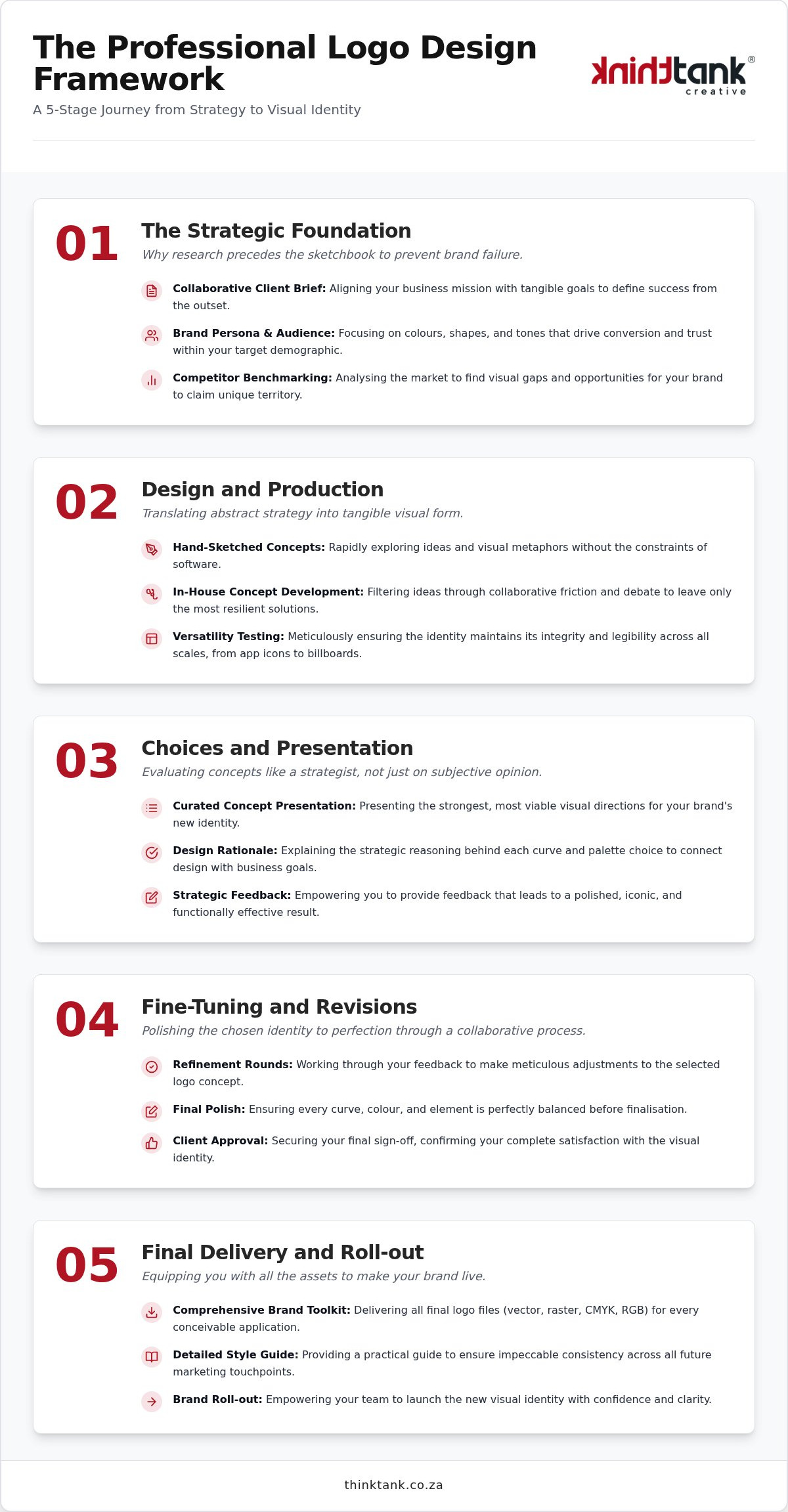
Stage 1: The Strategic Foundation — Why Research Precedes the Sketchbook

A logo is the visual anchor of your entire business strategy. Jumping straight into the sketchbook is the primary cause of brand failure because it ignores the psychological connection between a business and its audience. We anchor our methodology in visual communication principles to ensure your identity is built on a rock-solid foundation. This initial stage of the logo design process for clients is where we align your business mission with tangible goals. It's a collaborative journey of imagination that prevents costly pivots later.

Success in the South African market requires a customer-smart philosophy. We don't just look at what looks good; we look at what works for your specific demographic. Your client brief is the most important document we'll create together. It establishes the project boundaries and defines exactly what success looks like for your brand. During these early discussions, we also provide an estimated cost based on the scope we've defined together, ensuring total transparency before a single pixel is moved.

To better understand how this collaborative strategy unfolds in a real-world setting, watch this detailed breakdown:

Defining Your Brand Persona and Target Audience

Your brand persona is more than a list of adjectives. It's the emotional behaviour you want to elicit amongst your customers. We move beyond subjective preferences. It doesn't matter if your favourite colour is lime green if your audience associates it with something unrelated to your service. We focus on colours and shapes that drive conversion and trust. By building a vision board together, we ensure our creative team and your leadership are looking at the same horizon. This ensures the logo design process for clients remains objective and results-oriented.

Market Analysis and Competitor Benchmarking

Standing out amongst the noise in South Africa's vibrant economy takes more than luck. We conduct a thorough benchmarking exercise to see what your competitors are doing well and, more importantly, where they are failing. We look for visual gaps where your brand can claim unique territory. This strategic positioning ensures that your logo remains relevant as you scale from a local startup to a national leader. We design with the future in mind, ensuring your identity is as functional on a website as it is on a printed billboard.

Stage 2: Design and Production — Translating Strategy into Visual Form

Visual transformation begins with a pencil, not a mouse. Our award-winning designers initiate the logo design process for clients by translating abstract strategic pillars into tangible metaphors through hand-sketched concepts. This raw, unfiltered exploration allows us to test ideas rapidly without the constraints of software. It's a stage where innovative creativity meets the golden rules of logo design, ensuring that every mark we make is intentional and rooted in the research conducted during Stage 1. We prioritise these sketches because they represent the purest form of the journey of imagination.

The Concept Development Phase

Refining these sketches involves a rigorous period of challenging interaction amongst our in-house team. We debate every curve and intersection to ensure the iconography tells a cohesive story that resonates with your sector. This collaborative friction filters out the ordinary, leaving only the most resilient visual solutions. We simultaneously prepare for both digital and printing solutions, ensuring your mark remains crisp whether it's embossed on premium stationery or glowing on a high-resolution screen. Our goal is to create a visual language that doesn't just follow trends but leads the way in your specific industry.

Ensuring Versatility Across Every Touchpoint

A professional identity must maintain its integrity across vastly different scales. We meticulously test legibility, ensuring your logo is as recognisable on a tiny business card as it is on a massive national billboard. In our mobile-first era, your icon needs to stand out within the small confines of social media profiles and favicon icons. This level of functional usability is essential when your logo integrates with custom website design South Africa, where it serves as the cornerstone of your digital presence.

Typography and colour palettes are chosen with precision to evoke the exact brand persona we defined together. We don't just select colours; we curate emotional responses that align with your long-term growth. This meticulous attention to detail ensures your brand is equipped for success across every medium. If you're ready to see your vision take shape through elite execution, we invite you to explore our creative design services to begin your own brand transformation.

Stage 3: Choices and Presentation — Evaluating Concepts Like a Strategist

The presentation phase represents the first time your strategic vision takes a definitive visual form. It's a significant milestone in the logo design process for clients, where abstract concepts are distilled into a selection of refined identities. We don't just send a PDF and wait for a "yes" or "no". Instead, we guide you through each concept, explaining the strategic reasoning that led to every line and shade. This ensures that the choices you make are informed by the goals we established together during the research phase.

We provide a comprehensive "Design Rationale" for every concept presented. This document clarifies the "why" behind our creative choices. If we've utilised a specific weight for a typeface or a particular geometric shape, it's because those elements align with the brand persona we established during Stage 1. This ensures your decision is based on objective business benefits rather than fleeting personal trends. By understanding the methodology behind the art, you can lead your brand with quiet assurance.

Seeing a logo in isolation is rarely enough to judge its efficacy. We present your new identity within high-fidelity, real-world mock-ups. You'll see how the logo behaves on a digital interface, a corporate letterhead, and even national signage. This context is vital. It helps you visualise the brand's potential and ensures the corporate identity remains robust across all physical and digital touchpoints. It's about seeing the potential for transformation in every application.

How to Review Your Logo Concepts

Effective review requires you to step into the shoes of your audience. Don't ask if you like the colour; ask if the colour elicits the correct emotional behaviour from your target market. A successful logo makes your customer look smart for choosing your service. We encourage you to evaluate each concept against the "Strategic Guide" objectives we set at the start. This keeps the focus on creating a professional corporate identity that drives growth rather than just settling for an attractive image.

The Collaborative Feedback Loop

Our team views this stage as a partnership, not a transaction. Constant communication is essential to refine the chosen concept into its final form. We value your insights as the expert in your industry, whilst we provide the expertise in visual strategy. Honest debate is welcomed. It's through this collaborative friction that we move from "good marketing" to "great marketing," ensuring the final result is as innovative as it is functional. This iterative synergy is what defines a truly elite logo design process for clients.

Professional Logo Design Process: 2026 Strategic Guide

Stage 4: Fine-Tuning and Revisions — Polishing the Identity to Perfection

Precision is the hallmark of this stage. Once you've selected a primary concept from the previous phase, we enter the meticulous fine-tuning process. This is the part of the logo design process for clients where we shift from broad creative strokes to microscopic technical adjustments. We examine the optical kerning between letters, the mathematical balance of icons, and the precise saturation levels of your colour palette. These refinements ensure your identity remains robust and legible whether it's embossed on premium stationery or glowing on a high-resolution digital interface.

Our designers focus on creating a sense of visual harmony that feels both effortless and intentional. We don't just move elements around; we apply strategic reasoning to every pixel. This ensures that the final result isn't just a pretty picture, but a functional tool that supports your business growth. By the time we reach the end of this stage, you'll feel a sense of quiet assurance that your brand is represented by an elite visual asset. It's about reaching that "eureka" moment where the identity feels perfectly aligned with the vision we established in Stage 1.

The Art of Constructive Revision

Feedback is a powerful tool when it's anchored in strategy. We encourage you to focus on the emotional behaviour you want the brand to elicit amongst your customers rather than subjective personal preferences. Instead of suggesting a specific font change, tell us if the current weight feels too aggressive for your professional persona. This collaborative approach empowers our award-winning team to find the most innovative solutions whilst maintaining the integrity of the brand. Avoiding "design by committee" is vital here; whilst gathering internal opinions is helpful, the final decision must always serve the strategic goals of the business.

Final Approval and Quality Assurance

Before moving to the final delivery, we conduct a rigorous quality audit. This includes testing the logo's performance across various platforms to ensure maximum usability and functionality. We verify that the concept adheres to the core principles of what makes a good logo design, focusing on longevity and scalability. Once you provide the final sign-off on the master concept, the creative project transforms into a permanent business asset. Secure your brand's future by partnering with experts who value this level of precision; explore our Logo and Corporate Identity Design solutions today.

Stage 5: Final Delivery and Roll-out — Making Your Brand Live

The culmination of our collaborative journey arrives with the delivery of your comprehensive Brand Toolkit. This final phase of the logo design process for clients ensures that your new visual identity is not just a static image, but a versatile engine for growth. We provide you with a curated suite of assets designed to maintain impeccable standards across every national touchpoint. This transition from design to implementation is where your brand truly begins its life in the South African marketplace, backed by our quiet assurance of quality and elite execution.

Our team remains deeply invested in your success well beyond the initial hand-off. We move beyond being a mere vendor to act as your long-term creative partner, ensuring your brand evolves alongside your business. Whether you are launching a new social media campaign or preparing for a national trade show, we provide the strategic depth needed to keep your identity sharp. We handle everything from the initial logo concept to professional printing and website development, providing a seamless end-to-end experience that respects your time and your vision.

Understanding Your Deliverables

We supply industry-standard vector files, such as AI and EPS, which allow for infinite scalability without any loss of resolution. These are essential for professional printing solutions and large-scale signage. Alongside these, you'll receive high-resolution raster files like PNG and JPG for immediate digital application. We provide specific files in CMYK for physical production and RGB for digital marketing and social media profiles. Your toolkit also includes the Master Logo and its functional variants, including monochrome versions for subtle applications, stacked layouts for vertical spaces, and isolated icons for mobile environments. To ensure your new identity extends seamlessly to every physical touchpoint, our business card design tips 2026 guide will help you translate your brand assets into bespoke printed collateral that commands attention.

Implementing Your New Visual Identity

Consistency is the foundation of brand trust. We provide a detailed Brand Style Guide that dictates exact spacing, colour codes, and typography rules to ensure your identity remains uniform amongst different vendors and platforms. This guide is vital when integrating your logo into your email marketing campaigns or PPC advertising. Using your new identity to enhance lead generation strategies for South African businesses ensures that every prospective client encounters a professional, cohesive brand persona. We facilitate the transition to professional printing for all your branded promotional material, ensuring the colours you saw on screen are perfectly replicated in the physical world.

Secure Your Brand's Future through Strategic Design

Your visual identity is the most hard-working asset in your business toolkit. By moving through a structured, research-led framework, you transform a simple graphic into a powerful symbol of trust and credibility. Understanding the logo design process for clients ensures that every creative decision is rooted in measurable business objectives rather than fleeting trends. You've seen how a collaborative journey, from the initial deep-dive to the final brand roll-out, creates a foundation for long-term growth and national recognition.

Since 2001, our all-in-house team of expert designers has been dedicated to this level of precision. We provide comprehensive end-to-end branding and printing solutions that ensure your message remains consistent across every medium. Partnering with award-winning designers means you aren't just buying a logo; you're investing in a strategic vision that elevates your presence in the South African market. We're ready to help you navigate this transformation with quiet assurance and elite execution.

Embark on a journey of imagination with ThinkTank Creative today. Your brand's next chapter starts here.

Frequently Asked Questions

How long does the professional logo design process usually take?

The timeline for a professional logo design process for clients generally spans several weeks to ensure thorough research and execution. We balance competitive time limits with a commitment to high-quality work that doesn't compromise on strategic depth. Factors like the speed of your feedback and the complexity of the project boundaries influence the final delivery date. We provide a clear schedule during the initial strategy phase to help you plan your brand roll-out with confidence.

How many logo concepts will I receive during the presentation stage?

We typically present a curated selection of initial concepts that directly address the strategic goals defined in your brief. Rather than overwhelming you with dozens of weak ideas, we focus on delivering a few resilient, high-fidelity directions that each tell a unique brand story. This approach allows us to engage in deep discussion and debate during the presentation stage, ensuring that the final choice is rooted in functional usability and innovative creativity.

What happens if I don't like any of the initial logo designs?

Our collaborative journey of imagination includes dedicated fine-tuning and revision stages to ensure the final result resonates with your vision. If the initial concepts don't immediately feel like a perfect fit, we use your strategic feedback to refine the direction. We encourage honest debate and constant communication throughout the project. This partnership ensures we navigate through the creative process together until we achieve a visual identity that makes your customers look smart.

Will I own the full copyright to my logo once the project is finished?

You will receive full ownership of the final approved logo once the project is completed and delivered. This includes the rights to use the master logo and its variants across all digital and physical marketing collateral. We provide all the essential file formats, such as high-resolution vectors for printing solutions and RGB files for social media. This gives you the quiet assurance that your brand assets are secure and ready for national implementation.

What is the difference between a logo and a full corporate identity?

A logo is the central visual mark of your business, whilst a corporate identity is a comprehensive ecosystem of brand elements. A full identity includes stationery, company profiles, and promotional branded material that work together to create a unified presence. This end-to-end approach ensures consistency across every touchpoint. Whilst a logo starts the conversation, a corporate identity builds a lasting relationship with your audience through professional and cohesive visual communication principles.

How much does a professional logo design cost for a South African business?

We provide a detailed estimated cost for our logo design process for clients after an initial discussion regarding your specific needs and timeline. This personalised approach ensures that the investment aligns with the scope of your project, whether you require a simple mark or a full brand roll-out. Since every business has unique goals, we avoid fixed pricing in favour of a tailored solution that focuses on the long-term growth of your brand.

Can you help me update my existing website with the new logo?

We certainly can assist with integrating your new identity into your digital presence. As a full-service agency, we specialise in custom website design and development, as well as ongoing website maintenance and support. Our in-house team can ensure your new logo is perfectly implemented across your site, social media profiles, and email marketing templates. This seamless transition ensures that your digital brand remains as professional and functional as your new corporate identity.

Do I need a brand style guide if I only have a small business?

Every business, regardless of size, benefits from a brand style guide essentials framework to maintain national consistency. This document acts as a strategic guide for any future marketing efforts, ensuring that external vendors or internal teams apply your colours and typography correctly. It prevents your brand from becoming fragmented as you grow. Having clear rules for your visual identity helps you maintain a professional corporate persona that builds trust with your South African customers.