Understanding Your Website Analytics Report: A 2026 Strategic Guide

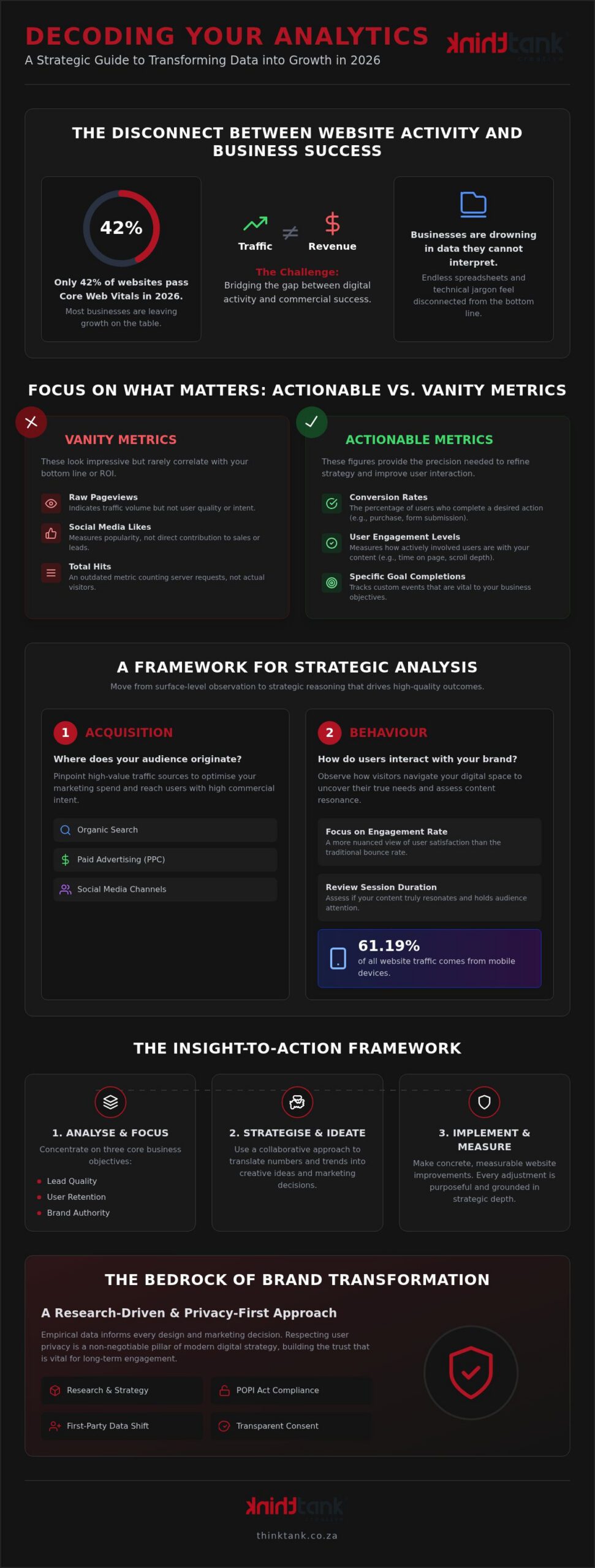
With only 42% of websites currently passing Core Web Vitals in 2026, most businesses are unknowingly leaving growth on the table whilst drowning in data they cannot interpret. You likely feel the weight of endless spreadsheets and technical jargon that feels disconnected from your actual bottom line. It's frustrating to watch traffic figures rise without seeing a corresponding lift in your revenue or engagement. Mastering the art of understanding your website analytics report is no longer a technical chore; it's a vital strategic advantage that bridges the gap between digital activity and commercial success.

Our guide ensures you can transform these complex data points into actionable insights that fuel your business growth. This resource provides a clear framework for identifying which metrics truly move the needle, allowing you to make confident investment decisions with quiet assurance. We'll examine the latest 2026 GA4 updates, including custom conversion windows and AI-powered trend analysis, to ensure your digital strategy is both precise and forward-looking. By the end of this article, you'll possess the clarity needed to turn confusing vanity metrics into a bespoke roadmap for elevation and excellence.

Key Takeaways

  • Distinguish between deceptive vanity metrics and actionable data that reflects true commercial progress and revenue growth.
  • Gain confidence in understanding your website analytics report to pinpoint high-value traffic sources and optimise your digital marketing spend.
  • Decode the specific user behaviours that signal engagement and trust amongst your target audience to refine your creative strategy.
  • Apply a structured insight-to-action framework to translate monthly reporting trends into concrete, measurable website improvements.
  • Learn how a collaborative, research-driven approach to data serves as the essential bedrock for bespoke website design and long-term brand transformation.

Beyond Vanity Metrics: Why Interpreting Your Data is Non-Negotiable

Harness the power of raw data to fuel your creative evolution. At ThinkTank Creative, we view the Research & Strategy phase as the essential bedrock of our five-stage development process, where empirical data informs every design and marketing decision we make. A website analytics report is a strategic map for brand transformation. Without this clarity, your digital presence is guided by guesswork rather than the documented voice of your customer. True understanding your website analytics report begins by stripping away the noise of high-volume numbers that lack commercial substance.

We distinguish between two distinct categories of data to ensure your focus remains on growth:

The Shift from Reporting to Interpretation

A static report is a conversation starter, not a final destination for an ambitious business owner. We believe in a collaborative approach where numbers are translated into creative ideas through constant communication. You can easily overcome data fatigue by ignoring the hundreds of available data points and focusing exclusively on three core business objectives: lead quality, user retention, and brand authority. This methodical focus ensures that every adjustment to your website is purposeful and grounded in strategic depth rather than a reaction to temporary fluctuations.

Data Privacy and the ZA Regulatory Landscape

Respecting the privacy of your South African audience is a non-negotiable pillar of modern digital strategy. As we move through 2026, nuances in POPI Act compliance and the global shift towards first-party data have changed how we track user behaviour. Utilising web analytics with a privacy-first mindset is no longer just a legal requirement; it's a powerful tool for brand reputation. By implementing transparent consent mechanisms and cookieless tracking where appropriate, you signal to your clients that your organisation values their digital rights. This ethical approach to data collection builds a foundation of trust that is vital for long-term user engagement and bespoke brand growth amongst a discerning local market.

Decoding the Core Metrics: A Framework for Strategic Analysis

Transform raw data into a blueprint for sustainable growth. Within the Planning stage of our five-stage development process, we use empirical data to define the scope of your brand’s digital evolution. Deepening your understanding your website analytics report allows you to move beyond surface-level observations and into the strategic reasoning that drives high-quality outcomes. This methodical approach ensures that every creative decision is grounded in evidence rather than assumption, setting the stage for a website that performs as beautifully as it looks.

Acquisition: Where Does Your Audience Originate?

Identifying the origin of your traffic is the first step in refining your digital marketing spend. You must distinguish between organic search, paid advertising (PPC), and social media channels to see where your most loyal customers reside. Effective keyword research for South Africa serves as the vital starting point for this acquisition data, ensuring you attract users with high commercial intent. By pinpointing high-value sources, you can allocate resources with the quiet assurance that your investment is reaching the right eyes amongst a crowded digital marketplace.

Behaviour: How Do Users Interact with Your Brand?

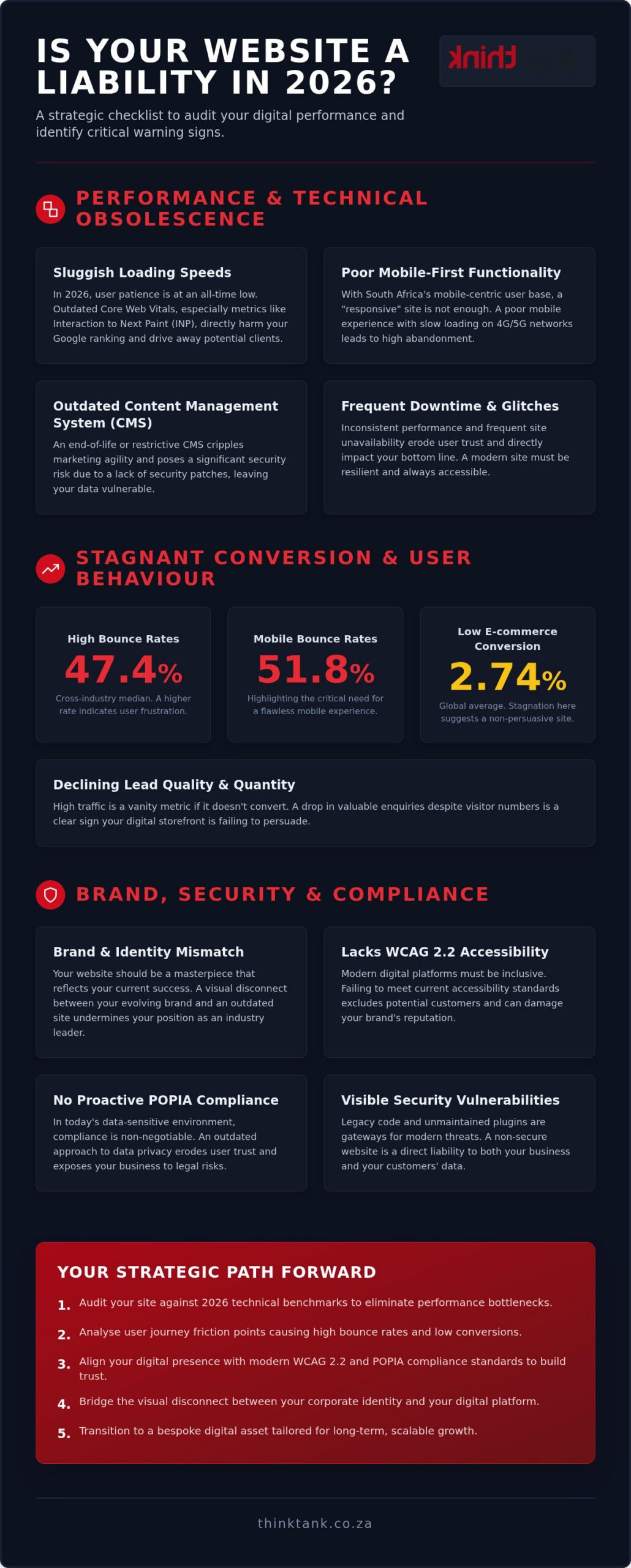
Observe how visitors navigate your digital space to uncover their true needs and frustrations. In 2026, the focus has shifted towards engagement rate, which offers a more nuanced view of user satisfaction than the traditional bounce rate. Reviewing common website analytics metrics like average session duration helps you assess whether your content resonates with your audience. With mobile devices accounting for 61.19% of all website traffic this year, your behaviour metrics must be segmented to ensure your mobile experience is flawless. If visitors leave quickly, it often highlights friction points in the user journey that require bespoke creative intervention. By mastering the art of understanding your website analytics report, you gain the ability to make meticulous adjustments that improve user retention whilst elevating your brand authority.

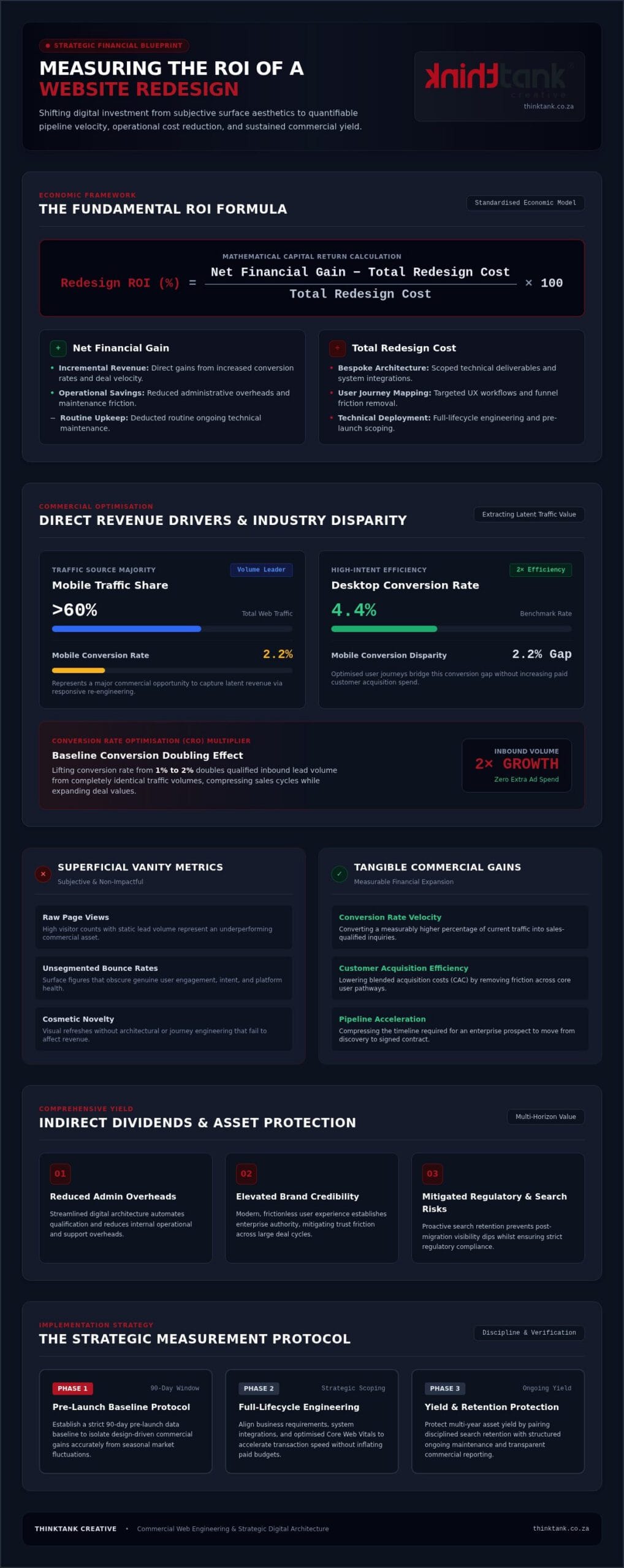
Conversion rate remains the ultimate metric for measuring the ROI of a website redesign. It bridges the gap between creative excellence and commercial success by tracking specific actions that lead to growth. Data confirms that technical performance is a catalyst for these results; for instance, a page that loads in one second can achieve an average conversion rate of almost 40%. When you see a tangible lift in leads or sales, you validate the strategic depth of your digital presence. If you're ready to elevate your brand, our team is here to help you optimise your website design for maximum impact and synergy.

Analysing User Behaviour: Understanding the 'Why' Behind the Clicks

Uncover the psychological drivers that transform a casual visitor into a loyal advocate. Whilst previous sections focused on the 'what', understanding your website analytics report requires a deep dive into the 'why'. In the South African market, trust is a currency earned through reliability and seamless interaction. Every click is a customer telling you what they value. By improving website user experience, you align your digital presence with these user expectations, creating an environment where engagement feels natural and effortless.

Technical health is the invisible foundation of positive user behaviour. If your platform is sluggish, your data becomes skewed by high drop-off rates before the user even sees your value proposition. Research shows that whilst the average mobile page load time is 8.6 seconds, those that load in just one second see significantly higher conversions. A slow site doesn't just lose sales; it provides a fragmented view of your audience's intent. Reviewing 10 important website analytics reports can help you identify where these technical barriers are preventing users from reaching your core content.

The Impact of Performance on Analytics

Mobile-first design is essential for capturing accurate data in the ZA market, where 61.19% of traffic originates from handheld devices. You must fix a slow loading WordPress site to ensure your analytics reflect genuine user interest rather than frustration-driven exits. When your site performs with precision, the behaviour flow in your report becomes a reliable narrative of the customer journey. This technical stability allows our team to move from mere maintenance into high-level strategic elevation, ensuring your data is a true reflection of your brand's potential.

Visualisation and Heatmaps

Visual data provides a sophisticated layer of insight that standard tables cannot match. Heatmaps allow you to see exactly where users linger and which calls to action they ignore. Our award-winning design team utilises this visual feedback during the 'Revision' and 'Fine-Tuning' phases of our development process to ensure every element is meticulously placed. By translating these heatmaps into better corporate identity and layout choices, we ensure your brand transformation is guided by evidence. This collaborative approach turns raw interaction data into a bespoke user experience that resonates with your specific audience, moving them smoothly from broad objectives to specific service areas.

Understanding Your Website Analytics Report: A 2026 Strategic Guide

The Insight-to-Action Framework: Making Data-Driven Decisions

Elevate your decision-making process by adopting a structured methodology that converts observations into measurable outcomes. Understanding your website analytics report is only half the battle; the true value lies in how you respond to the patterns revealed. We guide our partners through a methodical five-step cycle that ensures every adjustment is purposeful, strategic, and grounded in reality. This approach moves your brand from a reactive state to one of proactive growth, where documented data dictates the creative path forward and eliminates the risks of speculative changes.

Our framework begins with identifying a specific anomaly or trend within your monthly reporting. Once a pattern emerges, we formulate a hypothesis based on established user behaviour. During the 'Program' phase of our development process, our creative team is briefed to design a bespoke solution that addresses the root cause of the data shift. We then execute these changes, using A/B testing to validate the new strategy against real-world interactions. Finally, we review the subsequent report to measure success, ensuring a steady, reassuring cadence of improvement that mirrors the stability of your business.

Turning Negative Data into Positive Change

High bounce rates on critical landing pages often signal a disconnect between user intent and page content. Rather than viewing this as a setback, use it as a catalyst for refinement. If you notice organic traffic has stalled, it may be necessary to pivot your local link building strategies South Africa to better align with the evolving ZA search landscape. This collaborative journey involves discussing these findings openly with your agency partner to ensure your marketing and design efforts work in perfect synergy.

Budgeting Based on Real-World Performance

Allocate your digital marketing spend with the quiet assurance that comes from empirical evidence. By identifying the specific channels that consistently show the highest levels of user engagement, you can move away from fragmented, low-yield investments. Data-driven budgeting allows you to justify the investment in a site expansion or a bespoke new feature based on documented user requirements rather than gut feel. This meticulous approach to financial planning is the hallmark of a truly visionary organisation. The process of understanding your website analytics report ensures that every Rand spent is an investment in a proven path to success. If you're ready to make more informed investment decisions that drive genuine ROI, connect with our specialists to begin a collaborative review of your digital strategy.

Elevating Your Digital Strategy with ThinkTank Creative

Adopt a philosophy where your digital presence serves as a testament to your customer's intelligence. At ThinkTank Creative, we believe that whilst good marketing makes a company look smart, great marketing makes the customer look smart. This belief drives our five-stage development process, ensuring that every creative choice is a deliberate response to user needs. By understanding your website analytics report, we move beyond aesthetic appeal to create high-functioning digital environments that foster genuine brand transformation and growth.

Our role as an all-rounder agency means we don't just hand over a spreadsheet and leave you to decipher the implications. We are your approachable creative partner, founded in 2001, with the capacity to design, develop, and even provide printing solutions that align with your digital findings. This end-to-end capability ensures that the synergy between your online data and your physical brand remains unbroken. We do it all so you don't have to, providing a polished, invitation-based approach that emphasises mutual success over aggressive sales tactics.

A Partnership Built on Imagination and Evidence

Embark on a journey where imagination and evidence coexist in perfect harmony. Our award-winning design team uses your data as a compass, ensuring that the 'Planning' and 'Design' phases are rooted in the reality of your audience's behaviour. We prioritise usability and functionality, tailoring every bespoke website design to resolve the specific friction points identified in your reporting. This meticulous attention to detail transforms your site from a simple URL into a powerful business tool that reflects the craftsmanship of your organisation.

Next Steps for Your 2026 Strategy

Transition your online presence from a static site into a living digital asset that evolves alongside your market. Constant communication is the hallmark of our ongoing service, and we remain deeply invested in your journey long after the initial launch. We invite you to join us for a collaborative discussion to audit your current setup. During this session, we can explore how understanding your website analytics report can lead to improved conversion and user engagement. We provide an estimated cost for a comprehensive digital performance review after our initial discussion, ensuring our proposal is as bespoke as the solutions we create. Let's work together to elevate your brand to its highest potential through precision, synergy, and excellence.

Charting Your Path to Digital Excellence

Your digital presence is a living asset that requires constant refinement and strategic depth. By moving beyond the surface of vanity metrics and embracing a meticulous framework for interpretation, you empower your brand to make investment decisions with quiet assurance. Mastering the art of understanding your website analytics report ensures that every creative adjustment is a purposeful step towards higher engagement and measurable ROI.

As an all-rounder agency founded in 2001, ThinkTank Creative possesses the seasoned expertise to translate these complex numbers into bespoke design and marketing solutions. Our award-winning design team remains energised by the possibilities of the 2026 digital landscape, offering a collaborative partnership that prioritises your growth. We invite you to move from broad objectives to concrete success by aligning your technical health with the psychological needs of your audience.

Let’s embark on a journey of imagination together; contact ThinkTank Creative for a strategic audit. We look forward to helping you transform your data into a powerful narrative of brand elevation and excellence.

Frequently Asked Questions

What are the most important metrics to look at in a website analytics report?

Focus on actionable metrics like conversion rate, engagement rate, and lead quality rather than vanity metrics like raw hits. In 2026, tracking referral traffic from AI sources and monitoring Core Web Vitals are also essential for digital success. These specific numbers provide the foundation for our Research and Strategy phase, ensuring your digital presence aligns with actual business growth rather than superficial popularity.

How often should I be reviewing my website analytics?

Review your data at least once a month to identify long-term trends and anomalies effectively. Whilst daily checks can lead to over-analysis of minor fluctuations, a monthly cadence allows for strategic depth and methodical adjustments. This regular review forms part of our ongoing service, where constant communication ensures your digital strategy remains fluid and responsive to new possibilities in the competitive South African market.

Why is my bounce rate so high, and should I be worried?

A high bounce rate often indicates a disconnect between user intent and your landing page content or technical friction like slow load times. In 2026, GA4 focuses more on 'Engagement Rate', which offers a more nuanced view of user behaviour. If visitors leave within seconds, it's likely time to refine your UX design to ensure your brand transformation resonates with your target audience.

Can website analytics help me improve my offline printing and branding efforts?

Yes, analytics provide deep insights into which messaging and visual elements drive the most digital engagement. As an all-rounder agency, we use these digital findings to inform your corporate identity and printing solutions. If a specific campaign theme performs exceptionally well online, we can mirror that success in your physical marketing collateral, ensuring a consistent and elite brand experience across all channels.

What is the difference between a user and a session in my report?

A user represents a unique individual visiting your site, whilst a session encompasses the group of interactions that occur within a specific timeframe. Understanding this distinction is vital for understanding your website analytics report as it clarifies how often your favourite customers return. Segmenting these metrics helps us determine if your site serves as a dependable resource for recurring engagement or a one-time discovery point.

How do I know if my digital marketing spend is actually working?

Track your conversion rate and cost-per-acquisition across different traffic sources like PPC and organic search. By identifying which channels deliver high-value leads, you can allocate your budget with quiet assurance. We use these insights to justify the strategic reasoning behind your digital marketing spend, moving away from fragmented tactics towards a bespoke strategy that prioritises actual commercial success and long-term growth.

Is Google Analytics 4 (GA4) compliant with the South African POPI Act?

GA4 can be configured to meet POPI Act requirements by implementing robust consent mechanisms and anonymising IP addresses correctly. Being a privacy-first brand is essential for building trust amongst your South African audience in 2026. Our team ensures your data collection respects local regulatory nuances, providing a secure foundation for your analytics whilst maintaining the high-quality outcomes your business demands.

How can I see which specific pages are leading to the most enquiries?

Navigate to the 'Pages and Screens' report and filter by 'Key Events' to see which content drives the most conversions. This allows you to identify your most popular content and understand the psychology behind the clicks. Pinpointing these high-performing pages is a critical part of understanding your website analytics report, helping our award-winning designers fine-tune your layout for maximum engagement and synergy.

How to Fix a Slow Loading WordPress Site: A 2026 Strategic Guide

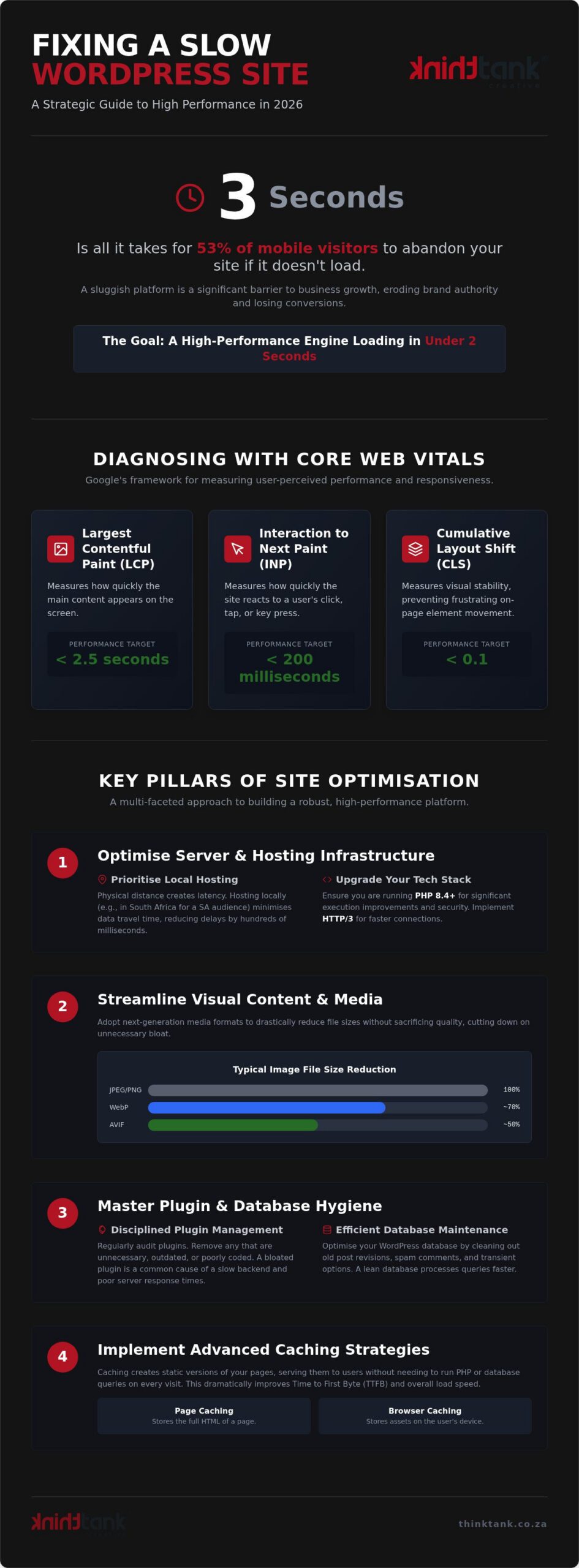
Fifty-three per cent of mobile visitors will abandon your brand's digital experience before it even begins if your page takes longer than three seconds to load. It's a sobering reality that highlights the thin margin between a successful conversion and a lost opportunity. You've likely felt the frustration of high bounce rates and poor search visibility whilst your competitors seem to glide effortlessly to the top of the rankings. It's clear that a sluggish platform isn't just a technical glitch; it's a significant barrier to your business growth.

We're here to help you reclaim your competitive edge. This strategic guide details exactly how to fix a slow loading wordpress site by aligning technical precision with sophisticated design principles. You'll learn to master the nuances of the WordPress 7.1 environment, from optimising for the latest Interaction to Next Paint (INP) standards to leveraging the power of PHP 8.4. We'll move from the anxiety of complex optimisations to the quiet assurance of a high-performance engine that loads in under two seconds. Let's transform your site into a stable, secure platform that reflects the excellence of your brand and supports your long-term vision.

Key Takeaways

  • Gain a precise understanding of Core Web Vitals, including the latest Interaction to Next Paint (INP) standards, to diagnose exactly where your user experience is faltering.
  • Explore our strategic methodology on how to fix a slow loading wordpress site by optimising server infrastructure and leveraging national expertise for superior performance.
  • Elevate your site's performance by streamlining visual delivery and adopting next-generation media formats like WebP and AVIF to reduce unnecessary bloat.
  • Implement a disciplined approach to plugin hygiene and database maintenance, ensuring your platform's backend remains lean and efficient.
  • Discover how professional maintenance and advanced caching strategies can sustain a high-performance engine, allowing you to focus on growth whilst we manage the technical complexity.

Diagnosing Performance Bottlenecks and Core Web Vitals

High-performance websites aren't built by accident; they're the result of meticulous planning and technical precision. In the digital economy of 2026, speed has evolved from a technical luxury into a fundamental pillar of professional user experience (UX). When you're investigating how to fix a slow loading wordpress site, you must first view performance through the lens of your audience's expectations. A site that lags behind the national two-second benchmark doesn't just lose traffic; it erodes the brand authority you've worked so hard to establish. We believe that every millisecond shaved off your load time is an investment in your brand's reputation and its ability to convert visitors into loyal clients.

Understanding Core Web Vitals in 2026

Google's Core Web Vitals provide a structured framework for measuring how users actually perceive your site's responsiveness. Largest Contentful Paint (LCP) tracks how quickly the main content appears, aiming for a target of 2.5 seconds or less to ensure your visitors aren't left staring at a blank screen. Cumulative Layout Shift (CLS) measures visual stability, preventing the frustrating experience where buttons or text jump around as the page loads. Whilst Interaction to Next Paint (INP) has succeeded First Input Delay (FID) as the primary metric for responsiveness, both focus on how quickly your site reacts to a user's click or tap. Core Web Vitals represent the gold standard for 2026 SEO.

Setting Up Your Performance Audit

Before you can implement a solution, you need a clear, data-driven map of your current infrastructure. Utilise professional diagnostic tools like Google PageSpeed Insights, GTmetrix, and Pingdom to establish a baseline across multiple global locations. These platforms provide a detailed "Waterfall" chart, which is a chronological view of every script, image, and style sheet your site requests. By analysing this chart, you can pinpoint specific delays within the WordPress architecture, such as a bloated plugin or a slow server response. This level of precision is essential for moving beyond generic fixes toward a bespoke optimisation strategy.

Whilst DIY audits are a useful starting point, our Website Maintenance and Support team often steps in to handle the heavy lifting. We adopt the philosophy that "We Do It All So You Don't Have To", managing the technical complexities so you can focus on your core business. As part of our rigorous development process, we ensure that speed is baked into the custom design rather than being an afterthought. If you require a tailored performance strategy to elevate your digital presence, an estimated cost is provided after discussion to ensure the solution matches your specific growth objectives.

Optimising Server Infrastructure and Hosting Latency

Your server is the silent engine of your digital presence. If the foundation is weak, even the most polished front-end will struggle to perform. When considering how to fix a slow loading wordpress site, many businesses overlook the physical reality of data transmission. Speed isn't just about code; it's about the distance that data must travel between your server and your user's device. We believe that a high-performance platform begins with a robust hosting strategy that prioritises low latency and professional-grade resources.

The Impact of Local vs International Hosting

Physical distance creates latency. If your primary audience is based in South Africa but your server sits in North America or Europe, you're adding hundreds of milliseconds of delay to every request. Choosing a host with a local South African presence ensures that your content reaches your audience with minimal resistance. This is particularly vital for custom website design south africa, where high-quality visual assets require dedicated resources. Cheap shared hosting plans often force you to compete for CPU cycles with thousands of other sites, leading to unpredictable performance dips. Moving to a VPS or managed WordPress environment provides the stability and scalability your business growth demands.

Upgrading Your Technical Stack

Modern performance requires modern tools. By September 2026, running any version of PHP below 8.3 is a significant risk to both speed and security. PHP 8.4 offers substantial execution improvements that allow your server to process requests more efficiently. We also recommend implementing HTTP/3 to facilitate faster handshakes and improved multiplexing. This technical synergy ensures that your server-side optimisations complement your front-end efforts. It's a common misconception that a few plugins can solve everything, but WordPress site performance and bloat often stem from an inadequate technical stack trying to carry too much weight. For those seeking national reach, integrating a Content Delivery Network (CDN) further reduces the load on your origin server by caching content at edge locations across the country.

Building a high-performance platform is a collaborative journey. Our 5-stage development process places server optimisation at the heart of our strategy, ensuring your site remains agile as you scale. We adopt a "We Do It All So You Don't Have To" approach to technical maintenance, providing you with the peace of mind that your infrastructure is secure. If you're ready to move beyond generic templates toward a bespoke solution, our Website Maintenance and Support team is here to guide the transition. We provide an estimated cost after discussion to ensure our services align perfectly with your business requirements.

Streamlining Visual Content and Media Delivery

Visual excellence defines the modern digital experience. However, unoptimised media assets remain the primary reason businesses struggle with how to fix a slow loading wordpress site. We believe that aesthetic brilliance and technical efficiency should exist in a perfect synergy; high-resolution imagery must enhance the user journey without causing friction. By adopting a disciplined approach to media delivery, you transform your site from a heavy, static brochure into a fluid, responsive platform that respects your visitor's time and data.

Professional Image Optimisation Workflow

Precision begins before you even touch the upload button. Every image must be resized to its exact display dimensions to avoid forcing the browser to perform unnecessary scaling tasks. Whilst legacy formats like JPEG and PNG served us well for decades, the transition to WebP and AVIF is now mandatory for high-performance platforms. These modern formats offer superior compression, allowing you to maintain bespoke visual quality at a fraction of the file size. For a full-width hero image, you should aim for a file size under 150KB to ensure immediate visual impact without delaying the page load.

Managing Video and External Embeds

Self-hosting large video files is a common mistake that quickly exhausts server resources and creates massive latency for your visitors. We always recommend utilising professional hosting platforms like YouTube or Vimeo, which are engineered for high-speed global delivery. Understanding how to fix a slow loading wordpress site also requires a holistic view of third-party scripts. Elements like Google Maps or social media feeds can trigger multiple requests that stall your site's rendering. To mitigate this, we implement "facading" techniques, where a static placeholder image appears first, and the heavy script only executes when the user interacts with the element.

At ThinkTank Creative, we integrate these meticulous optimisations into our 5-stage development process. We adopt a "We Do It All So You Don't Have To" philosophy, refining every asset to ensure your custom design remains agile and competitive. Performance is never a secondary thought; it's a core component of our craftsmanship. If you're looking to elevate your site's media strategy, an estimated cost is provided after discussion to ensure our services align perfectly with your business goals.

How to Fix a Slow Loading WordPress Site: A 2026 Strategic Guide

Mastering Plugin Hygiene and Database Maintenance

Curate your digital tools with the same precision you apply to your business operations. A common misconception when investigating how to fix a slow loading wordpress site is that you need more tools to solve the problem. In reality, performance excellence often requires a disciplined "less is more" philosophy. Every active plugin adds a layer of complexity and potential script bloat that can drag down your Core Web Vitals. We advocate for a lean, purposeful architecture where every element serves a specific strategic goal.

The Plugin Audit: Quality over Quantity

Execution speed is frequently compromised by "plugin overlap", where multiple tools perform similar functions or load unnecessary CSS and JavaScript on every single page. A professional audit identifies these redundancies, allowing you to replace several single-purpose plugins with one high-quality, well-coded solution. This streamlined approach reduces the number of external requests your site makes, directly improving your Interaction to Next Paint (INP) scores. Understanding how to maintain a wordpress website involves regular reviews to ensure your technical stack remains agile and secure.

Database Cleaning and Optimisation

Your database is the heart of your site's information retrieval, but it can quickly become cluttered with "orphaned" data from uninstalled plugins, thousands of post revisions, and expired transients. This bloat forces your server to work harder to find the information it needs, slowing down every query. By limiting post revisions to a manageable number, such as three or five, you prevent the database from swelling unnecessarily. Scheduling automated optimisations ensures that your tables remain defragmented and efficient, providing a stable foundation for your business growth.

Bespoke craftsmanship is the ultimate antidote to performance issues. Whilst generic "all-in-one" themes promise versatility, they often arrive with massive amounts of unused code that permanently throttles your speed. Our custom development process eliminates this weight, providing a tailored platform built specifically for your brand's requirements. We adopt a "We Do It All So You Don't Have To" approach, managing these intricate technical details so your team can focus on high-level strategy. Secure your platform's future with our professional Website Maintenance and Support; we provide an estimated cost after discussion to ensure our methodology matches your scale.

Implementing Advanced Caching and Professional Support

Caching represents the pinnacle of digital efficiency, acting as a strategic bridge between complex server-side logic and the immediate needs of your audience. When you're determining how to fix a slow loading wordpress site, implementing a robust caching strategy is often the final step in achieving that elusive sub-two-second load time. By storing "static" versions of your content, you eliminate the need for the server to execute heavy PHP scripts for every request, ensuring a fluid experience even during significant traffic surges. We view caching not as a simple plugin setting, but as a multi-layered architecture designed to ensure your site remains resilient and responsive.

The Three Layers of Effective Caching

A truly high-performance platform utilises three distinct layers of caching to maintain its competitive edge. Browser caching involves setting precise expiry headers for static assets, which allows returning visitors to retrieve your site's architecture from their local device rather than your server. Page caching elevates this efficiency by generating static HTML versions of your dynamic content, effectively bypassing the PHP execution process for every session. Amongst the most sophisticated techniques is object caching, utilising Redis or Memcached to store the results of intricate database queries, which ensures that even the most complex interactive elements respond with absolute precision.

Why Professional Maintenance Beats DIY Fixes

Whilst caching offers transformative speed benefits, a DIY approach often results in "broken" layouts or the display of outdated content. We believe that professional oversight is the cornerstone of a stable, high-growth platform. Our team manages the intricate balance of performance through our rigorous "Program, Development, and Testing" stages, ensuring every technical adjustment is verified before it impacts your audience. We adopt a "We Do It All So You Don't Have To" philosophy, allowing our innovative creativity to secure your digital presence whilst you focus on high-level strategy.

Speed is a moving target that requires meticulous, ongoing attention to detail. Our Website Maintenance and Support services are engineered to protect your investment and provide a foundation for long-term scalability. We provide an estimated cost after discussion to ensure our bespoke approach aligns perfectly with your specific technical requirements and business goals. If you're ready to transform your site into a high-performance engine for growth, Contact ThinkTank for a professional website audit today.

Elevating Your Digital Performance for Future Growth

Mastering how to fix a slow loading wordpress site is a journey that moves beyond simple technical tweaks toward a holistic vision of brand excellence. By aligning your server infrastructure with streamlined media delivery and a disciplined maintenance schedule, you create a platform that doesn't just load faster but actively supports your business growth. We believe that a high-performance website is a direct reflection of your professional standards; it's the stable foundation your audience expects in 2026.

Since 2001, our award-winning design team has utilised a rigorous 5-stage development process to ensure every project achieves its full potential. As a national agency with deep South African expertise, we understand the specific nuances of local latency and technical optimisation. We adopt a "We Do It All So You Don't Have To" approach, providing the quiet assurance you need to focus on your core objectives whilst we manage the technical complexity. An estimated cost for our bespoke support is provided after discussion to ensure the perfect fit for your requirements. Enquire about our Website Maintenance and Support services today and let's transform your digital presence together.

Frequently Asked Questions

How do I know if my WordPress site is slow?

You can confirm your site's performance by utilising professional diagnostic tools such as PageSpeed Insights or GTmetrix. A high-performance platform should ideally load in under two seconds to meet modern user expectations. If your visitors report sluggish behaviour or if your bounce rates are climbing, it's a clear signal that your infrastructure requires attention. We recommend running these tests from a local South African server to get the most accurate reflection of your national audience's experience.

Will deleting plugins really speed up my website?

Deleting unnecessary or redundant plugins is a critical step when learning how to fix a slow loading wordpress site. Every active plugin adds extra scripts, styles, and database queries that can throttle your server's execution speed. By conducting a lean audit and removing "plugin overlap", you reduce the technical weight on your platform. We often replace multiple single-purpose tools with one custom-coded solution to ensure your site remains agile, secure, and professional.

What is the best hosting for a fast WordPress site in South Africa?

For businesses serving a national audience, the best hosting is a managed WordPress environment with local South African servers. Physical proximity reduces latency, ensuring your data doesn't have to travel across oceans to reach your visitors. Whilst cheap international shared plans might seem attractive, they often lack the dedicated CPU and memory resources required for a fast, stable platform. We prioritise robust infrastructure that supports your business growth and provides a seamless user journey.

Can a slow website affect my Google rankings in 2026?

Yes, site speed is a non-negotiable ranking factor for Google in 2026. Search engines prioritise platforms that deliver a superior user experience, which is measured through Core Web Vitals. If your site is sluggish, you'll likely see a decline in search visibility compared to faster competitors. High bounce rates caused by slow loading times also signal to Google that your content isn't meeting user needs, which impacts your organic performance and erodes your brand's authority. Pairing a fast platform with a strategy built around how to do keyword research for a south african audience ensures your optimised site is also targeting the right local search terms.

What are Core Web Vitals and why should I care?

Core Web Vitals are a set of specific metrics, including Largest Contentful Paint (LCP) and Interaction to Next Paint (INP), that Google uses to quantify user experience. You should care because these scores directly influence your SEO rankings and conversion rates. A site that scores well in visual stability and responsiveness builds immediate trust with your audience. We integrate these standards into our 5-stage development process to ensure your platform meets the highest technical benchmarks.

How much does it cost to fix a slow loading WordPress site?

The investment required to optimise your platform depends entirely on its current technical state and your specific growth objectives. Every project is unique, involving different server configurations, plugin counts, and media assets. At ThinkTank Creative, we believe in a tailored approach rather than templated pricing. An estimated cost is provided after a detailed discussion of your timeline and requirements, ensuring that our professional maintenance and support services align perfectly with your business's long-term vision.

Do I need a developer to fix my site speed or can I use a plugin?

Whilst basic caching plugins can offer marginal improvements, they often fail to address deeper server-side bottlenecks or database bloat. Professional intervention is usually required for complex tasks like script minification, HTTP/3 implementation, and custom UX/UI optimisations. Our "We Do It All So You Don't Have To" philosophy means we handle the intricate technical heavy lifting. We move beyond simple plugin fixes to create a stable, high-performance engine that is built specifically for your brand's excellence.

How often should I perform speed maintenance on my site?

Speed maintenance should be a continuous part of your digital strategy rather than a one-off event. We recommend performing a comprehensive audit at least once a month to check for database clutter, plugin updates, and media bloat. Regular maintenance ensures that your platform remains agile as you add new content or features. By partnering with an award-winning team for ongoing support, you ensure your site stays fast, secure, and ready to support your business growth. Complementing your maintenance routine with a clear process for understanding your website analytics report allows you to translate performance improvements into measurable commercial outcomes.

Core Web Vitals for South African Websites: The 2026 Strategic Guide

Why does your website feel lightning-fast on your office fibre connection whilst Google's reports insist you are failing the latest performance benchmarks? For many local businesses, the disconnect between personal experience and search engine data is a source of immense frustration. Mastering core web vitals for south african websites in 2026 requires more than just technical tweaks; it demands a strategic alignment with how 51.7 million South Africans actually navigate the digital world, often on mobile devices with fluctuating network speeds. You likely feel the sting of high mobile bounce rates and inconsistent rankings, even though you have invested heavily in your digital presence. It is exhausting to keep up with shifting metrics like Interaction to Next Paint (INP) when you just want to focus on your core business.

This guide provides a clear, actionable roadmap to help you pass Google's thresholds, ensuring your brand remains visible and competitive. We will explore the technical signals that define success in our unique market, from MTN's 91.11 Mbps average speeds to the data sensitivity of the 69% of users who connect via smartphones. Since 2001, ThinkTank Creative has been dedicated to delivering "great marketing that makes the customer look smart." We believe in a collaborative approach that transforms technical hurdles into growth opportunities. By the end of this guide, you will have the strategic depth needed to elevate your user experience and convert more visitors into loyal clients.

Key Takeaways

  • Master the refined 2026 standards for Largest Contentful Paint, Interaction to Next Paint, and Cumulative Layout Shift to secure your site’s search authority.
  • Learn how to optimise core web vitals for south african websites by accounting for the specific network variability and data costs that define our mobile-first market.
  • Understand the vital distinction between simulated lab tests and real-world field data to ensure your performance scores reflect actual user experiences on local networks.
  • Transition to a design-first performance strategy that prioritises critical CSS and above-the-fold rendering for seamless browsing on both mobile and fibre connections.
  • Leverage a professional five-stage development framework to harmonise technical excellence with a user-centric design that drives measurable business growth and brand trust.

What are Core Web Vitals and Why Do They Matter in 2026?

Digital excellence in the local market is no longer a luxury; it's a technical requirement. Core Web Vitals are the primary set of signals Google uses to quantify real-world user experience. These metrics serve as a standardised framework for measuring how users perceive the speed, responsiveness, and visual stability of your pages. For those seeking to optimise core web vitals for south african websites, understanding these signals is the difference between a high-performing asset and a digital ghost town. In 2026, these metrics are central to what makes a good business website because they align technical performance with human behaviour.

The landscape shifted significantly when Google replaced First Input Delay (FID) with Interaction to Next Paint (INP) in March 2024. Whilst FID only measured the delay of the very first interaction, INP captures the latency of all interactions throughout a user's entire visit. This change reflects a more holistic view of responsiveness. If your site feels sluggish when a user clicks a menu or filters a product list, your INP score will suffer. This technical friction can suppress your rankings whilst competitors with smoother interfaces climb higher in the search results.

The Three Pillars of User Experience

Google focuses on three specific metrics to determine if a page provides a "good" experience. Each one addresses a different aspect of how a visitor interacts with your content:

The SEO and Business Connection

Performance scores directly influence how Google prioritises your content. There is a documented link between poor vitals and high bounce rates amongst South African users, who often face high data costs and variable network conditions. When a site takes too long to render or feels unresponsive, users simply leave. This doesn't just hurt your SEO; it erodes brand trust. Since 2001, ThinkTank Creative has championed the idea that "great marketing makes the customer look smart," and nothing achieves this better than a website that respects the user's time and data. Failing these vitals means you're essentially handing market share to more agile competitors who have prioritised their technical health.

The South African Context: Network Variability and Data Costs

South Africa's digital environment is defined by its contradictions. Whilst 99.5% of the population has 4G/LTE coverage, only 17.4% of households enjoy fixed home broadband. This means the vast majority of your audience interacts with your brand via a smartphone, often whilst balancing the high cost of mobile data. With a 2GB package costing approximately R152, users are naturally protective of their data usage. If your site is bloated with unoptimised assets, you aren't just losing a visitor; you're costing them money. Optimising core web vitals for south african websites requires a deep respect for these economic realities.

Network performance varies wildly across the country. A user on MTN might experience download speeds of 91.11 Mbps, while someone on the Rain network averages just 22.27 Mbps. These disparities directly impact your field data. Google's real-world measurements will reflect these slower connections, potentially dragging down your scores even if your site feels fast on a high-speed fibre link. Establishing local hosting is the essential first step on any technical seo checklist for small business, as it reduces the physical distance data must travel between the server and the user.

Designing for the National Network Reality

Efficiency is the cornerstone of a successful South African web strategy. Minimising the initial payload size ensures that your site remains accessible to data-conscious consumers. Your Time to First Byte (TTFB) is a critical metric here; it sets the ceiling for your LCP score by determining how quickly the server responds to a request. To bridge the gap for users across different provinces, implementing a Content Delivery Network (CDN) can help distribute content more effectively. South African websites must prioritise lightweight architecture to accommodate diverse network conditions.

The Cost of Performance Neglect

Ignoring these technical signals has a direct impact on your bottom line. Slow sites significantly increase the website total cost of ownership south africa, as you end up paying for high-traffic marketing campaigns that fail to convert due to poor usability. When a mobile user encounters a sluggish checkout process, they don't wait; they abandon their cart. This hidden revenue loss can be devastating for growing enterprises. If you want to ensure your site is built to withstand these local challenges, our team can help you refine your digital infrastructure for maximum impact.

Measuring Your Success: Lab Data vs. Field Data

Performance data is often misunderstood by business owners who rely solely on synthetic tests. To master core web vitals for south african websites, you must distinguish between lab data and field data. Lab data provides a controlled, synthetic environment to test specific optimisations, whilst field data captures the actual, messy experience of your visitors. Google uses field data, specifically the Chrome User Experience Report (CrUX), to determine your search rankings. This data is collected from real users over a rolling 28-day window, reflecting the true diversity of devices and network conditions across South Africa.

A website might pass a lab test with flying colours but fail for real visitors. This disconnect happens because a lab test is a snapshot taken under ideal conditions, often on a high-speed connection. In contrast, your real-world visitors might be accessing your site on a mid-range smartphone whilst commuting or using a congested 4G tower. Setting realistic performance benchmarks for 2026 requires looking past the "perfect" lab score and focusing on the aggregate experience of your actual audience. If your field data shows a fail, Google considers your site a poor experience, regardless of what your developer's local machine suggests.

Essential Tools for Performance Auditing

Google PageSpeed Insights remains the most effective starting point for any performance audit. It is a unique tool because it displays both lab and field data side-by-side, allowing you to see the gap between simulation and reality. For a broader view, the Search Console Core Web Vitals report is indispensable for identifying sitewide issues that affect groups of pages. When our team needs to deep-dive into specific technical bottlenecks, we use Lighthouse. This tool allows us to simulate throttled mobile networks, providing the granular detail needed to iterate on code changes before they are deployed to your live environment.

Interpreting the Results

Identifying the specific elements that trigger a poor LCP or CLS score requires a methodical approach. A failing LCP is frequently caused by a large hero image that hasn't been properly compressed or a server that takes too long to respond to the initial request. CLS issues are often more subtle, typically caused by images without defined dimensions or late-loading fonts that push text down the screen. Success is measured at the 75th percentile; this means Google only grants a "Good" rating if 75% of your real-world visitors have a positive experience. This statistical reality is why how to maintain a wordpress website is so critical. Consistent, professional monitoring ensures that new content or plugin updates do not cause your field data to trend downwards over time.

Core Web Vitals for South African Websites: The 2026 Strategic Guide

Strategic Optimisation: A Design-First Approach

High-performance digital experiences begin on the drawing board, not in the server room. To truly master core web vitals for south african websites, you must treat performance as a core design principle rather than a post-launch patch. This design-first approach involves prioritising critical CSS, which ensures that the "above the fold" content renders instantly for the user whilst the rest of the page loads in the background. By utilising modern image formats like WebP or AVIF, you can significantly reduce payload sizes without sacrificing visual quality. It's a delicate balance; you want a site that looks bespoke and professional but operates with the lean efficiency of a race car. Reducing third-party script bloat is equally essential. Every external tracker or widget adds latency, so we advocate for a meticulous audit of what's truly necessary for your business objectives.

Visual Stability and Content Hierarchy

Visual stability is the hallmark of a polished user interface. To eliminate Cumulative Layout Shift (CLS), you must set explicit width and height dimensions for all images and advertisement slots. This simple step ensures the browser can reserve the correct amount of space whilst the asset downloads, preventing that jarring "jump" that leads to accidental clicks. Typography also plays a role. If your custom fonts load too late, the text will shift once they appear. We organise font delivery to ensure a seamless transition between system fonts and your brand's unique typefaces. A clean, professional layout doesn't just look better; it creates a predictable environment where users feel in control.

Interactivity and the Path to Conversion

Responsiveness defines the user's perception of your brand's competence. With the transition to Interaction to Next Paint (INP), you must optimise how your site handles JavaScript execution. If a user taps a mobile menu and nothing happens for half a second, they lose confidence. We ensure that mobile navigation is "thumb-friendly" and responsive, providing immediate visual feedback for every interaction. This technical precision is especially vital for e-commerce website development south africa, where every millisecond of delay correlates to lost revenue. If you're ready to build a site that marries elite aesthetics with technical excellence, we invite you to partner with our creative team to elevate your digital presence.

Engineering Performance: The ThinkTank 5-Stage Process

Transformation requires a partner who understands the long-term evolution of the digital space. Since our founding in 2001, ThinkTank Creative has refined a methodology that removes the burden of technical complexity from business owners. We operate with a clear philosophy: "We Do It All So You Don’t Have To." By leveraging an award-winning in-house team, we ensure that the pursuit of core web vitals for south african websites is a seamless part of your brand's growth rather than an exhausting technical hurdle. Our role is to act as your strategic visionary, turning high-level concepts into high-performance digital assets.

Our structured 5-stage development process is designed to eliminate the guesswork from site performance. We don't believe in templated solutions; instead, we focus on bespoke craftsmanship that aligns with your specific commercial objectives. This end-to-end approach ensures that every technical signal is optimised for the unique conditions of the South African market, from the initial research phase through to final deployment.

The Development Roadmap for High Performance

Success is built during the Planning and Design phase, where we establish the technical foundation for your vitals. We map out the content hierarchy to ensure that Largest Contentful Paint (LCP) and Cumulative Layout Shift (CLS) are managed from the very first wireframe. During the Program and Development stage, our team focuses on coding for speed, security, and SEO. We prioritise clean, efficient code that minimises browser work, which is essential for passing the Interaction to Next Paint (INP) metric. Finally, the Testing and Launch phase involves rigorous validation across all South African network types. We simulate various connection speeds to ensure your site performs flawlessly for users on both high-speed fibre and mobile data.

Beyond the Launch: Ongoing Excellence

Maintaining a "Green" status in Google's reports isn't a one-off achievement. Continuous maintenance and support are required to ensure that as your content grows and web standards evolve, your performance doesn't degrade. We remain deeply invested in our clients' journeys, providing the meticulous care needed to sustain organic visibility. Because every brand transformation is unique, we provide a tailored estimated cost for our services after a thorough strategic discussion. This allows us to align our expertise with your specific vision. We invite you to embark on a journey of imagination with us, where we elevate your digital presence and ensure your website remains a powerful tool for conversion and growth.

Secure Your Strategic Advantage in the South African Market

Mastering core web vitals for south african websites is no longer just a technical checkbox; it's a fundamental requirement for brand survival. By prioritising field data over lab simulations and embracing a design-first philosophy, you ensure that your digital presence remains resilient against network variability and data cost sensitivities. This strategic alignment doesn't just satisfy Google's algorithms; it respects your users' time and resources, fostering deeper trust and higher conversion rates whilst keeping you ahead of the competition.

Since 2001, our award-winning in-house team has helped businesses navigate the complexities of the digital landscape with 25 years of excellence. We invite you to elevate your website performance with ThinkTank Creative through our structured 5-stage development process. This methodical approach ensures that every aspect of your site, from initial research to post-launch support, is engineered for precision and growth. Let's work together to transform your technical signals into a lasting competitive edge. Your journey toward a faster, more engaging website starts here.

Frequently Asked Questions

Do Core Web Vitals actually affect my Google rankings in South Africa?

Core Web Vitals are a confirmed ranking signal that directly influences your position in Google's search results. In a competitive digital landscape, these metrics act as a tie-breaker between sites with similar content quality. Failing to meet the thresholds can lead to suppressed visibility whilst competitors who prioritise user experience rise. It is essential to understand that core web vitals for south african websites represent Google's commitment to rewarding sites that provide a stable, responsive experience.

What is the most important Core Web Vital metric to fix first?

Largest Contentful Paint (LCP) is often the most critical metric to address first because it dictates a user's initial perception of speed. If your main content takes longer than 2.5 seconds to load, visitors are likely to abandon your site before it even becomes interactive. By focusing on LCP, you immediately improve the loading experience for the 69% of South Africans who access the internet via smartphones on variable network speeds.

How does Interaction to Next Paint (INP) differ from the old FID?

Interaction to Next Paint (INP) provides a more comprehensive view of responsiveness than the retired First Input Delay (FID). Whilst FID only measured the latency of a user's very first interaction, INP evaluates every interaction, such as clicks or taps, throughout the entire visit. This shift ensures that your site remains snappy and responsive from the moment a user arrives until they complete their journey, providing a more accurate reflection of real-world usability.

Can my web hosting provider fix my Core Web Vitals automatically?

A hosting provider can only address server-side performance, such as Time to First Byte (TTFB). Whilst fast local hosting is a vital foundation, it cannot automatically resolve issues like unoptimised images, bloated JavaScript, or layout shifts caused by your site's code. Achieving "Good" scores requires a holistic approach that combines high-performance infrastructure with meticulous front-end engineering and design, ensuring that your core web vitals for south african websites are truly optimised.

Is it possible to pass Core Web Vitals on a WordPress website?

It is entirely possible to pass these thresholds on a WordPress site, provided you maintain a lean architecture. Success depends on selecting high-performance themes and avoiding the common pitfall of plugin bloat, which can significantly degrade your scores. By implementing server-side caching, optimising your database, and using modern image formats, you can transform a standard WordPress installation into a high-speed asset that meets all of Google's latest user-experience standards.

How much does it cost to optimise a website for Core Web Vitals?

The investment required for performance optimisation depends on the current technical state and complexity of your digital presence. Because every project presents unique challenges, we provide a tailored estimated cost only after a comprehensive strategic discussion. This ensures that our collaborative efforts are aligned with your brand's specific goals. Investing in professional optimisation typically pays for itself through improved organic visibility and a website that converts a higher percentage of visitors.

Why does my site pass on desktop but fail on mobile devices?

Mobile failure often occurs because smartphones have less processing power than desktop computers and frequently operate on slower, less stable network connections. Google uses mobile-first indexing, meaning your mobile scores are the primary driver of your ranking success. If your site is not specifically engineered for mobile efficiency, the extra work required to render complex layouts or execute heavy scripts will cause your performance metrics to plummet in real-world field data.

How often should I check my website’s performance reports?

We recommend reviewing your performance reports at least once a month to catch any regressions caused by new content or software updates. Google's field data operates on a rolling 28-day window, so consistent monitoring allows you to respond quickly to any downward trends. Regular audits ensure that your site remains in the "Green" zone, protecting your search authority and ensuring a consistently excellent experience for your South African audience.

Technical SEO Checklist for Small Business: Debunking the Myths of Search Invisibility

What if the reason your website remains invisible isn't a lack of quality content, but a fundamental breakdown in your digital plumbing? It's a common frustration for many entrepreneurs who find their beautiful pages ignored by search engines whilst competitors with less flair seem to climb the rankings. You've likely felt the sting of a wasted investment, where sophisticated copy and bespoke designs fail to move the needle because the underlying architecture is flawed. This is where a technical seo checklist for small business becomes your most vital strategic asset, ensuring that Google and AI agents can actually find, trust, and surface your brand.

We understand that the technicalities of modern search can feel overwhelming, but you don't need a massive team to achieve elite results. This guide will help you ground your site for the AI-driven search landscape of 2026, focusing on the precision of Core Web Vitals and the synergy of structured data. We'll explore how to refine your site's performance and security, ensuring your online behaviour aligns with the latest standards for excellence. We Do It All So You Don't Have To, allowing you to focus on your vision whilst we handle the complexity of the digital infrastructure.

Key Takeaways

  • Move beyond the myth of automatic indexing by providing search engines with a precise XML roadmap and logical site architecture.
  • Shift from purely aesthetic design to technical performance by meeting the specific Core Web Vitals thresholds required for elite rankings.
  • Utilise our technical seo checklist for small business to implement structured data that allows AI agents to surface your brand with confidence.
  • Protect your digital investment through strategic ongoing maintenance that addresses broken links and outdated code before they impact your growth.

Debunking the Indexing Myth: Why "Going Live" Is Not Enough

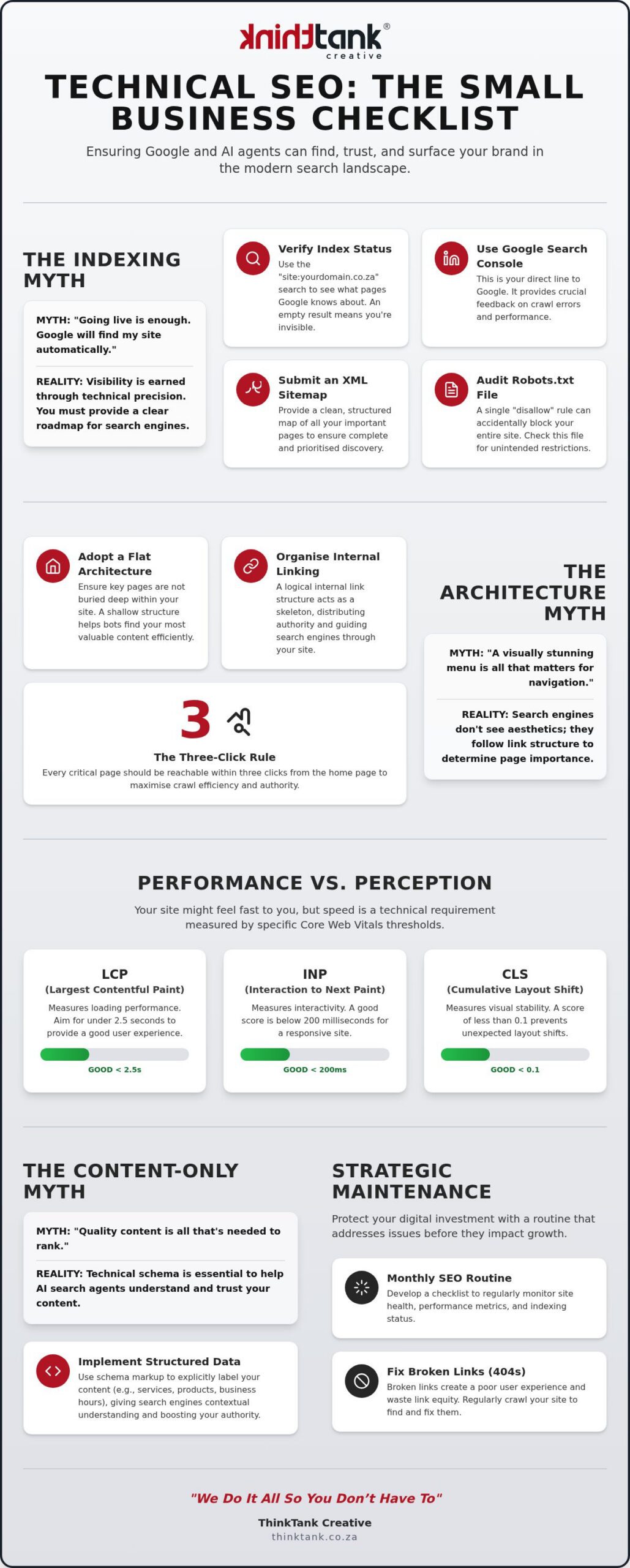
Launch day often brings a sense of relief, but it's usually followed by a confusing silence. Many entrepreneurs believe the myth that once a site is live, Google automatically finds and ranks it. Search engines aren't psychic; they require a structured roadmap and explicit permission to explore your pages. Visibility is earned through technical precision, not just existence. Understanding the foundations of Search Engine Optimization (SEO) reveals that visibility is a deliberate outcome of strategic configuration rather than a lucky accident.

To better understand this concept, watch this helpful video:

A quick reality check involves the "site:yourdomain.co.za" test. By typing this into a search bar, you'll see exactly which pages Google has committed to its memory. If the results are sparse or non-existent, your business is effectively invisible. In 2026, the most common hurdle for small enterprises is the "crawled - currently not indexed" status. This indicates that while Google's bots have visited your site, they haven't deemed the technical health or content structure worthy of being served to users. Implementing a robust technical seo checklist for small business starts with verifying this indexation status to ensure your foundations are secure.

The Essential Indexing Toolkit

Your journey toward visibility requires the right diagnostic tools. Setting up Google Search Console provides the only honest view into your search performance, offering direct feedback from the algorithm itself. You must submit a clean XML sitemap to ensure every service page is discovered and prioritised. Additionally, audit your Robots.txt file. A single accidental "disallow" rule can hide your entire site from the world, turning your digital investment into a ghost ship. At ThinkTank Creative, We Do It All So You Don't Have To, ensuring these technical gatekeepers are always working in your favour.

Reasons My Business Is Not Showing Up on Google

When a site fails to appear, the culprit is often found in the code. A common oversight is the presence of "noindex" tags, often left over from the development staging site by mistake. Security issues or manual actions can also lead to sudden de-indexing, requiring a professional eye to resolve. Duplicate content caused by multiple URL versions, such as the conflict between www and non-www addresses, confuses search bots and dilutes your authority. Addressing these overlaps is a critical step in any technical seo checklist for small business, as it ensures search engines see one clear, authoritative version of your brand.

The Architecture Myth: Why Your Site Navigation Might Be Blocking Google

Aesthetic appeal often masks structural decay. Whilst a visually stunning menu might impress your visitors, it offers little value to a search engine if the underlying hierarchy is convoluted or illogical. Search engines don't see the colours or the sleek animations; they follow link equity to determine which pages are important. If a page isn't linked properly within your site's framework, it effectively doesn't exist to the bots that decide your ranking. As noted in foundational guides regarding SEO for Small Business, your site structure is the skeleton that supports all your other marketing efforts.

Adopting a flat site architecture is a strategic move that allows smaller brands to compete with national players. We recommend the "Three-Click Rule," which ensures every critical service or product page is reachable within three clicks from the home page. When your architecture is deep and buried, link authority dissipates before it reaches your high-value content. By keeping your structure shallow, you ensure that search engines can crawl your site efficiently and index your most important offerings without getting lost in a digital labyrinth. Including this structural audit in your technical seo checklist for small business ensures your site remains accessible and authoritative.

Organising Your Digital Hierarchy

Precision in your hierarchy helps both users and bots understand the relationship between your pages. Breadcrumbs act as an essential orientation tool, providing a clear path back to the home page whilst signalling page depth to search engines. You must also identify and fix "orphan pages," which are those isolated sections of your site with no internal links pointing to them. These pages are invisible to crawlers and provide zero SEO value. Additionally, ensure your URL slugs are descriptive and clean. A slug like /services/website-design-development/ provides immediate context, whereas a generic string of numbers offers no strategic benefit. If you're unsure where your site structure stands, our team can help you organise your digital presence for maximum impact.

The Role of Internal Linking

Internal linking is the mechanism that distributes authority across your domain. Use keyword-rich anchor text to link from your high-traffic blog posts to your core service pillars, building topical authority as you go. This practice tells Google exactly what the target page is about whilst helping visitors discover more of your expertise. Internal link equity serves as the primary currency of your website architecture, distributing authority from your most popular pages to those that drive conversions. By meticulously mapping these connections, you create a web of relevance that is difficult for competitors to ignore. This level of detail is a cornerstone of any comprehensive technical seo checklist for small business, transforming a simple website into a powerful lead-generation tool.

Performance vs. Perception: Why Speed is a Technical Requirement

Many small business owners believe that a slightly sluggish website is merely a minor inconvenience for their visitors. This perception is a dangerous myth that can cripple your search presence before you've even begun. Google prioritises user experience above all else, treating site speed as a direct and non-negotiable ranking factor. If your site doesn't load quickly, it doesn't matter how high the quality of your copy is; you'll be penalised and pushed down the rankings. Following a comprehensive technical SEO guide for small business helps you move past the "Content is King" mantra to realise that performance is the actual foundation of your digital authority.

Understanding Core Web Vitals in 2026

Google's metrics have evolved to measure real-world user behaviour with extreme precision, focusing on how a page feels rather than just how it loads. The Largest Contentful Paint (LCP) requires your main content to appear in under 2.5 seconds, whilst current 2026 standards suggest a target of 2.0 seconds for those aiming for elite status. Interaction to Next Paint (INP) measures the delay of every user interaction, ensuring your site reacts instantly to a click or a tap. Finally, Cumulative Layout Shift (CLS) prevents the annoying "jumping" of content as images load. These aren't just abstract numbers; they're the technical benchmarks that stop Google from ignoring your hard-earned traffic. For a deeper understanding of how these metrics apply locally, our dedicated guide to core web vitals for South African websites provides a strategic roadmap tailored to our unique digital environment.

Optimising for the National User

In our national context, performance is not just about pleasing an algorithm; it's about accessibility and resilience. Our digital landscape is defined by high mobile data costs and the persistent challenge of load shedding, which can impact server uptime and connection stability. A lightweight, efficient site performs better for users on limited data plans or those trying to access your services between power cuts. Choosing a server location with national proximity is a strategic decision that reduces latency and ensures your site remains responsive when your customers need it most. This focus on the end-user is a vital component of any technical seo checklist for small business.

Modern image optimisation is another pillar of a successful strategy. Moving beyond outdated JPEGs to next-gen formats like WebP can reduce file sizes by up to 30% without sacrificing visual quality, which is essential for a mobile-first world. However, technical performance isn't a one-time fix. It requires high-quality website maintenance and support to ensure your plugins remain updated and your code stays clean. We handle these intricate details with a sense of quiet assurance, ensuring your brand remains fast, responsive, and ready for growth in any environment.

Technical SEO Checklist for Small Business: Debunking the Myths of Search Invisibility

Many business owners believe that high-quality prose is the final frontier of search visibility. Whilst compelling copy engages human readers, AI agents like ChatGPT and Google Gemini require a different kind of clarity to function effectively. These systems rely on structured data to ground their responses in verifiable facts, ensuring that the information they provide is accurate and sourced from reliable domains. If your site lacks this technical layer, even your most insightful articles may remain invisible to the generative engines that define the search landscape of 2026.

Technical SEO has evolved from simply ranking in a list to becoming the cited source in an AI-generated answer. Small businesses can win this race by being the most readable and reliable source of truth within their specific niche. By following a robust technical seo checklist for small business, you provide the structural clarity these machines crave, moving your brand from the shadows into the spotlight of modern search. This approach transforms your website from a static brochure into a dynamic data source that search engines can trust and surface with confidence. Understanding what makes a good business website in 2026 means recognising that technical precision and content quality must work together as a unified strategy.

Essential Schema for Small Businesses

Precision in your structured data allows you to claim digital space that competitors often overlook. Organisation Schema is the first step, defining your brand identity, logo, and national contact details for search engines. Service Schema goes further, telling the algorithm exactly what you sell and who your target audience is. Whilst Google retired visual FAQ rich results in May 2026, implementing FAQ Schema remains a vital strategy; it helps AI systems understand the depth of your expertise and can still capture valuable real estate in "People Also Ask" sections. Including these elements in your technical seo checklist for small business ensures your brand is not just indexed, but deeply understood.

Preparing for Generative Engine Optimisation (GEO)

The transition toward generative engine optimisation requires a meticulous approach to your site's underlying code. AI crawlers prefer clean HTML that allows them to parse text without getting stuck in bloated scripts or outdated tags. Security also plays a vital role in this new era, as HTTPS and valid SSL certificates serve as essential trust signals for AI grounding. Schema acts as the translator between your bespoke business language and complex machine logic, ensuring your data is surfaced accurately across all platforms. To ensure your site is ready for this evolution, partner with our SEO experts to build a future-proof foundation that handles the complexity whilst you focus on your growth.

Strategic Maintenance: Developing Your Monthly Technical SEO Routine

Achieving a high ranking is a significant milestone, but maintaining that position requires constant vigilance and precision. There's a common misconception that SEO is a project with a definitive finish line, yet the reality of the digital space is far more fluid. Technical decay is an inevitable byproduct of a growing site; broken links, bloated plugins, and outdated code accumulate naturally as your business evolves. By adopting a proactive mindset, you protect your digital assets from the slow erosion of performance that often leads to a sudden loss in visibility. Investing in a consistent routine is always more cost-effective than an emergency SEO rescue after your traffic has already plummeted.

Your Monthly Technical SEO Checklist

A disciplined technical seo checklist for small business transforms maintenance from a chore into a strategic advantage. This routine allows you to catch minor issues before they escalate into systemic failures that alienate both users and search engines. We recommend a methodical approach to your monthly health checks:

Factoring in these recurring tasks prevents the accumulation of technical debt, ensuring your website remains a stable platform for your marketing efforts.

When to Call in the Experts

Whilst routine checks are manageable, certain digital bottlenecks require the intervention of a seasoned partner. Complex issues such as redirect loops, server-side performance drags, or database optimisations can be difficult to diagnose without specialised tools and deep technical expertise. If your rankings have plateaued despite producing high-quality content, it's often a sign that deeper architectural issues are hindering your progress.

At ThinkTank Creative, we provide a meticulous end-to-end process that spans from initial research to launch and comprehensive ongoing support. We believe in building long-term relationships where we handle the intricate plumbing of your digital presence whilst you focus on your core vision. We Do It All So You Don't Have To, ensuring your brand remains elite, dependable, and perfectly positioned for the AI-driven search landscape of 2026. By combining our award-winning design with technical excellence, we help you turn search invisibility into a thing of the past.

Elevating Your Digital Presence for the AI Era

Securing a prominent position in the digital landscape requires more than just high-quality content; it demands a foundation built on technical excellence and structural integrity. By implementing a robust technical seo checklist for small business, you ensure that your architecture is logical, your performance is optimised for Core Web Vitals, and your data is perfectly translated for AI agents. This strategic approach transforms your website from a quiet digital brochure into a powerful, visible asset that search engines can trust and surface with confidence. It's about moving beyond simple visibility to achieve a state of digital authority that lasts.

As a top all-rounder agency in South Africa since 2001, ThinkTank Creative brings over 25 years of experience to every project. Our award-winning design and development team is dedicated to handling the complex digital plumbing that keeps your brand moving forward. We provide bespoke solutions where estimated costs are provided after a detailed discussion of your unique needs. We Do It All So You Don't Have To, allowing you to focus on your vision whilst we secure your growth. Partner with ThinkTank Creative for a comprehensive SEO strategy and begin your journey toward lasting search visibility today.

Frequently Asked Questions

Why is my business not showing up on Google after my website launch?

Your site may not be showing up because search engines haven't crawled your pages or have been blocked by technical barriers. This often happens if you haven't submitted an XML sitemap or if a "noindex" tag was accidentally left in the code from the development stage. Google needs a clear roadmap to find you. Without these essential signals, your professional website remains invisible to the very customers you're trying to reach.

How long does it take for technical SEO changes to affect my rankings?

Technical SEO changes usually take between a few days and several weeks to reflect in search results. The timeline depends entirely on how often Google crawls your specific domain. Whilst smaller sites might see a slower response, larger sites with high authority are indexed more frequently. You can accelerate this process by manually requesting indexation through Google Search Console after you've implemented critical fixes to your site's infrastructure.

Do I need a technical SEO checklist if I use a platform like Wix or Shopify?

You absolutely need a technical seo checklist for small business even when using closed platforms like Wix or Shopify. Whilst these systems handle basic hosting and server security, they don't automatically organise your site hierarchy or implement bespoke schema markup. You're still responsible for managing URL structures, internal linking, and image optimisation. Relying solely on a platform's default settings often leads to a generic, underperforming presence that fails to compete.

What is the difference between on-page SEO and technical SEO?

On-page SEO focuses on the visible content and keywords your visitors read, whilst technical SEO handles the invisible infrastructure that search engines crawl. Think of on-page SEO as the beautiful interior design of a house and technical SEO as the essential plumbing and foundations. Both must work in synergy to achieve success. If your foundations are cracked, even the most compelling copy won't be enough to secure a top ranking.

Can a slow website really stop my business from showing up on Google?

A sluggish website can definitely prevent your business from appearing in top search results. Google prioritises user experience, and their Core Web Vitals update directly penalises sites that fail to load quickly on mobile devices. If your page takes too long to respond, visitors will bounce back to the search results, signalling to the algorithm that your site is not a high-quality destination for national users on limited data plans.

Is technical SEO a one-time cost for small businesses?

Technical SEO is not a one-time investment but an ongoing commitment to your site's health. Digital infrastructure naturally decays as plugins update, links break, and search algorithms evolve. Regular maintenance prevents these minor issues from turning into major ranking drops. At ThinkTank Creative, we provide continuous support to ensure your site remains fast and secure, protecting your long-term marketing investment from the risks of technical obsolescence.

How does the POPI Act affect technical SEO for South African websites?

The POPI Act impacts technical SEO by making website security and data privacy essential trust signals. Implementing SSL certificates and secure data handling isn't just a legal requirement; it's a technical necessity that tells search engines your site is safe for South African users. Google's algorithms increasingly prioritise secure domains, meaning that a failure to comply with privacy standards can indirectly damage your search visibility and brand reputation.

What is schema markup and why does my small business need it for AI search?

Schema markup is a specific vocabulary of code that helps search engines and AI agents understand the context of your content. By using this structured data, you provide a clear "translator" for machine logic, allowing AI systems to ground their answers in your business facts. This is vital for appearing in AI-driven search results, as it ensures your services and contact details are surfaced accurately across the modern digital landscape. To build a truly high-performance platform, it helps to first understand what makes a good business website at a foundational level, combining technical rigour with strategic design.

15 Critical Signs You Need a New Website in 2026: The Strategic Checklist

If your website were an employee on your sales team, would you be celebrating their targets today, or would they be facing a performance review? It is a confronting thought, but in the sophisticated digital environment of 2026, a platform that felt revolutionary a few years ago can quickly become a silent liability. You likely recognise the frustrating signs you need a new website, such as a dip in lead quality or a bounce rate that has climbed toward the current industry median of 47.4 per cent. It is common to feel a growing misalignment between your ambitious brand vision and a digital presence that no longer reflects your excellence.

We believe your website should be a bespoke masterpiece that evolves alongside your success. This guide provides a strategic checklist to help you audit performance bottlenecks and identify where your current site falls short of modern expectations. We will explore fifteen critical indicators, including WCAG 2.2 accessibility standards and the latest proactive POPIA compliance requirements, to give you total clarity on your next steps. This journey will move you from technical uncertainty to a position of quiet assurance, ready to craft a digital experience that truly resonates with your audience and restores your competitive edge.

Key Takeaways

  • Audit your digital performance against 2026 technical benchmarks to ensure that sluggish loading speeds and outdated Core Web Vitals are not driving potential clients toward your more modern competitors.
  • Recognise the critical signs you need a new website by identifying friction points in your customer journey that lead to declining lead quality and high bounce rates.
  • Align your digital presence with the latest WCAG 2.2 accessibility standards and proactive POPIA compliance to protect your brand reputation and foster trust amongst your users.
  • Bridge the visual disconnect between your evolving corporate identity and your current site, ensuring your online platform accurately reflects your status as an industry leader.
  • Master the strategic transition to a new platform using a collaborative five-stage development process designed to create a bespoke digital asset tailored for long-term growth.

Performance and Technical Obsolescence

Performance is the silent heartbeat of your brand's digital presence. In 2026, user patience has reached an all-time low. If your pages hesitate for even a few seconds, you're effectively handing your leads to a more agile competitor. This technical friction is one of the most undeniable signs you need a new website. Often, the culprit is a gradual build-up of technical obsolescence. Legacy code and unmaintained plugins behave like digital anchors, dragging down server response times and creating a fragile architecture prone to glitches.

Evaluating your site against 2026 Core Web Vitals is no longer optional. Google's focus on metrics like Interaction to Next Paint (INP) means that stability and responsiveness are now primary ranking signals. Frequent downtime isn't just a nuisance; it's a direct hit to your bottom line and brand authority. We've seen how inconsistent performance erodes the trust you've worked hard to build. A modern site must be resilient, ensuring your brand is always available when your customers need you most. This quiet assurance in your technical foundation allows your business to scale without the constant fear of a digital breakdown.

Mobile-First Functionality for ZA Users

South Africa's digital landscape is uniquely mobile-centric. Whilst global mobile traffic averages 59.6 per cent, local users frequently access the web via mobile data networks where every kilobyte counts. The cross-industry median bounce rate for mobile is currently 51.8 per cent, highlighting how quickly users abandon sites that don't perform. A site that is simply "responsive" often fails the 2026 mobile-first test. True mobile excellence requires bespoke craftsmanship, focusing on thumb-friendly navigation and generous touch-target spacing. If your mobile experience feels like a cramped version of your desktop site, you aren't meeting the needs of your audience. Fast loading on 4G and 5G networks is essential for maintaining engagement in a competitive market.

Outdated Content Management Systems

Your CMS should be a catalyst for growth, not a barrier to entry. Many businesses remain tethered to end-of-life platforms or restrictive systems that make content updates a technical ordeal. With WordPress powering 42.4 per cent of the web in 2026, the standard for ease-of-use is high. An outdated CMS isn't just difficult to manage; it's a security risk. End-of-life systems lack the patches needed to defend against modern threats, leaving your data vulnerable. Recognising that your platform limits your marketing agility is one of the key signs you need a new website. If updating a simple blog post requires a developer's intervention, your team's ability to react to market trends is being compromised.

Stagnant Conversion and User Behaviour

High traffic volume is a vanity metric if it fails to catalyse meaningful business growth. If your analytics show a steady stream of visitors but your inbox remains quiet, you are witnessing a classic disconnect between visibility and value. This stagnation is one of the most pressing signs you need a new website because it suggests your digital storefront is no longer persuasive. Great marketing isn't just about shouting louder; it is about making your customers look smart for choosing you. With global e-commerce conversion rates averaging just 2.74 per cent in 2026, every percentage point represents a significant shift in revenue. When a site feels intuitive and professional, it validates the user's decision to engage, whilst a clumsy interface creates immediate doubt.

Analysing where these friction points occur requires a methodical approach. By consulting a strategic checklist for a new website, you can begin to pinpoint whether the issue lies in your messaging, your layout, or a fundamental breakdown in user experience. We often find that businesses possess excellent products but present them through a digital lens that feels dated or difficult to navigate. This misalignment prevents you from reaching your full digital potential and keeps your conversion rates anchored to the floor. Recognising these signs you need a new website early allows you to pivot before the gap between you and your competitors becomes insurmountable.

High Bounce Rates and Low Engagement

Your bounce rate acts as a direct feedback loop from your audience. In 2026, the cross-industry median bounce rate sits at approximately 47.4 per cent, but a figure significantly higher than this often indicates user frustration. Cluttered layouts and confusing navigation menus force visitors to work too hard to find what they need. We recommend using heatmaps to observe exactly where users lose interest or encounter barriers. If people are dropping off before they even scroll, your "above the fold" content isn't doing its job. A clean, purposeful design respects the user's time and encourages deeper exploration of your brand's story.

Friction in the Customer Journey

A seamless path from discovery to enquiry is the hallmark of elite digital craftsmanship. If your calls-to-action are buried at the bottom of long paragraphs or use uninspiring language, you are missing vital opportunities to convert. Every click should feel like a natural progression toward a solution. This is where a sophisticated custom website design South Africa strategy becomes invaluable. It ensures that your user experience (UX) is not an afterthought but a core component of your business logic. By removing technical and cognitive hurdles, you empower your visitors to move confidently through your sales funnel. If you suspect your current journey is more of a maze than a motorway, it might be time to reimagine your digital presence with a partner who understands the nuances of conversion-driven design.

Brand Evolution and Identity Mismatch

Your business is a living entity that matures, adapts, and reaches new milestones. If your online presence remains frozen in a version of your company from five years ago, you are projecting an identity mismatch that confuses potential clients. This visual disconnect is one of the subtle yet profound signs you need a new website. When a prospect meets your high-calibre team or sees your polished corporate identity but finds a dated, uninspired website, their trust in your capabilities begins to waver. A professional redesign isn't merely a cosmetic upgrade; it is a strategic realignment that ensures your digital home reflects the excellence you've achieved today.

Evaluating your site's appeal to your primary target audience is a vital exercise in brand health. As markets shift, the visual language that once resonated may now feel disconnected from the expectations of your ideal customer. A professional redesign elevates your credibility amongst competitors, positioning you as a forward-thinking leader rather than a legacy player. We believe in a collaborative approach that treats your website as a dynamic asset capable of expressing your brand's full potential. By closing the gap between who you are and how you appear online, you create a foundation for sustained growth and deeper client relationships.

Outgrowing Your Digital Identity

Success often brings a diversification of services that your original site was never built to accommodate. If you find yourself struggling to showcase new offerings because the layout is too rigid, you've outgrown your digital architecture. Our award-winning design team specialises in creating a bespoke visual language that captures the unique essence of your brand. By integrating sophisticated logo and corporate identity design into your platform, we move away from templated solutions toward a tailored experience. This synergy between your physical brand and your digital presence ensures you never miss an opportunity to demonstrate your full range of expertise.

The Good vs Great Marketing Gap

Great marketing makes your customers look smart for choosing you. It shifts the narrative from a company-focused "about us" page to a customer-focused journey of transformation. Whilst good marketing tells people what you sell, great marketing uses customer-centric storytelling to build deep, lasting trust. Your website must act as a true reflection of your brand's excellence, positioning you as a collaborative partner in your client's success. If your current site feels like a static brochure rather than an engaging experience, it is one of the clear signs you need a new website. We focus on bridging this gap, ensuring that every interaction on your site reinforces your status as an industry visionary.

15 Critical Signs You Need a New Website in 2026: The Strategic Checklist

Accessibility, Security, and POPI Compliance

Integrity in the digital age is measured by how well you protect your users and how inclusive you make their experience. In 2026, failing to meet modern accessibility and security standards isn't just a technical oversight; it's a significant risk to your brand's reputation. As the South African Information Regulator moves toward proactive enforcement of the POPI Act, ensuring your data collection methods align with current regulations has become a business imperative. A platform that feels like a 'black box' regarding privacy or excludes users with disabilities is one of the most serious signs you need a new website. True brand transformation requires a foundation built on trust, excellence, and meticulous attention to legal requirements.

Protecting your brand reputation through robust security measures is a collaborative effort that begins with your site's architecture. We've seen how legacy platforms become targets for sophisticated threats, often due to outdated protocols or unsupported plugins. Beyond the technical fixes, there is an ethical necessity to ensure your digital presence is welcoming to all. By aligning your site with 2026 technical benchmarks, you project a personality that is both elite in its execution and deeply invested in the user's journey. This quiet assurance in your site's safety allows you to focus on growth whilst we handle the complexities of digital defence.

Meeting 2026 Accessibility Standards

Inclusive design has evolved from a tick-box exercise into a competitive business advantage. Meeting WCAG 2.2 AA standards ensures that your site is navigable for everyone, including those using screen readers or alternative input devices. This focus on clarity and structure provides a significant boost to your search engine optimisation South Africa strategy, as search engines increasingly reward sites that offer superior user experiences. By prioritising high colour contrast and logical heading structures, you invite a wider audience to engage with your brand whilst demonstrating an ethical commitment to digital equity.

Security Vulnerabilities and POPI Compliance

Security is the quiet guardian of your professional relationships. For South African enterprises, the proactive monitoring by the Information Regulator means that standard SSL certificates are no longer the finish line. Your site must handle personal data according to the eight conditions for lawful processing, particularly following the new health information regulations that came into force on 6 March 2026. If your current platform lacks robust security safeguards or relies on unsupported legacy code, these are critical signs you need a new website. We believe that ongoing maintenance and support are essential to prevent breaches before they occur, protecting both your data and your hard-earned credibility. To ensure your digital presence is both secure and compliant, we invite you to partner with our expert development team and secure your brand's future.

Transformation begins with a single, decisive step toward clarity. Once you recognise the signs you need a new website, the focus shifts from diagnosing the problem to architecting a solution that elevates your brand. We approach every project through a meticulous five-stage development process: strategy and planning, creative design, technical development, testing, and the final launch. This methodical cadence ensures that every pixel and line of code serves a specific business purpose. Our philosophy of 'We Do It All So You Don’t Have To' means you can focus on your core operations whilst we handle the intricate details of your digital evolution.

Defining Strategic Objectives

Setting measurable goals for traffic, leads, and brand engagement transforms your website from a digital brochure into a high-performing asset. We collaborate with you to define objectives that challenge the status quo, ensuring your new platform isn't just an iteration of the old one but a bold leap forward. Research and strategy form the bedrock of this phase, allowing us to align your brand identity with the technical requirements of the 2026 digital space. Identifying these signs you need a new website is simply the catalyst for a much larger transformation. This phase is about looking beyond the immediate horizon to see what your brand could truly become with the right tools and a clear roadmap.

Selecting a Collaborative Creative Partner

Synergy between design and code is most effectively achieved with an integrated, multidisciplinary team. Our award-winning team of in-house graphic and web designers work alongside our developers to ensure the vision we create together is executed with precision. We've been refining this collaborative approach since 2001, positioning ourselves as a partner in your journey of imagination. This elite level of craftsmanship avoids the 'templated' feel of many modern sites, offering instead a bespoke solution that feels as unique as your business. The relationship doesn't end at launch; we highlight the importance of ongoing support and maintenance to ensure your site remains a top-tier performer in an ever-changing market. Because every business has unique requirements, an estimated cost is provided only after we've discussed your bespoke needs and strategic goals. This ensures the value we provide is perfectly tailored to your specific journey of growth.

Elevate Your Digital Presence for 2026

Your website is more than a digital placeholder; it's the primary engine of your business growth. By identifying the technical and strategic signs you need a new website, you've taken the first step toward reclaiming your competitive advantage. Whether you're addressing stagnant conversion rates or ensuring your platform meets the latest POPIA and accessibility standards, the path forward requires a blend of technical precision and inspired creative vision. We believe every brand deserves a bespoke digital home that reflects its true excellence and maturity.

ThinkTank Creative has been guiding South African businesses through this journey of imagination since 2001. With 25 years of expertise, our all-rounder team utilises a proven 5-stage development process to ensure your project moves smoothly from concept to a high-performing launch. We invite you to discuss your vision with our award-winning design team and discover the potential for your brand's transformation. The future of your digital presence is a collaborative journey, and we're ready to partner with you to achieve extraordinary outcomes.

Frequently Asked Questions

How often should a business website be redesigned?

Most businesses should consider a redesign every two to three years to keep pace with rapid technological shifts and evolving user expectations. In 2026, the acceleration of AI-driven design and performance standards means a platform can feel dated faster than in previous cycles. Regular audits help you identify the technical signs you need a new website before your competitors gain a significant lead. This steady cadence ensures your brand remains a modern, authoritative leader.

What are the most common signs that my website is outdated?

Sluggish loading times, high bounce rates, and a visual disconnect from your current brand identity are the primary indicators of obsolescence. If your site is difficult to update or fails to convert mobile traffic effectively, these are undeniable signs you need a new website. You might also notice that your platform lacks modern accessibility features or fails to meet proactive POPIA compliance standards, creating both ethical and legal risks for your South African enterprise.

Can a slow website affect my search engine rankings in South Africa?

Performance is a critical ranking signal for search engines, especially considering South Africa's mobile-first user base. With mobile devices accounting for 59.6 per cent of global traffic in 2026, a slow site directly impacts your visibility. Search engines reward platforms that offer superior Core Web Vitals and stable user experiences. A sluggish site leads to higher bounce rates, signalling to algorithms that your content might not be the best result for users.

What is the difference between a website refresh and a full redesign?

A refresh focuses on cosmetic updates like new imagery or typography, whilst a full redesign involves a complete structural and technical overhaul. Think of a refresh as a new coat of paint and a redesign as rebuilding the foundation for better performance. If your current architecture is technically obsolete or fails to support your strategic goals, a full redesign is essential. This process allows for deeper integration of modern security protocols and bespoke user journeys.

How does the POPI Act affect my website design?

POPIA requires your website to handle personal data with transparency and robust security safeguards. Your design must include clear privacy policies and active consent mechanisms for data collection. Following the new health information regulations that came into force on 6 March 2026, the Information Regulator has intensified enforcement. A compliant design ensures that user data is processed according to the eight conditions for lawful processing, protecting your brand's hard-earned reputation and credibility.

Is it better to use a DIY builder or a professional agency for a redesign?

DIY builders offer speed but often lack the bespoke craftsmanship and strategic depth required for high-level brand transformation. A professional agency provides an integrated team of designers and developers who ensure technical excellence and brand alignment. This collaborative approach results in a tailored digital asset that scales with your business. For enterprises seeking a sophisticated, secure, and compliant presence, the expertise of a seasoned partner is a vital investment in long-term success.

What should I prepare before contacting a web design agency?

Clear strategic objectives and an understanding of your target audience are excellent starting points. Gather your current brand assets, such as logos and corporate identity guidelines, to help your partner understand your visual language. It's also helpful to identify specific pain points in your current user journey or performance bottlenecks you've observed. Coming prepared with measurable goals allows us to move efficiently into the research and strategy phase of our collaborative 5-stage development process.

How long does a professional website redesign typically take?

A bespoke redesign usually takes between 12 to 24 weeks depending on the project's complexity and your specific requirements. This timeframe allows for our thorough methodology, ensuring that every phase from initial strategy to final testing is handled with precision. We avoid rushing the journey of imagination to ensure the final product is a stable, high-performing asset. A methodical pace guarantees that your new site is built for long-term endurance in a competitive digital market.