Social media content ideas for small businesses that connect

A feed built around one kind of post can leave a business’s personality and expertise unseen. The strongest social media content ideas for small businesses combine behind-the-scenes moments, cross-promotion, customer recognition, practical tutorials and competitor research. Together, these formats help content feel more varied, relevant and connected to the people a business wants to reach.

It makes sense to want posts that do more than fill a calendar. Social media content works harder when each format has a purpose: introducing the people behind the business, answering a customer question or celebrating a positive review. A social media professional can shape these ideas into a considered plan that reflects your brand and speaks to your audience.

Explore how different content types can support a more engaging social presence, from showing how your business works to sharing useful advice and recognising customers. You’ll also see how competitor research can inform original content without simply copying what others post.

Key Takeaways

  • Use behind-the-scenes moments to show the people, process and personality that make your business distinctive.
  • Plan cross-promotion so social posts and email support one another, rather than competing for attention.
  • Recognise customers and share positive feedback to make your online community feel valued.
  • Turn common questions into practical tips and tutorials that demonstrate your expertise.
  • Use competitor research to spot content gaps and shape original posts around your audience’s needs.

1. Behind-the-scenes content

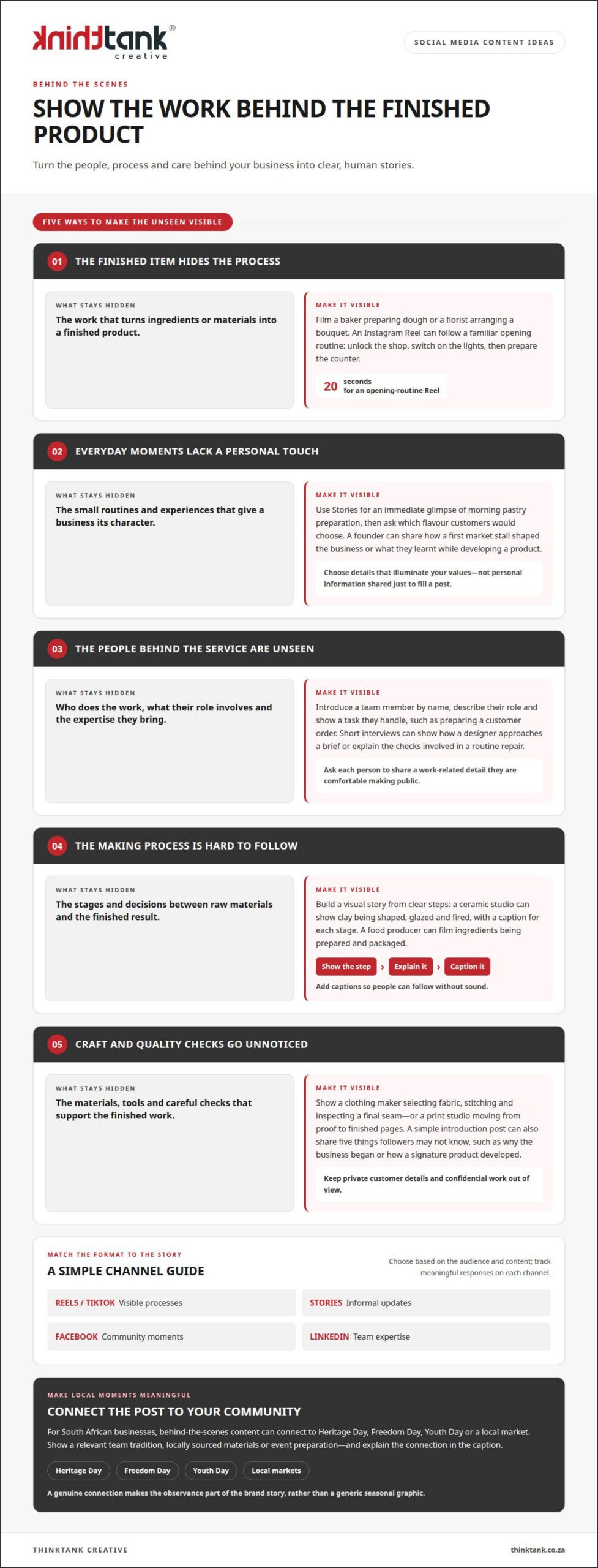
Show the work behind the finished product. A short clip of a baker preparing dough or a florist arranging a bouquet gives the audience a closer view of the process. For Instagram, a 20-second Reel of the opening routine can capture a familiar sequence: unlocking the shop, switching on the lights and preparing the counter. The detail makes the scenes recognisable, while the routine gives viewers a reason to watch through.

Stories can make these moments feel immediate. A café might share the morning’s pastry preparation, then add a poll asking which flavour customers would choose. Personal experiences can add context: a founder could explain how a first market stall shaped the business or what they learnt while developing a product. Choose details that illuminate the brand’s values, rather than sharing personal information just to fill a post.

Introduce the people behind the service, too. A team post could name a staff member, describe their role and show one task they handle, such as preparing a customer order. Short interviews can reveal useful details: a designer might explain how they approach a brief, while a mechanic describes the checks involved in a routine repair. Ask each person to share a work-related detail they are comfortable making public.

How-it’s-made posts turn a sequence of steps into a clear visual story. A ceramic studio could show clay being shaped, glazed and fired, with captions explaining each stage. A food producer might film ingredients being prepared and packaged. Keep the camera focused on the process, and add captions so viewers can follow without sound. These examples help people see the care and decisions behind the finished product.

Production content can also feature tools, materials and quality checks. A clothing maker could show fabric selection, stitching and a final seam inspection; a print studio could show a design moving from proof to finished pages. Avoid revealing private customer details or confidential work. For a simple introduction post, share five things about the business that followers may not know, such as why it began or how a signature product developed.

On Instagram, Facebook, TikTok and LinkedIn, choose formats that suit the story: Reels or TikTok clips for visible processes, Stories for informal updates, Facebook posts for community moments, and LinkedIn posts for team expertise. The most engaging option depends on the audience and the content, so track meaningful responses on each channel.

South African businesses can connect behind-the-scenes posts to Heritage Day, Freedom Day, Youth Day or a local market. Show a relevant team tradition, locally sourced materials or event preparation, and explain the connection in the caption. A genuine link makes the observance part of the brand story, rather than a generic seasonal graphic.

2. Cross-promotion across social platforms and email

Give each platform a role, then connect content so interested customers can follow the story. A business could publish a product highlight on Instagram, share a useful excerpt from its blog on Facebook, and send subscribers an email with further details. Cross-promotion works best when each version suits its platform, rather than repeating identical copy everywhere.

For a South African campaign, use content you own or have permission to share, protect identifiable customer information, and make promotional incentives clear. Keep product descriptions and advertising claims accurate. These practices help a professional plan content responsibly across social channels and email.

Choose formats that make the offer easy to understand. An infographic can explain a service process or compare product features, while a podcast excerpt can introduce an expert opinion. A blog post can provide fuller detail, with social posts highlighting a useful takeaway and directing interested followers to the relevant page. A customer quote can add a human perspective, provided you secure permission before sharing it.

Promotions should offer a clear reason to act. A retailer might highlight a seasonal product, while a service business could explain what an introductory offer covers. Contests and giveaways can encourage participation and invite people to join an email list. For example, a business could offer a 15-minute coaching call as a prize, then promote the entry details across its platforms and email. The campaign should state the entry conditions plainly and make the next step easy to find.

Posting frequency should reflect your audience’s habits, each platform’s purpose and the content you have available. A professional can review channel performance and production capacity, then set a sustainable cadence rather than applying the same schedule everywhere. A content calendar brings the plan together: it maps campaign dates, platform formats, email sends, product highlights and review points. It also leaves room to respond to relevant news or customer questions.

To measure performance and return on investment, align metrics with the campaign goal. Reach and interaction can indicate whether content attracts attention; tracked links, enquiries and sales can show whether that attention leads to action. Comparing campaign results with the resources invested gives the business a clearer view of value. Use the findings to inform the next calendar, including which messages to refine or reuse.

For businesses that need a coordinated plan across social platforms and email, professional social media marketing can connect content choices to business objectives.

3. Follower recognition and customer testimonials

Make customers part of the story, not just the audience. A thoughtful reply to a positive post shows followers that their feedback matters. For example, a coffee shop could thank a customer who shared a photograph of their takeaway cup, then ask permission before featuring it. This turns a real interaction into content while keeping recognition personal and respectful.

User-generated content is unsponsored social media content shared by a business or its followers across social platforms. It might include customer photos, short videos or a post describing a service experience. A professional can identify relevant posts, confirm permission to reuse them and add a brief caption explaining the context. This gives prospective customers a genuine view of how people experience the business.

Reviews can provide useful social proof when they are shared with care. A post might quote a customer praising a local clothing shop’s helpful fitting service, alongside the review’s original meaning and attribution. Keep the wording accurate, avoid implying that one person’s experience represents everyone’s, and respond constructively to criticism. A considered reply can show how the business handles concerns, not only compliments.

Testimonials work in several formats. A short quote can sit on a branded graphic, while a video can let a customer explain what they valued in their own words. For a home bakery, a testimonial might describe the ordering process and the presentation of a celebration cake. Choose feedback that illustrates a specific strength, rather than publishing praise without useful detail.

Customer support questions can also become helpful posts. A professional can review FAQs and recurring questions recorded by sales or support teams, then shape clear answers into captions, carousel posts or short videos. For instance, a local salon could explain how to prepare for an appointment, while avoiding customer names or private details. This turns repeated enquiries into accessible information for followers.

Recognition can mark community milestones as well as individual contributions. When a business reaches 1,000 followers, a thank-you post can celebrate the people who helped build its community. Another idea is a shoutout to its top five fans, with a specific reason for recognising each person. Thoughtful details make the acknowledgement feel sincere instead of like a standard promotional graphic.

A content plan should balance reviews, customer photos, support answers and direct appreciation. Rotate formats, match each post to a relevant product or service, and invite followers to contribute their experiences. For example, a garden centre could ask customers to share photos of plants bought there, then feature selected submissions and thank each contributor. This creates a continuing conversation grounded in real customer voices.
Social media content ideas for small businesses that connect

4. Educational tips and tutorials

Teach one useful skill at a time, and make each post easy to apply. A hardware shop could publish a short video showing how to use a new drill safely for a basic household task. A bookkeeper might explain an invoice term in a caption, then add an example using a fictional transaction. Clear, focused lessons give followers a practical reason to save or share a post.

For businesses with limited time and budget, a social media professional can build posts from existing expertise, common questions and simple demonstrations. A hair salon could turn an appointment question into a short tip, while a garden centre could explain how to identify dry soil. These ideas need useful knowledge and a clear format, not elaborate production.

Quick tips work well when they solve one small problem. A Pretoria vehicle workshop could share a checklist for preparing a car before a long drive, while a Durban guesthouse might explain how to pack for a coastal weekend. A professional can shape each tip around the audience’s needs, then use concise captions and showing-focused visuals to make the advice straightforward.

Some topics deserve a sequence rather than a single post. A professional could plan a five-day mini-course around a business speciality, with each lesson building on the previous one. For example, a nutrition practice might cover meal planning, ingredient labels and preparation routines. A seven-day mini-course in a Facebook group can create a longer learning journey and give participants space to discuss each lesson.

Useful resources can make tutorials more actionable. A property maintenance firm could share a seasonal home-care checklist, then explain one task in a short video. A stationery shop might demonstrate a simple weekly planning method using a notebook and pen. Show how the resource supports a real activity, rather than displaying products without context.

Life tips can connect expertise to everyday routines. A local optician could explain how to organise a work desk for comfortable screen use, while a coffee roaster might show how grind size affects a home brew. A social media professional can adapt these subjects into a carousel, a short video or a caption-led post, depending on the detail and audience.

Interactive prompts can turn education into participation. A career coach could ask followers to write down three work goals and aim to achieve at least one within a week. Follow-up content could offer a planning tip and invite people to share progress. This gives the series a clear purpose, supports engagement and makes success visible through audience responses.

5. Competitor research and content creation

Research competitors to find unanswered audience needs, not posts to reproduce. A social media professional can review public content from similar South African businesses, noting recurring themes, formats and questions in comments. For example, if local estate agents mainly post property listings, a useful gap might be practical explanations of viewing preparation or rental terminology. The opportunity lies in adding a distinct perspective, not copying their wording or visuals.

Start with the business goal and target audience. A Durban homeware shop might want more enquiries about custom orders, whilst a Johannesburg accountant may need to explain services clearly. The professional can select relevant competitors, assess how they present similar offers, and identify topics their own audience asks about. This keeps research focused on business relevance instead of collecting examples without a clear purpose.

Look beyond visible likes. Comments can reveal what followers find confusing, and repeated questions can point to content worth developing. If several posts about skincare attract questions about product order, a beauty retailer could create an original routine guide. If Instagram competitors rely on polished product images, a brand might stand apart by talking through materials, care or practical use in short videos.

Turn findings into a content brief. It should connect an audience need with the brand’s expertise, the intended format and a clear next step. For instance, a Cape Town tour operator could address questions about choosing a neighbourhood through a local guide carousel. A follow-up post might explain one area in greater depth. The professional keeps the message grounded in the business’s own knowledge and voice.

Competitor research also informs posting choices. If other businesses publish frequently but repeat the same message, you do not need to match their volume. Instead, plan varied, purposeful posts and use performance data to refine themes. Reach, saves, comments and enquiries each reveal different signals. The most useful measure depends on whether the content aims to inform, build awareness or prompt contact.

Keep research current through regular review, especially when customer questions or business priorities shift. A simple working record can capture a competitor’s topic, format, audience response and the content gap it suggests. Turn those observations into original ideas, check that examples fit the brand, and avoid treating another business’s popularity as proof that the same approach will work.

Use competitor insight as a starting point for distinctive creative work, not a template. Develop original content with tailored creative design that reflects your business’s own expertise and identity.

ThinkTank Creative: Social Media Marketing

ThinkTank Creative offers Social Media Marketing for businesses that want a more considered, consistent online presence. Turn to a social media professional when planning posts takes time, content feels disconnected from your brand, or competitor research could help inform a fresh direction. A tailored approach can bring behind-the-scenes stories, customer recognition, tutorials and promotional content together around your business goals and audience.

Strong social content also needs a cohesive visual identity. Creative design and Logo and Corporate Identity Design can align your posts with your wider brand, while Website Design and Development can support a consistent journey from social discovery to your online presence. The right combination depends on what your business needs to communicate.

To discuss social media marketing for your business, contact ThinkTank Creative.

Build a social presence that grows with your business

Your social presence can become a clearer expression of what your business stands for as your priorities and audience develop. Treat planning as an ongoing connection between brand strategy and customer insight: each conversation can reveal what people value, what they need explained and where your next opportunity lies. That perspective keeps social media content ideas for small businesses connected to real business direction, rather than simply filling a publishing schedule.

A professional can help translate those insights into a coherent approach, aligning social content with the wider customer journey. ThinkTank Creative brings social media marketing together with creative design and website development, so the experience can feel consistent from first discovery to further engagement. The right next step is a conversation about your goals, your audience and the role social media should play in your growth.

Contact ThinkTank Creative today to discuss a considered direction for your business. Your next stage of growth can begin with a clear, collaborative plan.

Frequently Asked Questions

Why should you use different types of social media posts?

Different post types let a business inform, entertain and invite action without making every update feel like an advert. A mix of formats can also suit different audience preferences: one follower may watch a brief demonstration, while another prefers a concise written tip. For social media content ideas for small businesses, variety gives each post a distinct purpose and helps the brand communicate beyond a single product or promotion.

How can a social media professional create engaging product and service posts for your business without making them sound too promotional?

Start with the customer’s need, then show how a product or service fits into a real situation. For example, a stationery business could demonstrate how a particular notebook helps organise meeting notes, instead of relying on repeated sales language. Clear captions, useful context and a restrained invitation to learn more keep the focus on value. Make the benefit understandable without overstating what the offer can do.

What user-generated content and customer testimonial ideas can small businesses use?

Invite customers to share how they use a purchase, what they enjoyed about an experience or what problem it helped them address. A craft shop might feature a customer’s finished project made with supplies from the shop, while a service business could publish a short testimonial about the experience from enquiry to completion. Ask permission before reposting, credit the contributor as agreed, and preserve the meaning of their original words.

Which content formats get the most engagement on Instagram, Facebook, TikTok and LinkedIn?

The article doesn’t identify a single format as generating the most engagement. It suggests Reels for Instagram, TikTok clips for visible processes, Stories for informal updates, Facebook posts for community moments and LinkedIn posts for team expertise, then recommends tracking responses on each channel.

How often should a small business post on each social media platform?

Post regularly, using a sustainable cadence based on your audience’s habits, each platform’s purpose and the content you can produce. Avoid relying on posting to Instagram only once a month, and use a content calendar to plan consistently.
Strategic Print Marketing Ideas for Local Businesses in 2026

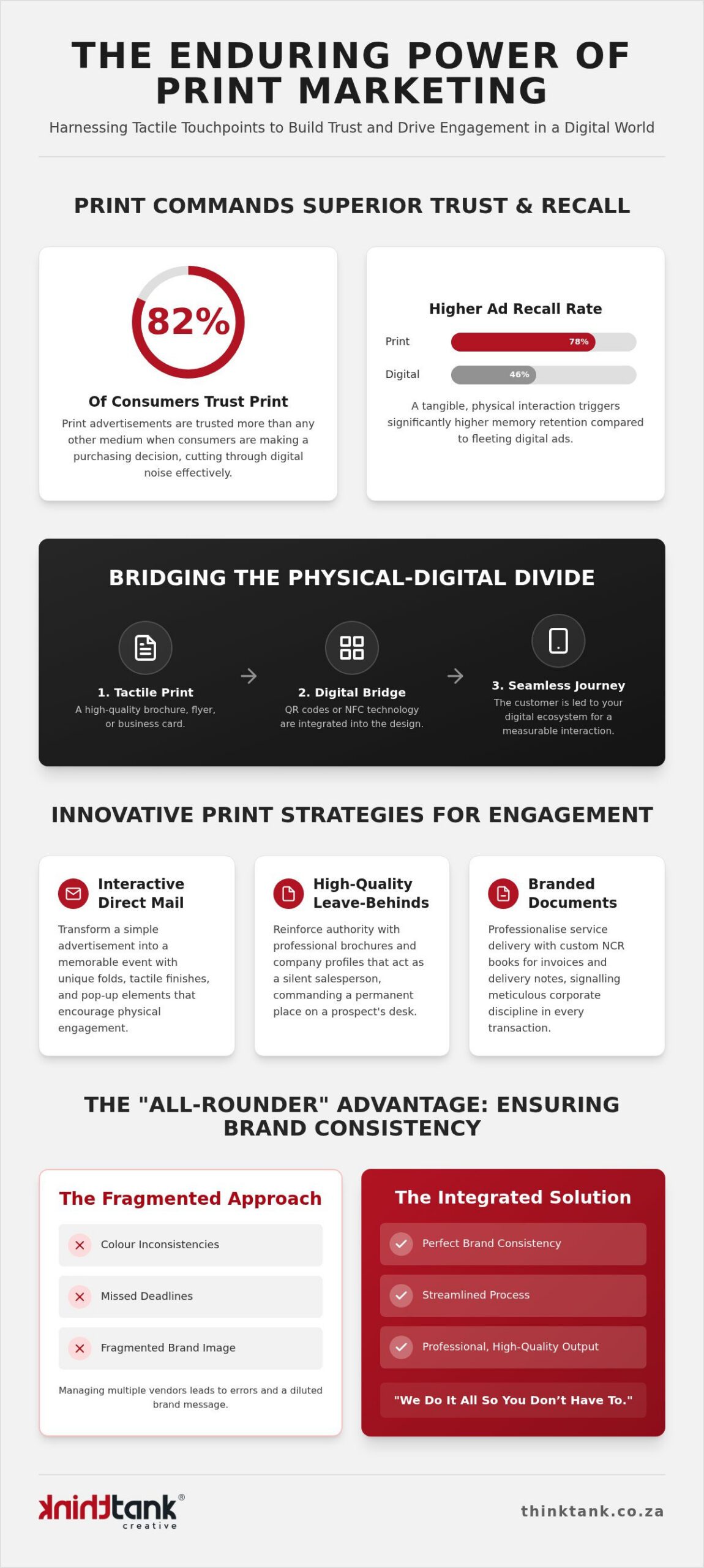
Did you know that 82% of consumers trust print advertisements more than any other medium when making a purchase decision? In a landscape increasingly defined by digital fatigue, these strategic print marketing ideas for local businesses offer a sophisticated way to command attention and build lasting credibility. You've likely felt the frustration of seeing your digital messages ignored or wondered if your physical flyers are truly driving foot traffic to your door. It is a common challenge to balance the desire for tactile branding with the need for measurable data and professional execution.

We believe that your physical marketing should do more than just exist; it should act as a high-quality bridge to your entire digital ecosystem. This article reveals how to combine bespoke physical assets with modern strategy to drive engagement amongst a national audience. We will explore how to move beyond poor DIY designs toward a polished, professional identity that makes your business look smart. By integrating QR codes and precision tracking, you can finally see the synergy between your print and digital efforts. At ThinkTank Creative, “We Do It All So You Don’t Have To”, ensuring your brand transformation is both seamless and impactful.

Key Takeaways

  • Combat digital saturation by utilising tactile touchpoints that command attention and foster genuine trust amongst your target audience.
  • Discover innovative print marketing ideas for local businesses that leverage interactive elements to transform standard flyers into high-performing lead generation tools.
  • Bridge the physical-digital divide by integrating QR codes and NFC technology into your branding to create a seamless, measurable customer journey.
  • Ensure national brand consistency by implementing a comprehensive style guide that prevents fragmented representation and maintains high-quality standards.
  • Benefit from a collaborative, end-to-end design process that moves your brand from strategy to final delivery, as “We Do It All So You Don’t Have To”.

The Strategic Role of Physical Branding in 2026

Physical presence creates a psychological anchor that digital pixels simply cannot replicate. Consumers are increasingly overwhelmed by the sheer volume of screen-based advertising, leading to a phenomenon known as digital fatigue. Research indicates that 78% of marketing buyers now view print as a more effective medium because it cuts through this noise. When you provide a customer with a beautifully textured brochure or a weighted business card, you aren't just sharing information; you're offering a tangible experience. This physical interaction triggers a higher ad recall rate, which sits at approximately 78% for print compared to just 46% for digital advertisements. These strategic print marketing ideas for local businesses are designed to turn fleeting glances into lasting impressions.

At ThinkTank Creative, we distinguish between "Good Marketing" and "Great Marketing". Good marketing focuses on the company's achievements, but great marketing focuses on the customer, making them feel smart and well-informed. By using high-quality paper stocks and bespoke finishes, you signal that your brand values precision and excellence. This establishes a baseline of trust that is essential for national growth. Because every project is unique, an estimated cost is provided after discussion to ensure the bespoke solution fits your specific strategic requirements.

Establishing Your Corporate Identity

Your logo and stationery represent the silent ambassadors of your brand. They form the foundation of every physical interaction, from the first business card exchange to the final corporate folder delivered to a client. A cohesive identity ensures that your brand doesn't feel fragmented or amateurish. Understanding what makes a good logo design is the first step in this journey. When your letterheads and business cards share a consistent visual language, you project an image of a stable, professional enterprise that is ready for serious partnership.

The "All-Rounder" Advantage

Managing multiple vendors for design and production often leads to colour inconsistencies and missed deadlines. We operate as an all-rounder partner to eliminate these hurdles, ensuring your creative vision translates perfectly from the screen to the press. Whilst Web-to-print technologies have made ordering easier, they often lack the bespoke craftsmanship required for premium branding. Our approach bridges this gap by combining modern efficiency with award-winning design expertise. We adopt a “We Do It All So You Don’t Have To” philosophy, which allows you to focus on your core operations while we handle the technical complexities of print marketing ideas for local businesses. This synergy ensures that your physical and digital assets share a single, powerful soul.

Innovative Print Marketing Ideas to Drive Engagement

Engagement begins when a customer feels that a brand truly understands their specific needs. Whilst many companies settle for generic flyers that are quickly discarded, the most successful print marketing ideas for local businesses focus on creating interactive experiences. Interactive direct mail, for instance, uses unique folds or tactile finishes to encourage the recipient to physically engage with the piece. This approach transforms a simple advertisement into a memorable event that stays in the mind far longer than a fleeting social media post.

Professionalising your service delivery is another critical avenue for engagement. Using custom NCR books for delivery notes or invoices ensures that every transaction feels polished and organised. These are not merely administrative tools; they are reflections of your corporate discipline. When you present a client with a branded, professional document, you reinforce the idea that your business is meticulous and dependable. Because every business has different needs, an estimated cost for these bespoke solutions is provided after a thorough discussion of your objectives.

The Power of the Leave-Behind

A high-quality leave-behind acts as a silent salesman long after you have left the room. In high-stakes B2B meetings, a physical brochure or company profile often carries more weight than a digital deck because it commands a permanent place on a prospect's desk. Consider the example of Lebo the Accountant from the TaxShop franchise. By utilising professional leave-behind collateral, Lebo was able to project an image of authority and expertise that resonated with clients seeking financial stability. This type of bespoke craftsmanship ensures your brand remains top-of-mind. If you are looking to elevate your physical presence, our creative design services can help you craft materials that speak with authority.

Promotional Items with Purpose

Selecting promotional material requires a strategic lens to ensure your investment doesn't end up in the bin. Items that provide genuine utility are far more likely to be kept and used, extending the life of your brand's visibility. Rather than choosing generic trinkets, select items that align with your brand’s core values and the daily habits of your audience. This alignment is a key component of a comprehensive guide to marketing strategies, where the focus is on understanding the user journey. The most effective print marketing ideas for local businesses prioritise longevity over fleeting novelty. When promotional material is designed with purpose, it becomes a valuable brand asset that recipients are proud to display and use.

Bridging the Gap: Integrating Print with Your Digital Ecosystem

Transform your physical touchpoints into dynamic digital gateways to maximise your marketing impact. In 2026, the most effective print marketing ideas for local businesses don't exist in a vacuum; they serve as a high-quality bridge to your online presence. By embedding sophisticated tracking mechanisms into your physical assets, you move beyond the frustration of untraceable flyers and toward a data-driven strategy. This synergy ensures that every Rand spent on printing contributes directly to your digital growth and customer acquisition goals.

QR codes have evolved into essential lead generation tools that connect a physical interaction with an automated digital sequence. When a prospect scans a code on a high-quality brochure, they should be directed to a bespoke landing page that triggers an immediate email auto-responder or a special offer. This convergence is a fundamental part of any modern introduction to marketing concepts, where the focus is on creating a frictionless journey for the customer. By linking physical vouchers to your email marketing campaigns, you create a measurable path from the letterbox to the digital checkout.

Print as a Traffic Driver

Directing physical traffic to your custom website design requires a clear and compelling call to action. Whether you are using large-format posters or targeted direct mail, the goal is to encourage social media follows or website visits that lead to conversions. We focus on creating a seamless transition where the aesthetic of your print material matches the user experience of your digital channels. This consistency reduces cognitive friction and builds the trust necessary to turn a curious reader into a loyal customer.

Smart Business Card Strategies

Your business card should be a sophisticated conversation starter rather than just a list of contact details. Incorporating business card design tips 2026 allows you to integrate NFC technology, enabling prospects to save your details or view your portfolio with a single tap. For those who prefer a more traditional approach, using digital vanity URLs on your cards allows you to track exactly how many hand-outs result in website visits. This level of precision is part of our commitment to "Great Marketing" that makes your brand look smart whilst providing the data you need to grow. Because we understand that every brand journey is bespoke, an estimated cost for these integrated solutions is provided after we have discussed your specific networking objectives.

Strategic Print Marketing Ideas for Local Businesses in 2026

Maintaining Brand Consistency Across National Campaigns

Fragmented branding is the quickest way to erode consumer trust. When your visual identity fluctuates between different regions or platforms, it suggests a lack of corporate discipline and attention to detail. These print marketing ideas for local businesses rely on a unified front to be truly effective, especially when scaling from a single location to a national audience. Transitioning your assets from vibrant digital screens to physical CMYK printing requires technical precision. Without expert oversight, colours that look brilliant on a monitor can appear muddy or dull on paper, damaging the "smart" perception you've worked hard to build.

We ensure that your corporate identity remains elite across every medium through rigorous colour management and strategic planning. This process involves more than just hitting "print"; it requires a deep understanding of how different materials absorb ink and reflect light. Because every national campaign has unique logistical requirements, an estimated cost is provided after a thorough discussion of your scope and objectives. This ensures your investment is precisely aligned with your brand's growth trajectory.

The Role of the Style Guide

A comprehensive brand style guide acts as the definitive blueprint for your physical presence. It dictates exact typography, spacing, and colour palettes, ensuring your logo never suffers from the "stretching" or poor-quality reproductions that often plague DIY designs. We take a meticulous approach to brand governance, protecting your integrity across every touchpoint. By establishing these rules early, you prevent the fragmented aesthetic that occurs when different vendors interpret your brand in isolation. Our collaborative process ensures your vision is preserved with absolute fidelity.

Quality Control in Printing

The choice of paper stock is a strategic decision that fundamentally alters your brand message. In 2026, South African trends favour sustainable, high-grammage uncoated stocks that offer a premium, tactile experience. A matt finish often conveys understated elegance and authority, whilst a gloss finish can add necessary vibrancy to high-impact promotional materials. Our award-winning in-house team manages every fine-tuning and revision stage, ensuring that the final product meets our exacting standards of excellence. If you are ready to professionalise your physical footprint, our corporate identity design services provide the elite execution your business deserves. We adopt a “We Do It All So You Don’t Have To” philosophy, allowing you to focus on your core operations whilst we safeguard your brand's national reputation.

The ThinkTank Creative Process: From Imagination to Final Delivery

Execution is where strategy meets reality. Our refined five-stage design process ensures that your print marketing ideas for local businesses are not only aesthetically brilliant but also strategically sound. We begin with Stage 1: Research and Strategy. Before a single pixel is moved, we immerse ourselves in your brand's world to understand your audience and competitive landscape. This foundational work prevents the common pitfall of "Good Marketing" that only speaks about the company, allowing us to pivot toward "Great Marketing" that truly empowers the customer. By the time we reach Stage 2: Design and Production, our award-winning in-house team is equipped with the insights needed to create bespoke assets that resonate deeply.

Precision requires a rigorous feedback loop to achieve excellence. We implement a meticulous five-stage revision process that invites collaboration at every critical juncture. This methodical approach ensures that the final output aligns perfectly with your vision whilst maintaining the high-quality standards expected of a national brand. Final delivery involves printing solutions that meet international benchmarks, utilising the latest South African paper stock trends to provide a tactile experience that commands respect. Because every brand journey is unique, an estimated cost is provided after a thorough discussion of your specific requirements, ensuring your investment is tailored to your goals.

A Journey of Imagination

We transform simple flyers into strategic assets through a journey of shared imagination. This isn't a transactional service; it's a creative partnership that thrives on challenging interaction and debate. We encourage our clients to engage deeply with our designers, as this synergy often reveals the most innovative possibilities for brand elevation. By moving from a project-based mindset to an ongoing service partnership, we help you maintain a consistent and "smart" presence across all physical touchpoints. Our goal is to ensure your brand remains energised and relevant in an ever-evolving market.

Getting Started with ThinkTank

Preparing a comprehensive brief is the first step toward a successful collaboration. Our designers need to understand your core objectives, target demographics, and the specific "soul" of your brand to deliver their best work. When you choose to partner with us, you gain the assurance of an elite, all-rounder team that handles everything from initial concept to final delivery. We adopt a “We Do It All So You Don’t Have To” philosophy, which significantly reduces client friction and ensures a seamless transition between your digital and physical marketing efforts. If you are ready to experience a professional brand transformation, we invite you to start the conversation today.

Transforming Your Local Impact through Strategic Print

Your physical branding is the tangible soul of your business. It serves as a powerful anchor in a world cluttered with digital noise, providing the trust and recall that pixels alone cannot achieve. By embracing these strategic print marketing ideas for local businesses, you position your brand as a sophisticated leader that values precision and customer experience. ThinkTank Creative has refined the art of bridging the physical and digital divide since being established in 2001, ensuring that every touchpoint drives meaningful engagement. Our award-winning design team provides complete end-to-end branding and printing solutions that make you look smart.

The journey toward a more professional identity begins with a collaborative deep-dive into your vision. We invite you to request an estimated cost for your strategic print project, which is provided after a thorough discussion of your unique objectives. It's time to move beyond fragmented DIY designs and embrace a polished presence that commands respect. We are ready to help you elevate your brand to its next level of excellence and look forward to partnering with you on this journey of growth.

Frequently Asked Questions

Is print marketing still effective for businesses in 2026?

Print remains exceptionally effective because it provides a tactile connection that digital channels lack. In a landscape where screen-based advertisements are often ignored, physical media commands a 78% recall rate. This tangible presence builds deep-seated trust, with 82% of consumers favouring print when making purchase decisions. We focus on creating high-quality assets that cut through the noise, ensuring your brand stands out amongst the digital clutter with a professional, forward-looking aesthetic.

How can I track the ROI of my print marketing campaigns?

Tracking ROI is achieved by integrating digital gateways into your physical assets. You can use unique landing pages, vanity URLs, or dynamic tracking codes to monitor exactly how many prospects move from a flyer to your website. These print marketing ideas for local businesses ensure that every Rand spent is measurable. By linking physical touchpoints to your digital ecosystem, you gain precise data on engagement and conversion rates, allowing for informed strategic adjustments and brand growth.

What are the most effective "leave-behind" materials for service businesses?

The most effective materials are those that provide genuine utility or authoritative information. Bespoke company profiles and high-value brochures act as silent salesmen, remaining on a prospect's desk long after a meeting ends. We often recommend items that align with your brand’s daily utility, such as professional stationery or branded folders. For example, Lebo the Accountant utilised professional collateral to project an image of stability and expertise that resonated with clients seeking expert financial advice.

Should I use a QR code on all my printed marketing materials?

QR codes should be used whenever you want to create a frictionless transition from physical to digital spaces. They are essential for turning static flyers into lead generation machines by directing users to specific offers or auto-responders. However, the integration must be purposeful and accompanied by a clear call to action. We ensure that these codes are designed to complement your aesthetic whilst providing a seamless journey from the letterbox to your custom digital checkout.

What is the difference between good marketing and great marketing in print?

Good marketing focuses on the company's achievements, but great marketing focuses on the customer's needs and aspirations. Our philosophy is that great marketing should make the customer look smart by providing them with valuable, well-organised information. It's about shifting the narrative from what you do to how you solve their problems. This approach builds a collaborative partnership based on mutual success rather than just a transactional relationship between a vendor and a client.

How do I ensure my printed colours match my digital brand colours?

Matching colours across different mediums requires professional colour management and a rigorous brand style guide. Digital screens use RGB light, whilst physical printing relies on CMYK ink, which can lead to significant discrepancies if not handled correctly. We manage these technical complexities by fine-tuning your assets for specific paper stocks and finishes. This ensures that your corporate identity remains consistent and "smart" across every national campaign, protecting your brand's visual integrity and professional reputation.

Can ThinkTank Creative handle both the design and the printing?

Yes, we are a full-service all-rounder agency that manages the entire process from initial research to final delivery. By handling both design and printing in-house, we eliminate the friction often caused by managing multiple vendors. This synergy ensures that the creative vision we develop together is perfectly executed on the press. We adopt a “We Do It All So You Don’t Have To” approach, allowing you to focus on your core operations whilst we safeguard your brand's national footprint.

How long does the professional print design process typically take?

Our collaborative design process involves five distinct stages, moving from research and strategy through to final delivery. The timeline varies depending on the complexity of the project, whether it's a simple flyer or a comprehensive national campaign. We prioritise high-quality work whilst adhering to competitive time limits. An estimated cost and timeline are provided after a deep-dive discussion of your needs, ensuring that the final delivery meets your strategic deadlines without compromising on excellence.