Google Ads Agency South Africa: How to Choose the Right Partner

Clicks can look like progress while telling you little about business growth. A search for a google ads agency south africa can bring up plenty of confident promises, but the real challenge is finding a partner who can connect campaign activity to meaningful business objectives.

Before committing advertising spend, get clear on what success means, how it will be measured and what the reports will show. Impressions and clicks describe activity, but they don’t tell you on their own whether advertising is contributing to relevant enquiries or sales. This guide will help you assess an agency’s strategy, measurement and communication so you can choose an approach that fits your business and growth plans.

We’ll look at what effective Google Ads management involves, which questions to raise before work begins, and how to compare a paid-media specialist with a broader marketing partner. ThinkTank Creative offers digital paid advertising alongside website design and development, SEO and ongoing support. That combination can help connect advertising with the experience customers find after they click. Choose based on the strength of the plan for measuring and improving business outcomes, not on promises alone.

Key Takeaways

  • Assess a google ads agency south africa by how it links campaign planning and optimisation to agreed business objectives.
  • Look beyond clicks and impressions. Clear conversion tracking and reporting can help connect advertising activity with qualified enquiries.
  • Compare agencies on strategy, measurement, communication, website integration and ongoing support to find a suitable fit.
  • Prepare your goals, audience, offer and website context. Consider how your team records lead quality or sales feedback.
  • Decide whether a paid-media specialist or an integrated partner better suits your needs, especially if you want advertising aligned with your website and wider digital marketing.

What a Google Ads agency in South Africa should actually do

A Google Ads agency should do more than launch adverts. It should plan, manage and evaluate paid campaigns against business objectives agreed with you. That means connecting campaign choices to what the business needs, whether that is relevant product enquiries, bookings or online sales, then reviewing evidence to guide the next steps.

For a business searching for a google ads agency south africa, it helps to separate campaign activity from business outcomes. Activity is the work carried out; outcomes are what that work is intended to support. An agency can influence planning, targeting, advertising and measurement, but results also depend on the strength of the offer, the audience’s needs, the website experience and the quality of the tracking. Campaign activity alone cannot guarantee a particular outcome.

What does Google Ads campaign management include?

Campaign management begins with research and strategy. The agency needs to understand your objectives, audience and offer, then translate them into priorities that reflect what potential customers are looking for. The Google Ads platform supports paid advertising across different formats and campaign types. The appropriate choices depend on the goal and the options available in the platform.

From there, management can include preparing campaigns, overseeing advertising activity, reporting on performance and making adjustments as evidence develops. A considered process can involve:

These activities create a structured basis for improvement, not a promise that every click will become a customer.

How paid advertising fits into the wider marketing picture

Paid advertising can create visibility for selected audiences, while search engine optimisation (SEO) works to improve a website’s organic visibility in search results. They serve different roles and can complement one another: paid activity can support a focused campaign, while SEO and useful content can contribute to a longer-term presence. The right balance depends on your priorities, resources and customer journey.

The journey doesn’t end at the click. A relevant advert can bring someone to a landing page, but a confusing page, unclear offer or difficult enquiry process may weaken their experience. Website design, usability and a clear next step all matter. Social media marketing and content can also support how people discover and understand a business. A joined-up South African digital marketing strategy connects these channels rather than treating each campaign in isolation.

Choose an agency approach that considers the full path from audience intent to website interaction and business feedback. This wider view grounds campaign decisions and gives you a clearer basis for evaluating the work.

How strategy, tracking and reporting make Google Ads accountable

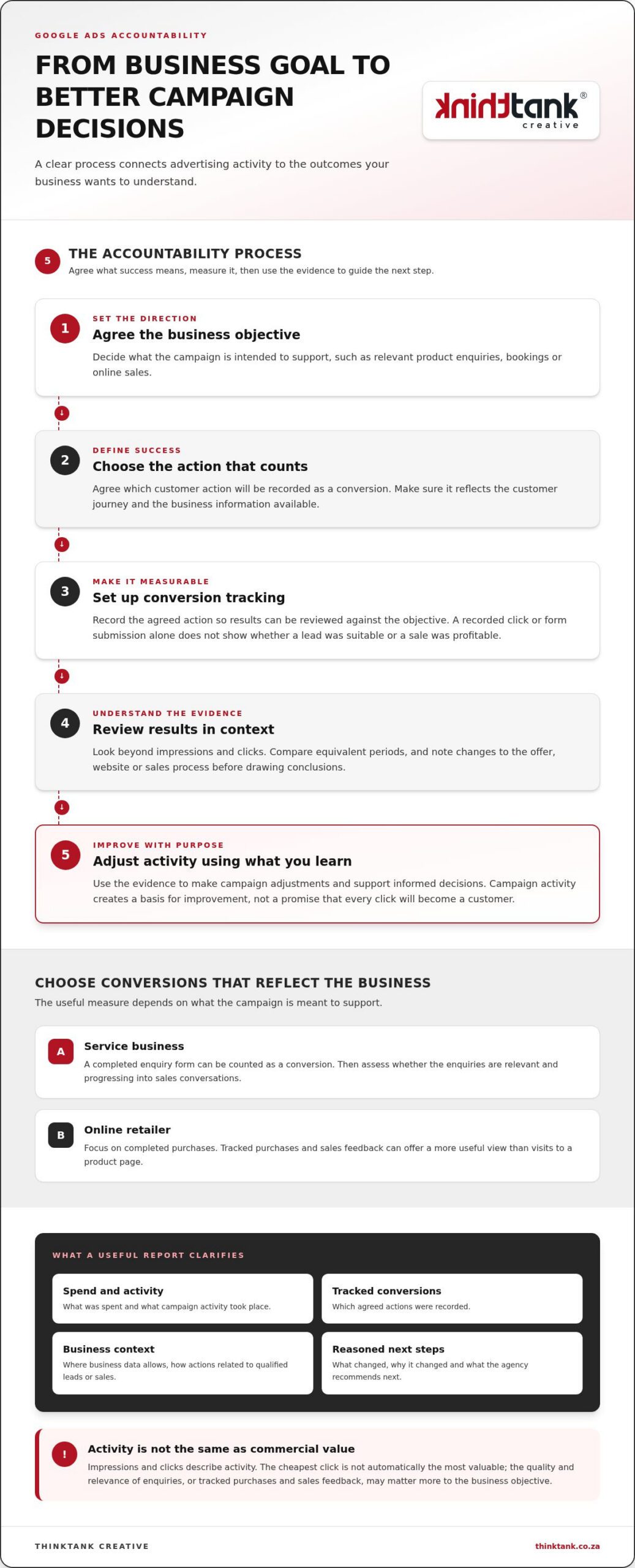
Accountability starts before the first advert runs. Agree the business objective, define the action that will count as a conversion, set up measurement, review the results and adjust activity. This sequence gives you and your agency a shared basis for decisions. Google’s Google Ads platform documentation offers guidance on working with the platform, but reliable conclusions still depend on defining what success means for your organisation.

For example, a service business might count a completed enquiry form as a conversion, then assess whether those enquiries are relevant and progressing into sales conversations. An online retailer might focus on completed purchases. A click or form submission can be recorded, but it doesn’t automatically show whether a lead was suitable or a sale was profitable. Measurement should reflect the customer journey and the business information available.

Campaign metrics only matter when interpreted against the business objective.

Which Google Ads measures matter to your business?

Impressions and clicks show that adverts were displayed or interacted with. They describe campaign activity, not necessarily commercial value. If the goal is to generate qualified enquiries, the number and quality of those enquiries matter more than click volume alone. If the goal is sales, tracked purchases and sales feedback may offer a more useful view than visits to a product page.

The cheapest click isn’t automatically the most valuable. A lower-cost visit that rarely leads to a relevant enquiry may be less useful than an interaction that supports the intended action. Before drawing conclusions, compare equivalent periods and note changes to the offer, website or sales process. This helps distinguish a genuine trend from differences in how data was collected.

What transparent reporting should help you understand

A useful report is a decision-making tool, not a dashboard of unexplained figures. It should make clear what was spent, what campaign activity took place, which conversions were tracked and, where business data allows, how those actions related to qualified leads or sales. It should also explain what changed, why the change was made and what the agency recommends doing next.

Good reporting distinguishes observed data from interpretation. A recorded form submission is an observed event; whether it represents a qualified prospect may require feedback from the team handling enquiries. If sales data isn’t connected to advertising data, the report should say so rather than presenting an assumption as proven attribution. Share lead-quality or sales feedback with your agency so campaign decisions reflect what happens after the conversion.

The post-click experience also shapes what the numbers mean. A visitor may arrive on the right page but leave because the offer or next step is unclear. Reviewing the website experience can help identify friction beyond the advert itself. If you’re evaluating a google ads agency south africa, look for a partner that connects measurement with practical next steps. ThinkTank Creative brings paid advertising together with wider digital capabilities. Explore ThinkTank Creative’s digital marketing approach to see how those pieces can work together.

How to compare Google Ads agencies in South Africa

Compare the work behind each proposal, not just its headline promise. A useful proposal shows how an agency will understand your objectives, manage the agreed scope and keep you informed. If you’re assessing a google ads agency south africa, the criteria below can make different approaches easier to compare side by side.

Criterion What to look for
Strategy Does the proposal connect your business priorities and audience intent to campaign choices?
Scope Are research, campaign management, reporting and optimisation responsibilities clearly described?
Measurement Does the approach explain what will be tracked and how performance will be interpreted?
Communication Are reporting frequency, points of contact and decision-making processes set out?
Website integration Does the plan consider the landing page and the experience after an advert is clicked?
Ongoing support Is it clear how reviews, feedback and campaign adjustments will be handled over time?

Use the table to identify gaps and differences, not to award points mechanically. A proposal that promises growth but doesn’t define the objective, measurement basis or responsibilities is difficult to assess. Treat performance claims with the same care: look for context, clear definitions and an explanation of how the result was measured. Headline figures alone may not show whether the work fits your business.

Specialist PPC agency or integrated marketing partner?

A specialist may suit a business with a clearly defined paid-media requirement and other marketing capabilities already in place. An integrated partner may be a better fit when paid advertising needs to work alongside website design, SEO, social media or creative activity. Neither model is automatically superior. The right choice depends on which capabilities your priorities require and how much coordination you want across the customer journey.

A specialist can bring depth to paid media; an integrated partner can coordinate paid activity with the wider marketing experience.

A practical agency comparison checklist

Before deciding, check that each proposal explains the objective, scope, responsibilities, reporting and communication process in comparable terms. Consider how the agency will work with your team and how feedback will inform decisions. If proposals use different definitions of a conversion or success, clarify those differences before comparing performance claims.

Fees and scopes vary, so compare the stated work with the estimated cost rather than choosing on price alone. ThinkTank Creative provides an estimated cost after discussing your needs and timeline. A clear discussion helps align expectations about deliverables and collaboration before work begins.
Google Ads Agency South Africa: How to Choose the Right Partner

What to prepare before engaging a Google Ads agency

A focused brief makes the first campaign discussion more useful. It gives an agency a clearer view of what your business needs, what customers can act on and where the customer journey may need attention. You don’t need perfect data or a complete campaign history. Share what you know, flag what’s uncertain and use the discussion to identify what needs further investigation.

Information that helps shape a useful campaign discussion

Start with the business priority, such as attracting relevant enquiries for a particular service or increasing sales of a specific offer. Describe your intended audience, the value you provide and the action you want visitors to take. Include your website address, relevant landing pages and practical constraints, such as pages that need updating or an enquiry process handled by a small team.

That last point matters. A campaign may generate enquiries, but the agency needs a feedback loop to understand which ones are relevant and how they progress. A considered lead-generation strategy takes follow-up into account instead of treating a submitted form as the end of the customer journey.

Questions that reveal how an agency works

Use the discussion to understand how the agency will turn your brief into a working plan. Ask how strategy connects to the stated objective, what campaign management includes, how results will be measured and what the reporting will help you decide. The answers should make responsibilities clear, including what your team needs to provide and who will approve changes.

Agree on practical ways of working before activity begins. Discuss communication routines, access responsibilities, the reporting format and how often the work will be reviewed. Ask how decisions and adjustments will be explained, and how your team’s feedback on lead quality or sales will shape future activity. A google ads agency south africa should be able to describe this collaboration in plain language, without relying on jargon or unsupported promises.

Preparation doesn’t mean having every answer. Bring your priorities, available information and open questions so research and strategy can be tailored to your business. To put these considerations into practice, discuss your paid advertising needs with ThinkTank Creative.

Working with ThinkTank Creative on paid advertising and digital growth

Choose a partner whose process starts with understanding your business, not simply selecting campaign settings. Founded in 2001, ThinkTank Creative is a South African agency offering digital paid advertising alongside website design and development, SEO, social media marketing and creative services. This broader perspective helps businesses consider how advertising fits into the experience customers have before and after they click.

A joined-up approach from strategy to ongoing support

Paid advertising is more useful when it reflects the wider context of your marketing. For example, a campaign may direct people to a landing page, so the page’s content, usability and next step should support the same objective as the advert. If your website needs attention, or your SEO and social media activity also contribute to customer discovery, these elements can be considered alongside PPC rather than in isolation.

ThinkTank Creative’s process puts research and strategy before delivery, with communication and feedback forming part of the working relationship. This creates space to understand your audience, business priorities and existing digital activity before shaping a suitable scope. Rather than applying a fixed campaign formula, the work is shaped around the needs and timeline discussed with you.

Collaboration continues beyond delivery. ThinkTank Creative provides ongoing service after project completion, supporting a longer-term relationship as business needs evolve. Clear communication and review keep the work connected to your priorities, while your feedback can bring practical insight into customer responses and enquiry quality.

Start a conversation about your business objectives

To make an initial discussion productive, share the outcomes you’re working towards, the audiences you want to reach and the offer or service you want to promote. It also helps to explain current challenges, the state of your website and any relevant marketing activity. You don’t need a perfect brief. A clear account of what you know and what you’re still working through gives the conversation a useful starting point.

ThinkTank Creative can discuss an approach and scope that reflect your requirements and timeline, then provide an estimated cost based on that discussion. This gives you a grounded basis for considering the work, rather than relying on a generic package or unsupported promise. The aim is to build a partnership around considered decisions and well-aligned activity.

If you’re looking for a google ads agency south africa that can discuss paid advertising in the context of your wider digital presence, bring your objectives and questions to the conversation. ThinkTank Creative’s guiding phrase, “We Do It All So You Don’t Have To”, reflects its collaborative, broad-service perspective. Start a conversation about your paid advertising goals and explore a scope tailored to your business.

Make your next advertising decision with clarity

Your first step doesn’t need to be a sweeping marketing overhaul. Choose one business priority that matters now, then use it to shape what to promote, what the visitor should do and what evidence will help you decide whether to refine the approach. That focus creates room for steady learning and a more considered path to growth.

The right google ads agency south africa should bring thoughtful collaboration to the process and help connect paid advertising with the wider direction of your business. With a clear shared purpose, campaign decisions can become part of a lasting growth plan rather than isolated activity.

Discuss your digital marketing goals with ThinkTank Creative and take the next step towards an approach shaped around your business.

Frequently Asked Questions

Is a Google Ads agency worth it for a small business in South Africa?

It can be worthwhile if paid search supports a specific business priority and your team can assess and follow up the resulting enquiries or sales. For example, a small business promoting one core service may benefit from structured campaign management, but should weigh the proposed work against internal capacity and marketing priorities. An agency can bring planning and reporting, but hiring one doesn’t guarantee results. Consider whether the proposed scope and working relationship suit your needs.

What does a Google Ads agency do?

A Google Ads agency can plan, manage and evaluate paid campaigns against objectives agreed with a business. The scope may cover research, campaign planning, advertising management, performance updates and adjustments. Before work begins, clarify who will provide business information, approve campaign materials and share feedback from customers. This division of responsibilities helps connect the agency’s activity with the website journey and the way your organisation responds to prospective customers.

How do I choose a Google Ads agency in South Africa?

Start by deciding what you want advertising to contribute, such as enquiries for a particular service or sales of a specific offer. Then compare agencies on how they explain their approach, measurement, communication and responsibilities. A google ads agency south africa should be able to describe how campaign activity relates to meaningful business actions, not just clicks. Consider whether your priorities call for paid-media focus or coordination with other marketing work, and assess claims in context.

How much does a Google Ads agency cost in South Africa?

There isn’t one fee that applies to every agency or campaign. The work required, account scope and level of support all influence an estimate, so compare proposals by what they include rather than by the headline figure alone. Also distinguish the agency’s management fee from the advertising budget paid to the platform. Ask for both to be explained clearly, along with the work and assumptions behind the proposed scope.

Can a Google Ads agency guarantee leads or sales?

No agency can responsibly treat leads or sales as certain outcomes. Results may be affected by the offer, audience, competition, website experience, measurement and how quickly enquiries are followed up. Instead of relying on a guarantee, look for a clear explanation of intended objectives, assumptions and how performance will be assessed. This helps you understand what campaign data can indicate, what it can’t establish on its own and which decisions are reasonable.

What should a Google Ads report include?

A useful report should help you decide what to do next, not simply present a collection of figures. It can show advertising spend, campaign activity and tracked conversions, with relevant trends and recommendations. Check that conversion terms are explained, reporting periods are consistent and data limitations are made clear. Where your team can share sales or enquiry outcomes, those details add context to campaign data and help distinguish recorded actions from business value.

Should I choose a specialist PPC agency or a full-service marketing agency?

Choose according to the work that needs to fit together. A business with an established website and marketing team may prefer a partner focused on paid media. If campaign activity also needs to align with a new landing page, SEO, social media or creative work, an integrated agency may help coordinate those elements. Compare the actual responsibilities, reporting and communication proposed; the agency label alone won’t tell you which model best suits your priorities.
SEO vs PPC for Small Businesses in South Africa: 2026

The channel that brings enquiries this month may not be the one that builds your most dependable source of demand. Choosing seo vs ppc for small business in south africa isn’t simply a choice between free traffic and paid clicks; it’s about matching your marketing to your goals, budget runway and ability to convert interest into business.

If you’re weighing up limited resources, it’s sensible to want a clear way to measure what they’re achieving. PPC can put your offer in front of people actively searching, while SEO works to build organic visibility over time. Paid activity can stop when campaigns pause; organic visibility may continue to attract visitors, although it requires ongoing attention and isn’t guaranteed.

This guide compares the roles, trade-offs and measurement needs of both channels, then shows how to decide whether to focus on one or combine them. You’ll also find practical next steps for testing performance, tracking meaningful outcomes and refining a plan around your South African business’s readiness to grow.

Key Takeaways

  • Understand how SEO builds unpaid search visibility over time, while PPC uses paid campaigns to reach potential customers.
  • Compare SEO and PPC by the effort, control and ongoing investment each requires, rather than assuming one is free or guarantees quick returns.
  • Use seo vs ppc for small business in south africa as a practical decision: align your channel choice with business goals, website readiness and capacity.
  • Follow a clear framework to select a channel, track meaningful outcomes and refine your approach as you learn.
  • See how coordinated SEO and PPC, supported by campaign planning, copywriting and reporting, can contribute to a more considered growth strategy.

SEO vs PPC for South African small businesses: what each channel does

Should your business build organic discoverability, pay for search visibility, or coordinate both? The answer depends on what you need to achieve and how ready your website is to turn visits into enquiries or sales. In the seo vs ppc for small business in south africa comparison, these channels serve different purposes, even though both can help connect your business with people searching online.

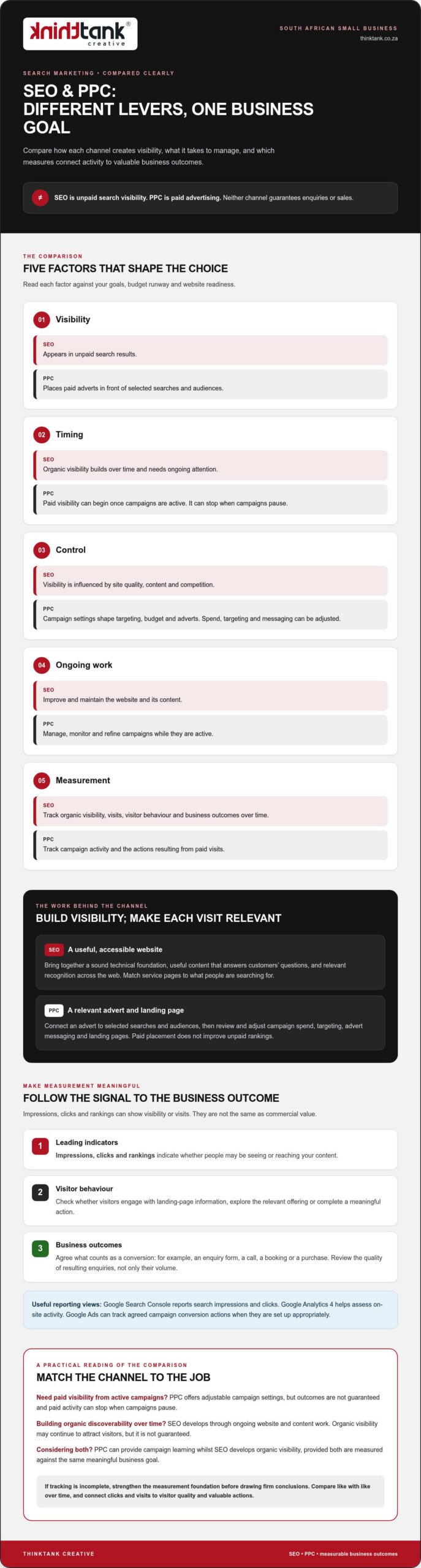
Search Engine Marketing (SEM) is an umbrella term for approaches that increase visibility in search, including Search Engine Marketing (SEM). SEO improves a website’s unpaid visibility in relevant search results. PPC, or pay-per-click advertising, places paid ads in front of selected audiences, with campaign spend and platform settings influencing when and where those ads may appear.

For a concise visual overview of how small businesses can weigh these channels, watch:

Factor SEO PPC
Visibility Unpaid search results Paid ad placements
Timing Builds over time Can begin once campaigns are active
Control Influenced by site quality, content and competition Campaign settings shape targeting, budget and ads
Ongoing work Improve and maintain the website and content Manage, monitor and refine campaigns
Measurement Track visibility, visits and business outcomes over time Track campaign activity and resulting actions

What does SEO involve for a small business?

SEO brings together a sound technical foundation, useful content and signals that help establish a website’s authority. That means making pages accessible to search engines, answering the questions potential customers actually ask, and earning relevant recognition across the web. A person searching for a particular service should land on a page that clearly explains that offering and what to do next. For more context, read this South African SEO strategic guide.

What does PPC involve in search marketing?

Paid search campaigns connect an advert to selected searches, audiences and a relevant landing page. Businesses can manage factors such as spend, targeting and ad messaging, then review results and adjust the campaign. Paid placement is separate from organic rankings: paying for an advert doesn’t improve a page’s unpaid position. PPC is controllable activity, not a promise of traffic, enquiries or sales.

Neither channel produces the same outcome for every business. Competition, execution, website readiness and the clarity of the offer all matter. A coordinated approach can use PPC to gather campaign learning while SEO develops organic visibility, provided both are measured against meaningful business goals.

How SEO and PPC work, and what South African businesses can measure

Measure activity in context, not in isolation. SEO develops through ongoing work, so assess changes in search visibility alongside what visitors do and whether they take valuable action. PPC performance reflects active campaigns, where targeting, advert creative, landing pages and spend settings can be adjusted and reviewed. Google offers a useful explanation of the difference between PPC and SEO, but your reporting should connect that distinction to your own business objectives.

Paid visibility comes from active advertising; organic visibility comes from appearing in unpaid search results. Impressions, clicks and rankings are leading indicators: they show whether people may be seeing or reaching your content. Enquiries, bookings, purchases or other agreed conversions are business outcomes. Define each measure before reporting, so a rise in clicks isn’t mistaken for a rise in commercial value.

Which measures help evaluate SEO?

Review relevant organic impressions and clicks, then examine how visitors behave on the landing pages they reach. Are they engaging with the information, exploring the relevant offering or completing a meaningful action? Google Search Console reports on a site’s search performance, including impressions and clicks. Google Analytics 4 helps assess on-site activity. Together, these views add context, but neither rankings nor traffic alone proves commercial success.

Set a regular review period and compare like with like, such as the same pages or search topics over time. This helps distinguish a visibility change from a change in visitor quality or conversion behaviour.

Which measures help evaluate PPC?

Track campaign impressions and clicks, then look at the conversion actions associated with those visits. Before launch, agree what counts as a conversion, whether that’s a completed enquiry form, a call or a purchase, and ensure the relevant action is tracked appropriately in Google Ads. Then review the quality of resulting enquiries, not just their volume. A lead generation strategy is more useful when it connects activity with the prospects a business can serve.

For a broader approach to assessing lead quality, explore this lead generation strategies framework.

For seo vs ppc for small business in south africa, use consistent definitions across channels and review performance against the same business goal. If the tracking is incomplete, improve that foundation before drawing firm conclusions. A clear reporting approach can connect campaign planning, website experience and customer outcomes; explore ThinkTank Creative’s digital marketing approach as you shape your measurement plan.

SEO or PPC: which trade-offs matter most to a small business?

Neither channel is a shortcut. SEO isn’t automatically free: it takes time and expertise to improve a website, create useful content and maintain visibility. PPC isn’t automatically profitable as soon as an advert goes live. Paid campaigns can be adjusted, but the offer, audience fit and landing page still shape whether clicks become worthwhile enquiries.

For seo vs ppc for small business in south africa, weigh the work each channel needs against what your business can sustain and learn. SEO and PPC answer different needs, and neither guarantees leads or revenue.

Trade-off SEO PPC
Ongoing effort Requires continuing site improvements, relevant content and optimisation. Requires active campaign monitoring and refinement.
Control Search visibility is influenced by relevance, site quality and competition. Campaign settings let you adjust targeting, adverts and spend.
Learning Can reveal which topics and pages attract relevant organic interest over time. Can test messages and audience choices within a defined campaign.
Dependence on activity Visibility may endure, but depends on ongoing quality and changing search conditions. Paid exposure depends on campaigns remaining active.
Key consideration Progress may take sustained effort and is shaped by competition. Control over campaign activity doesn’t guarantee profitable results.

When might SEO be the stronger starting point?

SEO may suit a business that can invest in useful content, site improvements and sustained optimisation, particularly if customers research services through search before deciding. For example, a customer comparing service options may value a clear page that answers common questions and explains what’s offered. That page can support discovery and decision-making, but organic visibility develops amid competition and changing search conditions, so it needs ongoing attention.

When might PPC be the more practical test?

PPC may be a practical way to test demand or messaging when you have a relevant landing page and can set aside capacity to manage a campaign. You can adjust targeting, advert creative and spend settings as you learn. However, a campaign can only direct attention to the offer and experience you provide. If the page is unclear or the next step is difficult, paid activity won’t fix the underlying issue.

Use each channel for the work it does best. PPC can support controlled experiments; SEO can build organic discoverability through continued improvements. A thoughtful mix may make sense when your team can support both, but prioritisation should reflect business readiness, customer behaviour and the outcomes you’re equipped to measure.

SEO vs PPC for Small Businesses in South Africa: 2026

How to choose an SEO and PPC mix for your South African business

Choose the channel mix that fits your business’s current capacity, customer behaviour and website readiness. A focused plan makes it easier to learn what supports your goals, without spreading effort across activities you can’t yet measure or maintain.

Set the goal, check your readiness, choose a channel, track the outcome and review what you learn. Use this framework to decide whether to prioritise SEO, PPC or a coordinated test:

  1. Set a business goal. Be specific about the result you want, such as relevant service enquiries or online sales. Choose an outcome you can track, not just a rise in visits.
  2. Assess website readiness. Check that the right page explains your offer clearly and gives visitors a relevant next step, such as making an enquiry or completing a purchase.
  3. Choose a starting channel. Consider whether customers search for your offering, how much time your team can commit and whether you need to test messaging or build lasting organic visibility.
  4. Track outcomes. Decide what counts as a meaningful action before activity begins, then make sure your reporting captures it consistently.
  5. Review and refine. Use what the data and customer response show to adjust the campaign, improve the page or shape the next piece of SEO work.

This is the practical lens for seo vs ppc for small business in south africa: match your first step to your goal, capacity, customer behaviour and ability to convert, then review before expanding.

Is your website ready to support either channel?

Check that the landing page matches the search message, explains the offering in plain language and makes the next step easy to find. Usability matters too: review the mobile experience, page clarity and loading experience, especially for visitors browsing on mobile data. If the journey feels confusing, improve it before directing more people to the page. Explore this website user experience guide for a deeper look at usability.

How should a small business structure a first test?

Keep the test focused. Agree one business objective, the intended audience, the conversion action and when you’ll review the results. For PPC, test relevant search terms and landing-page messaging, then assess the quality of the resulting actions. For SEO, prioritise useful pages and improvements that answer the same customer need. If both channels are viable, PPC can help explore messaging while SEO develops stronger pages around that demand.

Use the content marketing planning template to align useful content with business goals. For an integrated plan connecting channel choices with your website and customer journey, work with ThinkTank Creative on your SEO and PPC strategy.

Plan your next step with an integrated SEO and PPC strategy

The right mix starts with your business priorities, not a preference for one channel. If your website is ready and customers are actively searching for what you offer, PPC may help you test relevant search activity, while SEO builds a stronger foundation for organic visibility. If the site needs clearer pages or a smoother customer journey, address that readiness as part of the plan. Where capacity allows, coordinated paid tests and longer-term organic improvements can inform one another.

This is the practical conclusion of seo vs ppc for small business in south africa: align the channel with your goal, customer, website and ability to measure meaningful outcomes. There’s no universal mix, so a considered plan should reflect what your business can support and learn from.

What to prepare before planning your search marketing

Bring together the details that help turn a broad marketing ambition into a focused plan:

This preparation helps identify where to begin and which parts of the customer journey may need attention before more traffic is directed to the site.

How ThinkTank Creative can support the planning process

ThinkTank Creative brings SEO and digital paid advertising together with campaign planning, copywriting and reporting. That connected view helps keep channel activity aligned with business goals, the website experience and the actions you want visitors to take. Rather than treating each channel as a separate task, the planning process considers how they can support a coherent customer journey.

If your site needs to better support search visitors and conversions, website design and development can form part of the work. The process can include planning, UX/UI design, coding, testing, launch, training and support, creating a considered connection between how people find your business and what they experience when they arrive.

Discuss your needs and timeline, and an estimated cost is provided to reflect the project. This keeps the proposed scope grounded in your priorities rather than implying a fixed price for every business.

With a clear objective, an honest view of website readiness and a practical measurement plan, you can make a more informed choice about where to focus first. When you’re ready to shape a tailored digital marketing approach, discuss your digital marketing approach with ThinkTank Creative.

Build a search strategy around your next business goal

The choice between SEO and PPC comes down to more than visibility. Match your channel to your business priorities, website readiness and capacity, then measure meaningful outcomes rather than clicks alone. SEO can build organic discoverability through sustained work; PPC offers a way to test campaign activity and refine it. For many businesses, a coordinated approach can connect those roles.

That’s the practical lesson of seo vs ppc for small business in south africa: choose a starting point you can support, make sure your website gives visitors a clear next step, and review what the results tell you before refining the plan.

ThinkTank Creative has served businesses since 2001, bringing SEO and digital paid advertising together with campaign planning, copywriting and reporting. When your website needs to better support search visitors and conversions, its design and development process includes post-launch training and support.

Ready to shape a strategy around your goals and resources? Discuss a tailored SEO and PPC approach with ThinkTank Creative. A thoughtful first step can create a clearer path for your business’s next stage of growth.

Frequently Asked Questions

Is SEO or PPC better for a small business in South Africa?

For seo vs ppc for small business in south africa, the better option depends on your goals, website readiness and capacity. SEO may suit a business building useful content and organic visibility over time. PPC may suit one that wants to test search demand with a managed campaign and a relevant landing page. Compare both against meaningful outcomes, such as qualified enquiries or sales, rather than choosing on clicks alone.

Can a small business use SEO and PPC at the same time?

Yes, a small business can use SEO and PPC together if it can support and measure both. For example, PPC can test which search messages attract relevant visitors, while SEO improves pages that answer the same customer needs. Coordinate the landing pages, messaging and conversion definitions so the channels support a consistent customer journey. If resources are limited, start with a clear priority and expand when you can manage the work.

How long does SEO take compared with PPC?

PPC campaigns can begin generating ad exposure once they’re active, while SEO typically needs sustained work before organic visibility develops. Neither timing guarantees enquiries or sales. Results depend on factors such as competition, campaign or website execution, the relevance of the offer and the landing-page experience. Set an appropriate review period for each channel, and assess progress using agreed business outcomes as well as early indicators such as impressions and visits.

Does PPC improve organic SEO rankings?

No, paying for search adverts doesn’t directly improve a website’s organic rankings. PPC controls paid campaign exposure, whereas SEO work aims to improve unpaid visibility through relevant content, technical foundations and other search-quality factors. The channels can still inform one another: campaign activity may reveal which messages or search needs attract interest, helping you consider what content or pages to develop. Treat that learning as strategic insight, not a ranking boost.

Is SEO free for a small business?

No, SEO isn’t automatically free. A business may not pay for each organic click, but improving and maintaining visibility takes time and work, including website improvements, useful content and ongoing optimisation. There may also be a cost for professional support. Plan for the resources needed to create relevant pages and review their contribution, rather than treating organic traffic as cost-free or assuming that publishing content alone will deliver results.

What should a small business measure when comparing SEO and PPC?

Measure visibility and activity alongside business outcomes. For SEO, review relevant organic impressions and clicks, landing-page behaviour and meaningful enquiries or sales. For PPC, track impressions, clicks, conversion actions and the quality of resulting enquiries. Agree what counts as a conversion before reporting, and use consistent definitions across channels. Rankings or visits alone don’t show whether marketing is contributing to business goals, so review them in context.

Should I run PPC before investing in SEO?

Not necessarily. PPC may be a useful first test if you have a clear offer, a relevant landing page and the capacity to monitor campaign results. SEO may be a better starting point if customers research your services through search and you can invest in useful pages and ongoing improvement. You can also coordinate both around one customer need. Choose based on your readiness, learning priorities and ability to measure meaningful actions.

Digital Marketing for Service Businesses: 2026 Guide

What if the issue isn’t how much you market your service business, but how well each channel works with the others? Digital marketing for service-based businesses is most effective when potential customers can discover your business, find clear reasons to trust it and take a straightforward next step.

If your marketing feels scattered across search, social media, paid advertising and email, you’re not alone. Keeping every channel active takes time, and visibility alone doesn’t guarantee suitable enquiries. The opportunity is to connect your efforts around how customers research and choose a service provider.

This guide will help you prioritise channels based on customer behaviour, create a measurable path from discovery to enquiry and follow-up, and decide what makes sense to manage in-house or with support. We’ll look at how your website, SEO, social media, PPC and email can work together, and what to measure so you can refine your approach with confidence.

Key Takeaways

  • Discover how digital marketing for service-based businesses can connect customer discovery, trust and enquiry across relevant channels.
  • See how to match channels such as SEO, social media, paid advertising and email to different stages of the customer journey.
  • Use a practical framework to choose priorities that fit your business goals, your customers’ behaviour and your team’s capacity.
  • Learn which measures can help you assess visibility, engagement, enquiries and follow-up beyond surface-level activity.
  • Identify when outside support may help bring greater clarity and consistency to your marketing, and what to ask a potential partner.

What digital marketing for service-based businesses needs to achieve

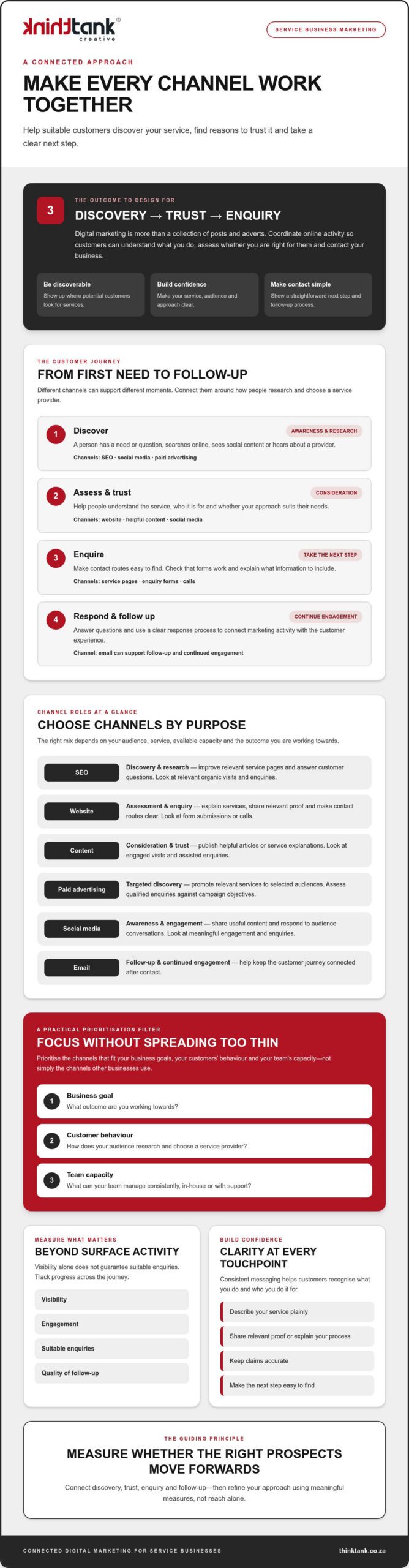
Service businesses sell expertise, trust and a clear next step, not just a product. Customers often need to understand what a service involves and whether the provider is right for them before they enquire. That makes digital marketing for service-based businesses more than a collection of posts and adverts. It’s coordinated online activity that helps suitable customers discover, assess and contact a business.

Services can be harder to evaluate before purchase because customers can’t simply inspect or try them in advance. The unique characteristics of service marketing help explain why clear information and confidence-building matter. Aim to guide people from awareness and consideration through to enquiry, follow-up and, where appropriate, repeat engagement.

For a useful perspective on marketing a service business, watch this conversation:

How the service-business customer journey works online

A potential customer may begin with a need or question, then search online, see a social media post or hear about a provider through someone they trust. As they compare options, your website should make the service, intended audience and next step easy to understand. Useful content can answer common questions and help people judge whether your approach suits their needs.

Make the next step visible, whether that’s completing an enquiry form or contacting your business through a stated channel. Check that the form works, the contact details are easy to find and the page tells visitors what information to include. The journey doesn’t end when someone gets in touch. A clear process for responding, answering questions and following up helps connect marketing activity to the real customer experience.

Why trust and clarity matter before the enquiry

Consistent messaging across your website, search presence, social media and email helps customers recognise what you do and who you do it for. Straightforward service descriptions reduce guesswork, while relevant proof, such as a suitable example of your work or a clear explanation of your process, can help address uncertainty. Keep claims accurate and make it easy for a prospective customer to find the information they need.

Digital marketing for a service business connects each online interaction to help the right customer move from discovering your expertise to trusting your offer and taking a clear next step. Measure progress by suitable enquiries and the quality of follow-up, not reach alone. Visibility can introduce your business to people, but its value depends on whether it helps the right prospects move forwards.

Which digital marketing channels support each stage of the customer journey?

Choose channels for the role they can play, not because every business appears to be using them. In digital marketing for service-based businesses, search, a useful website, social media, paid advertising and email can support different steps, from first discovery to continued engagement. The right mix depends on how your audience researches services, what you offer, the capacity available and the business outcome you’re working towards.

Channel Customer-journey role Typical activity Useful measure
SEO Discovery and research Improve relevant service pages and answer customer questions Relevant organic visits and enquiries
Website Assessment and enquiry Explain services, share relevant proof and make contact routes clear Enquiry form submissions or calls
Content Consideration and trust Publish helpful articles or service explanations Engaged visits and assisted enquiries
Paid advertising Targeted discovery Promote relevant services to selected audiences Qualified enquiries against campaign objectives
Social media Awareness and engagement Share useful content and respond to audience conversations Meaningful engagement and enquiries
Email Follow-up and repeat engagement Send campaigns or relevant automated responses to permission-based contacts Replies, clicks or subsequent enquiries

Search, content and the business website

SEO helps connect prospective customers’ searches with relevant service pages and helpful content. A useful service page explains what the service includes, who it is for and what to do next. It should also address questions someone is likely to have before making contact. Explore this search engine optimisation strategic guide for further context.

Once visitors arrive, clear navigation, readable information and a visible enquiry route help them decide what to do next. Check that the page content matches the promise made in a search result or campaign, and that visitors don’t have to search for contact details. Search visibility has limited value if the page doesn’t match the visitor’s intent or make contacting the business straightforward.

Paid advertising, social media and email

Paid advertising can place a relevant service in front of a selected audience. Assess it against its purpose, such as suitable enquiries, rather than impressions alone. Social media supports useful content, engagement and community management, while email can continue the conversation with contacts who have given permission to hear from you. Give each channel a distinct role, a manageable level of activity and a measure linked to your objective.

These channels work best as a connected system, not a checklist. Social content might prompt someone to explore a service page, whilst a follow-up email can help an interested contact take the next step. If you’re considering how to align your website, SEO, advertising, social media and email, explore ThinkTank Creative’s digital marketing support.

How to prioritise digital marketing channels without spreading your team too thin

A focused plan beats a long list of activities that nobody has time to sustain. For digital marketing for service-based businesses, identify the business need first, then select channels your team can manage and measure. A gap in enquiry follow-up may need attention before a longer-term goal such as improving search visibility.

Choose priorities from customer needs and business capacity

Start with the people you want to reach and the questions customers raise before enquiring. Then take an honest view of the skills, content resources, budget and time available to execute consistently. Choose a manageable combination of activities rather than launching every channel at once.

Use this five-step framework to make the decision practical:

Not every need has the same timeframe. If enquiries are arriving but aren’t being handled consistently, clarify responsibility and follow-up first. If enquiry handling is sound but suitable prospects aren’t finding the business, invest in longer-term discovery activity such as SEO. Neither priority replaces the other. Sequence them according to the current constraint.

Build a focused plan around leads and enquiries

Give each activity a purpose: discovery, trust-building or follow-up. Match campaign messages to a relevant service page, and make the next step clear. A useful starting point is to map how each activity can contribute to an enquiry, as outlined in this lead generation framework for South African businesses.

Marketing doesn’t always produce immediate results, particularly when the goal is to build visibility over time. Set realistic expectations, agree what evidence you’ll review and allow room to learn. In-house execution can suit a team with the right skills and time; specialist support can fill a defined capability gap; an integrated agency relationship may help coordinate strategy, implementation and ongoing work. Choose the arrangement that fits your needs, rather than assuming one model suits every business.

If coordinating the work is a challenge, ThinkTank Creative’s digital marketing support may be worth exploring as one option for bringing channel activity together.

Digital Marketing for Service Businesses: 2026 Guide

How to measure and improve digital marketing for a service business

Measure whether your marketing is helping the business move towards its goals, not simply how much activity each channel produces. For digital marketing for service-based businesses, a compact set of measures can show where prospective customers find you, what helps them assess your services, and whether they make contact and receive follow-up.

Useful marketing measurement connects activity with a defined business objective. Choose measures that reflect the purpose of each activity, then interpret them alongside the service you provide, your audience and the period being reviewed. A rise in reach, for example, doesn’t tell you on its own whether the right prospective customers are taking action.

Choose measures that reflect the service-business goal

Organise your measures around the customer journey. For awareness, review relevant search visibility or qualified visits to your website. For consideration, check whether visitors engage with service information and helpful content. For enquiries, track completed contact actions and, where your tracking allows, whether those enquiries receive appropriate follow-up.

Keep the set small enough to review consistently. Depending on your goal, it could include:

Use reporting to make informed adjustments

Channel reports offer one view; website activity and feedback from the people handling enquiries can add context. If a campaign attracts visits but few contacts, check whether the landing page matches the campaign message, whether the call to action is clear and whether the enquiry route works as expected. If enquiries arrive but don’t progress, review the follow-up process before changing the advertising.

Use a simple review cycle: inspect the evidence, identify a point of friction, adjust one relevant element and review the result again. Changing one element at a time can make it easier to understand what may have influenced the outcome. Avoid judging a longer-term visibility activity by the same immediate expectations as a campaign designed to prompt direct enquiries.

For help planning content around your objectives, explore this guide to creating a content marketing plan. To align reporting with your marketing activity, discuss digital marketing and reporting support with ThinkTank Creative.

When a digital marketing partner can help your service business move forward

Outside support can be valuable when marketing priorities are unclear, your team lacks time to execute consistently, or channels feel disconnected. The right partner should help you make informed choices, not simply add more activity. For digital marketing for service-based businesses, that means understanding your objectives and audience before recommending work, then agreeing how responsibilities and progress will be managed.

What to look for in a marketing partner

Look for a collaborative discovery process that explores your business goals, audience and customer journey. Before engaging a provider, ask how the proposed work will address your needs and what your team will be responsible for. Make sure you understand how communication, reporting and ongoing support will work in practice.

Clear answers help you compare in-house execution, specialist support and a broader agency relationship on practical grounds. The best fit depends on the skills and capacity you already have, the work you need done and how closely different activities need to be coordinated.

How ThinkTank Creative brings connected capabilities together

ThinkTank Creative is a South African agency founded in 2001, working with businesses nationally. Its relevant digital capabilities include SEO, paid advertising, social media marketing, content creation, copywriting, reporting and website design and development. Depending on your needs, these services can be brought together so that campaign activity and website experience support the same business objectives.

The agency’s collaborative process spans research and strategy through delivery and support. Website projects can include UX/UI design, coding, testing, launch, training and support. This provides a clear foundation for discussing how digital activity fits together, while keeping the scope shaped around your requirements rather than assuming every service is needed.

Good marketing makes the company look smart; great marketing makes the customer look smart. If your priorities or next steps are still taking shape, ThinkTank Creative invites you to start a collaborative conversation about your needs and timeline. An estimated cost is provided after discussing them. “We Do It All So You Don’t Have To”.

Make your next marketing steps count

Effective digital marketing for service-based businesses isn’t about being everywhere. It’s about choosing channels that fit your customers’ behaviour, connecting them to a clear next step and measuring whether they lead to meaningful enquiries. Prioritise what your team can sustain, then use reporting and customer feedback to refine your approach.

If your website, campaigns and follow-up feel disconnected, a collaborative partner can help bring the pieces into focus. ThinkTank Creative, founded in 2001, brings together digital marketing, website design and development, and ongoing support. Its approach centres on research, strategy, communication and service beyond project delivery, helping shape work around your business needs.

Discuss your digital marketing needs with ThinkTank Creative and explore a practical way forward for your business. Every well-considered step can help the right customers find, trust and contact you.

Frequently Asked Questions

What is digital marketing for a service-based business?

Digital marketing for a service-based business is coordinated online activity that helps suitable customers discover, assess and contact the provider. It can connect a website, SEO, paid advertising, social media and email across the customer journey. The aim isn’t simply to attract attention, but to explain the service clearly, build confidence, make enquiries straightforward and support follow-up, so marketing activity contributes to meaningful business goals.

Which digital marketing channels work best for service businesses?

The most suitable channels depend on how your audience researches services, your business objectives and your capacity to execute consistently. SEO can help people discover relevant services through search, while a clear website supports their assessment and enquiry. Paid advertising can promote specific services, social media can build engagement, and email can support follow-up with permission-based contacts. Start with the channels that best match your customers’ behaviour and your immediate priorities.

How much should a service business spend on digital marketing?

There’s no universal marketing budget that suits every service business. Set your spend in relation to your objectives, available resources, chosen channels and ability to handle the enquiries generated. Consider what work your team can manage and where specialist support may be needed, then review results against business goals. If you’re discussing digital marketing with ThinkTank Creative, an estimated cost is provided after your needs and timeline have been discussed.

How can a service business get more enquiries online?

Make it easy for suitable customers to understand your service and take the next step. Ensure your website describes what you offer, who it’s for and how to enquire. Align search, social media or paid campaign messages with the relevant service information, and make contact options visible. Then assign responsibility for responding and following up. Track completed enquiries and their quality, so you can identify whether the issue is visibility, page clarity or follow-up.

Is social media enough for a service business’s digital marketing?

Social media can support awareness, useful content and engagement, but relying on it alone may leave gaps in how customers find and assess your service. A clear website can provide detailed service information and an enquiry route, while SEO can support discovery through relevant searches. Email may help maintain contact with people who have agreed to hear from you. Choose a connected mix based on customer behaviour and what your team can sustain.

How long does digital marketing take to show results for a service business?

There’s no fixed timeframe for results, because timing depends on the channel, your starting point, the audience and the outcome you’re measuring. Paid advertising may be assessed against campaign objectives, while SEO and content are typically part of a longer-term visibility effort. Set realistic expectations for each activity, track progress consistently and use the evidence to refine your approach. Avoid treating a short-term measure as proof of lasting business impact.

Should a service business manage digital marketing in-house or hire an agency?

Manage marketing in-house if your team has the skills and time to plan, execute and review it consistently; seek outside support when priorities are unclear, capacity is limited or channels need coordination. A provider should clarify strategy, scope, responsibilities, communication, reporting and ongoing support before work begins. ThinkTank Creative, founded in 2001, offers digital marketing, website design and development, and ongoing support through a collaborative process shaped around business needs.

Website Launch Marketing Plan: The Ultimate 2026 Checklist for South African Businesses

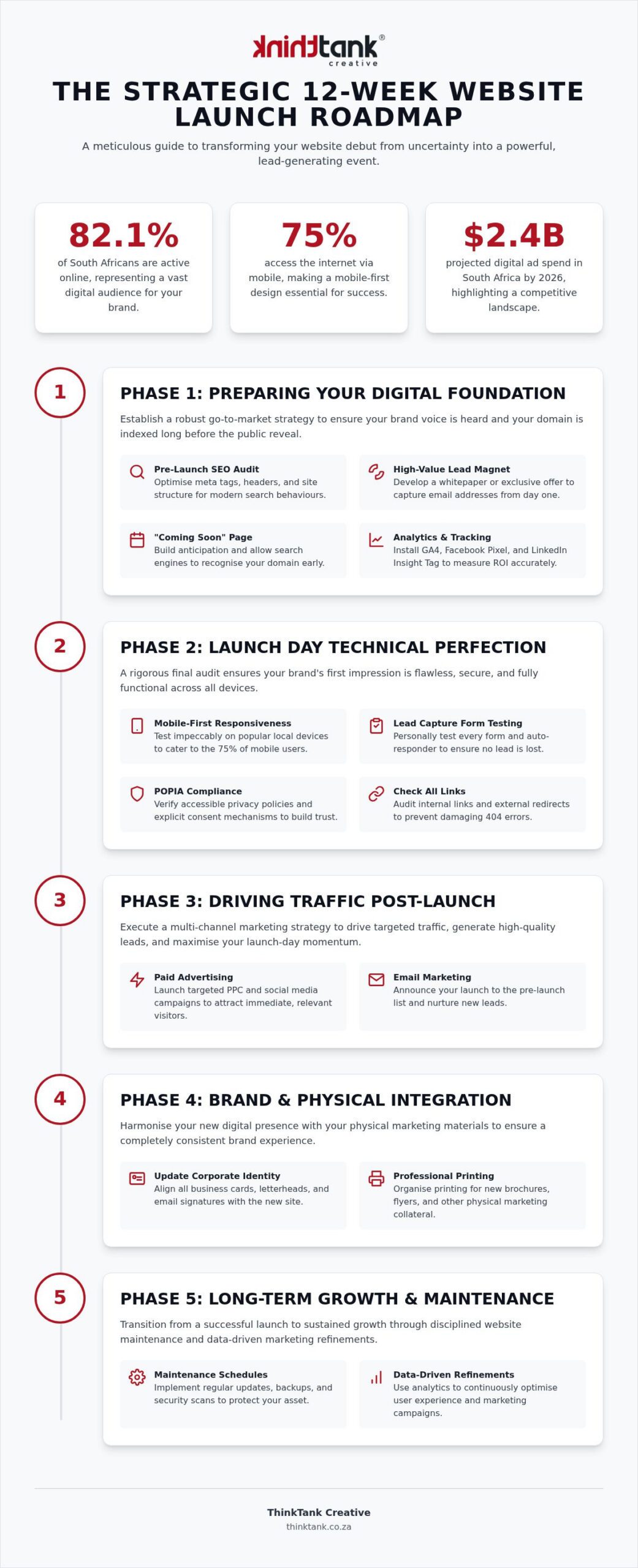
Did you know that as of May 2026, 82.1% of South Africans are active online, yet many local brands still debut their digital presence to nothing but silence? It's a common anxiety to fear that your significant investment will result in "launching to crickets" or that technical bugs will mar your brand's first impression. You've likely spent months perfecting your vision; the thought of fragmented social media messaging or a lack of immediate leads is genuinely daunting. At ThinkTank Creative, we believe a successful debut requires more than just pushing a button.

This guide provides the clarity you need to transform that uncertainty into a strategic advantage by using a meticulous website launch marketing plan. We'll walk you through a clear, 12-week roadmap that integrates our proven 5-stage development process to ensure your brand identity remains consistent across every channel. Whilst every project is unique and a tailored cost estimate is provided after our initial discussion, this checklist ensures you're equipped to handle POPIA compliance and AI-driven search trends. By the end of this article, you'll possess a bespoke strategy to drive growth and convert South African leads the moment your site goes live.

Key Takeaways

  • Secure your digital foundation by conducting pre-launch SEO audits and developing lead magnets that capture high-value enquiries from the moment you go live.
  • Execute a seamless debut with a strategic website launch marketing plan that spans twelve weeks of preparation, execution, and post-launch optimisation.
  • Eliminate technical anxiety with a rigorous launch day checklist, focusing on mobile-first responsiveness and fully functional lead-capture forms.
  • Harmonise your digital and physical presence by updating corporate identity materials and organising professional printing for a consistent brand experience.
  • Transition from a successful launch to long-term growth through disciplined maintenance schedules and data-driven marketing refinements.

Phase 1: Preparing Your Digital Foundation Before the Reveal

Precision is the hallmark of a successful debut. A robust website launch marketing plan begins long before the public reveal, acting as the strategic bridge between technical development and commercial success. By establishing a solid go-to-market strategy, you ensure that your domain starts indexing early and your brand voice is heard above the noise. This phase is about setting the stage for growth, ensuring that when the curtain rises, every technical and creative element is poised for high-performance engagement.

Start by conducting a meticulous pre-launch SEO audit to ensure meta tags, header hierarchies, and site structures are optimised for modern search behaviours. Simultaneously, develop a high-value lead magnet, such as an industry whitepaper or exclusive discount, to capture email addresses from your very first visitor. A "Coming Soon" landing page is vital; it builds anticipation amongst your audience and allows search engines to recognise your domain whilst your full site is under construction. With South African digital ad spend projected to reach US$2.40 billion in 2026, you must organise your marketing budget to include initial PPC and social media spend as part of your broader website launch marketing plan. Whilst every project varies, we provide a detailed estimated cost after a thorough discussion of your specific requirements.

To better understand the synergy between development and marketing, watch this helpful video:

The 5-Stage Development Alignment

Our 5-stage development process creates a seamless transition from concept to conversion. During Research & Strategy, we uncover the deep insights that inform your launch marketing, ensuring your messaging resonates with South African audiences. The Design & Production stage prioritises conversion-ready elements and bespoke aesthetics that turn casual visitors into loyal leads. Finally, the Program and Development phases support the exceptional loading speeds and mobile-first architecture essential for 2026 SEO rankings. We do it all so you don't have to, providing a meticulously crafted foundation for your digital brand.

Setting Up Analytics and Tracking

Data is the fuel for strategic decision-making and brand elevation. Install Google Analytics 4 and configure specific conversion goals to track user journeys from the very first click. It's essential to verify that the Facebook Pixel and LinkedIn Insight Tag are firing correctly to enable precise retargeting and audience segmentation. Tracking every interaction is the only way to measure your return on investment with absolute certainty.

Phase 2: The Launch Day Checklist for Technical Perfection

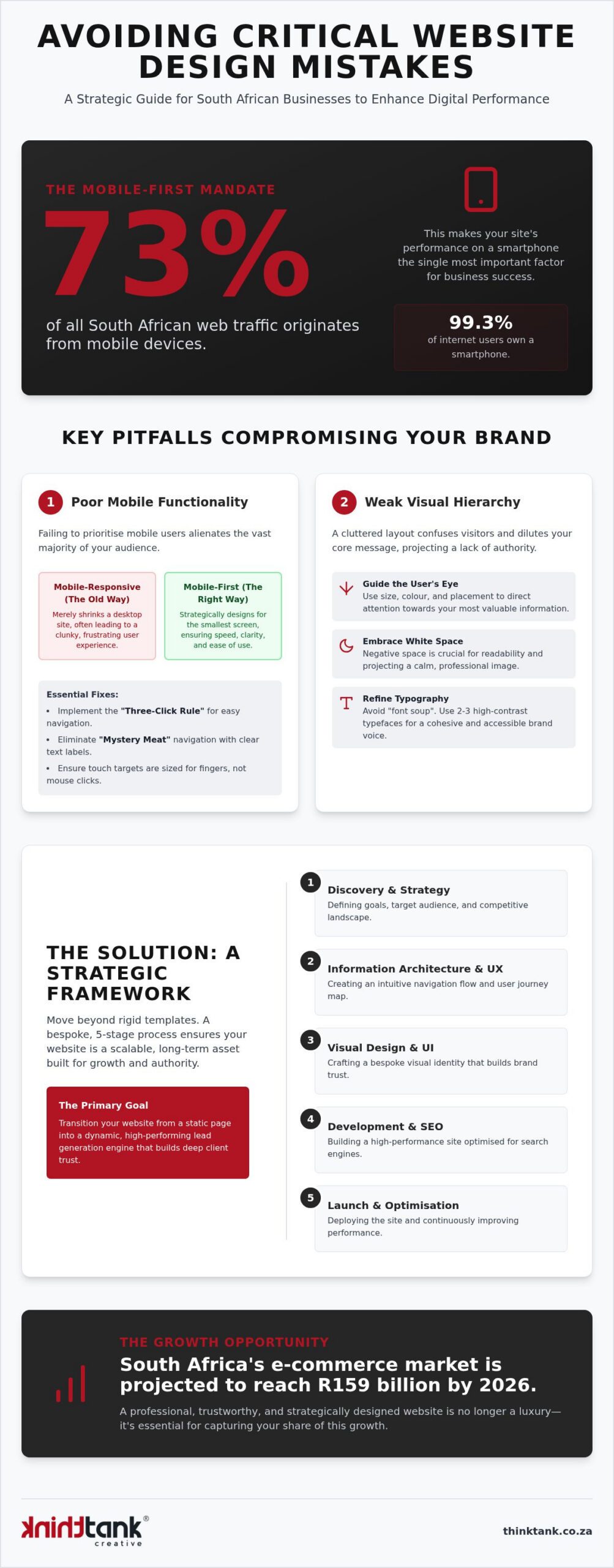
Launch day is the culmination of your creative journey, but it's also the moment where technical precision matters most. Your website launch marketing plan must include a rigorous final audit to ensure that your brand's first impression is flawless. With over 75% of South Africans accessing the internet via mobile devices, your site's mobile-first responsiveness isn't just a feature; it's a prerequisite for commercial survival. Test your site across a range of popular local devices to ensure the layout remains impeccable and functional for every user, regardless of their screen size.

Don't leave your lead generation to chance. Test every contact form and auto-responder personally to confirm that no potential client is lost in a technical void. In the 2026 regulatory environment, the Information Regulator has intensified compliance monitoring, making POPIA alignment mandatory for every data collection point. Verify that your privacy policy is accessible and that your consent mechanisms are explicit. Beyond POPIA, ensure your PAIA manual for website South Africa is correctly published and accessible, as the Information Regulator's increased scrutiny extends to this often-overlooked legal requirement. This level of detail prevents legal friction and builds immediate trust with your audience. Before you flip the switch, check all internal links and external redirects to prevent frustrating 404 errors that could damage your SEO equity.

Technical Stability and Speed

Security and performance are the pillars of digital authority. Ensure your SSL certificate is active to provide a secure HTTPS connection, which remains a fundamental ranking signal for search engines. Page load speeds should be measured against South African server benchmarks; aim for a median mobile speed that exceeds the national average of 66.15 Mbps to keep your visitors engaged. High bounce rates often stem from easily avoidable errors, so consult our guide on 7 Web Design Mistakes to Avoid to ensure your debut is technically sound. If you'd prefer a partner to manage these complexities, our website maintenance and support services provide the ongoing peace of mind you need.

The "Big Bang" Social Media Debut

A coordinated multi-channel announcement creates the "Big Bang" effect your brand deserves. Focus your efforts on LinkedIn, Facebook, and Instagram, using short-form video posts to showcase the new site's unique functionality and aesthetic. Video content continues to dominate social algorithms in 2026, making it the most effective medium for capturing attention quickly. Encourage your entire team to share the launch amongst their professional networks to amplify your organic reach and foster a sense of collective success. This synergy between technical perfection and social momentum ensures your website launch marketing plan delivers the impact your brand transformation requires.

Phase 3: Driving Traffic and Generating Leads Post-Launch

Momentum defines the success of your new digital presence. Whilst the initial launch creates a spark, a sustained website launch marketing plan ensures that spark becomes a steady flame of high-quality leads. You shouldn't wait for search engines to discover you naturally. Instead, take a proactive stance by initiating a targeted PPC campaign to drive immediate traffic to your most critical service pages. This immediate influx of visitors allows you to monitor user behaviour through heatmaps, identifying potential friction points before they impact your conversion rates.

Don't overlook the goldmine within your existing database. Launch an automated email marketing sequence to announce your new features, inviting loyal clients to experience your brand's transformation firsthand. This direct line of communication, combined with a consistent SEO content schedule, builds both immediate engagement and long-term organic authority. By providing valuable insights from day one, you position your brand as a dependable industry leader that understands the evolving needs of the South African market.

Strategic PPC and Paid Advertising

Google Ads serves as the essential bridge whilst your organic SEO matures, providing visibility for high-intent keywords that South African service-based businesses rely on. With the local digital ad market projected to reach US$2.40 billion in 2026, competition is fierce; precision in your targeting is non-negotiable. For a deeper dive into these methodologies, explore our Lead Generation Strategies for South African Businesses. We provide an estimated cost for managing these bespoke campaigns after a collaborative discussion about your specific growth targets.

Content Marketing and Social Growth

Plan a 90-day content calendar that addresses the specific pain points your clients face daily. This structured approach ensures your social media marketing remains purposeful and aligned with your new site's objectives. Utilise active community management to engage with users who comment on your launch posts, fostering a sense of partnership and trust. Social proof, such as client testimonials and case studies, acts as the final persuasive push that converts a curious visitor into a committed lead. It's this synergy between paid visibility and organic credibility that drives sustainable growth.

Website Launch Marketing Plan: The Ultimate 2026 Checklist for South African Businesses

Phase 4: Brand Continuity and Physical Marketing Integration

True brand transformation extends far beyond the confines of a browser window. Whilst your digital presence is the engine of modern growth, your physical touchpoints act as the tangible anchors of your professional reputation. A comprehensive website launch marketing plan must harmonise these two worlds to ensure a seamless experience for your clients. This phase focuses on the meticulous alignment of your offline collateral with your new digital identity, preventing the brand fragmentation that often dilutes market impact.

Begin by auditing all existing physical assets to reflect your updated URL and visual language. Organise professional printing for new business cards, letterheads, and "leave-behind" materials that mirror the sophistication of your new site. Distributing these promotional materials to your key clients serves a dual purpose; it celebrates your evolution whilst providing a physical reminder of your renewed commitment to excellence. This synergy between digital and print channels reinforces your authority as a cohesive, forward-thinking enterprise.

Logo and Corporate Identity Alignment

A website launch provides the ideal catalyst for a strategic brand refresh. If your visual identity feels dated, it will undermine the modern functionality of a 2026-standard website. High-quality logo and corporate identity design ensures that your brand remains legible and impactful across every medium, from a smartphone screen to a printed banner. The tactile quality of premium printing solutions shouldn't be underestimated; it communicates a level of meticulousness that digital pixels alone cannot replicate. For businesses seeking a partner capable of managing this complex synergy, understanding how to choose a web design agency in South Africa is the first step toward achieving a unified brand vision.

The Power of Print in a Digital World

Physical materials remain a potent tool for driving high-intent traffic to your new digital home. Printed company profiles and brochures can be transformed into interactive gateways by incorporating QR codes that lead directly to specific landing pages. This is particularly effective in B2B service-based sales, where "leave-behind" materials provide a lasting impression after a face-to-face meeting. These physical cues guide potential leads back to your website launch marketing plan's primary conversion points, bridging the gap between a handshake and a digital enquiry. By integrating these channels, you create a robust ecosystem that supports lead generation at every possible touchpoint.

Ready to elevate your brand's physical presence alongside your new digital home? Explore our bespoke printing solutions and let us bring your corporate identity to life with precision and excellence.

Phase 5: Long-Term Growth and Maintenance Strategy

Evolution is the engine of digital longevity. A sophisticated website launch marketing plan is a living strategy that requires consistent refinement to remain effective in the competitive South African market. We view the launch not as a final destination, but as the beginning of a collaborative journey toward market leadership. To maintain the momentum generated during your debut, you must transition from initial excitement to disciplined, data-driven growth. This ensures your brand remains a relevant and authoritative voice in an ever-shifting digital environment.

Success in the long term depends on your ability to adapt. Establish a monthly maintenance schedule to keep the site secure, functional, and aligned with the latest browser standards. Review your analytics reports every thirty days to refine your marketing strategy based on actual user behaviour rather than assumptions. By implementing ongoing SEO optimisations, you can protect and improve your search rankings as algorithms evolve. We recommend scheduling regular feedback sessions with your agency to discuss "Fine-Tuning" and "Revision" phases, ensuring your platform grows alongside your business objectives. Whilst every growth path is unique, a bespoke estimated cost for these ongoing services is provided after a detailed discussion of your specific goals.

Ongoing Website Maintenance and Support

The "set and forget" mentality is perhaps the most dangerous strategy a business can adopt after a successful debut. In 2026, the digital space is too volatile for static assets; security updates and plugin management are essential to prevent vulnerabilities and performance degradation. As part of our 5-stage development process, ThinkTank Creative provides dedicated ongoing service to ensure your platform remains elite in its execution. This meticulous care protects your corporate identity and ensures that the user experience stays as polished as it was on launch day. Meticulous maintenance is the hallmark of a brand that values its reputation and its customers' security.

Measuring Success and ROI

Precision in measurement leads to excellence in outcomes. Identify the key performance indicators that matter most for your first six months, such as lead conversion rates, organic traffic growth, and the median time spent on key service pages. Adjust your marketing plan based on actual user conversion data to eliminate friction and amplify what truly resonates with your audience. This methodical approach allows you to pivot with confidence, turning raw data into a strategic roadmap for expansion. Ultimately, we believe that exceptional marketing makes the customer look smart by solving their problems with effortless precision. By positioning yourself as a dependable partner through consistent performance, you secure not just a sale, but a lasting professional relationship.

Elevate Your Brand with a Strategic Digital Debut

A successful digital transformation requires moving beyond the "launch and leave" mentality. By integrating technical precision with a robust website launch marketing plan, you ensure your brand resonates with South African audiences from the very first click. Our award-winning design team, established in 2001, has refined a 5-stage development process that bridges the gap between creative vision and commercial performance. Whether you're aligning your corporate identity across print and digital or navigating the complexities of 2026 search trends, a meticulous approach is your greatest asset.

You don't have to manage this complex transition alone. As South Africa's premier all-rounder agency, we're deeply invested in your journey from the initial research phase to long-term maintenance and support. Whilst every project is unique, an estimated cost is provided after a collaborative discussion about your specific needs. Partner with ThinkTank Creative for a seamless website launch and strategic growth. Get your estimated cost today. We're ready to help you turn your digital presence into a powerful engine for sustainable growth and brand elevation.

Frequently Asked Questions

How long should a website launch marketing plan take to execute?

A comprehensive website launch marketing plan typically requires a twelve-week lead time to ensure strategic alignment across all channels. This duration allows for our meticulous 5-stage development process, moving from initial research and strategy through to testing and the final reveal. By starting three months in advance, you can build anticipation amongst your audience whilst ensuring every technical element is polished. This timeline provides the necessary space for SEO auditing and setting up tracking before the public launch.

What is the most important thing to do on the day my website goes live?

The most critical action on launch day is performing a final, live verification of all lead-capture mechanisms and technical functions. You must personally test every contact form, auto-responder, and checkout process to ensure no potential enquiry is lost. Simultaneously, check your site's mobile responsiveness on various devices popular in South Africa. Ensuring a flawless user experience from the first minute prevents brand friction and establishes immediate trust with your new visitors.

How do I ensure my new website is compliant with the POPI Act?

Ensuring POPIA compliance involves implementing explicit consent mechanisms and a transparent privacy policy at every data collection point. You must clearly state why you're collecting personal information and how it will be protected, especially since the Information Regulator has intensified enforcement in 2026. Verify that your cookie banners and email signup forms are updated to meet current legal standards. It's also essential to publish a compliant PAIA manual for your website in South Africa, as this is a distinct legal obligation that operates alongside POPIA and is increasingly scrutinised by regulators. It's essential to have a documented process for handling data subject rights to avoid significant penalties.

Should I run Google Ads immediately after my website launch?

Initiating a targeted PPC campaign immediately after launch is highly recommended to bridge the visibility gap whilst your organic SEO matures. Google Ads provides instant visibility on search engine results pages, allowing you to capture leads from day one. This proactive approach also generates valuable data on user behaviour, which helps us refine your broader website launch marketing plan. By targeting specific high-intent keywords, you ensure your brand is seen by the right audience immediately.

How often should I update the content on my new website?

You should aim to update your website content at least once a month to maintain search engine relevance and user engagement. Regular updates, such as blog posts or case studies, signal to search engines that your site is active and authoritative. This consistent content creation is a core part of our ongoing maintenance and support services. Fresh content addresses evolving client pain points whilst improving your long-term organic rankings in a competitive national landscape.

What is the difference between a website launch and a website redesign marketing plan?

A website launch focuses on establishing a brand's first digital foundation, whilst a redesign marketing plan prioritises the seamless transition of existing traffic and SEO equity. For a new launch, the emphasis is on building buzz from zero and indexing a new domain. In contrast, a redesign requires careful management of redirects and communicating new features to an established database. Both strategies utilise our 5-stage methodology to ensure consistent corporate identity across all digital touchpoints.

How much does a professional website launch marketing plan cost in South Africa?

The investment for a professional website launch marketing plan varies based on the complexity of your requirements and business size. At ThinkTank Creative, we provide a tailored estimated cost after a collaborative discussion about your specific goals and timeline. This ensures you receive a bespoke solution that aligns with your growth objectives. Whether you're a small enterprise or a large organisation, we offer comprehensive packages that cover everything from SEO to high-quality printing solutions.

7 Web Design Mistakes to Avoid: South African Guide

With nearly 73% of South Africa's web traffic originating from mobile devices, your digital storefront is being judged on a screen that fits in the palm of a hand. It's disheartening to watch business growth stall due to common website design mistakes to avoid, especially when you've poured your expertise into crafting world-class services. You might be struggling with high bounce rates or finding it difficult to organise complex offerings into a layout that feels intuitive rather than overwhelming for your visitors.

We believe your online presence should be a bespoke masterpiece that functions as a high-performing lead generation engine. In this guide, we'll identify the critical pitfalls currently hindering local brands and provide a clear, strategic roadmap to transform your site into an authoritative digital asset. By moving beyond templated thinking, you'll discover how to elevate your user experience, improve search engine rankings, and build the deep trust your clients deserve. We'll explore the essential shifts needed to turn your website from a static page into a dynamic partner in your professional success.

Key Takeaways

  • Adopt a mobile-first strategy to engage the 73% of South African users who primarily access the web via smartphones.
  • Master the art of visual hierarchy to guide potential clients effortlessly toward your most valuable service offerings.
  • Identify and resolve the common website design mistakes to avoid that compromise your site's loading speed and search engine visibility.
  • Strengthen digital trust by integrating clear calls to action and ensuring your platform meets the latest local legal compliance standards.
  • Transition from rigid templates to a bespoke, 5-stage strategic framework designed for long-term business scalability and brand growth.

Overlooking Mobile-First Functionality and Navigation Flow

South African digital landscapes are uniquely mobile-centric. With 72.7% of all web traffic in the country originating from mobile devices, your site's performance on a smartphone is the single most important factor for business survival. Neglecting this reality is one of the most common website design mistakes to avoid if you intend to capture a market where 99.3% of internet users are smartphone owners. A desktop-first mindset creates friction; it alienates users who expect immediate, intuitive interactions whilst they're on the move.

Success begins with a robust Information Architecture. Think of this as the strategic blueprint that maps out how a visitor moves from initial curiosity to a final enquiry. When navigation feels clunky or illogical, it triggers a psychological disconnect, causing users to abandon the site in favour of a competitor who offers a smoother journey. Building trust requires a seamless flow that respects the user's time and intent.

To better understand how these design choices impact your brand, watch this helpful video:

The Pitfalls of Complex Navigation Menus

Service-based businesses often fall into the trap of over-complicating their menus. One frequent error is "mystery meat" navigation, where minimalist icons are used without text labels, leaving users guessing where a link might lead. We advocate for the "three-click rule": a visitor should be able to find any piece of critical information within three taps. By organising content for specific audience segments, you ensure that every visitor finds what they need without unnecessary cognitive load.

Mobile-First vs. Mobile-Responsive

Whilst "responsive" design merely shrinks a desktop layout to fit a smaller screen, mobile-first design is a strategic prioritisation of core content for the most common user device. This methodology forces us to identify what truly matters to your client. It ensures that touch targets, such as buttons and links, are appropriately sized for human fingers rather than precision mouse clicks. By designing for the smallest screen first, we eliminate the clutter that often plagues traditional sites, creating a refined experience that prioritises speed and clarity.

Compromising Visual Clarity with Poor Hierarchy and Imagery

Visual clarity serves as the bridge between a visitor's initial curiosity and their eventual trust in your brand. It's not merely about "looking good"; it's about the strategic arrangement of elements to guide a potential client through your professional story. One of the most common website design mistakes to avoid is treating every piece of content with equal importance. When everything shouts for attention, nothing gets heard. By utilising size, colour, and placement, we establish a visual hierarchy that directs the eye toward your primary value proposition and most critical business information.

We often encounter businesses that view white space as "wasted" real estate, yet negative space is an active and essential design element. It provides the breathing room necessary for your message to resonate. A cluttered layout increases cognitive load, making it difficult for users to organise your service offerings in their minds. Conversely, a clean, well-spaced design projects a sense of calm authority and meticulous craftsmanship. It suggests that your business is organised, dependable, and focused on quality.

The Impact of Typography and Readability

Effective communication relies heavily on how your text is presented across various devices. Avoiding the "font soup" mistake is vital; we recommend limiting your selection to two or three typefaces to maintain a cohesive brand voice. High contrast is equally important for accessibility, ensuring your content remains readable even for mobile users in bright, outdoor South African conditions. Your choice of typography influences the perceived personality of your brand, moving from the traditional stability of a serif to the modern, fluid energy of a sans-serif font.

Using Authentic Visuals to Build Trust

Generic stock imagery often dilutes brand authenticity, making a professional enterprise feel like a templated afterthought. In a maturing e-commerce market projected to reach R159 billion by 2026, standing out requires a unique visual signature. Custom graphics and professional photography demonstrate a level of investment that generic visuals simply cannot match. For national brands, a custom logo and corporate identity design are non-negotiable components of a high-performing digital presence. For deeper bespoke branding insights, you can explore our guide on custom website design south africa.

Establishing this level of visual consistency creates a sense of reliability that mirrors the stability of a long-standing enterprise. If you're looking to refine your brand's aesthetic, our creative design experts can help you move from a generic online presence to a tailored digital experience that truly reflects your excellence.

Prioritising Aesthetics Over Technical Performance and SEO

A visually striking website is a source of pride for any business owner, yet its value vanishes if it remains hidden from your target audience. We often see brands fall into the trap of over-designing, where heavy scripts and high-resolution assets create a significant barrier to entry. This is a critical oversight amongst common website design mistakes to avoid, as it directly impacts your search engine visibility and user retention. Technical performance is the foundation upon which all creative design must sit.

Google's March 2026 Core Update introduced holistic Core Web Vitals scoring, which now aggregates performance metrics into a composite score. If your site suffers from the "Speed Gap" caused by unoptimised animations or bulky code, you risk being penalised in the rankings. In a market where 72.7% of traffic is mobile, even a three-second delay can lead to an immediate loss of potential leads. We focus on balancing sophisticated aesthetics with the lean, efficient code required to satisfy modern search algorithms.

Designing for Search Engine Optimisation

Structure is as vital as style. We use H1-H6 tags to define a clear content hierarchy that search engines can easily crawl and index, rather than using them merely for font styling. A frequent error involves using "images-as-text" or hidden content, which renders your site's value invisible to Google's bots. Building a strong internal linking strategy is equally important for establishing topical authority and guiding users through your service ecosystem. For a comprehensive look at these technical requirements, you can read our strategic guide on search engine optimisation south africa.

Optimising for Local Connectivity Challenges

South African internet users often face connectivity fluctuations or high data costs. We prioritise data efficiency by utilising modern image formats like WebP and advanced compression techniques to maintain visual quality without the heavy file size. By implementing robust caching and Content Delivery Networks (CDNs), we ensure your digital presence is delivered with consistent speed across the country. This methodical approach ensures your site remains accessible to all users, regardless of their connection type or location, whilst maintaining the polished professional image your brand deserves.

7 Web Design Mistakes to Avoid: South African Guide

Your digital presence acts as your most tireless sales representative. Yet, many businesses struggle with the "Invisible Call to Action", where visitors browse but never actually engage. This often stems from a lack of clarity in the user's primary journey. If a visitor cannot understand your value proposition within five seconds of landing, you've likely lost a potential lead. Great marketing isn't about making your company look smart; it's about making your customer look smart by providing immediate, elegant solutions to their specific challenges.

Compliance is another critical area where oversight leads to severe consequences. As of September 2026, the Information Regulator has increased enforcement of the Protection of Personal Information Act (POPIA) and the Promotion of Access to Information Act (PAIA). With recent fines of R5 million imposed for non-compliance, private enterprises must be equally vigilant. Neglecting these legal frameworks is one of the most common website design mistakes to avoid, as it erodes client trust and invites significant regulatory scrutiny. We believe that transparency in data handling is a cornerstone of professional credibility. Ensuring your site includes a fully compliant PAIA manual for website South Africa is an essential step in meeting these obligations and protecting your business from regulatory risk.

Strategic Placement of Calls to Action (CTAs)

Effective conversion relies on both visual prominence and persuasive language. We utilise contrasting colours to ensure buttons stand out against the page background, instinctively guiding the user's eye toward the next step. It's essential to understand the distinction between "hard" conversions, like a direct enquiry, and "soft" conversions, such as signing up for an industry newsletter. Balancing these options allows you to nurture leads at different stages of the buying cycle. To refine your conversion funnel, explore our lead generation strategies for south african businesses.

Trust Signals and Compliance

Building digital trust requires meticulous attention to detail. Every site should include essential security features like SSL certificates, clear privacy policies, and transparent cookie consents. These technical trust signals are reinforced by social proof, such as verified testimonials and detailed case studies that validate your expertise. Ensure your contact details are prominent and easily accessible; users feel more secure when they know exactly how to reach a human being. This transparency is vital for establishing a long-term professional partnership.

If you're unsure whether your current platform meets these rigorous standards, our team can provide a comprehensive website maintenance and support audit to ensure you remain compliant and competitive.

Executing Without a Strategic Design and Development Framework

Designing a digital platform without a rigorous strategy is akin to constructing a complex architectural marvel without a blueprint. One of the most common website design mistakes to avoid is "designing in a vacuum", where aesthetics are chosen based on personal preference rather than data-driven user behaviour. Whilst DIY templates might seem like a cost-effective entry point, they frequently fail to scale as your business requirements evolve. These templated solutions often result in a fragmented user experience that lacks the synergy and precision of a bespoke digital asset.

We believe that excellence is achieved through a disciplined, 5-stage development process. This structured methodology, comprising Planning, Design, Program, Development, and Revise, ensures that every creative choice is grounded in strategic reasoning. By positioning ourselves as an all-rounder partner that does it all so you don't have to, we allow you to focus on your core operations whilst we handle the technical precision of your digital transformation. This end-to-end approach moves your project from a high-level concept to a concrete, high-performing reality.

The Importance of Research and Strategy

Successful design begins long before the first pixel is placed. We immerse ourselves in understanding your target audience, identifying their specific pain points and motivations to prevent design errors before they even manifest. This collaborative phase involves challenging ideas through healthy debate, which often leads to the most innovative creative solutions for your brand. Final delivery is never the end; it's preceded by a meticulous phase of testing and fine-tuning to ensure the platform performs flawlessly under real-world conditions.

Ongoing Support and Maintenance

The "launch and leave" mentality is a significant risk to the functional longevity of any site. Digital environments are fluid, requiring regular maintenance to ensure security remains robust and features continue to operate as intended. A well-considered website launch marketing plan ensures your debut is strategic, consistent, and positioned to generate immediate leads rather than launching to silence. We provide comprehensive website maintenance and support to protect your investment and ensure your platform remains a high-performing lead generation engine. Because every project possesses unique complexities and bespoke requirements, we provide an estimated cost after discussing your individual project needs during our initial consultation.

Elevate Your Digital Future

Your website is more than a digital brochure; it's the engine of your brand's growth in a competitive South African market. Identifying and resolving the common website design mistakes to avoid ensures your platform functions as a high-performing lead generation engine rather than a static page. Prioritising a seamless mobile journey and strict POPIA compliance aren't just technical requirements; they're essential steps in building the lasting trust your audience deserves.

Transforming your online presence requires a partner who understands the synergy between bespoke artistry and technical precision. Since 2001, ThinkTank Creative has empowered brands through our award-winning in-house creative team and a meticulous 5-stage development process. We're ready to help you move beyond generic templates toward a tailored solution that reflects your professional excellence. Partner with ThinkTank Creative for a strategic website redesign and let's build a digital platform that truly drives your business forward. The potential for your brand's transformation is immense, and we're here to help you capture it.

Frequently Asked Questions

What are the most common website design mistakes for small businesses?

Small businesses often overlook mobile-first functionality and fail to define a clear call to action. These common website design mistakes to avoid can lead to high bounce rates and lost revenue. Many enterprises also rely on generic stock imagery that dilutes their brand authenticity. By focusing on a structured hierarchy and custom visuals, you ensure your site represents your professional standards whilst guiding visitors toward a meaningful conversion.

How does poor website design affect my SEO rankings in South Africa?

Search engines prioritised user experience significantly in 2026, especially regarding Core Web Vitals and mobile performance. Since over 72% of South African web traffic is mobile, a site that loads slowly or lacks a responsive layout will be penalised in rankings. Poor technical structure, such as improper heading tags or unoptimised images, makes it difficult for search bots to crawl your content, ultimately pushing your business off the first page.

Is a DIY website builder a mistake for a growing company?

DIY builders often lack the scalability required as business requirements evolve. Whilst they offer a low entry barrier, they frequently result in "designing in a vacuum" without a robust research and strategy phase. A growing company benefits more from a bespoke 5-stage development process that ensures the platform is secure, functional, and tailored to specific audience needs. Investing in custom development prevents the technical debt and limitations inherent in templated solutions.

How can I tell if my website navigation is too complicated?

High bounce rates and low time-on-page metrics are primary indicators that your navigation is confusing. You should apply the "three-click rule", ensuring any critical information is accessible within three taps. If your menu relies on "mystery meat" icons without labels or lacks a logical hierarchy, visitors will likely feel overwhelmed. Testing your site with real users can reveal friction points where they struggle to organise your complex service offerings.

What legal requirements must a South African website follow in 2026?

Every South African website must strictly adhere to the Protection of Personal Information Act (POPIA) and the Promotion of Access to Information Act (PAIA). As of September 2026, the Information Regulator has significantly increased enforcement, with fines reaching R5 million for non-compliant entities. Your site must include a transparent privacy policy, clear cookie consents, and secure data handling protocols to protect user privacy whilst ensuring your business remains legally compliant and trustworthy. Understanding the full requirements of a PAIA manual for website South Africa is a critical component of meeting these 2026 standards.

How often should I redesign my website to avoid design decay?

Most professional websites require a significant refresh or redesign every two to three years to keep pace with evolving technology and design trends. However, consistent website maintenance and support can extend this lifecycle by ensuring your platform remains secure and functionally modern. Design decay occurs when a site feels dated or fails to support new business goals. Regular audits help you identify when a strategic overhaul is necessary to maintain your competitive edge.

Does website speed really impact my conversion rates?

Speed is a critical driver of conversion; even a one-second delay can lead to a measurable drop in enquiries. In South Africa, where many users face connectivity fluctuations, an unoptimised site that consumes excessive data will be abandoned quickly. Ensuring fast loading times through caching and efficient coding is essential for retaining mobile users. Technical performance serves as the vital foundation that allows your creative design to actually convert visitors into loyal clients.

What is the difference between good marketing and great marketing in web design?

We believe good marketing makes the company look smart, but great marketing makes the customer look smart. Good design might focus on flashy aesthetics, whilst great design prioritises the user's journey by solving their problems with elegance and ease. By removing friction and providing clear solutions, you empower your visitors. This customer-centric approach transforms a simple website into a high-performing lead generation engine that fosters long-term professional relationships.

How to Choose a Web Design Agency in South Africa: The 2026 Strategic Guide

A beautiful website that fails to generate leads isn't a digital asset; it's a vanity project that drains your marketing budget. You've likely felt the frustration of investing in a platform that looks professional whilst remaining invisible to your target audience or failing to spark meaningful conversations. It's a common pain point for businesses seeking growth. Understanding how to choose a web design agency in South Africa requires looking beyond aesthetics to find a partner who integrates branding, SEO, and user experience into a single, high-performance engine.

We'll help you master the art of selecting a digital partner with our expert criteria and a professional briefing template. You'll learn to identify agencies that prioritise your ROI and maintain clear communication throughout the development journey. This guide explores the essential benchmarks for 2026, including mobile-first excellence and POPIA compliance. We'll move from basic selection tips to a sophisticated strategy that ensures your website serves as a 24/7 lead generation tool. This is a journey of imagination and precision, designed to secure a long-term partnership with a reliable ZA agency built on mutual success and measurable growth.

Key Takeaways

  • Shift your perspective from simple aesthetics to integrated strategic ecosystems that drive measurable business growth and brand transformation.
  • Evaluate agency longevity and portfolio depth to ensure your partner possesses the technical precision and creative vision required for high-performance outcomes.
  • Prioritise non-negotiable standards such as POPIA compliance and mobile-first design to protect your brand whilst reaching the majority of South African users on their smartphones.
  • Master how to choose a web design agency in south africa by using a professional briefing template to align your vision and secure accurate project estimations.
  • Understand the significance of a structured 5-stage development process in maintaining consistent branding and long-term digital stability after your site goes live.

Your digital presence is no longer a luxury; it's the primary engine of your business growth. In the 2026 South African market, a 'pretty site' is merely the entry fee, whereas a high-performance platform is the winning strategy. When considering how to choose a web design agency in south africa, you must look for a partner capable of transforming your vision into a lead-generating powerhouse that thrives in a competitive economy. Static brochures are relics of the past; today's businesses need ecosystems that work as hard as they do to organise their digital leads and customer data.

Distinguishing between a freelance developer and a full-service creative agency is a critical first step for any expanding enterprise. Whilst a freelancer might offer lower initial costs, they often lack the technical and creative breadth required to manage the web design process across complex branding, SEO, and custom development. Agencies with a national footprint and a reputation spanning over two decades, such as ThinkTank Creative (founded in 2001), provide the stability and multi-disciplinary depth that a solo contractor cannot match. This longevity is vital in a volatile digital market where reliability is the ultimate currency for your brand's colour and identity.

To better understand the current standards of excellence in the local market, watch this helpful overview:

Defining Your Business Objectives

Identify your primary goal before your first consultation to ensure your investment delivers a high ROI. Do you require a sophisticated e-commerce platform to capture a share of the growing online retail market, or perhaps a corporate identity hub that aligns perfectly with your physical printing solutions? Your website must be the centre of your marketing universe, reflecting a consistent brand behaviour that builds trust amongst cautious South African consumers. Setting realistic expectations for digital engagement ensures your platform isn't just a placeholder but a dynamic tool that makes your brand look smart and capable.

The "All-Rounder" Advantage

Working with a single partner who manages your entire brand lifecycle provides unparalleled synergy and creative consistency. This collaborative approach ensures that your logo, social media marketing, and web systems speak with one voice, eliminating the friction of managing multiple vendors. It's a cost-efficient path to excellence that avoids the fragmentation often found in complex projects. By integrating advertising and web development, you create a seamless journey for your customers. An all-rounder agency is one that manages the entire brand lifecycle from logo to launch.

Essential Criteria for Vetting a Strategic Digital Partner

Look beyond the surface to find a partner who understands that a website is a living business tool. When you evaluate how to choose a web design agency in south africa, your first instinct might be to scan for aesthetic appeal, yet the most vital criteria lie in functionality and strategic visualisation. A portfolio should demonstrate how an agency solves complex user journeys whilst maintaining brand integrity. ThinkTank Creative's founding in 2001 provides a benchmark for this stability; 25 years of experience ensures your project isn't a playground for experimentation but a refined execution of proven methodologies.

Seek out agencies that showcase real business outcomes in their case studies. It's easy to produce 'pretty pictures', but it's far more difficult to engineer a platform that consistently converts visitors into loyal customers. Award-winning designers play a pivotal role here, as they possess the refined skill set required to elevate your brand above the digital noise through bespoke craftsmanship rather than templated shortcuts. To see how these elements combine, you can explore our creative design portfolio for examples of brand-led digital transformation.

The Importance of an In-House Team

Direct collaboration is the heartbeat of a successful digital transformation. Outsourcing often leads to communication breakdowns, where the original vision is diluted through layers of external contractors who don't share the agency's core values. An in-house team ensures that your project benefits from a collaborative, discussion-driven process where designers and developers work in synergy. This environment encourages challenging interaction and debate, which is exactly how superior creative ideas are born and refined. When experts sit in the same room, they can iterate faster and maintain a higher standard of quality control.

Transparency and Communication

Transparent communication is the cornerstone of a healthy partnership. When you are deciding how to choose a web design agency in south africa, the quality of the initial proposal tells you everything you need to know about their professionalism. Be wary of 'one-size-fits-all' pricing models that fail to account for the unique complexities of your business. A professional agency provides an estimated cost after a thorough discussion, reflecting the bespoke nature of high-quality web systems. Avoid red flags such as promises of 'instant' results or the 'cheapest' rates, as these often mask a lack of technical depth and strategic reasoning. Familiarising yourself with the common website design mistakes to avoid can further sharpen your ability to identify agencies that cut corners rather than deliver genuine value.

Technical and Regulatory Non-Negotiables for ZA Websites

Technical excellence is the silent foundation of a successful brand. When deciding how to choose a web design agency in south africa, you must ensure your partner understands the local legal landscape. POPI Act compliance is a non-negotiable legal necessity, as the Information Regulator actively enforces data protection with potential penalties reaching R10 million for breaches. A strategic partner integrates privacy by design, ensuring your contact forms and newsletters align with the strengthened 2025 consent requirements. This meticulous approach protects your business whilst building deep trust with your audience.

Mobile connectivity is the heartbeat of the South African internet, with over 75% of users accessing the web via mobile data. Your website must be lightweight and fast to accommodate users on prepaid plans whilst maintaining a premium feel across all devices. High-speed local hosting is essential here; it reduces latency and improves your search engine visibility by serving content from a local centre. Scalability ensures your system development keeps pace with your revenue, preventing the need for a total rebuild as your business expands into new markets.

SEO and Lead Generation Integration

Search visibility is a strategic asset that must be woven into the fabric of your code rather than added as an afterthought. Choosing a partner who understands custom website design south africa ensures your site is built for search engine algorithms from day one. Great marketing makes the customer look smart by providing immediate, intuitive solutions to their needs. This synergy between design and SEO turns your website into an active participant in your sales cycle, ensuring your brand remains visible to those searching for your specific expertise.

Security and Maintenance

A "set and forget" mentality is a recipe for technical debt and lost traffic. Ongoing website maintenance and support are vital for protecting your investment against evolving security threats and ensuring your software remains current. Evaluate an agency's commitment to ongoing service post-launch; a reliable partner provides a steady cadence of updates and support. This commitment is part of a comprehensive 5-stage development process that moves from planning and design through to delivery and long-term support. Constant vigilance ensures your platform remains a dependable asset for your brand journey.

How to Choose a Web Design Agency in South Africa: The 2026 Strategic Guide

The Professional Web Design Brief Template

Clarity is the catalyst for creative success. A well-structured brief doesn't just describe a website; it defines the strategic trajectory of your brand's digital presence. When you are learning how to choose a web design agency in south africa, the quality of your brief determines the precision of the proposals you receive. It bridges the gap between your vision and the agency's execution, ensuring every pixel aligns with your commercial objectives. By articulating your needs clearly, you invite a collaborative partner to add strategic value rather than just taking orders.

Whilst you likely have a favourite brand aesthetic in mind, a professional brief helps you translate those preferences into a framework of professional standards. This ensures your digital and physical brand requirements, from your web systems to your printing solutions, maintain a unified and authoritative voice. A detailed brief is the most effective tool for obtaining accurate estimated costs, as it allows agencies to understand the true scope of your bespoke requirements and the methodology required to achieve them.

Step 1: Business and Audience Overview

Start by grounding the project in your business reality. Clearly state your mission and define your target audience with precision, identifying your primary competitors to help the agency understand the landscape you aim to disrupt. This overview should describe the emotional journey you want your customers to embark on, moving from initial curiosity to deep trust. Integrating these insights with proven lead generation strategies for south african businesses ensures your website is built for high-performance conversion from the very first draft.

Step 2: Technical and Creative Requirements

List your essential technical features, such as e-commerce capabilities or custom system development, to avoid scope creep later in the project. Define your corporate identity needs, including logo design, stationery, and promotional branded material, to ensure a cohesive presence across digital and physical platforms. Be transparent about your 2026 timeline and budget expectations to facilitate a more honest discussion about what is achievable. This level of detail empowers your partner to deliver excellence that matches your ambition. If you're ready to transform these requirements into a strategic asset, you can brief our creative team to begin your brand transformation.

Beyond the Launch: Maintenance, Support, and Brand Synergy

Launching your website is not the conclusion of a project; it is the commencement of a strategic brand journey. When you determine how to choose a web design agency in south africa, you must prioritise a partner who values the stability of your platform long after the initial deployment. A professional agency operates through a disciplined 5-stage development process: Planning, Design, Programming & Development, Testing & Revision, and Launch, Delivery & Support. This methodical structure ensures that your digital asset remains secure, high-performing, and aligned with your evolving business goals whilst avoiding the pitfalls of technical debt.

Your website serves as the central hub for your entire advertising and social media marketing strategy. It is the destination where your brand's promise meets the customer's needs. To create a truly cohesive presence, your digital storefront should work in tandem with your physical branding, utilising printing solutions and corporate identity materials to reinforce trust. This synergy ensures that whether a customer interacts with you online or via traditional marketing, the experience is seamless and professional. Maintaining this level of excellence requires constant, collaborative communication with your agency to refine your digital behaviour and stay ahead of market trends. A well-executed website launch marketing plan is essential to ensuring your new platform debuts to an engaged audience rather than an empty room.

Maximising ROI Through Digital Marketing

Driving consistent traffic to your site is essential for long-term success. By utilising a combination of PPC, email marketing, and SEO, you can ensure that your brand remains visible to your target audience throughout the year. However, traffic alone is not enough. You must understand that improving website user experience is the most direct way to impact your conversion rates and secure a higher ROI. Transparent analytics and detailed reporting allow you to measure these outcomes with precision, turning raw data into actionable insights that fuel your brand transformation.

The ThinkTank Creative Promise

Our commitment to your success is encapsulated in our slogan: "We Do It All So You Don't Have To." This is more than just a tagline; it's a promise of peace of mind for business owners who need a partner they can depend on. Since 2001, we've navigated the evolution of the national South African market, helping businesses of all sizes elevate their presence through bespoke craftsmanship and strategic visionary thinking. We invite you to contact info@thinktank.co.za for a strategic discussion about how we can help your brand reach its full potential in the digital landscape.

Secure Your Digital Future

Your website is the architectural foundation of your digital identity. Mastering how to choose a web design agency in south africa ensures that your investment transcends mere aesthetics to become a high-performance engine for growth. By prioritising technical precision, such as POPIA compliance and mobile-first responsiveness, you protect your reputation whilst engaging a national audience. A successful project relies on a structured 5-stage process and a partner who integrates branding, print, and web systems into a single, cohesive narrative.

ThinkTank Creative has been a visionary leader in this space since 2001, providing award-winning in-house designers and a comprehensive all-rounder service that simplifies your journey and amplifies your results. We invite you to start your journey of imagination with ThinkTank Creative today and experience the synergy of expert craftsmanship and strategic depth. Let's transform your brand into a smart, dependable leader that thrives in the 2026 landscape. Your potential for growth is limitless when you have the right partner by your side.

Frequently Asked Questions

How much does a professional website cost in South Africa in 2026?

Professional web design costs are determined by the specific complexity and strategic requirements of your project. Rather than offering a one-size-fits-all price, we provide an estimated cost after a detailed discussion regarding your business objectives and timeline. This approach ensures you receive a bespoke solution that aligns with your budget whilst maintaining our commitment to high-quality craftsmanship. It's a key factor in how to choose a web design agency in south africa that prioritises your ROI.

How long does the web design and development process typically take?

The duration of a project depends on its scope, though we always follow a disciplined 5-stage development process to ensure precision. This journey moves from initial planning and design through to programming, development, and a final phase of testing and support. We discuss specific timelines during the briefing stage to ensure our work meets your commercial deadlines. Our goal is to balance competitive time limits with the meticulous attention to detail your brand deserves.

Do I need to hire a separate agency for my logo and branding?

You don't need multiple vendors when working with an all-rounder partner like ThinkTank Creative. We specialise in both digital and physical brand transformation, offering professional logo and corporate identity design as part of our core services. By consolidating your creative requirements with a single agency, you ensure consistent branding across every touchpoint. This collaborative approach eliminates the communication friction often found when managing separate teams for your web and branding needs.

What is the difference between web design and web development?

Web design focuses on the visual and experiential aspects of your site, including UX/UI design and brand visualisation. Web development is the technical execution, involving the coding and programming required to make those designs functional and secure. Whilst they are distinct disciplines, we integrate them seamlessly within our 5-stage process. This synergy ensures your website doesn't just look smart but performs as a robust engine for lead generation and system development.

Is my business too small to work with a full-service creative agency?

No business is too small to benefit from a professional, strategic partnership. We serve organisations of all sizes, from those needing a simple promotional flyer to complex international web companies. Every project receives the same level of innovative creativity and collaborative interaction from our award-winning in-house team. We believe that great marketing should be accessible to any business looking to elevate its presence and build a dependable brand for the long term.

Will my new website be compliant with the POPI Act?

Data privacy is a non-negotiable legal requirement for every South African business collecting user information. We ensure that POPIA compliance is integrated into your website's architecture, from secure contact forms to transparent consent mechanisms for email marketing. This protects your organisation from significant penalties whilst building essential trust amongst your customers. When considering how to choose a web design agency in south africa, verifying their commitment to regulatory standards is a vital step.

Do you provide ongoing website maintenance and support after the launch?

Ongoing service is a fundamental component of our promise to our clients. Our 5-stage development process concludes with a dedicated phase for delivery and support, ensuring your platform remains secure and functional post-launch. We provide consistent website maintenance and support to handle technical updates and security patches as they arise. This commitment to your long-term digital stability reflects our slogan, "We Do It All So You Don't Have To," giving you total peace of mind.

Can you help with my physical branding and printing needs as well?

We provide comprehensive printing solutions alongside our digital services to ensure your brand remains cohesive across all platforms. This includes the design and production of print marketing collateral, promotional branded material, and corporate stationery. By integrating your physical and digital marketing efforts, we help you maintain a professional work environment where every piece of communication reinforces your brand identity. Our all-rounder team manages the entire lifecycle, from your logo to your printed leave-behind materials.

Lead Generation Strategies for South African Businesses: The 2026 Strategic Framework

Did you know that the average South African now spends over nine hours online every day? While this digital immersion offers a massive opportunity, many organisations find that traditional lead generation strategies for south african businesses are failing to deliver the quality or volume required for sustainable growth. You've likely felt the frustration of rising costs on generic platforms or the anxiety of ensuring every enquiry form perfectly aligns with the latest POPIA enforcement trends. It's disheartening to see healthy traffic figures on your dashboard when those visitors simply don't convert into meaningful business relationships.

Elevate your brand beyond the noise of the digital marketplace by mastering the art of attracting and converting high-quality leads with our comprehensive 2026 digital marketing blueprint. This framework provides a steady path toward measurable returns by balancing technical precision with creative excellence. You'll discover how to integrate search engine optimisation, social media marketing, and sophisticated email nurturing into a singular, high-performing system. This guide details a strategic methodology designed to build national brand authority and turn digital interactions into lasting commercial success.

Key Takeaways

  • Shift your focus from lead volume to high-intent quality by understanding the evolving 2026 regulatory landscape and shifting consumer behaviours.
  • Optimise your digital presence using a rigorous 5-stage development process that transforms your website into a high-performance conversion engine.
  • Discover how to balance long-term organic visibility with immediate traffic through a strategic blend of professional SEO and precision-targeted PPC advertising.
  • Implement sophisticated conversion rate optimisation and automated email nurturing to ensure every visitor interaction is maximised for commercial growth.
  • Learn how to scale your reach effectively by implementing integrated lead generation strategies for south african businesses through a collaborative agency partnership.

Understanding the Modern South African Lead Generation Landscape

Lead generation in 2026 isn't just about collecting data; it's about initiating a meaningful dialogue within a complex digital ecosystem. To answer the fundamental question, What is lead generation?, we must look beyond simple contact forms and view it as the strategic cultivation of interest. In South Africa, this process has evolved into a sophisticated dance of precision and regulatory integrity. It requires a blend of creative vision and technical rigour to capture the attention of a discerning national audience.

Gone are the days of mass email blasts and unvetted lists. Today, the most effective lead generation strategies for south african businesses prioritises high-intent prospects who are ready to engage. This shift is driven by the intensification of POPIA enforcement in early 2026, where the Information Regulator has focused on proactive investigations into customer-heavy sectors like insurance and retail. Businesses must now balance marketing efficiency with strict data privacy to avoid significant administrative fines whilst building genuine rapport with their audience.

To gain further insight into how these dynamics play out in the local market, consider this overview of modern lead acquisition:

The Role of Trust in the ZA Market

South African consumers are inherently cautious, often favouring established brands that project a sense of quiet assurance and professional excellence. Your corporate identity serves as a visual shorthand for reliability, making cohesive creative design a core component of your sales funnel. Within this unique landscape, lead generation is a trust-first strategy that bridges the gap between a prospect's initial curiosity and their eventual commitment to a partnership. By adopting an 'all-rounder' agency approach, you ensure that every touchpoint—from your logo to your landing pages—reinforces this authority. This unified front reduces the perceived risk for the buyer, leading to higher conversion rates and better-qualified enquiries.

Mobile-First and Connectivity Realities

With internet penetration reaching 79.6% across the nation, a mobile-first approach is no longer optional. However, the South African context presents specific challenges such as fluctuating data costs and the impact of load shedding on network stability. Your digital presence must be lightweight and resilient to ensure it remains accessible even during power outages or on slower connections. Lead generation strategies for south african businesses must account for these friction points by streamlining user journeys and ensuring that enquiry forms are functional on basic mobile browsers. This technical precision ensures your brand remains visible and dependable, regardless of the external environment or the user's device constraints.

Building a High-Performance Digital Engine for Lead Capture

Your website serves as the central nervous system for all effective lead generation strategies for south african businesses. It's not merely a digital brochure; it's a sophisticated tool designed to capture intent and foster trust at every touchpoint. To achieve this, we employ a rigorous 5-stage development process that ensures every pixel serves a purpose. This methodology begins with strategic Planning and bespoke Design before moving into the Program and Development phase. We then transition into meticulous Testing and Revision, culminating in a successful Launch followed by ongoing Delivery and Support. This structured approach guarantees that your platform is both functional and future-proof.

Effective lead generation strategies rely on a seamless user journey where technical performance meets aesthetic excellence. If your site is slow or difficult to navigate, potential leads will vanish before they even see your offer. Precision in UX/UI design ensures that visitors are guided naturally toward conversion, removing the friction that often plagues generic, templated sites. Being aware of the common website design mistakes to avoid is an essential first step in ensuring your digital presence actively supports your lead generation goals rather than undermining them.

Custom Website Design as a Conversion Tool

Relying on standard templates often leads to a diluted brand presence that fails to stand out in a competitive market. By opting for bespoke Custom Website Design in South Africa: 2026 Strategic Guide, you create an environment tailored specifically to your audience's needs. This involves prioritising rapid loading times and clear calls-to-action that guide visitors toward secure, POPIA-compliant enquiry forms. A site built with conversion in mind reduces friction, making it effortless for a prospect to take the next step in their journey with you. Understanding how to choose a web design agency in South Africa is equally critical, as the right partner will ensure your site integrates branding, SEO, and user experience into a single, high-performance engine rather than a visually appealing but commercially ineffective platform.

The Power of Professional Branding

A professional logo and corporate identity design act as the silent ambassadors of your business. They inspire immediate confidence, signalling to potential leads that they're dealing with an industry leader. Understanding what makes a good logo design is fundamental to ensuring your visual identity commands attention and builds the trust required to convert prospects into clients. This visual cohesion should extend beyond the screen; integrating high-quality printing solutions into your multi-channel strategy provides tangible touchpoints that stay with a client long after they've closed their browser. When your digital and physical assets work in synergy, you craft a brand story that truly resonates across the nation. If you're ready to elevate your presence, you might consider how a tailored creative partnership can transform your results.

Multi-Channel Traffic Acquisition: SEO, PPC, and Beyond

Achieve market dominance by orchestrating a symphony of digital channels that work in perfect unison. Whilst organic visibility provides the foundation, paid interventions offer the acceleration your growth requires. According to the Digital 2026: South Africa report, there were 51.7 million internet users in the country as of late 2025. This vast audience demands a multi-faceted approach to capture attention across various digital touchpoints. Effective lead generation strategies for south african businesses don't rely on a single source of traffic; they leverage the unique strengths of SEO, PPC, and social media marketing to build a resilient pipeline.

Deciding where to allocate your budget depends on your immediate objectives. PPC delivers high-intent traffic instantly, making it ideal for seasonal promotions or rapid scaling. Conversely, SEO builds long-term equity that reduces your cost-per-lead over time. Social media marketing bridges the gap by fostering community engagement and brand loyalty amongst the 29.1 million active social users in the nation. For most service-based enterprises, the highest ROI emerges from an integrated model where these channels support rather than compete with each other. This holistic perspective ensures your brand remains visible throughout the entire customer journey.

Dominating Local Search Results

Optimise your organic footprint to ensure your business remains visible long after the initial ad spend has vanished. Precision keyword research tailored to local nuances ensures your brand appears when it matters most to your target audience. By implementing advanced on-page techniques, you elevate your national search rankings and establish lasting authority. Securing high-authority backlinks through proven local link building strategies south africa businesses can rely on is an equally vital component of this organic growth framework. For a deeper dive into these methodologies, explore our Search Engine Optimisation in South Africa: The 2026 Strategic Guide. This long-term investment ensures your brand remains the first choice for prospects navigating the organic landscape, providing a steady stream of enquiries without the recurring costs of traditional advertising.

Strategic Paid Advertising

Accelerate your market penetration with precision-targeted advertising that yields immediate, measurable outcomes. Google Ads allows you to intercept customers at the exact moment of need, whilst social media paid campaigns reach specific demographics with surgical accuracy. Incorporating custom video posts into your strategy significantly increases engagement, as visual storytelling resonates deeply with South African users who spend an average of three hours and 36 minutes on social platforms daily. This proactive approach ensures your brand remains top-of-mind across the most used platforms, including WhatsApp and Facebook. By combining these efforts with a refined creative vision, you turn simple clicks into high-quality enquiries that drive business growth.

Lead Generation Strategies for South African Businesses: The 2026 Strategic Framework

Conversion Optimisation and Lead Nurturing

Transforming passive visitors into active enquiries requires more than just a functional form; it demands a psychological alignment between your brand's promise and the user's intent. Lead generation strategies for south african businesses often fail at the final hurdle because the digital experience feels fragmented or untrustworthy. Conversion Rate Optimisation (CRO) is the meticulous process of refining these touchpoints to ensure your website functions as an elite sales representative that never sleeps. By analysing user behaviour and removing technical friction, you turn your traffic into a measurable stream of qualified opportunities.

In our unique market, instant engagement is a non-negotiable expectation. With WhatsApp being used by 93.9% of active social media users across the nation, it has become a primary channel for quotes and support. However, simply receiving a lead isn't enough. You must implement a fast follow-up system that contacts prospects within minutes, as delayed responses are the leading cause of lost revenue. Coupling this with a robust FAQ section allows you to address common concerns immediately, positioning your brand as a transparent and dependable partner from the very first interaction.

Crafting Compelling Calls to Action

Designing effective buttons and forms is an exercise in strategic empathy. You aren't just asking for data; you're inviting a conversation. Great marketing makes the customer feel smart, and your calls to action should reflect this by offering clear, high-value outcomes rather than generic "Submit" commands. Every element, from the colour of a button to the simplicity of a form field, must be optimised to reduce cognitive load. To explore how to refine these elements further, read our guide on Improving Website User Experience: 2026 Strategic Guide. This approach ensures that your lead generation strategies for south african businesses remain both persuasive and user-centric.

Nurturing the Sales Pipeline

Because B2B buyer behaviour in South Africa typically involves a three to nine month purchase decision window, consistent nurturing is vital. Automated email marketing and tailored auto-responders keep your brand top-of-mind whilst providing the prospect with the information they need to move forward. This isn't about aggressive selling; it's about maintaining a professional work environment through constant, high-quality communication. By leveraging detailed reporting and analytics, we can measure exactly which messages resonate and fine-tune the process for maximum impact. If you're ready to build a more resilient pipeline, our team is here to help you organise your digital strategy for long-term success.

Ongoing website maintenance and support are the final pieces of the retention puzzle. A broken form or a slow-loading page can undo months of hard work in an instant. Regular updates and security patches ensure your lead capture engine remains secure and POPIA-compliant, protecting both your business and your customers' data. This meticulous attention to detail ensures that your brand transformation is not just a moment in time, but a sustainable foundation for growth.

Scaling Your Business with an Integrated Marketing Partnership

Choosing a partner for your lead generation strategies for south african businesses is a decision that defines your brand's trajectory. Many organisations struggle with fragmented services, where the design team doesn't speak to the developers, and the marketers are left guessing the strategic intent. The 'All-Rounder' agency model eliminates this chaos by providing a unified vision from inception to execution. Since our founding in 2001, we've pioneered this collaborative approach, ensuring that every creative asset and technical update serves a singular goal: your sustainable growth.

Our methodology is a journey of imagination and strategic execution. Whether you're starting with a simple flyer and corporate identity or scaling into an international web company, our scalability ensures your brand remains consistent. We do it all so you don't have to, allowing busy entrepreneurs to focus on their core operations whilst we handle the complexities of the digital space. This quiet assurance in our expertise allows us to act as an approachable creative partner, moving your brand from a high-level concept to a concrete market leader.

The Value of End-to-End Execution

A seamless transition between creative design, website development, and search engine optimisation is only possible when all experts sit under one roof. Our award-winning in-house team follows a rigorous 5-stage development process: Planning, Design, Program, Development, and Launch. This ensures every enquiry form and landing page is functional and high-performing. This relationship doesn't end at the launch; ongoing website maintenance and support are essential for long-term lead retention and technical excellence. By eliminating the friction between different service areas, we provide a polished, invitation-based approach that emphasises mutual success and high-quality outcomes.

Securing Your 2026 Marketing Estimated Cost

Precision in marketing requires a bespoke approach, which is why we provide estimated costs only after a detailed discussion of your specific goals and target audience. Preparing for a strategic consultation with an industry leader is the first step toward achieving national brand dominance and a measurable return on your marketing spend. During this discussion, we'll explore how to align your lead generation strategies for south african businesses with your long-term vision. This methodical and purposeful cadence ensures that every cent of your budget is utilised effectively, mirroring the stability of a long-standing enterprise whilst maintaining the fluid energy of a creative agency.

Elevating Your Brand for Sustainable Growth

Mastering the digital landscape requires a deliberate shift from simply chasing volume to cultivating high-intent connections. Success in the 2026 market hinges on your ability to blend technical excellence with a trustworthy brand identity that resonates on a national scale. By prioritising user experience and maintaining strict regulatory integrity, you create a resilient foundation for long-term growth. This approach ensures that every interaction moves your prospect closer to a meaningful partnership whilst building your authority in the marketplace.

Implementing effective lead generation strategies for south african businesses is a journey best taken with a seasoned expert. Since 2001, we've provided comprehensive all-rounder marketing solutions that empower brands to reach their full potential. Our award-winning in-house design team is ready to transform your vision into a high-performing reality. It's time to elevate your market presence and secure a future defined by measurable success. Partner with ThinkTank Creative for your 2026 lead generation strategy and embark on your journey of transformation today. We look forward to building something extraordinary together.

Frequently Asked Questions

What is the most effective lead generation strategy for South African SMEs in 2026?

The most effective approach is a cohesive multi-channel strategy that integrates organic visibility with precision-targeted paid advertising. SMEs should focus on building a robust digital presence that balances long-term SEO with immediate PPC results. This ensures a steady flow of high-intent prospects who are actively searching for your services. By combining these efforts with automated email nurturing, you create a resilient system that captures and converts interest across the entire national market.

How do POPIA regulations affect my digital marketing and lead collection?

POPIA mandates that you collect personal information transparently and secure it against unauthorised access. As enforcement intensified in early 2026, the Information Regulator began proactive investigations into sectors with large consumer databases. You must ensure your enquiry forms include clear consent checkboxes and that your data storage protocols are fully compliant. Failing to align your lead generation strategies for south african businesses with these regulations can lead to significant administrative fines and damage your brand's reputation.

Is SEO or PPC better for generating leads in the South African market?

Neither is objectively better as they serve distinct strategic purposes within your sales funnel. PPC advertising offers immediate results by positioning your brand in front of high-intent searchers at the moment of need. Conversely, Search Engine Optimisation builds lasting organic authority that reduces your cost-per-lead over several months. A balanced framework uses PPC to drive rapid growth whilst SEO creates a sustainable foundation for long-term national visibility and brand dominance.

How much should a South African business budget for lead generation?

Your budget should align with your specific growth objectives and the competitiveness of your industry. Rather than a fixed fee, we provide an estimated cost after a thorough discussion of your needs and timeline. This bespoke approach ensures that your investment is allocated effectively across channels like SEO, PPC, and social media. Investing in a comprehensive marketing package typically yields a more measurable return than fragmented, low-budget attempts that fail to achieve critical mass.

Does social media marketing actually generate high-quality leads for service businesses?

Social media is a powerful tool for generating high-quality leads when used for more than just brand awareness. By utilising targeted digital paid advertising and active community management, service businesses can engage specific demographics across the country. Platforms like Facebook and Instagram are particularly effective for fostering trust through custom video posts. When integrated with WhatsApp for instant enquiries, social media becomes a high-conversion channel that drives meaningful commercial outcomes for professional organisations.

What role does website design play in the lead generation process?

Your website is the central engine of your entire lead capture system. Professional website design and development ensures that visitors experience a frictionless journey from their initial click to the final enquiry. By following a rigorous 5-stage development process, we prioritise usability and functionality to reduce bounce rates. A site that looks smart and functions perfectly inspires the confidence required for a prospect to share their contact details and engage with your brand.

How can I track the ROI of my lead generation campaigns?

Tracking ROI involves monitoring specific metrics through comprehensive reporting and analytics tools. You should measure your cost-per-lead, conversion rates, and the eventual lifetime value of the customers acquired through digital channels. By using auto-responders and CRM integration, you can trace an enquiry from the first click on a Google Ad to the final sale. This data-driven approach allows you to fine-tune your strategy and ensure every cent of your marketing spend is working effectively.

Why is a mobile-first approach critical for South African lead capture?

With internet penetration at 79.6% and a mobile-dominant population, your digital presence must be optimised for smartphones. South Africans spend an average of nine hours online daily, mostly via mobile devices. A mobile-first approach ensures your site loads quickly and functions perfectly despite fluctuating data costs or network instability during load shedding. If your lead generation strategies for south african businesses aren't mobile-friendly, you risk losing nearly 80% of your potential audience before they can even see your offer.

Lead Generation Website Design South Africa: The 2026 Strategic Guide

Why does a website with thousands of monthly visitors often result in a silent inbox and a frustrated sales team? You likely understand the exhausting reality of seeing healthy traffic metrics that fail to translate into meaningful growth, especially when your lead generation website design south africa feels outdated compared to national competitors. It's a common hurdle amongst local businesses; maintaining a digital presence that looks acceptable but lacks the strategic architecture required to convert a casual browser into a high-quality enquiry.

We believe your website should be your most tireless salesperson, working around the clock to build credibility and filter for the right opportunities. In this 2026 strategic guide, you'll learn how to transform your digital presence into a high-performance lead engine that commands authority and secures immediate trust. We'll explore the synergy of conversion-focused design, our proven 5-stage development process, and the essential POPIA compliance measures that define the most successful brands in our market, whilst explaining how a thorough discussion of your needs leads to a clear, estimated cost for your project.

Key Takeaways

  • Understand the shift from passive "brochureware" to intentional lead-gen architecture that prioritises user action and business growth.
  • Discover why mobile-first performance and site speed are non-negotiable factors for capturing leads within the unique South African digital landscape.
  • Master the nuances of lead generation website design south africa by choosing bespoke builds that avoid the technical limitations and poor lead quality of generic templates.
  • Learn how a structured 5-stage development process provides a clear roadmap from initial strategy and design through to a successful, high-performance launch.
  • Explore the vital synergy between professional branding and strategic content in building immediate authority and reducing bounce rates.

What is Lead Generation Website Design and Why is it Vital in 2026?

Static brochureware has officially reached its expiration date in 2026. For years, businesses treated their websites as digital business cards, passive repositories of information that waited for the phone to ring. Modern lead generation website design south africa has evolved into a sophisticated discipline of intentional architecture. It prioritises user action over passive browsing, transforming every pixel into a strategic touchpoint designed to capture interest and cultivate trust. This shift is driven by a market that no longer tolerates digital friction; if your site doesn't immediately solve a problem, your potential client is only one click away from a competitor who does.

Success in this space begins with your digital anchor, which is your strategic domain choice. A well-considered domain acts as the foundation for your lead generation efforts, signaling relevance to both search engines and local users. By aligning your technical infrastructure with a clear conversion-focused vision, you create an environment where high-performance growth becomes inevitable rather than accidental.

The Psychology of the South African Digital Consumer

Building trust is the primary hurdle in a national market where concerns regarding online fraud remain prevalent. South African consumers are discerning; they demand immediate value and professional credibility before they'll consider sharing their personal details. This is why professional branding is the critical first step in the lead conversion process. Meticulous logo and corporate identity design do more than look polished; they signal stability and excellence. Great marketing doesn't shout at the audience. It empowers them, providing the clarity and insight that makes the customer feel smart for choosing your business as their partner.

Key Metrics for Measuring Lead Generation Success

Precision in measurement is what separates a visionary strategy from a hopeful guess. We encourage our partners to look past vanity metrics like page views or generic traffic spikes. Instead, the focus must remain on conversion rates and the quality of the enquiries received. A "Qualified Lead" looks different depending on your sector; a B2B service provider might value a detailed project brief from a corporate decision-maker, whilst a B2C retailer seeks immediate transactional intent. Understanding these nuances is essential when measuring the ROI of a website redesign. By tracking the right data, you gain a concrete understanding of how your bespoke build contributes to your bottom line, ensuring your digital investment remains a high-yielding asset for years to come.

The Anatomy of a High-Converting Lead Generation Website

High-performance lead generation website design south africa relies on a meticulous arrangement of technical and visual components. It isn't enough to simply have a contact form; every element must work in synergy to guide the visitor toward a specific outcome. This architectural approach ensures that your digital presence acts as a filter, attracting high-quality enquiries whilst discouraging time-wasters. By integrating strategic Call-to-Action (CTA) placements that feel helpful rather than intrusive, you respect the user's journey whilst maintaining a clear path to conversion. These prompts should appear at logical decision points, providing the next step exactly when the user's interest is piqued.

Trust signals serve as the psychological glue of your lead engine. When a visitor arrives, they subconsciously look for indicators of stability and professional excellence. Integrating client logos, verified testimonials, and a cohesive corporate identity provides the immediate reassurance needed to move forward. At ThinkTank Creative, we've refined this process since 2001, ensuring that every design element reinforces your brand's authority within the national market. This level of meticulous detail transforms a generic website into a bespoke sales tool that commands respect and builds immediate rapport with your audience.

Mobile-First UX/UI for National Accessibility

Designing for the South African thumb is a practical necessity. With the majority of local traffic originating from mobile devices, navigation must be effortless and reachable. We prioritise large, tappable areas and streamlined forms that minimise friction on small screens. It's essential to ensure your site follows the principles in our Improving Website User Experience Guide to maintain engagement across all device types. This focus on accessibility ensures that even users on older smartphones or fluctuating networks can interact with your brand without frustration. Every tap should lead the user closer to a conversion, not a dead end.

Technical Performance and Lead Retention

Technical performance is the silent driver of lead retention. In a landscape where connectivity can be inconsistent, a slow-loading page is the fastest way to lose a prospect. Mastering lead generation website design south africa requires more than aesthetic appeal; it demands a deep understanding of technical performance. Data suggests that even a one-second delay can lead to a sharp increase in abandonment rates. Our development team focuses on clean, efficient coding that balances high-impact visualisations with rapid load times. This technical rigour doesn't just improve user experience; it significantly enhances your national search visibility, as search engines prioritise sites that provide a stable and fast environment. If you're ready to elevate your digital presence, our specialised website design team is here to help you build a platform that truly performs.

Bespoke vs. Template: Which Generates Better Leads in ZA?

Choosing between a pre-built template and a bespoke digital architecture is the first critical decision in your growth journey. Whilst templates offer a tempting shortcut, they often trap businesses in a cycle of mediocrity characterised by bloated code and a generic aesthetic that fails to inspire trust. This "Template Trap" might save costs during the initial build, but the long-term impact on lead quality is frequently devastating. A template is designed to fit everyone, which means it isn't specifically engineered to fit your unique customer journey or the specific nuances of the South African market. Entrepreneurs looking to avoid these pitfalls will find valuable guidance in our dedicated resource on small business website design South Africa, which outlines the strategic foundations needed for a high-converting online presence.

Strategic lead generation website design south africa requires a level of precision that only bespoke builds can provide. Custom architecture allows for the seamless integration of unique sales funnels tailored to your industry's specific pain points. For scaling organisations, the transition to custom website design in South Africa is a vital step in moving from a passive online presence to a proactive lead-generation engine. By building from the ground up, you ensure that every design choice serves a purpose, guiding the user toward a conversion with quiet, authoritative assurance.

Scalability and Long-Term Digital Growth

Bespoke builds offer a level of flexibility that templates simply cannot match as your business expands. Custom sites are inherently easier to maintain and upgrade because the underlying code is clean and purposeful, avoiding the technical debt that accumulates with pre-packaged themes. We focus on bespoke system development that can automate your lead management, ensuring that every enquiry is tracked and handled with precision. This approach maintains absolute brand consistency across every digital touchpoint, reinforcing your authority whilst your organisation grows. It's about creating a foundation that supports future innovation rather than one that restricts it.

The SEO Advantage of Custom Architecture

Bespoke coding provides a significant advantage when competing for national visibility. Unlike restrictive website builders that often impose an "SEO ceiling", custom architecture allows for the integration of on-page SEO from the very first stage of our 5-stage development process. By eliminating unnecessary scripts and optimising the site's structure, we ensure your platform is primed to rank for competitive national keywords. This technical excellence ensures that your lead generation efforts aren't hampered by the hidden limitations of a rigid, pre-packaged solution. You aren't just building a site; you're engineering a high-performance asset that search engines can easily understand and prioritise.

Lead Generation Website Design South Africa: The 2026 Strategic Guide

The ThinkTank 5-Stage Framework for Lead Generation Success

High-performance growth is never a product of chance; it's the outcome of a disciplined, methodical framework. We follow a structured 5-stage development process that has been refined since 2001 to ensure every project delivers measurable results. This journey begins with Step 1: Research & Strategy, where we define your lead goals, followed by Step 2: Planning & Design to visualise the customer journey. We then move into Step 3: Program & Development to build your technical engine, followed by a rigorous Step 4: Testing & Revise phase. Finally, Step 5: Launch & Support ensures your digital presence maintains its momentum long after the initial build is complete. This journey transforms your lead generation website design south africa from a conceptual vision into a concrete, high-yielding asset. To understand exactly what to expect at each milestone, our website design process for clients guide provides a transparent, step-by-step walkthrough of the entire collaborative journey.

Research & Strategy: The Foundation of Every Lead

Effective lead generation starts with a deep dive into the competitive landscape. We embark on a journey of imagination to define your lead goals, ensuring every technical decision serves a strategic purpose. This stage involves analysing competitor behaviour in the South African market to identify gaps and opportunities that allow your brand to stand out. We carefully define your primary and secondary lead actions, such as direct WhatsApp enquiries or detailed form submissions, to ensure the site architecture supports your specific sales goals. By aligning this strategy with your established corporate identity, we create a synergy between your brand's heritage and its digital future. We do it all so you don't have to, managing the complex research required to anchor your project in reality.

The Importance of Testing and Post-Launch Support

A high-performance lead engine is never truly finished. The digital environment is fluid, requiring constant vigilance to ensure every form and CTA performs flawlessly across all devices. Our Testing & Revise phase is meticulous, identifying potential friction points before they can impact your conversion rates or brand reputation. Once the site is live, we use real-world data and feedback to fine-tune your conversion funnels, ensuring the platform evolves alongside your business. ThinkTank Creative's commitment to ongoing service means you have an approachable creative partner dedicated to your long-term success, providing the stability of a long-standing enterprise with the agility of a creative agency. If you're ready to begin your brand transformation, we invite you to contact our expert design team for a thorough discussion of your needs and a bespoke project estimate.

Maximising Conversions: Integrating Branding and Content

High-performance growth is the result of a seamless marriage between visual authority and persuasive messaging. Whilst technical speed and mobile-first architecture provide the foundation, it is your brand's unique identity that ultimately secures a conversion. Professional logo and corporate identity design act as critical trust markers; they reduce bounce rates by immediately signaling that your business is established, capable, and elite. In the competitive landscape of lead generation website design south africa, a polished visual presence ensures that you don't just attract visitors, but you command their respect from the very first second they land on your page.

The true power of a lead engine lies in the synergy between writing effective website copy and bespoke visual design. Words and imagery must work in perfect unison to guide the user through the sales funnel without friction. We enhance this journey by utilising custom video posts and detailed reporting, keeping users engaged whilst providing you with the data needed to understand their behaviour. This holistic approach reinforces the ThinkTank promise: "We Do It All So You Don't Have To". By managing every aspect of the creative and technical process, we allow you to focus on your core operations whilst we engineer your growth.

Branding as a Trust Engine

A cohesive visual brand does more than just look attractive; it makes your organisation look smart and dependable. This sense of professional excellence must extend beyond the digital screen to include high-quality printing solutions. When your digital leads are supported by synchronised print marketing collateral, such as professional "leave-behind" brochures, it creates a unified brand experience that builds immediate authority. Ensuring your digital and physical branding are perfectly aligned prevents the cognitive dissonance that often kills a sale. It's about creating a bespoke craftsmanship feel that makes every client interaction feel tailored and high-value.

Ready to Transform Your Digital Presence?

Our "all-rounder" team provides a comprehensive solution that moves your business from a passive observer to an industry leader. We don't just build websites; we facilitate a collaborative process of discussion and debate that leads to innovative, results-driven outcomes. This partnership ensures that every facet of your lead generation website design south africa is meticulously planned and expertly executed. We invite you to contact us for a thorough discussion of your specific business needs. Following our consultation, we provide a detailed project proposal and an estimated cost, ensuring you have a clear understanding of the ROI and strategic path ahead. Let's embark on this journey together to elevate your brand and secure your digital future.

Elevate Your Brand and Secure Your Digital Future

Transforming your digital presence from a passive brochure into a high-performance engine requires a meticulous blend of strategy, technical excellence, and visual authority. We've explored how bespoke architecture and a mobile-first approach eliminate user friction, whilst a structured 5-stage framework ensures your investment delivers measurable growth. Mastering lead generation website design south africa is no longer just about aesthetics; it's about engineering a platform that builds immediate trust and converts casual browsers into loyal partners.

At ThinkTank Creative, our award-winning design team has been refining this collaborative process since 2001. As an all-rounder agency, we handle everything from corporate identity to complex development, ensuring your brand remains consistent and competitive. We do it all so you don't have to, providing the strategic depth and creative craftsmanship needed to scale your organisation with confidence. We invite you to embark on a journey of imagination with ThinkTank Creative today and discover the potential for your brand's transformation. The future of your digital growth starts with a single, purposeful step toward excellence.

Frequently Asked Questions

What is the best type of website for lead generation in South Africa?

The most effective platform for lead generation website design south africa is a bespoke build designed with a conversion-focused architecture. Unlike passive brochure sites, these platforms are engineered to guide visitors through a specific journey, utilising clear calls-to-action and strategic trust signals. By focusing on usability and functionality, you ensure the site acts as a tireless salesperson, filtering for high-quality enquiries that align with your business goals and national market demands.

How long does it take to design and launch a lead generation website?

Launch timelines vary based on the project's complexity and your specific requirements. We follow a structured 5-stage development process encompassing planning, design, programming, testing, and delivery to ensure precision at every step. This methodical approach allows us to maintain competitive time limits whilst delivering award-winning quality. We provide a detailed project timeline and estimated cost after a thorough discussion of your needs, ensuring you have a clear roadmap for your brand's digital transformation. For a detailed breakdown of what each stage involves, our guide to the website design process for clients offers a transparent overview of every milestone from concept to launch.

Do I need a separate landing page for my lead generation campaigns?

Dedicated landing pages are often essential for high-performance campaigns, such as PPC or social media advertising. By removing global navigation and focusing on a single objective, you significantly reduce user distraction and improve conversion rates. Whilst your main website serves as a comprehensive brand anchor, these specialised pages act as targeted entry points. They allow for precise reporting and A/B testing, ensuring your marketing spend generates the highest possible volume of qualified leads.

How does mobile-first design impact lead conversion in ZA?

Mobile-first design is a non-negotiable requirement for success in the South African market. With the majority of local internet traffic originating from smartphones, your site must perform flawlessly on devices with varying screen sizes and connectivity speeds. A mobile-optimised interface reduces friction, making it easier for users to complete forms or initiate calls whilst on the move. This accessibility directly correlates with higher lead retention and a more professional brand image amongst national consumers.

Is custom web design better than using a template for leads?

Bespoke web design consistently outperforms templates by providing a foundation of clean, efficient code and unique functionality. Templates often carry unnecessary technical debt and bloated scripts that can hinder site speed and national search visibility. A custom build allows for the integration of specific sales funnels tailored to your industry's nuances. This investment ensures your platform is scalable and perfectly synchronised with your corporate identity, avoiding the restrictive SEO ceiling found in generic builders.

How much should I budget for a lead generation website in 2026?

Budgeting for a digital project in 2026 depends entirely on your organisation's scale and the technical complexity required. We don't offer one-size-fits-all pricing because every business has unique goals and challenges. Instead, we provide a comprehensive estimated cost after an initial discussion and debate regarding your strategic needs. This collaborative approach ensures that your budget is allocated effectively toward features that drive actual ROI, rather than unnecessary bells and whistles that don't support growth.

What are the most important trust signals for a South African website?

Establishing credibility in the national market requires a mix of visual and technical trust signals. Professional logo and corporate identity design are the first indicators of stability, whilst clear contact details and verified testimonials provide social proof. Additionally, transparent compliance with POPIA regulations and secure data handling are vital for reassuring South African consumers. These elements work together to reduce bounce rates and create a sense of quiet assurance that encourages visitors to share their information.

Does ThinkTank Creative provide ongoing support after the site goes live?

We are committed to providing ongoing service long after your lead engine goes live. Our all-rounder team offers comprehensive website maintenance and support to ensure your platform remains secure, functional, and optimised for growth. This includes everything from reporting and content creation to channel optimisation and technical updates. By acting as your approachable creative partner, we ensure your digital presence continues to evolve, reinforcing our core promise: "We Do It All So You Don't Have To."

What Makes a Good Business Website? The 2026 Strategic Success Framework

Did you know that nearly half of all global websites fail to meet the essential performance thresholds required to engage visitors in 2026? It's a sobering reality for many leaders who feel the sting of high bounce rates and the nagging fear that their digital investment isn't yielding a tangible return. You deserve a platform that acts as a silent partner in your growth, yet the path to understanding what makes a good business website often feels obscured by technical jargon and shifting search engine demands.

We'll move beyond the surface level to reveal the essential elements that transform a basic site into a high-performance strategic asset. This article provides a clear framework for website evaluation, details the measurable ROI of professional craftsmanship, and ensures your digital presence is fully optimised for the mobile-dominant reality of the modern market. By aligning sophisticated design with technical precision, you can finally build a site that reflects your true brand authority and resonates with your audience's behaviour. We invite you to discover how a methodical approach to development can elevate your business from a simple online presence to a position of industry leadership.

Key Takeaways

  • Understand why a high-performance site must function as a strategic ecosystem rather than a static brochure to drive measurable business growth.
  • Learn how the synergy between bespoke design and corporate identity, delivered through a rigorous five-stage development process, establishes immediate brand authority.
  • Discover exactly what makes a good business website in 2026 by prioritising technical precision, including site speed and security, to engage visitors across all devices.
  • Gain insights into crafting persuasive content and clear calls to action that guide users seamlessly from their initial curiosity to a confirmed conversion.
  • Recognise that a successful digital presence requires continuous fine-tuning and maintenance to ensure your asset evolves alongside your strategic objectives.

Defining the Strategic Purpose: Beyond the Digital Brochure

Command attention by transforming your digital presence from a static page into a dynamic engine for growth. A website isn't merely a digital business card; it's a strategic ecosystem where your brand identity meets the specific needs of your audience. When business owners ask what makes a good business website, they often prioritise aesthetics over function. A 'pretty' site that lacks a defined conversion funnel is essentially a beautiful showroom with no sales staff. It might attract attention, but it won't drive revenue.

We've observed that whilst good marketing makes the company look smart, great marketing makes the customer look smart. This philosophy shifts the focus from your internal achievements to your client's external success. A high-performance site serves as a sophisticated hub for three primary goals:

By positioning yourself as a partner in your customer's journey, you build a foundation of trust that outlasts a single transaction. This collaborative approach ensures your digital assets grow alongside your enterprise, moving beyond the limitations of a basic brochure to become a bespoke tool for market elevation.

To achieve this level of synergy, you must move beyond the surface level of design. True digital transformation requires a methodical alignment between your overarching business vision and the technical execution of your site. It involves a deep understanding of how visitors interact with your brand and what specific actions you want them to take. By treating your website as a living component of your business, you create a platform that is both elite in its execution and warm in its professional relationships.

Aligning Website Goals with Business Objectives

Every digital interaction should mirror a tangible business objective. If you aim to scale operations, your digital KPIs must track outcomes like lead captures or resource downloads. This synergy starts with a rigorous Research & Strategy phase. Modern Web development ensures your site remains the central hub of your digital strategy, pulling social media and organic search into one cohesive, high-performance environment.

Understanding User Intent and Journey

Your favourite customers land on your home page seeking a resolution to a challenge. They don't have the patience to navigate complex menus or decipher vague messaging. Creating a path of least resistance from click to enquiry is what distinguishes a high-performance asset. User intent is the bridge between a visitor's problem and your solution. By understanding these drivers, you can organise content to meet users exactly where they are. This clarity is essential for what makes a good business website in 2026.

User Experience and Visual Identity: Crafting a Cohesive Brand Journey

Elevate your brand by ensuring your digital presence is more than just a collection of pages. It must be a seamless extension of your physical business. This synergy between custom website design in South Africa and your corporate identity is a fundamental pillar of what makes a good business website. If your website looks like a generic template whilst your physical collateral feels bespoke, you create a jarring experience that erodes trust. A polished, invitation-based design approach ensures that every visitor feels welcomed into an elite professional environment.

We've refined a methodical 5-stage development process to ensure this level of excellence. It begins with Planning and moves through Design, Choices, Development, and finally Support. This structured methodology allows for meticulous attention to detail, ensuring that the strategic reasoning behind every visual element is grounded in your business goals. By following this path, we transform a basic site into a high-performance asset that resonates with your audience's behaviour and expectations.

The Marriage of Branding and Web Design

Your website should be the digital embodiment of your established logo and corporate identity designs. Maintaining visual consistency across all digital and print marketing collateral reinforces your professional standing and builds immediate recognition. Our award-winning design team prioritises both visualisation and usability, ensuring that the site isn't just attractive but also highly functional. High-quality graphics and professional logo design act as visual shorthand for your reliability, telling your story before a single word is read. If you're looking to refine your brand's digital journey, exploring our approach to creative design and corporate identity can provide the strategic clarity you need.

Intuitive Navigation and UX Hierarchy

Organise your information so visitors never have to struggle to find what they need. Strategic use of white space and uncluttered layouts are essential for modern professional aesthetics, as they allow your core message to breathe. During the "Choices" stage of our process, we present design directions that prioritise the path of least resistance, ensuring a steady, reassuring cadence for the user. This involves implementing a clear visual hierarchy that guides the eye to your most important message. Adhering to the Web Content Accessibility Guidelines (WCAG) ensures that this journey is inclusive for all users, regardless of their physical abilities. This level of thoroughness is a key component of what makes a good business website in 2026, as it mirrors the stability and reliability of a long-standing enterprise.

Technical Excellence: Performance, Security, and National Accessibility

Command the digital space by ensuring your site's architecture is as robust as its visual identity. In the South African context, where connection speeds vary significantly across different regions, technical precision is a non-negotiable component of what makes a good business website. A site that fails to load efficiently on a mobile device whilst a user is on the move isn't just a frustration; it's a lost opportunity for brand growth. We've found that technical foundations often dictate the ceiling of your digital success, serving as the silent engine behind every conversion.

Mobile-first design has transitioned from a recommendation to an absolute standard for any national audience. As of late 2026, mobile devices account for 59.6% of global web traffic, making it the primary lens through which your brand is viewed. Integrating technical SEO for small business ensures that this mobile experience is discoverable, bridging the gap between your services and the users searching for them. This meticulous approach aligns with the key components of a successful business website, where performance and visibility work in perfect synergy.

Loading Speed and Core Web Vitals

Slow loading times directly erode your search engine rankings and increase bounce rates, particularly amongst users with limited data or slower connections. To maintain your competitive edge, we focus on optimising images and scripts to meet Google's rigorous performance metrics. Core Web Vitals are the technical heartbeat of user satisfaction. Your Largest Contentful Paint (LCP) should occur under 2.0 seconds, whilst your Interaction to Next Paint (INP) must remain below 200 milliseconds to ensure a responsive, high-quality experience across all devices. For a comprehensive understanding of how these benchmarks apply locally, our guide to core web vitals for South African websites provides the strategic clarity needed to pass Google's thresholds in 2026.

Security and Legal Compliance (POPI Act)

Protecting your digital assets requires more than a simple SSL certificate; it demands a commitment to secure coding and robust testing during the development phase. In 2026, implementing HTTP Strict Transport Security (HSTS) is essential to force secure connections and mitigate emerging risks. Beyond technical safety, ensuring your business website remains compliant with the South African Protection of Personal Information (POPI) Act is a legal and ethical imperative. This involves clear data handling procedures and a transparent privacy policy that reflects your brand's integrity. Our ongoing support and maintenance services provide the steady, reassuring cadence needed to defend against threats, ensuring your site remains a dependable pillar of your brand's stability.

What Makes a Good Business Website? The 2026 Strategic Success Framework

Content and Conversion: Turning Visitors into Loyal Customers

Transform your digital presence from a silent observer into an active participant in your sales process. High-quality content is the catalyst that converts passive interest into decisive action. When evaluating what makes a good business website, the ability to communicate value with nuanced clarity is paramount. It is not just about filling pages with text; it's about crafting a narrative that resonates with your audience's specific challenges. By integrating sophisticated search engine optimisation, you ensure that this message reaches the right people at the right time, moving them through a purposeful journey of discovery.

Credibility is built through evidence and synergy. We utilise social proof, such as customer testimonials and detailed case studies, to reinforce your brand authority. For instance, our work with the TaxShop franchise, featuring Lebo the Accountant, demonstrates how a strategic digital presence can unify a national brand whilst maintaining a personal, approachable touch. This balance of elite execution and relatable success stories is a hallmark of great marketing that makes the customer look smart. It establishes a sense of quiet assurance in your expertise, encouraging potential clients to choose your services over a competitor's generic offering.

Strategic Copywriting for Engagement

Shift your perspective from "we do X" to "we solve your problem Y" in every line of your copy. Professional copywriting is a critical component of the production phase, ensuring your voice remains consistent across all digital and print collateral. We balance keyword density with natural, imaginative storytelling to keep visitors engaged without sacrificing search visibility. This bespoke approach ensures your messaging feels tailored rather than templated, reflecting the high-quality outcomes your business provides. Great copy acts as a guide, leading the reader from a high-level concept to a concrete understanding of your value.

Conversion Rate Optimisation (CRO) Tactics

Place your calls to action (CTAs) strategically throughout the user journey rather than hiding them on a contact page. These persuasive prompts should tell the user exactly what to do next, providing a steady, reassuring cadence that suggests thoroughness. We use custom video posts and promotional branded material to increase time-on-site and deepen engagement. Readily accessible contact information remains the simplest but most vital conversion tool in your arsenal. If you're ready to elevate your digital presence, our team can help you organise your website and marketing strategy for maximum impact. This methodical focus on user engagement is a core part of what makes a good business website in 2026.

The Post-Launch Lifecycle: Maintenance and Strategic Evolution

Secure your long-term digital success by acknowledging that a website is never truly "finished". It's a living ecosystem that requires constant fine-tuning and revision to remain effective in an ever-shifting market. When considering what makes a good business website, many leaders overlook the necessity of technical upkeep, yet this is where the true value of your investment is preserved. Neglecting this leads to technical debt, where outdated plugins or unoptimised code erode the user experience you worked so hard to build. By maintaining a WordPress website with precision, you protect your brand's stability and ensure a seamless journey for every visitor.

Understanding the website total cost of ownership is vital for any strategic leader who views their site as a high-performance asset. A website is an investment in your brand's future, and like any elite tool, it requires regular attention to maintain its ROI. ThinkTank Creative provides ongoing service and support after project completion, positioning ourselves as a partner in your growth rather than just a vendor. This collaborative relationship ensures your digital presence evolves alongside your brand, adapting to new market possibilities and user behaviours. We do it all so you don't have to, allowing you to lead your business whilst we handle the meticulous technical details.

The 5-Stage Development Process

Our methodology moves through five distinct stages: Planning, Design, Program, Development, and finally, Testing and Launch. Whilst the initial build is exciting, the "Delivery & Support" phase is the most critical for long-term ROI. It's during this time that feedback loops and meticulous testing ensure the final product exceeds expectations. This steady, purposeful approach creates a sense of reliability, mirroring the stability of a long-standing enterprise whilst maintaining the fluid energy of a creative agency. This thoroughness is a key factor in what makes a good business website over the span of years, not just months.

Measuring Success with Analytics

Command your market by using data to inform your next strategic move. Setting up robust reporting and analytics allows you to track user behaviour and the success of your digital marketing campaigns with nuanced clarity. This data provides the strategic reasoning needed to refine your SEO and PPC efforts, ensuring every Rand spent is an investment in growth. Constant communication with your agency partner is essential to interpret these metrics and adjust your digital presence accordingly. By aligning your digital strategy with real-world performance, you move from high-level concepts to concrete, measurable success.

Elevate Your Digital Presence for 2026 and Beyond

A high-performance website is the cornerstone of your brand's digital evolution. We've explored how technical precision, cohesive visual identity, and a results-driven content strategy define what makes a good business website in today's competitive landscape. By shifting your focus from a static digital brochure to a dynamic strategic ecosystem, you position your business for sustainable growth and industry leadership.

Since 2001, ThinkTank Creative has been dedicated to this level of excellence. Our award-winning design team employs a meticulous 5-stage development process to ensure every project is tailored to your specific objectives. We believe that great marketing makes your customer look smart, and we're here to provide the elite execution required to achieve that goal. It's a journey we take together, ensuring your digital asset reflects your true brand authority and resonates with your audience's behaviour.

You don't have to navigate these complexities alone. Partner with ThinkTank Creative for a strategic website redesign and discover the potential of a truly bespoke digital experience. We do it all so you don't have to, allowing your brand to thrive with quiet assurance and measurable impact.

Frequently Asked Questions

How much does a good business website cost in South Africa?

Professional website costs in South Africa vary significantly based on the complexity and strategic requirements of your project. Factors such as bespoke design, e-commerce functionality, and integration with existing corporate identity systems influence the final investment. We provide estimated costs after a thorough discussion of your objectives, ensuring that your quote reflects the high-quality outcomes you expect. This tailored approach avoids the limitations of templated solutions and focuses on long-term value.

How long does it take to design and develop a professional website?

The timeline for designing and developing a professional website depends on the scope of work and the depth of the initial strategy. A methodical five-stage process, from planning to support, typically spans several weeks to a few months. This duration allows for meticulous attention to detail during the design and testing phases. By taking a steady, purposeful approach, we ensure that the final product is a robust strategic asset that exceeds your growth expectations.

Do I really need a professional agency, or is a DIY builder enough?

Whilst DIY builders provide a basic online presence, they often fail to deliver the strategic reasoning and technical precision that define what makes a good business website. A professional agency offers an award-winning design team and a comprehensive development process that aligns your site with your brand authority. This elite execution ensures your platform is optimised for conversion and performance, providing a level of bespoke craftsmanship that templated builders simply cannot replicate.

Is search engine optimisation (SEO) included in a new website build?

Technical SEO is integrated into our initial development phase to ensure your site's architecture is search-engine friendly from the moment it launches. This includes optimising core web vitals, site structure, and mobile responsiveness. Whilst these foundations are essential for visibility, long-term search engine optimisation is an ongoing strategic service. It focuses on content creation and authority building to maintain your rankings and drive consistent traffic in a competitive national market.

What is the POPI Act, and how does it affect my business website?

The Protection of Personal Information (POPI) Act is a critical South African regulation that dictates how businesses handle personal data. Your website must comply by featuring a clear privacy policy and obtaining user consent for data collection. We ensure your site's technical framework supports these legal requirements, protecting your business from potential fines. Adhering to these standards is an essential part of building trust and demonstrating professional integrity to your digital audience.

What is website maintenance, and why is it necessary after launch?

Website maintenance involves the continuous fine-tuning of your site's software, security, and performance metrics after the initial launch. This process is vital for preventing technical debt and ensuring your digital asset remains secure against emerging threats. Regular updates keep your site compatible with modern browser standards and mobile devices. By prioritising maintenance, you protect the long-term ROI of your project and maintain a steady, reassuring cadence of reliability for your visitors.

Can I update the content on my website myself once it is live?

You can certainly update your website content yourself through a user-friendly content management system. We provide the guidance required to help you manage your blog posts, service details, and imagery with confidence. This collaborative approach allows you to keep your messaging fresh and relevant to your audience's needs. Whilst you handle the front-end updates, our team remains available to manage the complex technical support and maintenance required for sustained high performance.

How do I know if my current website needs a redesign?

Your website likely needs a redesign if it suffers from high bounce rates, slow loading speeds, or a layout that feels cluttered on mobile devices. If your current platform fails to reflect your brand's growth or no longer converts visitors into loyal customers, a strategic overhaul is necessary. Understanding what makes a good business website allows you to evaluate your current site against modern performance standards and ensure your digital presence remains an elite asset.

15 Critical Signs You Need a New Website in 2026: The Strategic Checklist

If your website were an employee on your sales team, would you be celebrating their targets today, or would they be facing a performance review? It is a confronting thought, but in the sophisticated digital environment of 2026, a platform that felt revolutionary a few years ago can quickly become a silent liability. You likely recognise the frustrating signs you need a new website, such as a dip in lead quality or a bounce rate that has climbed toward the current industry median of 47.4 per cent. It is common to feel a growing misalignment between your ambitious brand vision and a digital presence that no longer reflects your excellence.

We believe your website should be a bespoke masterpiece that evolves alongside your success. This guide provides a strategic checklist to help you audit performance bottlenecks and identify where your current site falls short of modern expectations. We will explore fifteen critical indicators, including WCAG 2.2 accessibility standards and the latest proactive POPIA compliance requirements, to give you total clarity on your next steps. This journey will move you from technical uncertainty to a position of quiet assurance, ready to craft a digital experience that truly resonates with your audience and restores your competitive edge.

Key Takeaways

  • Audit your digital performance against 2026 technical benchmarks to ensure that sluggish loading speeds and outdated Core Web Vitals are not driving potential clients toward your more modern competitors.
  • Recognise the critical signs you need a new website by identifying friction points in your customer journey that lead to declining lead quality and high bounce rates.
  • Align your digital presence with the latest WCAG 2.2 accessibility standards and proactive POPIA compliance to protect your brand reputation and foster trust amongst your users.
  • Bridge the visual disconnect between your evolving corporate identity and your current site, ensuring your online platform accurately reflects your status as an industry leader.
  • Master the strategic transition to a new platform using a collaborative five-stage development process designed to create a bespoke digital asset tailored for long-term growth.

Performance and Technical Obsolescence

Performance is the silent heartbeat of your brand's digital presence. In 2026, user patience has reached an all-time low. If your pages hesitate for even a few seconds, you're effectively handing your leads to a more agile competitor. This technical friction is one of the most undeniable signs you need a new website. Often, the culprit is a gradual build-up of technical obsolescence. Legacy code and unmaintained plugins behave like digital anchors, dragging down server response times and creating a fragile architecture prone to glitches.

Evaluating your site against 2026 Core Web Vitals is no longer optional. Google's focus on metrics like Interaction to Next Paint (INP) means that stability and responsiveness are now primary ranking signals. Frequent downtime isn't just a nuisance; it's a direct hit to your bottom line and brand authority. We've seen how inconsistent performance erodes the trust you've worked hard to build. A modern site must be resilient, ensuring your brand is always available when your customers need you most. This quiet assurance in your technical foundation allows your business to scale without the constant fear of a digital breakdown.

Mobile-First Functionality for ZA Users

South Africa's digital landscape is uniquely mobile-centric. Whilst global mobile traffic averages 59.6 per cent, local users frequently access the web via mobile data networks where every kilobyte counts. The cross-industry median bounce rate for mobile is currently 51.8 per cent, highlighting how quickly users abandon sites that don't perform. A site that is simply "responsive" often fails the 2026 mobile-first test. True mobile excellence requires bespoke craftsmanship, focusing on thumb-friendly navigation and generous touch-target spacing. If your mobile experience feels like a cramped version of your desktop site, you aren't meeting the needs of your audience. Fast loading on 4G and 5G networks is essential for maintaining engagement in a competitive market.

Outdated Content Management Systems

Your CMS should be a catalyst for growth, not a barrier to entry. Many businesses remain tethered to end-of-life platforms or restrictive systems that make content updates a technical ordeal. With WordPress powering 42.4 per cent of the web in 2026, the standard for ease-of-use is high. An outdated CMS isn't just difficult to manage; it's a security risk. End-of-life systems lack the patches needed to defend against modern threats, leaving your data vulnerable. Recognising that your platform limits your marketing agility is one of the key signs you need a new website. If updating a simple blog post requires a developer's intervention, your team's ability to react to market trends is being compromised.

Stagnant Conversion and User Behaviour

High traffic volume is a vanity metric if it fails to catalyse meaningful business growth. If your analytics show a steady stream of visitors but your inbox remains quiet, you are witnessing a classic disconnect between visibility and value. This stagnation is one of the most pressing signs you need a new website because it suggests your digital storefront is no longer persuasive. Great marketing isn't just about shouting louder; it is about making your customers look smart for choosing you. With global e-commerce conversion rates averaging just 2.74 per cent in 2026, every percentage point represents a significant shift in revenue. When a site feels intuitive and professional, it validates the user's decision to engage, whilst a clumsy interface creates immediate doubt.

Analysing where these friction points occur requires a methodical approach. By consulting a strategic checklist for a new website, you can begin to pinpoint whether the issue lies in your messaging, your layout, or a fundamental breakdown in user experience. We often find that businesses possess excellent products but present them through a digital lens that feels dated or difficult to navigate. This misalignment prevents you from reaching your full digital potential and keeps your conversion rates anchored to the floor. Recognising these signs you need a new website early allows you to pivot before the gap between you and your competitors becomes insurmountable.

High Bounce Rates and Low Engagement

Your bounce rate acts as a direct feedback loop from your audience. In 2026, the cross-industry median bounce rate sits at approximately 47.4 per cent, but a figure significantly higher than this often indicates user frustration. Cluttered layouts and confusing navigation menus force visitors to work too hard to find what they need. We recommend using heatmaps to observe exactly where users lose interest or encounter barriers. If people are dropping off before they even scroll, your "above the fold" content isn't doing its job. A clean, purposeful design respects the user's time and encourages deeper exploration of your brand's story.

Friction in the Customer Journey

A seamless path from discovery to enquiry is the hallmark of elite digital craftsmanship. If your calls-to-action are buried at the bottom of long paragraphs or use uninspiring language, you are missing vital opportunities to convert. Every click should feel like a natural progression toward a solution. This is where a sophisticated custom website design South Africa strategy becomes invaluable. It ensures that your user experience (UX) is not an afterthought but a core component of your business logic. By removing technical and cognitive hurdles, you empower your visitors to move confidently through your sales funnel. If you suspect your current journey is more of a maze than a motorway, it might be time to reimagine your digital presence with a partner who understands the nuances of conversion-driven design.

Brand Evolution and Identity Mismatch

Your business is a living entity that matures, adapts, and reaches new milestones. If your online presence remains frozen in a version of your company from five years ago, you are projecting an identity mismatch that confuses potential clients. This visual disconnect is one of the subtle yet profound signs you need a new website. When a prospect meets your high-calibre team or sees your polished corporate identity but finds a dated, uninspired website, their trust in your capabilities begins to waver. A professional redesign isn't merely a cosmetic upgrade; it is a strategic realignment that ensures your digital home reflects the excellence you've achieved today.

Evaluating your site's appeal to your primary target audience is a vital exercise in brand health. As markets shift, the visual language that once resonated may now feel disconnected from the expectations of your ideal customer. A professional redesign elevates your credibility amongst competitors, positioning you as a forward-thinking leader rather than a legacy player. We believe in a collaborative approach that treats your website as a dynamic asset capable of expressing your brand's full potential. By closing the gap between who you are and how you appear online, you create a foundation for sustained growth and deeper client relationships.

Outgrowing Your Digital Identity

Success often brings a diversification of services that your original site was never built to accommodate. If you find yourself struggling to showcase new offerings because the layout is too rigid, you've outgrown your digital architecture. Our award-winning design team specialises in creating a bespoke visual language that captures the unique essence of your brand. By integrating sophisticated logo and corporate identity design into your platform, we move away from templated solutions toward a tailored experience. This synergy between your physical brand and your digital presence ensures you never miss an opportunity to demonstrate your full range of expertise.

The Good vs Great Marketing Gap

Great marketing makes your customers look smart for choosing you. It shifts the narrative from a company-focused "about us" page to a customer-focused journey of transformation. Whilst good marketing tells people what you sell, great marketing uses customer-centric storytelling to build deep, lasting trust. Your website must act as a true reflection of your brand's excellence, positioning you as a collaborative partner in your client's success. If your current site feels like a static brochure rather than an engaging experience, it is one of the clear signs you need a new website. We focus on bridging this gap, ensuring that every interaction on your site reinforces your status as an industry visionary.

15 Critical Signs You Need a New Website in 2026: The Strategic Checklist

Accessibility, Security, and POPI Compliance

Integrity in the digital age is measured by how well you protect your users and how inclusive you make their experience. In 2026, failing to meet modern accessibility and security standards isn't just a technical oversight; it's a significant risk to your brand's reputation. As the South African Information Regulator moves toward proactive enforcement of the POPI Act, ensuring your data collection methods align with current regulations has become a business imperative. A platform that feels like a 'black box' regarding privacy or excludes users with disabilities is one of the most serious signs you need a new website. True brand transformation requires a foundation built on trust, excellence, and meticulous attention to legal requirements.

Protecting your brand reputation through robust security measures is a collaborative effort that begins with your site's architecture. We've seen how legacy platforms become targets for sophisticated threats, often due to outdated protocols or unsupported plugins. Beyond the technical fixes, there is an ethical necessity to ensure your digital presence is welcoming to all. By aligning your site with 2026 technical benchmarks, you project a personality that is both elite in its execution and deeply invested in the user's journey. This quiet assurance in your site's safety allows you to focus on growth whilst we handle the complexities of digital defence.

Meeting 2026 Accessibility Standards

Inclusive design has evolved from a tick-box exercise into a competitive business advantage. Meeting WCAG 2.2 AA standards ensures that your site is navigable for everyone, including those using screen readers or alternative input devices. This focus on clarity and structure provides a significant boost to your search engine optimisation South Africa strategy, as search engines increasingly reward sites that offer superior user experiences. By prioritising high colour contrast and logical heading structures, you invite a wider audience to engage with your brand whilst demonstrating an ethical commitment to digital equity.

Security Vulnerabilities and POPI Compliance

Security is the quiet guardian of your professional relationships. For South African enterprises, the proactive monitoring by the Information Regulator means that standard SSL certificates are no longer the finish line. Your site must handle personal data according to the eight conditions for lawful processing, particularly following the new health information regulations that came into force on 6 March 2026. If your current platform lacks robust security safeguards or relies on unsupported legacy code, these are critical signs you need a new website. We believe that ongoing maintenance and support are essential to prevent breaches before they occur, protecting both your data and your hard-earned credibility. To ensure your digital presence is both secure and compliant, we invite you to partner with our expert development team and secure your brand's future.

Transformation begins with a single, decisive step toward clarity. Once you recognise the signs you need a new website, the focus shifts from diagnosing the problem to architecting a solution that elevates your brand. We approach every project through a meticulous five-stage development process: strategy and planning, creative design, technical development, testing, and the final launch. This methodical cadence ensures that every pixel and line of code serves a specific business purpose. Our philosophy of 'We Do It All So You Don’t Have To' means you can focus on your core operations whilst we handle the intricate details of your digital evolution.

Defining Strategic Objectives

Setting measurable goals for traffic, leads, and brand engagement transforms your website from a digital brochure into a high-performing asset. We collaborate with you to define objectives that challenge the status quo, ensuring your new platform isn't just an iteration of the old one but a bold leap forward. Research and strategy form the bedrock of this phase, allowing us to align your brand identity with the technical requirements of the 2026 digital space. Identifying these signs you need a new website is simply the catalyst for a much larger transformation. This phase is about looking beyond the immediate horizon to see what your brand could truly become with the right tools and a clear roadmap.

Selecting a Collaborative Creative Partner

Synergy between design and code is most effectively achieved with an integrated, multidisciplinary team. Our award-winning team of in-house graphic and web designers work alongside our developers to ensure the vision we create together is executed with precision. We've been refining this collaborative approach since 2001, positioning ourselves as a partner in your journey of imagination. This elite level of craftsmanship avoids the 'templated' feel of many modern sites, offering instead a bespoke solution that feels as unique as your business. The relationship doesn't end at launch; we highlight the importance of ongoing support and maintenance to ensure your site remains a top-tier performer in an ever-changing market. Because every business has unique requirements, an estimated cost is provided only after we've discussed your bespoke needs and strategic goals. This ensures the value we provide is perfectly tailored to your specific journey of growth.

Elevate Your Digital Presence for 2026

Your website is more than a digital placeholder; it's the primary engine of your business growth. By identifying the technical and strategic signs you need a new website, you've taken the first step toward reclaiming your competitive advantage. Whether you're addressing stagnant conversion rates or ensuring your platform meets the latest POPIA and accessibility standards, the path forward requires a blend of technical precision and inspired creative vision. We believe every brand deserves a bespoke digital home that reflects its true excellence and maturity.

ThinkTank Creative has been guiding South African businesses through this journey of imagination since 2001. With 25 years of expertise, our all-rounder team utilises a proven 5-stage development process to ensure your project moves smoothly from concept to a high-performing launch. We invite you to discuss your vision with our award-winning design team and discover the potential for your brand's transformation. The future of your digital presence is a collaborative journey, and we're ready to partner with you to achieve extraordinary outcomes.

Frequently Asked Questions

How often should a business website be redesigned?

Most businesses should consider a redesign every two to three years to keep pace with rapid technological shifts and evolving user expectations. In 2026, the acceleration of AI-driven design and performance standards means a platform can feel dated faster than in previous cycles. Regular audits help you identify the technical signs you need a new website before your competitors gain a significant lead. This steady cadence ensures your brand remains a modern, authoritative leader.

What are the most common signs that my website is outdated?

Sluggish loading times, high bounce rates, and a visual disconnect from your current brand identity are the primary indicators of obsolescence. If your site is difficult to update or fails to convert mobile traffic effectively, these are undeniable signs you need a new website. You might also notice that your platform lacks modern accessibility features or fails to meet proactive POPIA compliance standards, creating both ethical and legal risks for your South African enterprise.

Can a slow website affect my search engine rankings in South Africa?

Performance is a critical ranking signal for search engines, especially considering South Africa's mobile-first user base. With mobile devices accounting for 59.6 per cent of global traffic in 2026, a slow site directly impacts your visibility. Search engines reward platforms that offer superior Core Web Vitals and stable user experiences. A sluggish site leads to higher bounce rates, signalling to algorithms that your content might not be the best result for users.

What is the difference between a website refresh and a full redesign?

A refresh focuses on cosmetic updates like new imagery or typography, whilst a full redesign involves a complete structural and technical overhaul. Think of a refresh as a new coat of paint and a redesign as rebuilding the foundation for better performance. If your current architecture is technically obsolete or fails to support your strategic goals, a full redesign is essential. This process allows for deeper integration of modern security protocols and bespoke user journeys.

How does the POPI Act affect my website design?

POPIA requires your website to handle personal data with transparency and robust security safeguards. Your design must include clear privacy policies and active consent mechanisms for data collection. Following the new health information regulations that came into force on 6 March 2026, the Information Regulator has intensified enforcement. A compliant design ensures that user data is processed according to the eight conditions for lawful processing, protecting your brand's hard-earned reputation and credibility.

Is it better to use a DIY builder or a professional agency for a redesign?

DIY builders offer speed but often lack the bespoke craftsmanship and strategic depth required for high-level brand transformation. A professional agency provides an integrated team of designers and developers who ensure technical excellence and brand alignment. This collaborative approach results in a tailored digital asset that scales with your business. For enterprises seeking a sophisticated, secure, and compliant presence, the expertise of a seasoned partner is a vital investment in long-term success.

What should I prepare before contacting a web design agency?

Clear strategic objectives and an understanding of your target audience are excellent starting points. Gather your current brand assets, such as logos and corporate identity guidelines, to help your partner understand your visual language. It's also helpful to identify specific pain points in your current user journey or performance bottlenecks you've observed. Coming prepared with measurable goals allows us to move efficiently into the research and strategy phase of our collaborative 5-stage development process.

How long does a professional website redesign typically take?

A bespoke redesign usually takes between 12 to 24 weeks depending on the project's complexity and your specific requirements. This timeframe allows for our thorough methodology, ensuring that every phase from initial strategy to final testing is handled with precision. We avoid rushing the journey of imagination to ensure the final product is a stable, high-performing asset. A methodical pace guarantees that your new site is built for long-term endurance in a competitive digital market.