Remarketing Campaign Best Practices: The 2026 Strategic How-To Guide

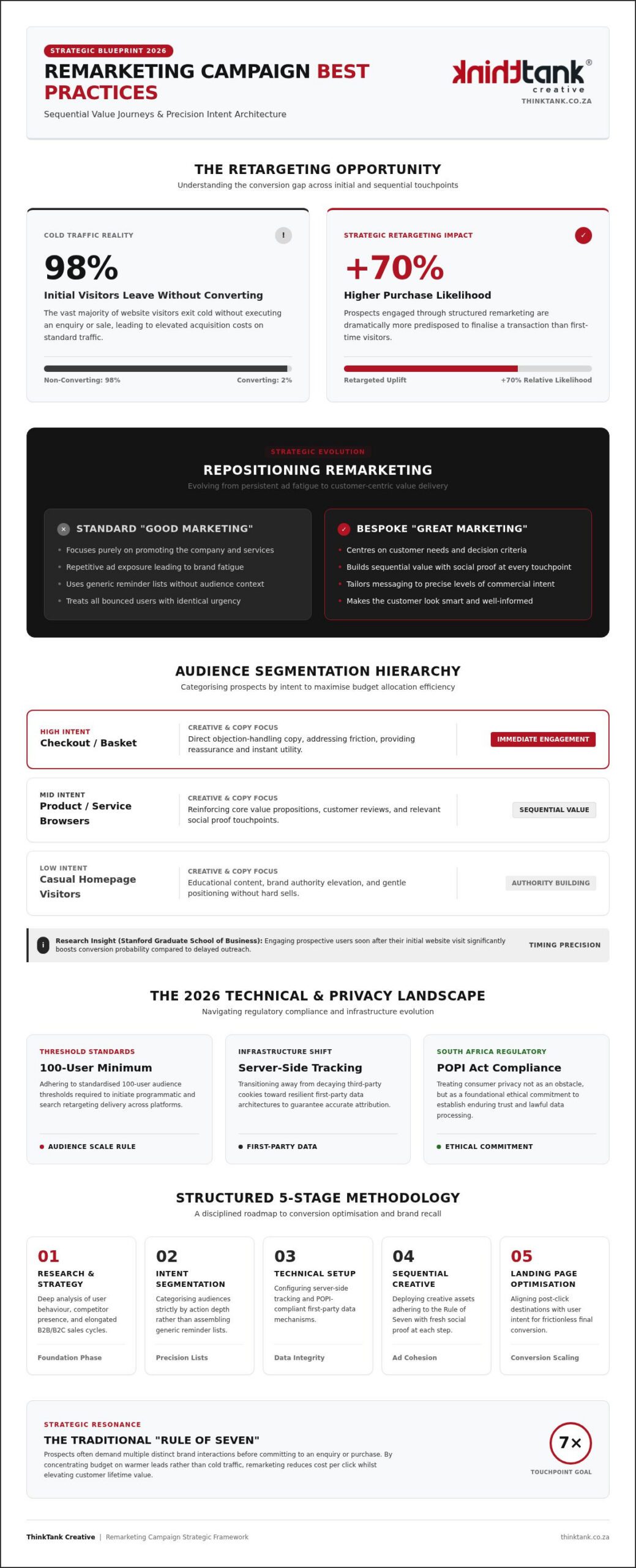
Did you know that whilst 98% of your website visitors leave without converting, those who are retargeted are 70% more likely to complete a purchase? It is a staggering reality that highlights the immense untapped potential sitting within your existing traffic. By implementing sophisticated remarketing campaign best practices, you can transform these missed opportunities into loyal customers through precise, value-driven touchpoints that respect the modern user journey.

We understand the frustration of seeing high acquisition costs on cold traffic and the concern that repetitive ads might lead to negative brand perception. You want to build a cohesive digital presence that respects your audience's privacy whilst driving measurable growth. This strategic guide provides a clear framework for segmenting your audiences and navigating the technical shifts of 2026, such as the standardised 100-user audience thresholds and the move toward server-side tracking. We will show you how to refine your creative approach to ensure every interaction feels like a bespoke invitation rather than a generic reminder.

At ThinkTank Creative, we believe that great marketing makes your customer look smart. By the end of this article, you will have the tools to improve your ROI and deliver a seamless brand experience across all digital touchpoints. We do it all so you don't have to, allowing you to focus on your business whilst we elevate your digital strategy.

Key Takeaways

  • Move beyond generic lists by categorising users based on their specific level of intent, ensuring your budget is directed toward high-value prospects.
  • Maintain brand cohesion and trust through sophisticated design principles that align your creative assets with a customer-centric journey.
  • Master the essential Research & Strategy phase required to implement remarketing campaign best practices that drive high-quality leads and measurable sales.
  • Utilise a structured 5-stage methodology to ensure your technical setup and landing pages are perfectly optimised for conversion and long-term growth.
  • Shift your perspective from chasing users to providing sequential value, evolving your digital presence from standard advertising to truly great marketing.

The Strategic Foundations of Modern Remarketing

Remarketing is often misunderstood as a digital shadow that follows users across the internet. In reality, it's a precise strategic tool designed to re-engage high-intent visitors who showed interest but did not convert during their initial visit. By understanding behavioral retargeting fundamentals, you can move beyond "Good Marketing" that merely promotes your company. We focus on "Great Marketing" that centres on the customer's needs, making them feel smart and well-informed throughout their decision-making process.

To better understand how these technical foundations are built and managed, watch this helpful guide on setting up your segments correctly:

In the South African B2B and B2C sectors, sales cycles have lengthened as consumers become more discerning and price-sensitive. You shouldn't expect a single visit to result in a conversion when competitors are only a click away. Effective remarketing campaign best practices involve creating a sequential value journey that respects the user's intelligence. Instead of repetitive ad exposure that leads to fatigue, we aim to provide new information or social proof at every touchpoint, guiding the prospect naturally toward a successful outcome.

Why Remarketing is Critical for ROI

Digital spaces are more crowded than ever, making the traditional "Rule of Seven" even more relevant for brand resonance. A prospect often needs multiple interactions with your brand before they feel confident enough to commit to a purchase or an enquiry. By focusing your spend on these warmer leads, you can significantly assist in reducing Google Ads cost per click. This strategic focus ensures that your budget isn't wasted on cold traffic, ultimately elevating your long-term brand recall and customer lifetime value.

The 2026 Privacy Landscape in South Africa

Privacy isn't a hurdle; it's an opportunity for brand transformation and building deeper trust with your audience. All data collection in South Africa must remain strictly compliant with the POPI Act to protect consumer rights. As third-party cookies lose their efficacy, successful brands are pivoting toward robust first-party data strategies that offer more reliable insights. We define POPI compliance for remarketing as a fundamental ethical commitment to user privacy that ensures every interaction is both lawful and respectful.

Audience Segmentation: The Key to Relevance

Broad remarketing lists are often the quickest way to erode a digital marketing budget. When you treat a casual homepage browser with the same urgency as someone who abandoned a shopping basket, your messaging loses its edge. Precision in segmentation ensures that your creative assets resonate with the user's current mindset, transforming a generic advert into a timely, helpful reminder. This tailored approach is the cornerstone of remarketing campaign best practices in a market where relevance is the primary currency of attention.

A strategic visionary approach requires mapping a clear hierarchy of intent. High-intent users, such as those who reached the final checkout stage, require direct, objection-handling copy. Conversely, top-of-funnel visitors benefit from educational content that reinforces your brand's authority. This level of granular tracking is only possible when you invest in custom website design that prioritises data integrity and user journey mapping from the ground up.

The timing of these interactions is just as vital as the content itself. According to Stanford Graduate School of Business retargeting research, engaging users soon after their initial visit significantly boosts return rates and conversion efficacy. However, this momentum must be balanced with strict exclusion discipline. Failing to remove converted users from your active lists leads to wasted spend and customer annoyance, which can quickly tarnish your brand's reputation.

Behaviour-Based Segmentation Strategies

Distinguishing between "lurkers" and "active researchers" allows you to allocate your budget more effectively. If a visitor spends several minutes on a specific service page, they've signalled a high level of interest that warrants a deeper nurture sequence, such as a case study or a detailed testimonial. For those who interact with lead magnets but stop short of a booking, your remarketing should focus on providing the next logical step in their research journey, rather than a repetitive sales pitch.

Technical Implementation and Compliance

Success on a national scale requires a robust technical foundation using the Meta Pixel and Google Tag Manager. In South Africa, this setup must be balanced with a commitment to privacy. Your cookie consent banner should be a user-friendly, POPI Act compliant interface that builds trust rather than creating friction. By integrating these segments with your CRM, you create a unified view of the customer journey. This synergy ensures that your PPC advertising efforts are always informed by real-time sales data, allowing for more agile and effective campaign adjustments.

Creative Excellence and Brand Cohesion

Visual identity serves as the silent ambassador of your brand, providing a sense of continuity that bridges the gap between a visitor's initial interest and their final decision. Within our award-winning design team, we approach the "Visualisation" stage of creative development with meticulous care, ensuring that every asset reflects the bespoke craftsmanship your brand deserves. Maintaining this visual consistency is a non-negotiable anchor of trust, especially when implementing remarketing campaign best practices that target users who are already familiar with your digital presence.

However, even the most stunning visuals can lose their impact if shown too frequently. Ad fatigue is a genuine threat to ROI, typically manifesting when users see the same creative more than three or four times within an active window. To maintain engagement, you must embrace best practices for retargeting advertising campaigns, which include rotating your creative assets every two to four weeks. This proactive refreshing prevents your brand from becoming background noise and preserves the integrity of your professional reputation.

Recognition often begins with the smallest details. A strong, professional logo design ensures that your ad units are instantly identifiable, even on a cluttered social media feed or a busy mobile site. This immediate recognition reduces the cognitive load on the user, making them more likely to stop scrolling and engage with your message.

Designing for Conversion

High-converting remarketing ads rely on a precise anatomy: a compelling headline that addresses a specific pain point, a high-quality visual that evokes an emotional response, and a clear, punchy CTA. Integrating social proof, such as short testimonials or star ratings, can effectively dismantle the final objections a prospect might have. We believe in balancing sophisticated brand aesthetics with performance-driven imperatives, ensuring your ads are as effective as they are beautiful.

Dynamic Creative vs. Static Assets

Choosing between dynamic product ads and static assets depends entirely on your business model. E-commerce brands often thrive on dynamic creative that displays the exact products a user viewed, whilst service-based businesses benefit from bespoke static ads that highlight unique value propositions. Custom video posts have also emerged as a powerful tool for re-engaging South African audiences on social platforms. Given that the majority of local traffic is mobile-based, every creative asset must be designed with a mobile-first mindset to ensure seamless usability and visual impact.

Remarketing Campaign Best Practices: The 2026 Strategic How-To Guide

Step-by-Step: Implementing Remarketing Best Practices

Launch with purpose by establishing a comprehensive Research & Strategy phase before any technical assets go live. This foundational step ensures that every interaction is grounded in a deep understanding of your customer's intent and pain points. You must define your primary conversion goal with absolute clarity from the outset. Whether you're seeking a lead form submission, a direct phone call, or a completed sale, this goal will dictate the structure of your lists and the tone of your messaging.

Setting realistic frequency caps is essential to avoid the common pitfall of over-exposing your brand to potential customers. Performance data from 2026 confirms that campaign efficiency begins to decay once a user sees an ad more than 3 to 4 times within an active window. By implementing remarketing campaign best practices, you can maintain a presence that feels supportive rather than intrusive. A cross-channel approach is vital here, following the user seamlessly from a Google Search to an Instagram feed whilst maintaining a cohesive brand narrative.

Bidding and Budget Management

Strategic budget allocation requires a delicate balance between Brand Awareness and Direct Response remarketing. You don't want to spend your entire budget on users who have already decided not to buy. Whilst automated bidding strategies like Target CPA offer significant efficiency in the 2026 AI-driven landscape, they still require the discerning oversight of a human expert to ensure alignment with broader business objectives. We also recommend monitoring the View-Through Conversion metric closely. This provides a clearer picture of how display ads influence decisions, even when a direct click doesn't occur immediately.

Testing and Fine-Tuning

Continuous refinement is the hallmark of a high-performing campaign. You should regularly A/B test your CTAs, comparing options like "Enquire Now" against "Get My Free Estimate" to see which resonates more deeply with your specific audience segments. Analysing the "Time to Conversion" report allows you to optimise your list duration, ensuring your budget is focused on the window when prospects are most likely to act. We utilise our ThinkTank 5-stage development process to fine-tune landing page performance, ensuring the post-click experience is as polished as the ad itself.

If you're ready to transform your digital strategy, partner with us for expert PPC advertising that delivers measurable growth.

Scaling Your Success with ThinkTank Creative

Mastering the nuances of the digital landscape requires more than just technical proficiency; it demands a strategic visionary who can see the thread connecting every touchpoint. We manage the complexity of your cross-channel presence, ensuring that your brand remains prominent and persuasive without becoming a burden on your internal resources. Our guiding principle is simple: we do it all so you don't have to. This collaborative approach allows you to focus on your core operations whilst we orchestrate a sophisticated presence that reflects your brand's excellence and commitment to quality.

A truly effective engine requires high-quality fuel to maintain its momentum. This is why our integrated content marketing plans are so vital to the success of your digital strategy. By aligning your top-of-funnel content with your lower-funnel retargeting, we create a seamless flow of information that educates and excites your prospects. This synergy ensures that your remarketing campaign best practices are supported by relevant, authoritative messaging that builds trust at every stage of the buyer's journey, moving them naturally from curiosity to conversion.

Our End-to-End Remarketing Process

We utilise a meticulous 5-stage process to ensure your campaigns are both resilient and high-performing. This journey begins with an in-depth Research & Strategy phase where we assess your specific needs and national growth goals. From there, we move through design, development, and fine-tuning, culminating in a launch that's backed by ongoing support. We provide continuous reporting and revisions based on real-time South African market data, ensuring your strategy remains agile. An estimated cost is provided only after a thorough discussion of your unique requirements and timelines, ensuring the solution is as bespoke as your brand.

Ready to Re-engage Your Audience?

Professional management transforms a standard advertising effort into a powerful engine for brand transformation. By choosing a partner deeply invested in your success, you move beyond the technical hurdles of audience thresholds and tracking pixels into a space of pure creative potential. We invite you to embark on a journey of imagination and conversion that makes your customers look smart and your brand feel indispensable. Contact us today for a professional consultation and let's begin the work of elevating your digital presence to new heights of excellence.

Elevate Your Digital Strategy for 2026

Mastering remarketing campaign best practices is no longer just about tracking visitors; it's about respecting the user's journey through sophisticated segmentation and visual excellence. By moving beyond generic lists and embracing a hierarchy of intent, you ensure your budget is invested in high-value prospects who are ready to convert. Consistency in your brand's visual identity, supported by professional design and mobile-first creative, remains the ultimate anchor of trust in a crowded digital landscape.

At ThinkTank Creative, we bring 25 years of digital marketing expertise and an award-winning design team to every partnership. Our comprehensive 5-stage strategic process ensures that your campaigns are meticulously planned, launched, and optimised for national growth. We believe that great marketing makes your customer look smart, and we're dedicated to helping you achieve that transformation whilst handling the technical complexity on your behalf. We do it all so you don't have to.

Contact ThinkTank Creative to Organise Your Strategic Remarketing Campaign and let's begin the work of re-engaging your audience with purpose. The potential for brand growth is immense, and we look forward to building your future together.

Frequently Asked Questions

What is the difference between remarketing and retargeting?

Remarketing and retargeting are often used interchangeably, although they traditionally held distinct technical meanings. Retargeting specifically refers to using browser pixels to serve ads to previous site visitors as they browse other websites. Remarketing historically focused on re-engaging existing customers through email or CRM lists. Today, most digital platforms have merged these concepts into a single strategic approach aimed at re-engaging high-intent users across multiple digital touchpoints.

How long should a user stay on my remarketing list?

The ideal duration for a user to stay on your list is determined by the length of your specific sales cycle. For quick impulse purchases, a window of 7 to 14 days is often sufficient to drive action. For complex B2B services, you might extend this to 60 or 90 days to stay top-of-mind. We recommend segmenting your lists by recency, as users who visited in the last 3 days typically show the highest conversion potential.

Is remarketing compliant with the POPI Act in South Africa?

Remarketing is fully compliant with the POPI Act provided you maintain transparency and secure explicit user consent. You must ensure your website features a clear, user-friendly cookie consent banner and an updated privacy policy that explains how data is collected. Implementing remarketing campaign best practices involves treating personal information as a private asset, ensuring all tracking is handled ethically and in accordance with national data protection regulations.

How many times should a potential customer see my ads per day?

We suggest a frequency cap of 3 to 4 impressions per user within a 24-hour window to maintain brand resonance without causing annoyance. Seeing an ad too often can lead to negative brand perception and diminishing returns on your ad spend. By carefully managing these limits, you ensure your brand remains visible whilst respecting the user's digital experience and preventing the intrusive "stalking" effect that many consumers find frustrating.

Do I need a large budget to start a remarketing campaign?

You don't need a massive budget to launch a successful remarketing campaign because you're only targeting a refined, pre-qualified audience. Since these users have already interacted with your brand, the cost-per-acquisition is often significantly lower than cold traffic prospecting. We provide an estimated cost after discussing your specific goals, allowing us to tailor a strategy that maximises your existing ROI regardless of your initial investment size.

Why are my remarketing ads not showing to my audience?

The most common reason remarketing ads don't show is that your audience list hasn't reached the minimum size threshold. Google Ads officially standardised the minimum audience size to 100 active users within the last 30 days across all networks. Other factors include overly restrictive bidding, narrow geographic settings, or technical issues with your tag implementation that prevent the pixel from firing correctly. We ensure your technical setup is flawless during our 5-stage development process.

Can I do remarketing across different platforms like Google and Meta simultaneously?

You can and should run remarketing campaigns across Google and Meta simultaneously to create a cohesive brand experience. A cross-channel approach ensures that your message follows the user from search results to their social media feeds, reinforcing brand recall. This synergy provides multiple opportunities for conversion across different devices. Our team handles this complexity for you, ensuring that your creative assets and messaging remain consistent across every digital touchpoint.

What is ad fatigue and how do I prevent it?

Ad fatigue occurs when your audience becomes so familiar with your creative that they stop noticing it or become annoyed by the repetition. You can prevent this by rotating your ad visuals and copy every two to four weeks to keep the message fresh. Using custom video posts and varying your value propositions helps maintain engagement. This proactive approach ensures your remarketing campaign best practices continue to deliver high click-through rates and strong performance.

Strategic Print Marketing Ideas for Local Businesses in 2026

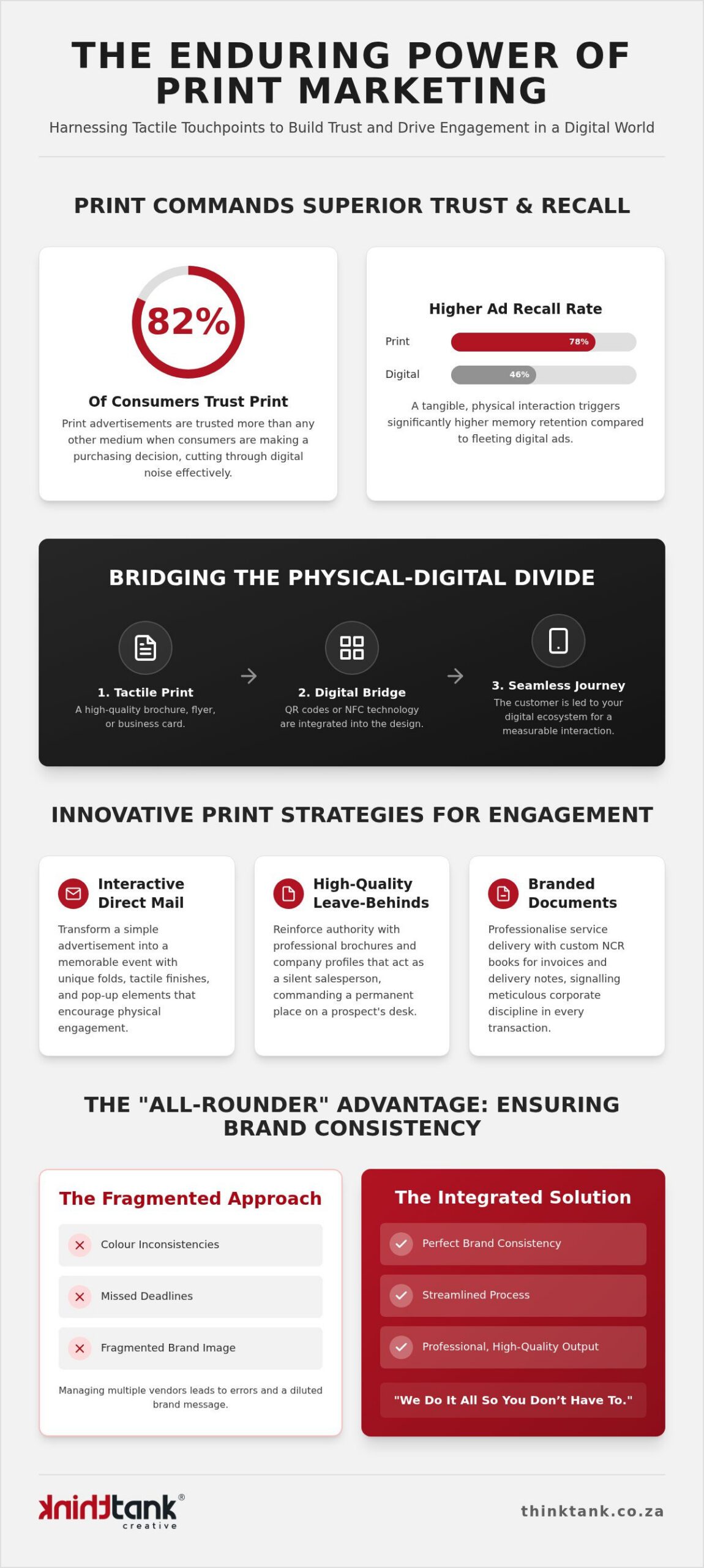
Did you know that 82% of consumers trust print advertisements more than any other medium when making a purchase decision? In a landscape increasingly defined by digital fatigue, these strategic print marketing ideas for local businesses offer a sophisticated way to command attention and build lasting credibility. You've likely felt the frustration of seeing your digital messages ignored or wondered if your physical flyers are truly driving foot traffic to your door. It is a common challenge to balance the desire for tactile branding with the need for measurable data and professional execution.

We believe that your physical marketing should do more than just exist; it should act as a high-quality bridge to your entire digital ecosystem. This article reveals how to combine bespoke physical assets with modern strategy to drive engagement amongst a national audience. We will explore how to move beyond poor DIY designs toward a polished, professional identity that makes your business look smart. By integrating QR codes and precision tracking, you can finally see the synergy between your print and digital efforts. At ThinkTank Creative, “We Do It All So You Don’t Have To”, ensuring your brand transformation is both seamless and impactful.

Key Takeaways

  • Combat digital saturation by utilising tactile touchpoints that command attention and foster genuine trust amongst your target audience.
  • Discover innovative print marketing ideas for local businesses that leverage interactive elements to transform standard flyers into high-performing lead generation tools.
  • Bridge the physical-digital divide by integrating QR codes and NFC technology into your branding to create a seamless, measurable customer journey.
  • Ensure national brand consistency by implementing a comprehensive style guide that prevents fragmented representation and maintains high-quality standards.
  • Benefit from a collaborative, end-to-end design process that moves your brand from strategy to final delivery, as “We Do It All So You Don’t Have To”.

The Strategic Role of Physical Branding in 2026

Physical presence creates a psychological anchor that digital pixels simply cannot replicate. Consumers are increasingly overwhelmed by the sheer volume of screen-based advertising, leading to a phenomenon known as digital fatigue. Research indicates that 78% of marketing buyers now view print as a more effective medium because it cuts through this noise. When you provide a customer with a beautifully textured brochure or a weighted business card, you aren't just sharing information; you're offering a tangible experience. This physical interaction triggers a higher ad recall rate, which sits at approximately 78% for print compared to just 46% for digital advertisements. These strategic print marketing ideas for local businesses are designed to turn fleeting glances into lasting impressions.

At ThinkTank Creative, we distinguish between "Good Marketing" and "Great Marketing". Good marketing focuses on the company's achievements, but great marketing focuses on the customer, making them feel smart and well-informed. By using high-quality paper stocks and bespoke finishes, you signal that your brand values precision and excellence. This establishes a baseline of trust that is essential for national growth. Because every project is unique, an estimated cost is provided after discussion to ensure the bespoke solution fits your specific strategic requirements.

Establishing Your Corporate Identity

Your logo and stationery represent the silent ambassadors of your brand. They form the foundation of every physical interaction, from the first business card exchange to the final corporate folder delivered to a client. A cohesive identity ensures that your brand doesn't feel fragmented or amateurish. Understanding what makes a good logo design is the first step in this journey. When your letterheads and business cards share a consistent visual language, you project an image of a stable, professional enterprise that is ready for serious partnership.

The "All-Rounder" Advantage

Managing multiple vendors for design and production often leads to colour inconsistencies and missed deadlines. We operate as an all-rounder partner to eliminate these hurdles, ensuring your creative vision translates perfectly from the screen to the press. Whilst Web-to-print technologies have made ordering easier, they often lack the bespoke craftsmanship required for premium branding. Our approach bridges this gap by combining modern efficiency with award-winning design expertise. We adopt a “We Do It All So You Don’t Have To” philosophy, which allows you to focus on your core operations while we handle the technical complexities of print marketing ideas for local businesses. This synergy ensures that your physical and digital assets share a single, powerful soul.

Innovative Print Marketing Ideas to Drive Engagement

Engagement begins when a customer feels that a brand truly understands their specific needs. Whilst many companies settle for generic flyers that are quickly discarded, the most successful print marketing ideas for local businesses focus on creating interactive experiences. Interactive direct mail, for instance, uses unique folds or tactile finishes to encourage the recipient to physically engage with the piece. This approach transforms a simple advertisement into a memorable event that stays in the mind far longer than a fleeting social media post.

Professionalising your service delivery is another critical avenue for engagement. Using custom NCR books for delivery notes or invoices ensures that every transaction feels polished and organised. These are not merely administrative tools; they are reflections of your corporate discipline. When you present a client with a branded, professional document, you reinforce the idea that your business is meticulous and dependable. Because every business has different needs, an estimated cost for these bespoke solutions is provided after a thorough discussion of your objectives.

The Power of the Leave-Behind

A high-quality leave-behind acts as a silent salesman long after you have left the room. In high-stakes B2B meetings, a physical brochure or company profile often carries more weight than a digital deck because it commands a permanent place on a prospect's desk. Consider the example of Lebo the Accountant from the TaxShop franchise. By utilising professional leave-behind collateral, Lebo was able to project an image of authority and expertise that resonated with clients seeking financial stability. This type of bespoke craftsmanship ensures your brand remains top-of-mind. If you are looking to elevate your physical presence, our creative design services can help you craft materials that speak with authority.

Promotional Items with Purpose

Selecting promotional material requires a strategic lens to ensure your investment doesn't end up in the bin. Items that provide genuine utility are far more likely to be kept and used, extending the life of your brand's visibility. Rather than choosing generic trinkets, select items that align with your brand’s core values and the daily habits of your audience. This alignment is a key component of a comprehensive guide to marketing strategies, where the focus is on understanding the user journey. The most effective print marketing ideas for local businesses prioritise longevity over fleeting novelty. When promotional material is designed with purpose, it becomes a valuable brand asset that recipients are proud to display and use.

Bridging the Gap: Integrating Print with Your Digital Ecosystem

Transform your physical touchpoints into dynamic digital gateways to maximise your marketing impact. In 2026, the most effective print marketing ideas for local businesses don't exist in a vacuum; they serve as a high-quality bridge to your online presence. By embedding sophisticated tracking mechanisms into your physical assets, you move beyond the frustration of untraceable flyers and toward a data-driven strategy. This synergy ensures that every Rand spent on printing contributes directly to your digital growth and customer acquisition goals.

QR codes have evolved into essential lead generation tools that connect a physical interaction with an automated digital sequence. When a prospect scans a code on a high-quality brochure, they should be directed to a bespoke landing page that triggers an immediate email auto-responder or a special offer. This convergence is a fundamental part of any modern introduction to marketing concepts, where the focus is on creating a frictionless journey for the customer. By linking physical vouchers to your email marketing campaigns, you create a measurable path from the letterbox to the digital checkout.

Print as a Traffic Driver

Directing physical traffic to your custom website design requires a clear and compelling call to action. Whether you are using large-format posters or targeted direct mail, the goal is to encourage social media follows or website visits that lead to conversions. We focus on creating a seamless transition where the aesthetic of your print material matches the user experience of your digital channels. This consistency reduces cognitive friction and builds the trust necessary to turn a curious reader into a loyal customer.

Smart Business Card Strategies

Your business card should be a sophisticated conversation starter rather than just a list of contact details. Incorporating business card design tips 2026 allows you to integrate NFC technology, enabling prospects to save your details or view your portfolio with a single tap. For those who prefer a more traditional approach, using digital vanity URLs on your cards allows you to track exactly how many hand-outs result in website visits. This level of precision is part of our commitment to "Great Marketing" that makes your brand look smart whilst providing the data you need to grow. Because we understand that every brand journey is bespoke, an estimated cost for these integrated solutions is provided after we have discussed your specific networking objectives.

Strategic Print Marketing Ideas for Local Businesses in 2026

Maintaining Brand Consistency Across National Campaigns

Fragmented branding is the quickest way to erode consumer trust. When your visual identity fluctuates between different regions or platforms, it suggests a lack of corporate discipline and attention to detail. These print marketing ideas for local businesses rely on a unified front to be truly effective, especially when scaling from a single location to a national audience. Transitioning your assets from vibrant digital screens to physical CMYK printing requires technical precision. Without expert oversight, colours that look brilliant on a monitor can appear muddy or dull on paper, damaging the "smart" perception you've worked hard to build.

We ensure that your corporate identity remains elite across every medium through rigorous colour management and strategic planning. This process involves more than just hitting "print"; it requires a deep understanding of how different materials absorb ink and reflect light. Because every national campaign has unique logistical requirements, an estimated cost is provided after a thorough discussion of your scope and objectives. This ensures your investment is precisely aligned with your brand's growth trajectory.

The Role of the Style Guide

A comprehensive brand style guide acts as the definitive blueprint for your physical presence. It dictates exact typography, spacing, and colour palettes, ensuring your logo never suffers from the "stretching" or poor-quality reproductions that often plague DIY designs. We take a meticulous approach to brand governance, protecting your integrity across every touchpoint. By establishing these rules early, you prevent the fragmented aesthetic that occurs when different vendors interpret your brand in isolation. Our collaborative process ensures your vision is preserved with absolute fidelity.

Quality Control in Printing

The choice of paper stock is a strategic decision that fundamentally alters your brand message. In 2026, South African trends favour sustainable, high-grammage uncoated stocks that offer a premium, tactile experience. A matt finish often conveys understated elegance and authority, whilst a gloss finish can add necessary vibrancy to high-impact promotional materials. Our award-winning in-house team manages every fine-tuning and revision stage, ensuring that the final product meets our exacting standards of excellence. If you are ready to professionalise your physical footprint, our corporate identity design services provide the elite execution your business deserves. We adopt a “We Do It All So You Don’t Have To” philosophy, allowing you to focus on your core operations whilst we safeguard your brand's national reputation.

The ThinkTank Creative Process: From Imagination to Final Delivery

Execution is where strategy meets reality. Our refined five-stage design process ensures that your print marketing ideas for local businesses are not only aesthetically brilliant but also strategically sound. We begin with Stage 1: Research and Strategy. Before a single pixel is moved, we immerse ourselves in your brand's world to understand your audience and competitive landscape. This foundational work prevents the common pitfall of "Good Marketing" that only speaks about the company, allowing us to pivot toward "Great Marketing" that truly empowers the customer. By the time we reach Stage 2: Design and Production, our award-winning in-house team is equipped with the insights needed to create bespoke assets that resonate deeply.

Precision requires a rigorous feedback loop to achieve excellence. We implement a meticulous five-stage revision process that invites collaboration at every critical juncture. This methodical approach ensures that the final output aligns perfectly with your vision whilst maintaining the high-quality standards expected of a national brand. Final delivery involves printing solutions that meet international benchmarks, utilising the latest South African paper stock trends to provide a tactile experience that commands respect. Because every brand journey is unique, an estimated cost is provided after a thorough discussion of your specific requirements, ensuring your investment is tailored to your goals.

A Journey of Imagination

We transform simple flyers into strategic assets through a journey of shared imagination. This isn't a transactional service; it's a creative partnership that thrives on challenging interaction and debate. We encourage our clients to engage deeply with our designers, as this synergy often reveals the most innovative possibilities for brand elevation. By moving from a project-based mindset to an ongoing service partnership, we help you maintain a consistent and "smart" presence across all physical touchpoints. Our goal is to ensure your brand remains energised and relevant in an ever-evolving market.

Getting Started with ThinkTank

Preparing a comprehensive brief is the first step toward a successful collaboration. Our designers need to understand your core objectives, target demographics, and the specific "soul" of your brand to deliver their best work. When you choose to partner with us, you gain the assurance of an elite, all-rounder team that handles everything from initial concept to final delivery. We adopt a “We Do It All So You Don’t Have To” philosophy, which significantly reduces client friction and ensures a seamless transition between your digital and physical marketing efforts. If you are ready to experience a professional brand transformation, we invite you to start the conversation today.

Transforming Your Local Impact through Strategic Print

Your physical branding is the tangible soul of your business. It serves as a powerful anchor in a world cluttered with digital noise, providing the trust and recall that pixels alone cannot achieve. By embracing these strategic print marketing ideas for local businesses, you position your brand as a sophisticated leader that values precision and customer experience. ThinkTank Creative has refined the art of bridging the physical and digital divide since being established in 2001, ensuring that every touchpoint drives meaningful engagement. Our award-winning design team provides complete end-to-end branding and printing solutions that make you look smart.

The journey toward a more professional identity begins with a collaborative deep-dive into your vision. We invite you to request an estimated cost for your strategic print project, which is provided after a thorough discussion of your unique objectives. It's time to move beyond fragmented DIY designs and embrace a polished presence that commands respect. We are ready to help you elevate your brand to its next level of excellence and look forward to partnering with you on this journey of growth.

Frequently Asked Questions

Is print marketing still effective for businesses in 2026?

Print remains exceptionally effective because it provides a tactile connection that digital channels lack. In a landscape where screen-based advertisements are often ignored, physical media commands a 78% recall rate. This tangible presence builds deep-seated trust, with 82% of consumers favouring print when making purchase decisions. We focus on creating high-quality assets that cut through the noise, ensuring your brand stands out amongst the digital clutter with a professional, forward-looking aesthetic.

How can I track the ROI of my print marketing campaigns?

Tracking ROI is achieved by integrating digital gateways into your physical assets. You can use unique landing pages, vanity URLs, or dynamic tracking codes to monitor exactly how many prospects move from a flyer to your website. These print marketing ideas for local businesses ensure that every Rand spent is measurable. By linking physical touchpoints to your digital ecosystem, you gain precise data on engagement and conversion rates, allowing for informed strategic adjustments and brand growth.

What are the most effective "leave-behind" materials for service businesses?

The most effective materials are those that provide genuine utility or authoritative information. Bespoke company profiles and high-value brochures act as silent salesmen, remaining on a prospect's desk long after a meeting ends. We often recommend items that align with your brand’s daily utility, such as professional stationery or branded folders. For example, Lebo the Accountant utilised professional collateral to project an image of stability and expertise that resonated with clients seeking expert financial advice.

Should I use a QR code on all my printed marketing materials?

QR codes should be used whenever you want to create a frictionless transition from physical to digital spaces. They are essential for turning static flyers into lead generation machines by directing users to specific offers or auto-responders. However, the integration must be purposeful and accompanied by a clear call to action. We ensure that these codes are designed to complement your aesthetic whilst providing a seamless journey from the letterbox to your custom digital checkout.

What is the difference between good marketing and great marketing in print?

Good marketing focuses on the company's achievements, but great marketing focuses on the customer's needs and aspirations. Our philosophy is that great marketing should make the customer look smart by providing them with valuable, well-organised information. It's about shifting the narrative from what you do to how you solve their problems. This approach builds a collaborative partnership based on mutual success rather than just a transactional relationship between a vendor and a client.

How do I ensure my printed colours match my digital brand colours?

Matching colours across different mediums requires professional colour management and a rigorous brand style guide. Digital screens use RGB light, whilst physical printing relies on CMYK ink, which can lead to significant discrepancies if not handled correctly. We manage these technical complexities by fine-tuning your assets for specific paper stocks and finishes. This ensures that your corporate identity remains consistent and "smart" across every national campaign, protecting your brand's visual integrity and professional reputation.

Can ThinkTank Creative handle both the design and the printing?

Yes, we are a full-service all-rounder agency that manages the entire process from initial research to final delivery. By handling both design and printing in-house, we eliminate the friction often caused by managing multiple vendors. This synergy ensures that the creative vision we develop together is perfectly executed on the press. We adopt a “We Do It All So You Don’t Have To” approach, allowing you to focus on your core operations whilst we safeguard your brand's national footprint.

How long does the professional print design process typically take?

Our collaborative design process involves five distinct stages, moving from research and strategy through to final delivery. The timeline varies depending on the complexity of the project, whether it's a simple flyer or a comprehensive national campaign. We prioritise high-quality work whilst adhering to competitive time limits. An estimated cost and timeline are provided after a deep-dive discussion of your needs, ensuring that the final delivery meets your strategic deadlines without compromising on excellence.

Brand Style Guide Essentials: The 2026 Strategic Checklist for National Consistency

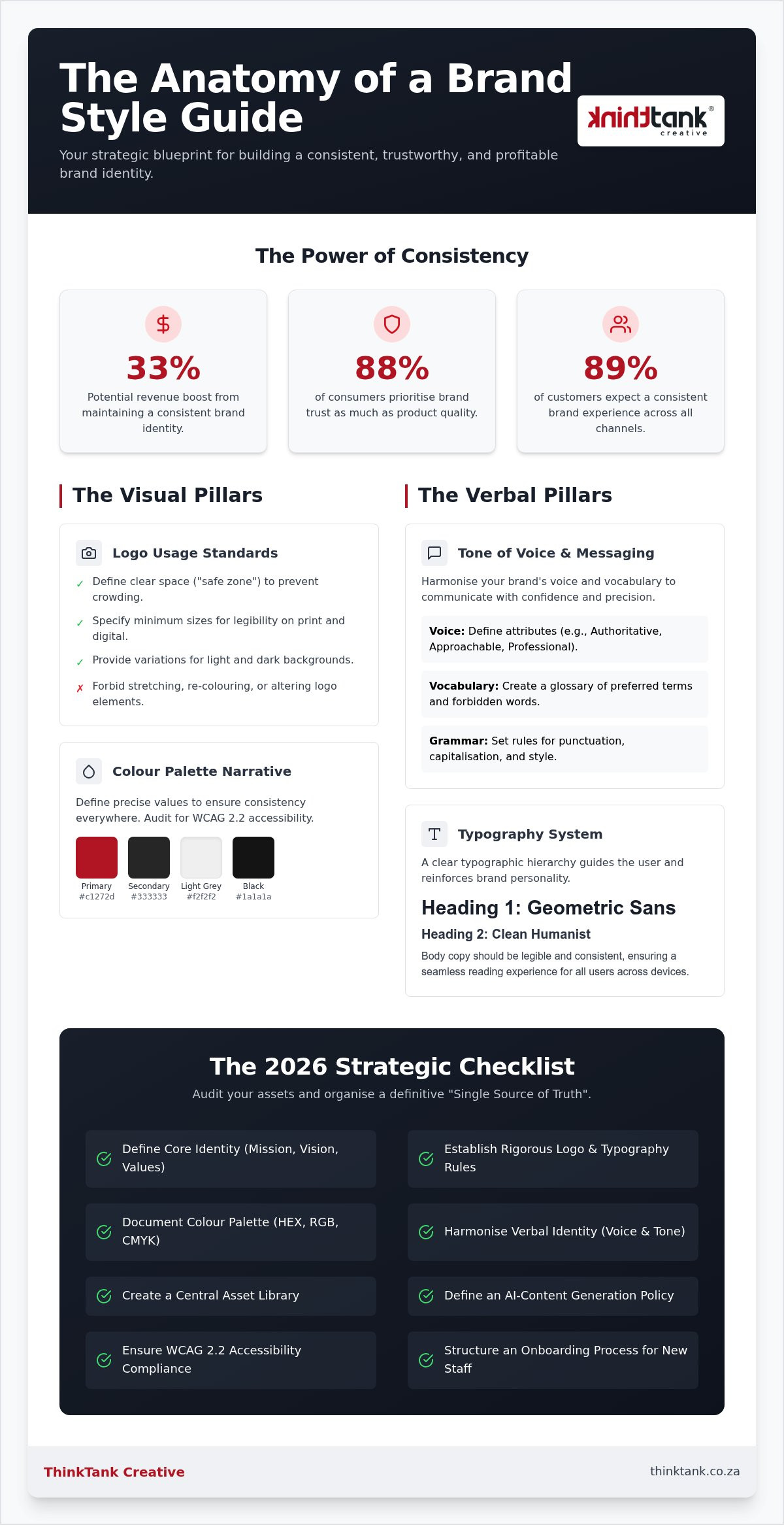
Did you know that maintaining a consistent brand identity can boost your revenue by as much as 33%? In a market where 88% of consumers prioritise trust as much as quality, your visual and verbal coherence isn't just a design choice; it's a vital financial driver. It's frustrating when different departments use conflicting logos or when the wrong colours appear in your print marketing. By mastering the brand style guide essentials, you transform your identity from a collection of assets into a strategic engine for growth that eliminates confusion and builds lasting authority.

You likely already recognise that a strong brand is built on reliability, yet achieving that uniformity across every department often feels like chasing a moving target. We're here to help you bridge that gap. This article provides a definitive roadmap to define your core identity, ensuring your business maintains a coherent and trustworthy presence at every digital and physical touchpoint. We'll explore a strategic checklist for 2026, covering everything from WCAG 2.2 accessibility standards and AI-content policies to the latest typography trends and the serene Cloud Dancer colour palette.

Key Takeaways

  • Discover why a comprehensive style guide serves as the strategic "DNA" of your corporate identity, building the consumer trust essential for long-term revenue growth.
  • Master the brand style guide essentials by establishing rigorous standards for logo usage and typography to ensure visual excellence across all physical and digital touchpoints.
  • Develop a sophisticated verbal identity that harmonises your brand's "voice" and vocabulary, allowing your team to communicate with confidence and precision.
  • Utilise our 2026 strategic checklist to audit your current assets and organise them into a definitive "Single Source of Truth" for seamless internal and external collaboration.
  • Learn how a structured implementation process protects your brand's integrity whilst simplifying the onboarding of new staff and creative partners.

Why a Brand Style Guide is a Non-Negotiable Business Asset

Think of your brand style guide as the strategic DNA of your corporate identity. It's the definitive blueprint that ensures every interaction, whether it's a social media update or a high-end brochure, feels like it belongs to the same family. Without this framework, businesses often fall victim to brand fragmentation. This occurs when different platforms look like they belong to entirely different companies, causing immediate cognitive dissonance for your customers. When 89.4% of customers expect a consistent brand experience across all channels, fragmentation is a risk you simply shouldn't take.

Maintaining these brand style guide essentials builds deep-seated trust. It reduces friction whilst customers navigate your digital space, ensuring your core values remain clear and undiluted. Beyond the external benefits, a guide empowers your internal team to produce high-quality work with increased velocity. By codifying your standards, you remove the guesswork, allowing marketers and designers to create content faster and more accurately. Whilst every brand transformation project is unique, we provide estimated costs after a thorough discussion of your specific requirements, ensuring the final asset is as bespoke as your business.

Protecting Your Brand Equity in a Digital-First World

A comprehensive style guide prevents the slow erosion of your visual impact over time. In our digital-first environment, your brand must remain instantly recognisable amongst a crowded marketplace. This consistency also aids search engine visibility, as a unified identity reinforces user recognition and encourages repeat engagement. Brand equity is the cumulative value of a recognisable identity that translates into consumer preference and long-term business stability.

The "All-Rounder" Advantage: Consistency Across Media

Bridging the gap between high-quality printing solutions and sophisticated digital interfaces requires a meticulous, multi-disciplinary approach. Your social media presence must speak the same language as your corporate profile, ensuring a seamless transition for the user at every touchpoint. Just as Wikipedia's Manual of Style provides a rigorous framework for verbal clarity and tone, your guide ensures your brand voice remains steady across every medium. This synergy starts with a solid foundation. Understanding what makes a good logo design is the critical first step in building a resilient corporate identity that stands the test of time.

The Visual Pillars: Core Brand Style Guide Essentials

Visual identity serves as the immediate visual shorthand for your brand's reputation. Establishing brand style guide essentials ensures that this shorthand remains clear, professional, and impactful across every application. A logo is often the first point of contact; however, its power is easily diluted by improper usage. Your guide must strictly forbid alterations such as stretching, "creative" recolouring, or the removal of key elements. By mandating minimum sizes for both print and digital formats, you ensure legibility remains constant, regardless of the medium. Our 5-stage design process prioritises these rules early, ensuring your identity is resilient from the moment of its creation.

Logo Anatomy and Usage Standards

Effective design requires breathing room to maintain its visual impact. We define a "safe zone" or padding around the logo to prevent it from being crowded by text or other graphic elements. This meticulous attention to detail extends to secondary marks and favicons, which are critical components of custom website design. Your document should also provide specific variations for placement on dark versus light backgrounds, ensuring your mark always maintains its visual authority without losing contrast or clarity.

Mastering the Colour Narrative

Colour is a powerful tool that influences customer behaviour and emotional response. To achieve national consistency, you must define your palette using HEX, RGB, and CMYK values. This precision ensures that the vibrant blue on your website perfectly matches the ink on your business cards or large-scale printing solutions. We also recommend auditing these choices against WCAG 2.2 accessibility standards to ensure contrast ratios are inclusive for all users. Looking at U.S. government style guides offers excellent examples of how complex organisations manage these technical requirements at scale whilst maintaining a friendly, accessible persona.

Typography and imagery provide the final layers of your visual personality. Select primary and secondary fonts that balance distinct character with high readability across different screens. Your imagery standards should define the "vibe" of photography, whilst custom iconography should follow a consistent line weight and style to ensure synergy. If you're ready to refine your visual presence, our specialists can help you develop a bespoke corporate identity that resonates with your audience and reflects your strategic vision.

Defining Your Verbal Identity: Messaging and Tone

Verbal identity is the heartbeat of your brand, yet it remains one of the most overlooked brand style guide essentials in the corporate world. Whilst many organisations obsess over hex codes and logo clear space, they often neglect the words that actually build the relationship. Your brand personality must be defined with precision. Are you the "Authoritative Expert" who leads with data, or the "Approachable Partner" who prioritises collaboration? At ThinkTank, we embody the "Strategic Visionary"—a persona that is elite in execution yet warm in professional relationships. This clarity allows us to champion our "We Do It All So You Don't Have To" philosophy, reassuring clients that their entire digital footprint is in expert hands.

A vocabulary list is a vital tool for maintaining this consistency. It establishes the specific words you use frequently to build authority and the terms you strictly avoid to prevent confusion. This level of detail ensures your messaging remains coherent across every touchpoint. For inspiration on how to codify these rules at scale, the U.S. government style guides demonstrate how even the most complex entities can maintain a unified verbal identity. By documenting these messaging standards, you ensure your mission statement isn't just a sentence on a wall, but a living part of your corporate behaviour.

Crafting a Consistent Brand Voice

Your brand voice is a constant, whilst your tone should be variable based on the context. A formal business proposal requires a steady, reassuring cadence that suggests thoroughness and strategic depth. Conversely, a casual social media post might adopt a more fluid, conversational energy. The goal is to translate complex technical jargon into clear, customer-focused benefits. Ultimately, great marketing makes the customer look smart by providing them with the clear messaging they need to make confident decisions. This approach moves the reader from a high-level concept to a concrete understanding of the value you provide.

Editorial Standards and Grammar

Precision in grammar and formatting reflects the stability of a long-standing enterprise. For South African audiences, adhering to British English spelling—such as "colour" and "organise"—is essential for national resonance. Your guide should also specify date formats, currency representation (ZAR), and capitalisation rules to ensure total alignment across all platforms. These editorial standards work in tandem with the professional logo design process, ensuring that your corporate stationery and digital assets project a polished, unified front. Whilst we provide estimated costs after a thorough discussion of your needs, the value of this verbal consistency is immediate and profound.

Brand Style Guide Essentials: The 2026 Strategic Checklist for National Consistency

The Ultimate Brand Style Guide Checklist for 2026

Transforming your brand from a loose collection of ideas into a disciplined corporate powerhouse requires a methodical approach. This checklist outlines the brand style guide essentials necessary for a future-proof identity in 2026. Auditing your current assets is the first priority. You must identify every instance where a logo is misused or a colour is off-brand to understand the scope of your transformation. Once the audit is complete, codify your logo usage, typography, and colour rules into a single, accessible document. This serves as your team's definitive source of truth.

Efficiency is the natural byproduct of a well-documented brand. By creating templates for common assets, you empower your staff to produce high-quality content without needing constant oversight. This reduces the risk of "creative" departures that dilute your visual impact. Whilst we provide estimated costs for these strategic projects after a thorough discussion of your needs, the long-term savings in production time and brand clarity are substantial.

Technical Specifications for Multi-Channel Use

Precision in file formats ensures your brand remains sharp across all platforms. Your guide should mandate SVG files for web use to maintain scalability, whilst high-resolution PDFs remain the standard for printing solutions. As mobile-first browsing dominates, responsive logo versions are no longer optional. You need simplified marks that remain legible on small screens without losing their essence. Additionally, document the standards for "leave-behind" print marketing collateral to ensure your physical presence is as polished as your digital interface. Exploring print marketing ideas for local businesses is one of the most effective ways to ensure your physical touchpoints command the same authority as your digital presence. Applying the latest business card design tips 2026 is one of the most effective ways to ensure your physical touchpoints command the same authority as your digital presence.

Imagery and Iconography Guidelines

Visual assets must evoke a specific emotional "mood" that aligns with your corporate identity. Whether you opt for candid, high-energy photography or serene, minimalist compositions, the subjects and lighting must feel intentional. Rules for iconography are equally critical. Specify the exact line weights, corner radii, and colour applications for your custom icons to prevent visual clutter. This level of detail ensures that every graphic element works in synergy to elevate your brand's authority. If you are ready to consolidate your identity, our team can help you design a bespoke corporate identity that commands attention across the South African market.

Implementation: Bringing Your Identity to Life

Launching a refined corporate identity requires more than just a static document; it demands a cultural shift within your organisation. To ensure long-term success, you must centralise your brand assets in a cloud-based repository that serves as the "Single Source of Truth" for every department. This prevents the use of outdated versions and ensures that brand style guide essentials are always accessible to your creative team. When every staff member and external agency can find the correct files instantly, you eliminate the friction that leads to brand inconsistency.

Training is the vital human element of this implementation. Host a dedicated workshop to walk your team through the new standards, explaining the strategic reasoning behind each decision. This collaborative approach turns the guide from a restrictive set of rules into a shared vision for excellence. Furthermore, your digital presence requires constant vigilance. Ongoing website maintenance and support ensure that as new pages or features are added, they strictly adhere to the established styles, preventing the "brand creep" that often occurs over time. By reviewing and fine-tuning the guide as your business evolves, you maintain a dynamic identity that remains relevant in a shifting market.

The ThinkTank Creative 5-Stage Design Framework

Our award-winning team utilises a proven 5-stage design process to build resilient identities: Research, Design, Choices, Presentation, and Fine-Tuning. This methodology begins with deep research, where we encourage challenging interaction and debate to uncover the true essence of your business. We don't believe in templated solutions. Instead, we act as a bespoke creative partner, moving your brand from a high-level concept to a concrete, future-proof identity that reflects 25 years of experience in the South African market. This meticulous approach ensures that every visual and verbal element is grounded in strategic depth.

From Guide to Growth: Your Next Steps

A robust style guide is the essential foundation for effective lead generation strategies. When your identity is coherent and professional, your marketing efforts become significantly more persuasive and trustworthy. If you're ready to elevate your corporate presence and protect your brand equity, we invite you to request a consultation for a comprehensive corporate identity redesign. We provide an estimated cost for our services following a thorough discussion of your specific needs, ensuring our partnership is built on transparency, synergy, and a shared commitment to high-quality outcomes.

Elevate Your Identity for the Next Era of Growth

Mastering the brand style guide essentials is the definitive step toward transforming your business from a fragmented collection of assets into a unified, authoritative presence. By codifying your visual and verbal standards, you eliminate the friction that erodes customer trust and internal efficiency. A well-maintained guide ensures that your message remains resilient across every touchpoint, from high-quality printing solutions to sophisticated digital interfaces. It's about creating a legacy of consistency that scales with your ambition.

ThinkTank Creative has been at the forefront of this evolution since 2001. As a comprehensive all-rounder agency, our award-winning design team brings 25 years of experience to every project, ensuring your corporate identity is both bespoke and future-proof. We believe in a collaborative journey that prioritises your unique strategic goals. Whilst we provide estimated costs after a thorough discussion of your requirements, the value of a coherent brand is immediate and enduring. We invite you to start your brand transformation with ThinkTank Creative and build a foundation for sustainable success. Your brand's potential is limitless when every detail is aligned.

Frequently Asked Questions

What is the difference between a brand style guide and a brand identity?

A brand identity is the complete collection of visual and verbal elements that define your business, whilst a style guide is the definitive manual that documents how to use them. Think of the identity as the personality and the guide as the strategic blueprint that ensures everyone communicates that personality consistently. Without a guide, your identity risks becoming fragmented across different platforms, leading to customer confusion and a loss of trust.

How long does it typically take to create a professional brand style guide?

The timeline for a professional guide varies based on the complexity of your corporate identity and the scope of your assets. At ThinkTank Creative, we utilise a rigorous 5-stage design process, moving from research and strategy through to final delivery and support. This methodical approach usually spans several weeks to ensure every detail is refined and bespoke. We provide a tailored estimated cost and timeline after a thorough discussion of your requirements.

Do small businesses really need a full brand style guide?

Every business, regardless of size, benefits from documenting their brand style guide essentials to build immediate credibility. For a small enterprise, consistency is the fastest way to appear established and trustworthy amongst larger competitors. It prevents expensive mistakes, such as printing incorrect colours or using low-resolution logos, and ensures that your first impression is always professional and aligned with your long-term growth strategy and vision.

How often should we update our brand style guide?

You should review your guide annually to ensure it remains aligned with your business objectives and current digital standards. A more comprehensive update is typically required every two to three years to incorporate evolving trends, such as 2026's focus on WCAG 2.2 accessibility or new AI-content policies. Regular maintenance prevents your brand from feeling dated and ensures your team remains energised by a forward-looking identity that adapts to the shifting marketplace.

What are the most common mistakes in a brand style guide?

One of the most frequent errors is focusing exclusively on visuals whilst neglecting the verbal identity and brand voice. Other common pitfalls include failing to define "safe zones" for logo usage or providing vague instructions that lead to "creative" departures by different departments. A successful guide must be meticulous and prescriptive, leaving no room for ambiguity that could dilute your visual impact or confuse your audience across different digital and physical touchpoints.

Can I create a brand style guide myself or should I hire an agency?

Whilst basic tools exist for DIY projects, partnering with an agency like ThinkTank Creative provides the strategic depth and award-winning expertise needed for a resilient identity. Our team has 25 years of experience in the South African market, offering an "all-rounder" perspective that covers everything from printing solutions to custom website design. This collaborative approach ensures your guide is a bespoke asset that reflects your unique value rather than a generic template.

How does a style guide help with digital marketing and SEO?

Consistency leads to improved brand recognition, which directly influences user engagement and conversion rates in digital marketing. When your social media, email campaigns, and website "speak the same language," you build the trust necessary for successful lead generation. From an SEO perspective, unified standards for imagery, alt text, and messaging ensure your brand appears robust and authoritative to both users and search engine algorithms, enhancing your overall visibility.

What is the "ZAR" focus in a South African brand style guide?

A South African focus ensures your brand resonates with a national audience by adhering to local editorial standards and market expectations. This includes using British English spelling—such as "colour" and "organise"—and correctly representing the ZAR currency in all corporate stationery and digital assets. By documenting these specific nuances, you project a professional image that respects the cultural and linguistic expectations of your clients across the country, fostering deeper local connections.

Understanding Your Website Analytics Report: A 2026 Strategic Guide

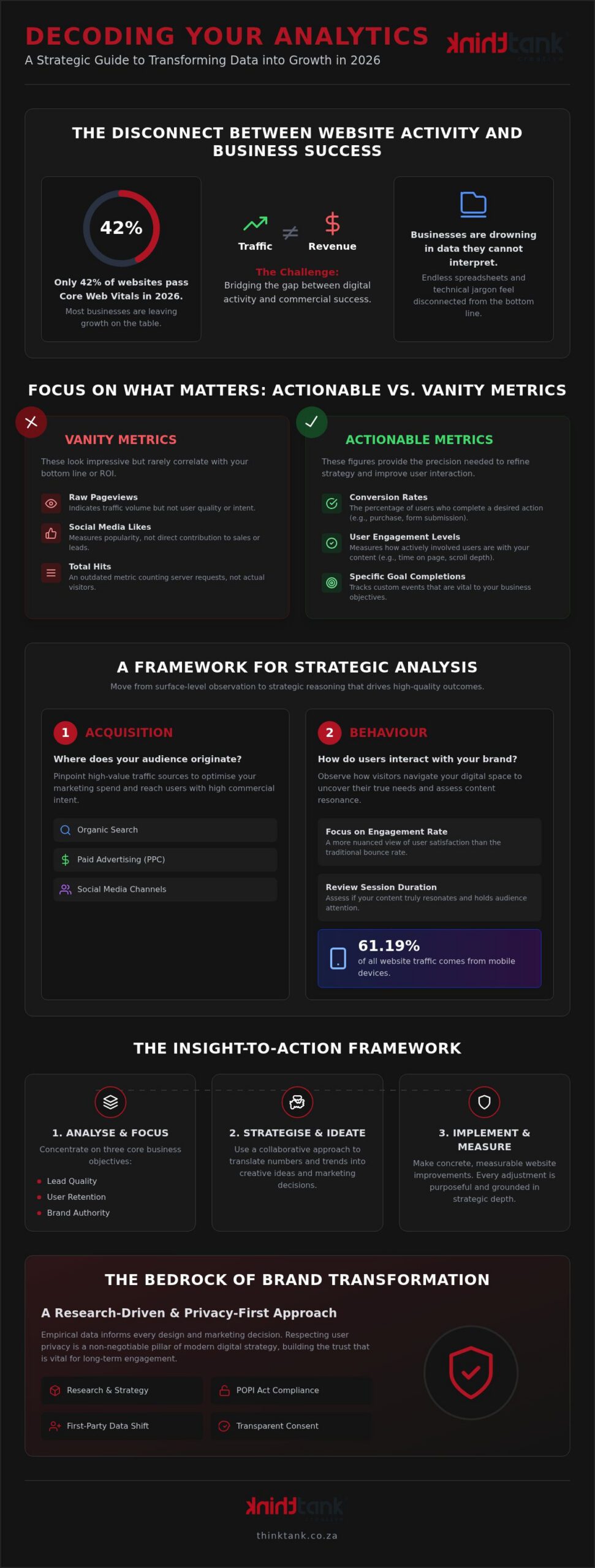
With only 42% of websites currently passing Core Web Vitals in 2026, most businesses are unknowingly leaving growth on the table whilst drowning in data they cannot interpret. You likely feel the weight of endless spreadsheets and technical jargon that feels disconnected from your actual bottom line. It's frustrating to watch traffic figures rise without seeing a corresponding lift in your revenue or engagement. Mastering the art of understanding your website analytics report is no longer a technical chore; it's a vital strategic advantage that bridges the gap between digital activity and commercial success.

Our guide ensures you can transform these complex data points into actionable insights that fuel your business growth. This resource provides a clear framework for identifying which metrics truly move the needle, allowing you to make confident investment decisions with quiet assurance. We'll examine the latest 2026 GA4 updates, including custom conversion windows and AI-powered trend analysis, to ensure your digital strategy is both precise and forward-looking. By the end of this article, you'll possess the clarity needed to turn confusing vanity metrics into a bespoke roadmap for elevation and excellence.

Key Takeaways

  • Distinguish between deceptive vanity metrics and actionable data that reflects true commercial progress and revenue growth.
  • Gain confidence in understanding your website analytics report to pinpoint high-value traffic sources and optimise your digital marketing spend.
  • Decode the specific user behaviours that signal engagement and trust amongst your target audience to refine your creative strategy.
  • Apply a structured insight-to-action framework to translate monthly reporting trends into concrete, measurable website improvements.
  • Learn how a collaborative, research-driven approach to data serves as the essential bedrock for bespoke website design and long-term brand transformation.

Beyond Vanity Metrics: Why Interpreting Your Data is Non-Negotiable

Harness the power of raw data to fuel your creative evolution. At ThinkTank Creative, we view the Research & Strategy phase as the essential bedrock of our five-stage development process, where empirical data informs every design and marketing decision we make. A website analytics report is a strategic map for brand transformation. Without this clarity, your digital presence is guided by guesswork rather than the documented voice of your customer. True understanding your website analytics report begins by stripping away the noise of high-volume numbers that lack commercial substance.

We distinguish between two distinct categories of data to ensure your focus remains on growth:

The Shift from Reporting to Interpretation

A static report is a conversation starter, not a final destination for an ambitious business owner. We believe in a collaborative approach where numbers are translated into creative ideas through constant communication. You can easily overcome data fatigue by ignoring the hundreds of available data points and focusing exclusively on three core business objectives: lead quality, user retention, and brand authority. This methodical focus ensures that every adjustment to your website is purposeful and grounded in strategic depth rather than a reaction to temporary fluctuations.

Data Privacy and the ZA Regulatory Landscape

Respecting the privacy of your South African audience is a non-negotiable pillar of modern digital strategy. As we move through 2026, nuances in POPI Act compliance and the global shift towards first-party data have changed how we track user behaviour. Utilising web analytics with a privacy-first mindset is no longer just a legal requirement; it's a powerful tool for brand reputation. By implementing transparent consent mechanisms and cookieless tracking where appropriate, you signal to your clients that your organisation values their digital rights. This ethical approach to data collection builds a foundation of trust that is vital for long-term user engagement and bespoke brand growth amongst a discerning local market.

Decoding the Core Metrics: A Framework for Strategic Analysis

Transform raw data into a blueprint for sustainable growth. Within the Planning stage of our five-stage development process, we use empirical data to define the scope of your brand’s digital evolution. Deepening your understanding your website analytics report allows you to move beyond surface-level observations and into the strategic reasoning that drives high-quality outcomes. This methodical approach ensures that every creative decision is grounded in evidence rather than assumption, setting the stage for a website that performs as beautifully as it looks.

Acquisition: Where Does Your Audience Originate?

Identifying the origin of your traffic is the first step in refining your digital marketing spend. You must distinguish between organic search, paid advertising (PPC), and social media channels to see where your most loyal customers reside. Effective keyword research for South Africa serves as the vital starting point for this acquisition data, ensuring you attract users with high commercial intent. By pinpointing high-value sources, you can allocate resources with the quiet assurance that your investment is reaching the right eyes amongst a crowded digital marketplace.

Behaviour: How Do Users Interact with Your Brand?

Observe how visitors navigate your digital space to uncover their true needs and frustrations. In 2026, the focus has shifted towards engagement rate, which offers a more nuanced view of user satisfaction than the traditional bounce rate. Reviewing common website analytics metrics like average session duration helps you assess whether your content resonates with your audience. With mobile devices accounting for 61.19% of all website traffic this year, your behaviour metrics must be segmented to ensure your mobile experience is flawless. If visitors leave quickly, it often highlights friction points in the user journey that require bespoke creative intervention. By mastering the art of understanding your website analytics report, you gain the ability to make meticulous adjustments that improve user retention whilst elevating your brand authority.

Conversion rate remains the ultimate metric for measuring the ROI of a website redesign. It bridges the gap between creative excellence and commercial success by tracking specific actions that lead to growth. Data confirms that technical performance is a catalyst for these results; for instance, a page that loads in one second can achieve an average conversion rate of almost 40%. When you see a tangible lift in leads or sales, you validate the strategic depth of your digital presence. If you're ready to elevate your brand, our team is here to help you optimise your website design for maximum impact and synergy.

Analysing User Behaviour: Understanding the 'Why' Behind the Clicks

Uncover the psychological drivers that transform a casual visitor into a loyal advocate. Whilst previous sections focused on the 'what', understanding your website analytics report requires a deep dive into the 'why'. In the South African market, trust is a currency earned through reliability and seamless interaction. Every click is a customer telling you what they value. By improving website user experience, you align your digital presence with these user expectations, creating an environment where engagement feels natural and effortless.

Technical health is the invisible foundation of positive user behaviour. If your platform is sluggish, your data becomes skewed by high drop-off rates before the user even sees your value proposition. Research shows that whilst the average mobile page load time is 8.6 seconds, those that load in just one second see significantly higher conversions. A slow site doesn't just lose sales; it provides a fragmented view of your audience's intent. Reviewing 10 important website analytics reports can help you identify where these technical barriers are preventing users from reaching your core content.

The Impact of Performance on Analytics

Mobile-first design is essential for capturing accurate data in the ZA market, where 61.19% of traffic originates from handheld devices. You must fix a slow loading WordPress site to ensure your analytics reflect genuine user interest rather than frustration-driven exits. When your site performs with precision, the behaviour flow in your report becomes a reliable narrative of the customer journey. This technical stability allows our team to move from mere maintenance into high-level strategic elevation, ensuring your data is a true reflection of your brand's potential.

Visualisation and Heatmaps

Visual data provides a sophisticated layer of insight that standard tables cannot match. Heatmaps allow you to see exactly where users linger and which calls to action they ignore. Our award-winning design team utilises this visual feedback during the 'Revision' and 'Fine-Tuning' phases of our development process to ensure every element is meticulously placed. By translating these heatmaps into better corporate identity and layout choices, we ensure your brand transformation is guided by evidence. This collaborative approach turns raw interaction data into a bespoke user experience that resonates with your specific audience, moving them smoothly from broad objectives to specific service areas.

Understanding Your Website Analytics Report: A 2026 Strategic Guide

The Insight-to-Action Framework: Making Data-Driven Decisions

Elevate your decision-making process by adopting a structured methodology that converts observations into measurable outcomes. Understanding your website analytics report is only half the battle; the true value lies in how you respond to the patterns revealed. We guide our partners through a methodical five-step cycle that ensures every adjustment is purposeful, strategic, and grounded in reality. This approach moves your brand from a reactive state to one of proactive growth, where documented data dictates the creative path forward and eliminates the risks of speculative changes.

Our framework begins with identifying a specific anomaly or trend within your monthly reporting. Once a pattern emerges, we formulate a hypothesis based on established user behaviour. During the 'Program' phase of our development process, our creative team is briefed to design a bespoke solution that addresses the root cause of the data shift. We then execute these changes, using A/B testing to validate the new strategy against real-world interactions. Finally, we review the subsequent report to measure success, ensuring a steady, reassuring cadence of improvement that mirrors the stability of your business.

Turning Negative Data into Positive Change

High bounce rates on critical landing pages often signal a disconnect between user intent and page content. Rather than viewing this as a setback, use it as a catalyst for refinement. If you notice organic traffic has stalled, it may be necessary to pivot your local link building strategies South Africa to better align with the evolving ZA search landscape. This collaborative journey involves discussing these findings openly with your agency partner to ensure your marketing and design efforts work in perfect synergy.

Budgeting Based on Real-World Performance

Allocate your digital marketing spend with the quiet assurance that comes from empirical evidence. By identifying the specific channels that consistently show the highest levels of user engagement, you can move away from fragmented, low-yield investments. Data-driven budgeting allows you to justify the investment in a site expansion or a bespoke new feature based on documented user requirements rather than gut feel. This meticulous approach to financial planning is the hallmark of a truly visionary organisation. The process of understanding your website analytics report ensures that every Rand spent is an investment in a proven path to success. If you're ready to make more informed investment decisions that drive genuine ROI, connect with our specialists to begin a collaborative review of your digital strategy.

Elevating Your Digital Strategy with ThinkTank Creative

Adopt a philosophy where your digital presence serves as a testament to your customer's intelligence. At ThinkTank Creative, we believe that whilst good marketing makes a company look smart, great marketing makes the customer look smart. This belief drives our five-stage development process, ensuring that every creative choice is a deliberate response to user needs. By understanding your website analytics report, we move beyond aesthetic appeal to create high-functioning digital environments that foster genuine brand transformation and growth.

Our role as an all-rounder agency means we don't just hand over a spreadsheet and leave you to decipher the implications. We are your approachable creative partner, founded in 2001, with the capacity to design, develop, and even provide printing solutions that align with your digital findings. This end-to-end capability ensures that the synergy between your online data and your physical brand remains unbroken. We do it all so you don't have to, providing a polished, invitation-based approach that emphasises mutual success over aggressive sales tactics.

A Partnership Built on Imagination and Evidence

Embark on a journey where imagination and evidence coexist in perfect harmony. Our award-winning design team uses your data as a compass, ensuring that the 'Planning' and 'Design' phases are rooted in the reality of your audience's behaviour. We prioritise usability and functionality, tailoring every bespoke website design to resolve the specific friction points identified in your reporting. This meticulous attention to detail transforms your site from a simple URL into a powerful business tool that reflects the craftsmanship of your organisation.

Next Steps for Your 2026 Strategy

Transition your online presence from a static site into a living digital asset that evolves alongside your market. Constant communication is the hallmark of our ongoing service, and we remain deeply invested in your journey long after the initial launch. We invite you to join us for a collaborative discussion to audit your current setup. During this session, we can explore how understanding your website analytics report can lead to improved conversion and user engagement. We provide an estimated cost for a comprehensive digital performance review after our initial discussion, ensuring our proposal is as bespoke as the solutions we create. Let's work together to elevate your brand to its highest potential through precision, synergy, and excellence.

Charting Your Path to Digital Excellence

Your digital presence is a living asset that requires constant refinement and strategic depth. By moving beyond the surface of vanity metrics and embracing a meticulous framework for interpretation, you empower your brand to make investment decisions with quiet assurance. Mastering the art of understanding your website analytics report ensures that every creative adjustment is a purposeful step towards higher engagement and measurable ROI.

As an all-rounder agency founded in 2001, ThinkTank Creative possesses the seasoned expertise to translate these complex numbers into bespoke design and marketing solutions. Our award-winning design team remains energised by the possibilities of the 2026 digital landscape, offering a collaborative partnership that prioritises your growth. We invite you to move from broad objectives to concrete success by aligning your technical health with the psychological needs of your audience.

Let’s embark on a journey of imagination together; contact ThinkTank Creative for a strategic audit. We look forward to helping you transform your data into a powerful narrative of brand elevation and excellence.

Frequently Asked Questions

What are the most important metrics to look at in a website analytics report?

Focus on actionable metrics like conversion rate, engagement rate, and lead quality rather than vanity metrics like raw hits. In 2026, tracking referral traffic from AI sources and monitoring Core Web Vitals are also essential for digital success. These specific numbers provide the foundation for our Research and Strategy phase, ensuring your digital presence aligns with actual business growth rather than superficial popularity.

How often should I be reviewing my website analytics?

Review your data at least once a month to identify long-term trends and anomalies effectively. Whilst daily checks can lead to over-analysis of minor fluctuations, a monthly cadence allows for strategic depth and methodical adjustments. This regular review forms part of our ongoing service, where constant communication ensures your digital strategy remains fluid and responsive to new possibilities in the competitive South African market.

Why is my bounce rate so high, and should I be worried?

A high bounce rate often indicates a disconnect between user intent and your landing page content or technical friction like slow load times. In 2026, GA4 focuses more on 'Engagement Rate', which offers a more nuanced view of user behaviour. If visitors leave within seconds, it's likely time to refine your UX design to ensure your brand transformation resonates with your target audience.

Can website analytics help me improve my offline printing and branding efforts?

Yes, analytics provide deep insights into which messaging and visual elements drive the most digital engagement. As an all-rounder agency, we use these digital findings to inform your corporate identity and printing solutions. If a specific campaign theme performs exceptionally well online, we can mirror that success in your physical marketing collateral, ensuring a consistent and elite brand experience across all channels.

What is the difference between a user and a session in my report?

A user represents a unique individual visiting your site, whilst a session encompasses the group of interactions that occur within a specific timeframe. Understanding this distinction is vital for understanding your website analytics report as it clarifies how often your favourite customers return. Segmenting these metrics helps us determine if your site serves as a dependable resource for recurring engagement or a one-time discovery point.

How do I know if my digital marketing spend is actually working?

Track your conversion rate and cost-per-acquisition across different traffic sources like PPC and organic search. By identifying which channels deliver high-value leads, you can allocate your budget with quiet assurance. We use these insights to justify the strategic reasoning behind your digital marketing spend, moving away from fragmented tactics towards a bespoke strategy that prioritises actual commercial success and long-term growth.

Is Google Analytics 4 (GA4) compliant with the South African POPI Act?

GA4 can be configured to meet POPI Act requirements by implementing robust consent mechanisms and anonymising IP addresses correctly. Being a privacy-first brand is essential for building trust amongst your South African audience in 2026. Our team ensures your data collection respects local regulatory nuances, providing a secure foundation for your analytics whilst maintaining the high-quality outcomes your business demands.

How can I see which specific pages are leading to the most enquiries?

Navigate to the 'Pages and Screens' report and filter by 'Key Events' to see which content drives the most conversions. This allows you to identify your most popular content and understand the psychology behind the clicks. Pinpointing these high-performing pages is a critical part of understanding your website analytics report, helping our award-winning designers fine-tune your layout for maximum engagement and synergy.