Core Web Vitals for South African Websites: The 2026 Strategic Guide
Why does your website feel lightning-fast on your office fibre connection whilst Google's reports insist you are failing the latest performance benchmarks? For many local businesses, the disconnect between personal experience and search engine data is a source of immense frustration. Mastering core web vitals for south african websites in 2026 requires more than just technical tweaks; it demands a strategic alignment with how 51.7 million South Africans actually navigate the digital world, often on mobile devices with fluctuating network speeds. You likely feel the sting of high mobile bounce rates and inconsistent rankings, even though you have invested heavily in your digital presence. It is exhausting to keep up with shifting metrics like Interaction to Next Paint (INP) when you just want to focus on your core business.
This guide provides a clear, actionable roadmap to help you pass Google's thresholds, ensuring your brand remains visible and competitive. We will explore the technical signals that define success in our unique market, from MTN's 91.11 Mbps average speeds to the data sensitivity of the 69% of users who connect via smartphones. Since 2001, ThinkTank Creative has been dedicated to delivering "great marketing that makes the customer look smart." We believe in a collaborative approach that transforms technical hurdles into growth opportunities. By the end of this guide, you will have the strategic depth needed to elevate your user experience and convert more visitors into loyal clients.
Key Takeaways
- Master the refined 2026 standards for Largest Contentful Paint, Interaction to Next Paint, and Cumulative Layout Shift to secure your site’s search authority.
- Learn how to optimise core web vitals for south african websites by accounting for the specific network variability and data costs that define our mobile-first market.
- Understand the vital distinction between simulated lab tests and real-world field data to ensure your performance scores reflect actual user experiences on local networks.
- Transition to a design-first performance strategy that prioritises critical CSS and above-the-fold rendering for seamless browsing on both mobile and fibre connections.
- Leverage a professional five-stage development framework to harmonise technical excellence with a user-centric design that drives measurable business growth and brand trust.
What are Core Web Vitals and Why Do They Matter in 2026?
Digital excellence in the local market is no longer a luxury; it's a technical requirement. Core Web Vitals are the primary set of signals Google uses to quantify real-world user experience. These metrics serve as a standardised framework for measuring how users perceive the speed, responsiveness, and visual stability of your pages. For those seeking to optimise core web vitals for south african websites, understanding these signals is the difference between a high-performing asset and a digital ghost town. In 2026, these metrics are central to what makes a good business website because they align technical performance with human behaviour.
The landscape shifted significantly when Google replaced First Input Delay (FID) with Interaction to Next Paint (INP) in March 2024. Whilst FID only measured the delay of the very first interaction, INP captures the latency of all interactions throughout a user's entire visit. This change reflects a more holistic view of responsiveness. If your site feels sluggish when a user clicks a menu or filters a product list, your INP score will suffer. This technical friction can suppress your rankings whilst competitors with smoother interfaces climb higher in the search results.
The Three Pillars of User Experience
Google focuses on three specific metrics to determine if a page provides a "good" experience. Each one addresses a different aspect of how a visitor interacts with your content:
- Largest Contentful Paint (LCP): This measures perceived loading speed. It marks the point in the page load timeline when the largest text block or image is visible. In 2026, a "good" score is 2.5 seconds or less.
- Interaction to Next Paint (INP): This assesses overall responsiveness. It measures the time it takes for the browser to paint the next frame after a user interacts with the page, such as clicking a button. A score of 200 milliseconds or less is the gold standard.
- Cumulative Layout Shift (CLS): This ensures visual stability. It quantifies how much elements move around whilst the page loads. A score of 0.1 or less prevents frustrating "jumping" content that leads to accidental clicks.
The SEO and Business Connection
Performance scores directly influence how Google prioritises your content. There is a documented link between poor vitals and high bounce rates amongst South African users, who often face high data costs and variable network conditions. When a site takes too long to render or feels unresponsive, users simply leave. This doesn't just hurt your SEO; it erodes brand trust. Since 2001, ThinkTank Creative has championed the idea that "great marketing makes the customer look smart," and nothing achieves this better than a website that respects the user's time and data. Failing these vitals means you're essentially handing market share to more agile competitors who have prioritised their technical health.
The South African Context: Network Variability and Data Costs
South Africa's digital environment is defined by its contradictions. Whilst 99.5% of the population has 4G/LTE coverage, only 17.4% of households enjoy fixed home broadband. This means the vast majority of your audience interacts with your brand via a smartphone, often whilst balancing the high cost of mobile data. With a 2GB package costing approximately R152, users are naturally protective of their data usage. If your site is bloated with unoptimised assets, you aren't just losing a visitor; you're costing them money. Optimising core web vitals for south african websites requires a deep respect for these economic realities.
Network performance varies wildly across the country. A user on MTN might experience download speeds of 91.11 Mbps, while someone on the Rain network averages just 22.27 Mbps. These disparities directly impact your field data. Google's real-world measurements will reflect these slower connections, potentially dragging down your scores even if your site feels fast on a high-speed fibre link. Establishing local hosting is the essential first step on any technical seo checklist for small business, as it reduces the physical distance data must travel between the server and the user.
Designing for the National Network Reality
Efficiency is the cornerstone of a successful South African web strategy. Minimising the initial payload size ensures that your site remains accessible to data-conscious consumers. Your Time to First Byte (TTFB) is a critical metric here; it sets the ceiling for your LCP score by determining how quickly the server responds to a request. To bridge the gap for users across different provinces, implementing a Content Delivery Network (CDN) can help distribute content more effectively. South African websites must prioritise lightweight architecture to accommodate diverse network conditions.
The Cost of Performance Neglect
Ignoring these technical signals has a direct impact on your bottom line. Slow sites significantly increase the website total cost of ownership south africa, as you end up paying for high-traffic marketing campaigns that fail to convert due to poor usability. When a mobile user encounters a sluggish checkout process, they don't wait; they abandon their cart. This hidden revenue loss can be devastating for growing enterprises. If you want to ensure your site is built to withstand these local challenges, our team can help you refine your digital infrastructure for maximum impact.
Measuring Your Success: Lab Data vs. Field Data
Performance data is often misunderstood by business owners who rely solely on synthetic tests. To master core web vitals for south african websites, you must distinguish between lab data and field data. Lab data provides a controlled, synthetic environment to test specific optimisations, whilst field data captures the actual, messy experience of your visitors. Google uses field data, specifically the Chrome User Experience Report (CrUX), to determine your search rankings. This data is collected from real users over a rolling 28-day window, reflecting the true diversity of devices and network conditions across South Africa.
A website might pass a lab test with flying colours but fail for real visitors. This disconnect happens because a lab test is a snapshot taken under ideal conditions, often on a high-speed connection. In contrast, your real-world visitors might be accessing your site on a mid-range smartphone whilst commuting or using a congested 4G tower. Setting realistic performance benchmarks for 2026 requires looking past the "perfect" lab score and focusing on the aggregate experience of your actual audience. If your field data shows a fail, Google considers your site a poor experience, regardless of what your developer's local machine suggests.
Essential Tools for Performance Auditing
Google PageSpeed Insights remains the most effective starting point for any performance audit. It is a unique tool because it displays both lab and field data side-by-side, allowing you to see the gap between simulation and reality. For a broader view, the Search Console Core Web Vitals report is indispensable for identifying sitewide issues that affect groups of pages. When our team needs to deep-dive into specific technical bottlenecks, we use Lighthouse. This tool allows us to simulate throttled mobile networks, providing the granular detail needed to iterate on code changes before they are deployed to your live environment.
Interpreting the Results
Identifying the specific elements that trigger a poor LCP or CLS score requires a methodical approach. A failing LCP is frequently caused by a large hero image that hasn't been properly compressed or a server that takes too long to respond to the initial request. CLS issues are often more subtle, typically caused by images without defined dimensions or late-loading fonts that push text down the screen. Success is measured at the 75th percentile; this means Google only grants a "Good" rating if 75% of your real-world visitors have a positive experience. This statistical reality is why how to maintain a wordpress website is so critical. Consistent, professional monitoring ensures that new content or plugin updates do not cause your field data to trend downwards over time.

Strategic Optimisation: A Design-First Approach
High-performance digital experiences begin on the drawing board, not in the server room. To truly master core web vitals for south african websites, you must treat performance as a core design principle rather than a post-launch patch. This design-first approach involves prioritising critical CSS, which ensures that the "above the fold" content renders instantly for the user whilst the rest of the page loads in the background. By utilising modern image formats like WebP or AVIF, you can significantly reduce payload sizes without sacrificing visual quality. It's a delicate balance; you want a site that looks bespoke and professional but operates with the lean efficiency of a race car. Reducing third-party script bloat is equally essential. Every external tracker or widget adds latency, so we advocate for a meticulous audit of what's truly necessary for your business objectives.
Visual Stability and Content Hierarchy
Visual stability is the hallmark of a polished user interface. To eliminate Cumulative Layout Shift (CLS), you must set explicit width and height dimensions for all images and advertisement slots. This simple step ensures the browser can reserve the correct amount of space whilst the asset downloads, preventing that jarring "jump" that leads to accidental clicks. Typography also plays a role. If your custom fonts load too late, the text will shift once they appear. We organise font delivery to ensure a seamless transition between system fonts and your brand's unique typefaces. A clean, professional layout doesn't just look better; it creates a predictable environment where users feel in control.
Interactivity and the Path to Conversion
Responsiveness defines the user's perception of your brand's competence. With the transition to Interaction to Next Paint (INP), you must optimise how your site handles JavaScript execution. If a user taps a mobile menu and nothing happens for half a second, they lose confidence. We ensure that mobile navigation is "thumb-friendly" and responsive, providing immediate visual feedback for every interaction. This technical precision is especially vital for e-commerce website development south africa, where every millisecond of delay correlates to lost revenue. If you're ready to build a site that marries elite aesthetics with technical excellence, we invite you to partner with our creative team to elevate your digital presence.
Engineering Performance: The ThinkTank 5-Stage Process
Transformation requires a partner who understands the long-term evolution of the digital space. Since our founding in 2001, ThinkTank Creative has refined a methodology that removes the burden of technical complexity from business owners. We operate with a clear philosophy: "We Do It All So You Don’t Have To." By leveraging an award-winning in-house team, we ensure that the pursuit of core web vitals for south african websites is a seamless part of your brand's growth rather than an exhausting technical hurdle. Our role is to act as your strategic visionary, turning high-level concepts into high-performance digital assets.
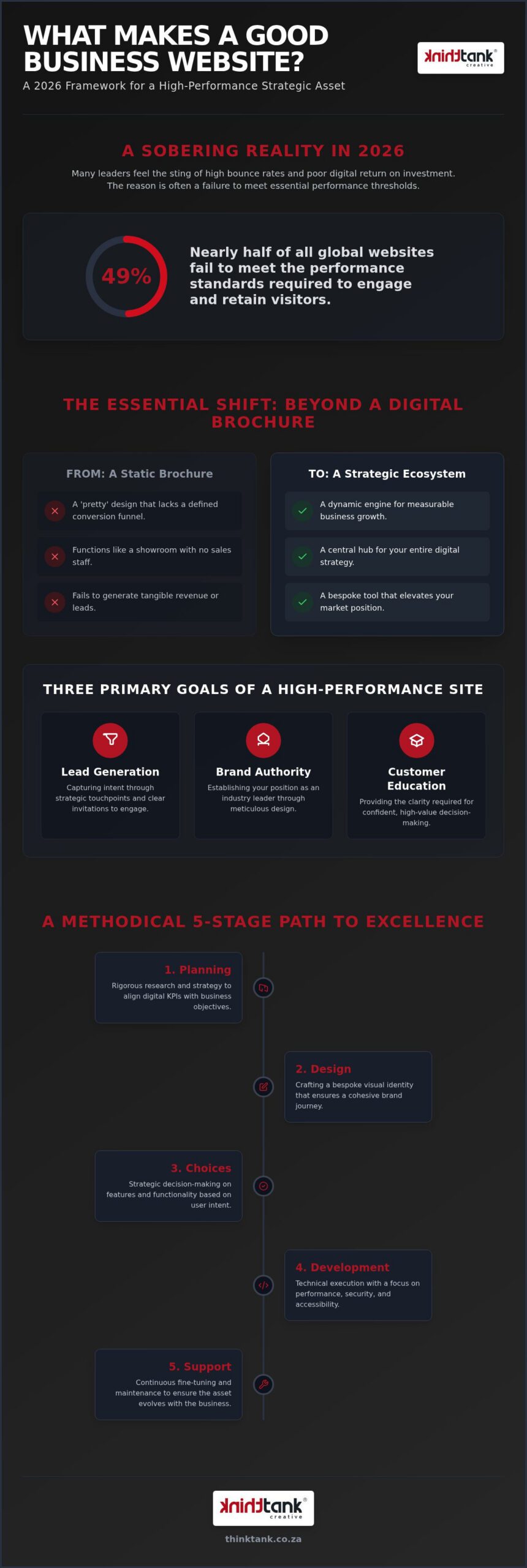
Our structured 5-stage development process is designed to eliminate the guesswork from site performance. We don't believe in templated solutions; instead, we focus on bespoke craftsmanship that aligns with your specific commercial objectives. This end-to-end approach ensures that every technical signal is optimised for the unique conditions of the South African market, from the initial research phase through to final deployment.
The Development Roadmap for High Performance
Success is built during the Planning and Design phase, where we establish the technical foundation for your vitals. We map out the content hierarchy to ensure that Largest Contentful Paint (LCP) and Cumulative Layout Shift (CLS) are managed from the very first wireframe. During the Program and Development stage, our team focuses on coding for speed, security, and SEO. We prioritise clean, efficient code that minimises browser work, which is essential for passing the Interaction to Next Paint (INP) metric. Finally, the Testing and Launch phase involves rigorous validation across all South African network types. We simulate various connection speeds to ensure your site performs flawlessly for users on both high-speed fibre and mobile data.
Beyond the Launch: Ongoing Excellence
Maintaining a "Green" status in Google's reports isn't a one-off achievement. Continuous maintenance and support are required to ensure that as your content grows and web standards evolve, your performance doesn't degrade. We remain deeply invested in our clients' journeys, providing the meticulous care needed to sustain organic visibility. Because every brand transformation is unique, we provide a tailored estimated cost for our services after a thorough strategic discussion. This allows us to align our expertise with your specific vision. We invite you to embark on a journey of imagination with us, where we elevate your digital presence and ensure your website remains a powerful tool for conversion and growth.
Secure Your Strategic Advantage in the South African Market
Mastering core web vitals for south african websites is no longer just a technical checkbox; it's a fundamental requirement for brand survival. By prioritising field data over lab simulations and embracing a design-first philosophy, you ensure that your digital presence remains resilient against network variability and data cost sensitivities. This strategic alignment doesn't just satisfy Google's algorithms; it respects your users' time and resources, fostering deeper trust and higher conversion rates whilst keeping you ahead of the competition.
Since 2001, our award-winning in-house team has helped businesses navigate the complexities of the digital landscape with 25 years of excellence. We invite you to elevate your website performance with ThinkTank Creative through our structured 5-stage development process. This methodical approach ensures that every aspect of your site, from initial research to post-launch support, is engineered for precision and growth. Let's work together to transform your technical signals into a lasting competitive edge. Your journey toward a faster, more engaging website starts here.
Frequently Asked Questions
Do Core Web Vitals actually affect my Google rankings in South Africa?
Core Web Vitals are a confirmed ranking signal that directly influences your position in Google's search results. In a competitive digital landscape, these metrics act as a tie-breaker between sites with similar content quality. Failing to meet the thresholds can lead to suppressed visibility whilst competitors who prioritise user experience rise. It is essential to understand that core web vitals for south african websites represent Google's commitment to rewarding sites that provide a stable, responsive experience.
What is the most important Core Web Vital metric to fix first?
Largest Contentful Paint (LCP) is often the most critical metric to address first because it dictates a user's initial perception of speed. If your main content takes longer than 2.5 seconds to load, visitors are likely to abandon your site before it even becomes interactive. By focusing on LCP, you immediately improve the loading experience for the 69% of South Africans who access the internet via smartphones on variable network speeds.
How does Interaction to Next Paint (INP) differ from the old FID?
Interaction to Next Paint (INP) provides a more comprehensive view of responsiveness than the retired First Input Delay (FID). Whilst FID only measured the latency of a user's very first interaction, INP evaluates every interaction, such as clicks or taps, throughout the entire visit. This shift ensures that your site remains snappy and responsive from the moment a user arrives until they complete their journey, providing a more accurate reflection of real-world usability.
Can my web hosting provider fix my Core Web Vitals automatically?
A hosting provider can only address server-side performance, such as Time to First Byte (TTFB). Whilst fast local hosting is a vital foundation, it cannot automatically resolve issues like unoptimised images, bloated JavaScript, or layout shifts caused by your site's code. Achieving "Good" scores requires a holistic approach that combines high-performance infrastructure with meticulous front-end engineering and design, ensuring that your core web vitals for south african websites are truly optimised.
Is it possible to pass Core Web Vitals on a WordPress website?
It is entirely possible to pass these thresholds on a WordPress site, provided you maintain a lean architecture. Success depends on selecting high-performance themes and avoiding the common pitfall of plugin bloat, which can significantly degrade your scores. By implementing server-side caching, optimising your database, and using modern image formats, you can transform a standard WordPress installation into a high-speed asset that meets all of Google's latest user-experience standards.
How much does it cost to optimise a website for Core Web Vitals?
The investment required for performance optimisation depends on the current technical state and complexity of your digital presence. Because every project presents unique challenges, we provide a tailored estimated cost only after a comprehensive strategic discussion. This ensures that our collaborative efforts are aligned with your brand's specific goals. Investing in professional optimisation typically pays for itself through improved organic visibility and a website that converts a higher percentage of visitors.
Why does my site pass on desktop but fail on mobile devices?
Mobile failure often occurs because smartphones have less processing power than desktop computers and frequently operate on slower, less stable network connections. Google uses mobile-first indexing, meaning your mobile scores are the primary driver of your ranking success. If your site is not specifically engineered for mobile efficiency, the extra work required to render complex layouts or execute heavy scripts will cause your performance metrics to plummet in real-world field data.
How often should I check my website’s performance reports?
We recommend reviewing your performance reports at least once a month to catch any regressions caused by new content or software updates. Google's field data operates on a rolling 28-day window, so consistent monitoring allows you to respond quickly to any downward trends. Regular audits ensure that your site remains in the "Green" zone, protecting your search authority and ensuring a consistently excellent experience for your South African audience.