How to Increase Domain Authority in South Africa: A Practical 2026 Guide

A higher Domain Authority score won’t, by itself, move your South African business up Google. If you’re searching for “how to increase domain authority south africa”, the more useful question is how to build a website that earns relevant links, serves its audience and strengthens search visibility over time.

It’s understandable to focus on a number when measuring SEO progress, particularly when relevant links can take time to earn. But Domain Authority is Moz’s third-party metric, not a Google ranking factor. Treat it as a comparative indicator, not a verdict on your website’s health or a score to chase at any cost.

This guide explains what Domain Authority can and can’t tell you, then sets out practical ways to build relevance in the South African market. You’ll learn how useful content, a well-functioning website and thoughtful link-building work together, and how to track progress through search visibility and meaningful business outcomes alongside third-party metrics.

Key Takeaways

  • Learn why authority scores differ between SEO platforms, and use each metric with its calculation method in mind.
  • Build a baseline by recording referring domains and organic performance, then compare your site with relevant South African competitors.
  • Follow a practical process for how to increase domain authority south africa: create a useful asset, identify relevant sources and explain its value.
  • Prioritise content that answers a specific audience need and gives credible websites a reason to reference it.
  • Review earned links, search visibility and enquiries together to decide what to do next.

What domain authority means for South African websites

Domain Authority is a third-party estimate of how likely a website is to rank in search results compared with other sites. Moz developed the Domain Authority metric, which draws on signals such as a site’s link profile. It’s an estimate, not a complete assessment of your website’s SEO health or a promise of future rankings.

Put simply, a third-party authority metric estimates a website’s relative ranking potential. It isn’t a score assigned or used directly by Google. If you’re exploring how to increase domain authority south africa, understanding this distinction helps keep your strategy focused on meaningful progress rather than a number alone.

For a visual introduction to the topic, watch this video:

Domain Authority, Domain Rating and Authority Score: what differs?

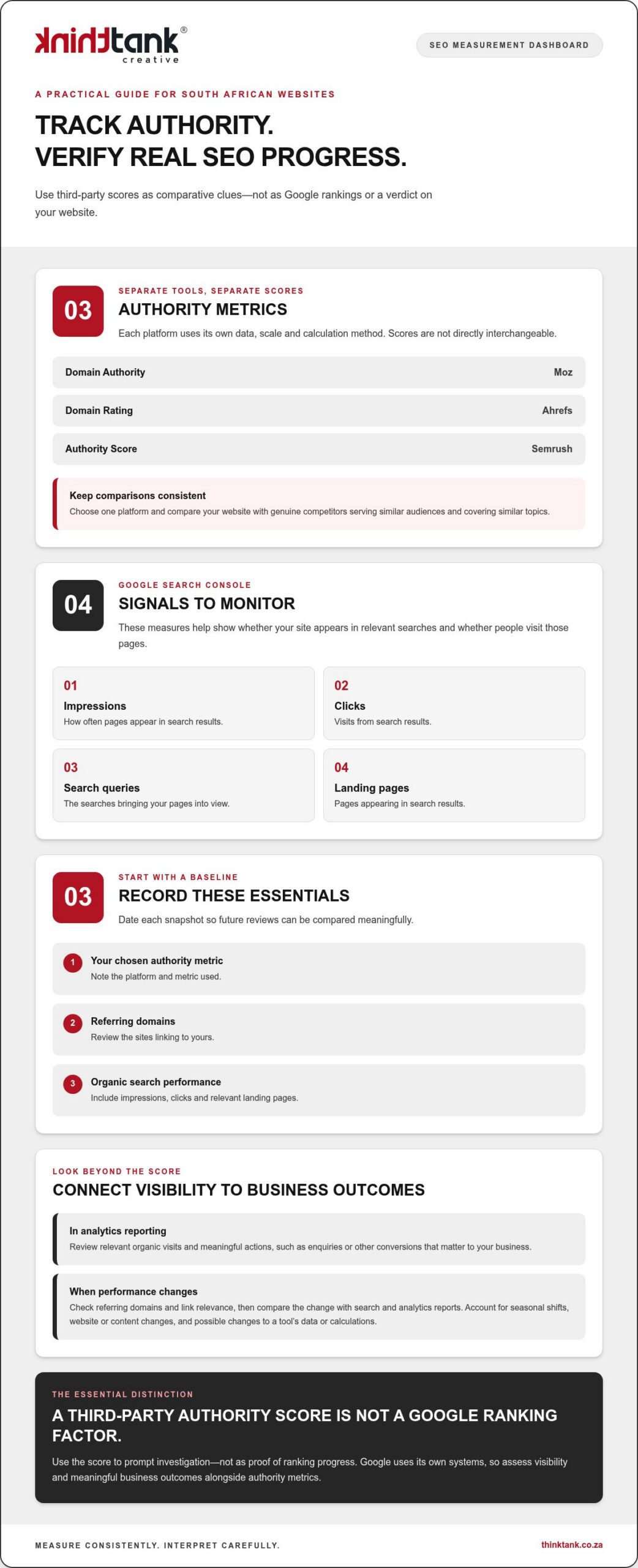
These are separate third-party metrics: Domain Authority is from Moz, Domain Rating from Ahrefs and Authority Score from Semrush. Each platform uses its own data, scale and calculation method, so the scores aren’t directly interchangeable. A site’s score can differ between tools even when its underlying search performance hasn’t changed.

For a useful comparison, choose one platform and use the same metric to review your website and a small set of genuine competitors with similar audiences and subject matter. This gives you a consistent benchmark instead of a misleading comparison between numbers calculated in different ways.

Why South African businesses should look beyond one score

Relevance depends on the people a website serves, the subjects it covers and the market it operates in. A focused South African business site may have a smaller link profile than a national or global publisher and still be useful to people looking for specialised expertise, products or services.

A higher score doesn’t prove that a site will rank above another, and it doesn’t cause Google to award better positions. Sites with stronger backlink profiles may also have better visibility, but that relationship alone doesn’t show that a third-party score caused the rankings. Google uses its own ranking systems.

Use authority scores to spot questions worth investigating, not as targets. A change can prompt you to review links or compare competitors, but assess it alongside relevant search visibility and audience response. That keeps SEO decisions grounded in what your audience needs.

Does domain authority affect Google rankings? Separate the metric from real SEO progress

No. A third-party Domain Authority score is not itself a Google ranking factor. Google doesn’t assign your website a Moz, Ahrefs or Semrush authority score. These tools provide estimates that can help you compare your site with others, but a change in the estimate doesn’t tell you directly what Google will rank or why.

Authority scores and search performance can move in the same direction: websites with strong backlink profiles may also have good visibility. But correlation isn’t causation. A higher third-party score doesn’t prove that the score caused improved rankings, or that every link contributing to it is valuable to your audience.

A rising authority score can’t guarantee better rankings, because Google uses its own systems to assess and rank pages. If you’re considering how to increase domain authority south africa, treat the metric as one diagnostic signal, then judge progress through search visibility and business outcomes.

Which signals are more useful for tracking SEO performance?

Use Google Search Console to monitor impressions, clicks, search queries and the landing pages appearing in results. These measures show whether your website is appearing for relevant searches and whether people are visiting those pages.

Pair that view with analytics reporting. Review relevant organic visits and meaningful actions on your site, such as enquiries or other conversions that matter to your business. Look at trends over time, account for seasonal shifts and note changes to your content or website. Don’t attribute every rise or fall to link-building alone.

Google’s guidance favours creating compelling material that people have a reason to reference, rather than relying on manipulative link schemes. Its advice on earning quality links supports a user-first approach: make your content genuinely useful and relevant.

How to interpret a domain authority score responsibly

Make comparisons consistent. Record the platform, metric and date each time you review your score, then compare it with relevant competitors serving similar audiences and covering similar topics. Unrelated websites and arbitrary targets make poor benchmarks.

If the number changes, investigate before drawing conclusions. Check whether referring domains have changed, review the relevance and quality of those links, and compare the results with your search and analytics reports. The score may also move because a tool’s data or calculations have changed. The aim is to understand what may have influenced the metric, not to pursue a particular number.

Clear reporting makes those signals easier to interpret. Learn more about SEO strategy and reporting as part of a considered approach to measuring website performance.

Start with a baseline before deciding what to improve. Record your chosen authority metric and SEO platform, your number of referring domains, and organic search performance, including impressions, clicks and relevant landing pages. Date each snapshot so you can make meaningful comparisons later.

Next, select a small group of genuine South African competitors. Choose businesses that serve a similar audience and cover related topics, rather than simply picking websites with high scores. For a broader view of how link-building fits into search optimisation, explore this South African SEO strategic guide. Moz also explains how its own Domain Authority metric is intended to be used as a comparative measure.

What makes a backlink relevant and worth pursuing?

Assess the page that links to you, not just the referring domain’s score. Does the page cover a related subject, serve a similar audience or connect to your business community? Is your link included naturally in useful editorial or resource content, where it helps readers understand or explore the topic?

Consider the likely audience value. A link from a relevant South African industry association, professional resource or supplier could introduce your website to interested visitors. A link with no clear connection to your work may offer little practical value, even if a tool gives the referring site a strong score.

How to find gaps against relevant competitors

Review competitors’ referring pages for credible industry, professional, supplier and community sources. Note why each page linked, then ask whether you have a useful resource that could meet a similar need. Separate realistic opportunities from sites that appear to exist mainly to sell links. A raw link count won’t show the difference.

Use a simple comparison to organise your assessment:

What to assess What to look for Question to ask
Relevance Connection to your subject, audience or South African market Would this source make sense to your customers?
Referring-site quality Credible, useful content and a clear purpose Does the site serve a real audience?
Link context A natural mention in relevant editorial or resource content Does the link help readers?
Audience value A plausible route for interested visitors to discover your site Could this referral support awareness or enquiries?

This audit gives you a grounded starting point for how to increase domain authority south africa: identify gaps that matter to your audience, then prioritise relevant opportunities over score-chasing.
How to Increase Domain Authority in South Africa: A Practical 2026 Guide

Earn links by giving relevant websites a genuine reason to reference your work. A strong authority-building plan starts with a useful resource and thoughtful outreach, not a target score. If you’re researching how to increase domain authority south africa, use this process to focus on links that make sense for your audience and market.

  1. Choose a useful asset. Identify a question your audience needs answered, then create a resource that responds clearly and thoroughly.
  2. Find relevant sources. Research South African industry bodies, professional networks, partners, publications and community resources that cover the topic or serve the same audience.
  3. Pitch the value. Contact each relevant organisation with a personal note explaining what the resource offers its readers and why it may be useful.
  4. Review the results. Track who you contacted, responses, links earned and referral or search performance. Use what you learn to refine the next round, without expecting a particular score increase.

For more detailed outreach guidance tailored to the local market, read these local link-building strategies for South Africa.

Create content that deserves references and recommendations

Build resources around genuine knowledge of your business and customers. This might be a practical guide, a clear explanation of a complex topic or a resource that helps people make an informed decision. Start with a defined audience need, then make the content specific, accurate and useful enough to stand on its own.

Presentation matters, too. Use clear headings, concise copy and an easy-to-follow structure so a publisher can quickly assess the resource. Coordinate content creation, copywriting and SEO priorities, rather than publishing material without a defined purpose or audience.

Build relationships without buying shortcuts

Personalise each approach. Refer to the recipient’s publication, resource or community, and explain why your content could help its audience. A relevant partner may value a useful resource, a publication may consider an expert explanation, and a community site may welcome material that answers a recurring question. Keep the pitch specific and respectful.

Avoid paid-link schemes, irrelevant directory submissions and mass-produced outreach promising easy results. These tactics can waste effort and don’t build relevant relationships that support lasting visibility. Record outreach and earned links, then assess quality and outcomes alongside any change in third-party metrics.

Bring research, content and outreach together in a considered plan. ThinkTank Creative provides SEO and content support to align this work with your website and business goals.

How to sustain authority growth and choose the right next steps

Turn your link-profile findings into a focused plan, not an endless list of SEO tasks. Set priorities for useful content and outreach, assign an owner to each action, and agree on reporting checkpoints. Sustainable progress comes from relevant, consistent activity and review. There’s no guaranteed timeline for an authority score or search result to improve.

Keep the objective clear: earn relevant references, improve search visibility and attract the right audience. A third-party score can help you spot changes, but it shouldn’t replace evidence that your website is reaching potential customers and supporting business goals.

What to review in a regular SEO report

Use each report to connect activity with outcomes. Review target-page visibility, organic clicks, relevant queries and meaningful conversions, such as enquiries. Check new referring domains for topical fit, the context of each link and whether the source’s audience is relevant to your business.

Then record what changed, what you learned and the next action that has a clear rationale. If a page earns links but attracts few relevant visits, consider whether its topic, search intent or next step needs refinement. If visibility changes, review other site and content updates before assuming outreach was the cause.

When integrated SEO and website support can help

Authority-building is easier to manage when research, strategy, content creation and reporting work together. Research identifies audience needs and realistic opportunities; strategy sets priorities; useful content gives relevant sources something worth referencing; reporting shows what is gaining traction. A functional, easy-to-use website gives visitors a clear experience once they arrive.

For a practical approach to how to increase domain authority south africa, treat SEO and website quality as connected parts of sustained improvement. ThinkTank Creative brings together SEO, content creation, copywriting, reporting, website development and ongoing support as part of its digital work.

To discuss your SEO and website project needs, explore ThinkTank Creative.

Build lasting search strength through relevant authority

Use Domain Authority as a diagnostic, not a destination. The most effective approach to how to increase domain authority south africa is to understand your baseline, create resources that meet real audience needs and earn relevant references from credible sources. Then assess progress through search visibility, useful website visits and enquiries, not one third-party score.

Keep the work focused and consistent. A practical plan with clear priorities, responsible outreach and regular reporting can help you learn what’s resonating and decide where to invest next. Strong SEO also relies on a functional website that makes it easy for visitors to find information and take action.

ThinkTank Creative, founded in 2001, brings SEO, content creation, copywriting and reporting together with a website process spanning research and strategy through launch and support. Explore ThinkTank Creative’s SEO and website services to discuss your project needs and shape a considered path forward.

Build with relevance, measure what matters and give your South African website room to grow.

Frequently Asked Questions

Is domain authority a Google ranking factor?

No. Domain Authority is a third-party metric developed by Moz, not a score Google uses to rank pages. Google has its own ranking systems, so a change in this metric doesn’t directly cause rankings to rise or fall. Use it as one comparative signal alongside Search Console visibility, relevant organic visits and enquiries. A higher score may coincide with a strong link profile, but that doesn’t prove the score caused better rankings.

How can I increase domain authority in South Africa?

To improve domain authority in South Africa, create genuinely useful content for a defined audience and earn relevant references from credible sources. Consider industry bodies, professional networks, partners, publications and community resources that serve your subject area. Personalise outreach by explaining the value to each source’s readers. Track referring domains and search performance, but don’t use link volume or a third-party score as the only measure of progress.

How long does it take to increase domain authority?

There’s no fixed timetable. Authority metrics can change gradually as your website earns relevant links and the SEO platform updates its data. Sustainable improvement may take several months or longer, and results depend on your starting point, competition and the consistency of your work. Set regular review points rather than expecting a quick score change, and monitor search visibility and business outcomes alongside the metric.

What is a good domain authority score for a South African business?

There isn’t a universal “good” score for South African businesses. Authority metrics are comparative estimates, and results depend on the tool and its calculation method. A useful benchmark is the score of relevant competitors serving similar audiences and covering similar topics, measured using the same platform. Focus on whether your website is improving its visibility for relevant searches and attracting valuable visitors, rather than pursuing an arbitrary score.

Can I improve domain authority without building backlinks?

You can improve other aspects of SEO without acquiring backlinks, including content usefulness, site structure and page experience. These improvements may support search visibility, but they’re unlikely to substantially increase a link-based authority metric on their own. For that, focus on creating resources that relevant websites may choose to reference. Measure progress across your search performance and website outcomes, not the authority score alone.

Should I buy backlinks to increase domain authority?

Don’t buy backlinks simply to inflate an authority score or manipulate search rankings. Paid links created to influence rankings can conflict with Google’s spam policies, and irrelevant links may deliver little audience value. Invest in useful content and relevant relationships instead. If a link is part of a legitimate paid promotion, make sure it’s handled transparently and in line with applicable search engine guidance.

How can I check my website’s domain authority?

Check the metric using the SEO platform that provides it, such as Moz for Domain Authority. Other platforms have their own measures, including Ahrefs’ Domain Rating and Semrush’s Authority Score, so don’t compare these scores as if they were interchangeable. Record the tool and date, then benchmark against relevant competitors using the same metric. Use Google Search Console separately to review impressions, clicks, queries and landing-page visibility.
Keyword Research for South Africa: 2026 Strategic Guide

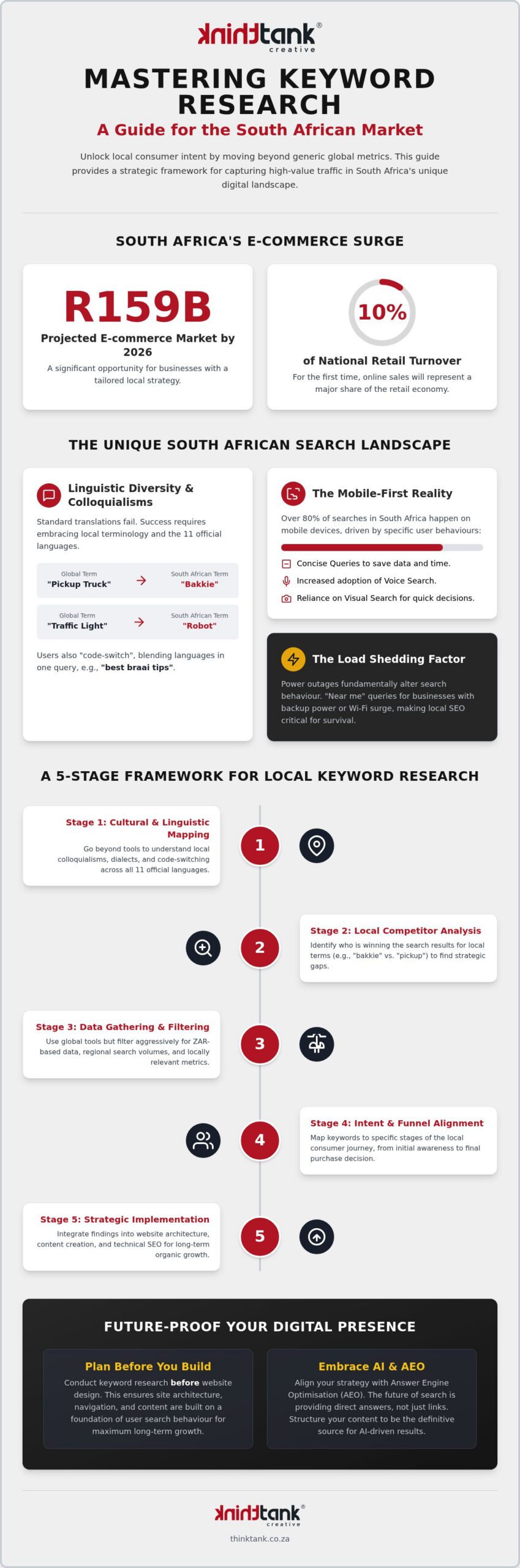
In 2026, South African e-commerce is projected to hit R159-billion, marking the first time online sales account for a full 10% of our national retail turnover. If your digital presence isn't reflecting this massive shift, it's often because global SEO strategies fail to translate to our unique local context. Learning how to do keyword research for a south african audience requires more than just a tool subscription; it demands a deep understanding of our 11 official languages and the specific colloquialisms that define how we search.

You've likely experienced the frustration of seeing decent traffic numbers that simply don't turn into sales, or perhaps you're struggling to find accurate ZAR-based data in a sea of US-centric metrics. We're here to bridge that gap and help you identify the high-value keywords that truly resonate with local consumers. This strategic guide provides a repeatable framework for local keyword research. We'll show you how to achieve better visibility in both Google and AI-driven search results whilst driving meaningful growth from local leads.

Key Takeaways

  • Gain a competitive edge by mastering how to do keyword research for a south african audience, moving beyond generic global metrics to capture authentic local intent.
  • Explore the impact of linguistic diversity and colloquialisms, ensuring your digital presence speaks the specific language of your target market across all 11 official languages.
  • Future-proof your brand's visibility by aligning your strategy with the rise of AI-driven search and Answer Engine Optimisation (AEO) trends.
  • Recognise the critical importance of conducting research before the website design and development phase to ensure your site architecture supports long-term organic growth.
  • Adopt a structured, 5-stage methodology that transforms raw data into a bespoke digital strategy tailored to the unique South African search landscape.

Understanding the South African Search Landscape in 2026

Mastering how to do keyword research for a south african audience involves a deliberate shift from technical data mining to cultural mapping. South African keyword research is the systematic process of identifying the precise linguistic nuances and search intents used by our diverse population to ensure digital content resonates across multiple cultural contexts. Whilst global platforms provide a foundation, they often overlook the bespoke requirements of the ZAR market, where local intent and cultural relevance dictate visibility.

To truly grasp the complexities of South Africa's internet landscape, one must look past the high-level statistics. Standard international "best practices" typically prioritise high-volume English terms, yet this approach misses the synergy between our 11 official languages. By focusing on precision rather than just volume, businesses can move from being mere vendors to becoming trusted local partners who understand the heartbeat of the local consumer.

To better understand how these search dynamics are evolving and how to apply them to your strategy, watch this helpful tutorial:

The Mobile-First Reality of ZA Search

Mobile devices account for over 80% of searches in the country, creating an environment where speed and brevity are paramount. High data costs influence user behaviour, often leading to specific patterns that digital strategies must accommodate:

Designing your keyword strategy around these mobile-centric habits ensures your brand remains accessible to the 51.7 million active internet users nationwide. It's about creating a seamless path from the initial search to the final conversion.

Search Behaviour During Load Shedding

Power outages have fundamentally altered how we interact with the digital world. When the lights go out, search patterns shift instantly to mobile-first, offline-ready, or location-based behaviours. "Near me" searches for businesses with backup power or reliable Wi-Fi surge during these windows, making local SEO visibility a critical survival trait for retail and service providers. Understanding how to do keyword research for a south african audience means acknowledging that connectivity isn't a constant; it's a variable that requires a strategic, time-sensitive approach to content delivery. Whilst every business journey is unique, an estimated cost for a tailored search strategy is typically provided after a detailed discussion of your specific goals.

Linguistic Diversity: Beyond English Keywords

South Africa's search environment is a vibrant tapestry of 11 official languages. Mastering how to do keyword research for a south african audience requires looking beyond the dominant English queries that many global tools prioritise. Whilst English serves as a commercial bridge, a significant portion of the digital economy in South Africa is driven by users searching in their primary tongue or employing unique local dialects. Developing a framework for how to do keyword research for a south african audience involves a deep dive into these cultural intersections.

Direct translation is a common pitfall that limits reach. A keyword like "traffic light" might have high search volume globally, but a local user is just as likely to search for "robot repair" or "robot malfunctions." Similarly, a "pickup truck" is almost universally a "bakkie" here. Failing to account for these "South Africanisms" means leaving high-intent traffic on the table for your competitors. Code-switching is another reality, as users often blend languages within a single query, searching for "best braai tips" or "isizulu lessons online." This linguistic fusion creates a specific type of search intent that requires a nuanced, human-led approach to strategy.

Targeting Colloquialisms and Local Slang

Informal search terms often carry immense commercial weight with surprisingly low competition. For instance, using local slang in your Search Engine Optimisation strategy can help you connect with the "man on the street" who finds overly formal corporate language exclusionary. We identify these terms through social listening and community engagement, ensuring your brand speaks with an authentic local voice. It's this level of bespoke craftsmanship that distinguishes a generic campaign from a truly resonant one. We do it all so you don't have to.

Multilingual Keyword Mapping

Organising your keyword clusters across different language groups is a hallmark of a sophisticated digital strategy. Languages like Afrikaans and isiZulu frequently present lower difficulty scores, allowing for faster rankings for high-value terms that competitors often ignore. This isn't about simple duplication; it's about strategic alignment that respects the nuances of each audience. Maintaining brand consistency whilst adapting to these linguistic shifts ensures your business remains both elite in its execution and warm in its professional relationships. Our team provides an estimated cost for these bespoke services after a thorough discovery discussion, ensuring our partnership is built on transparency and mutual success.

The Transition to AI Visibility and AEO in South Africa

Search is undergoing a fundamental metamorphosis. Whilst traditional SEO focuses on driving traffic to a specific URL, Answer Engine Optimisation (AEO) aims to position your brand as the definitive response provided by generative AI agents. Understanding how to do keyword research for a south african audience in this new era requires a shift from tracking "blue links" to becoming an authoritative data point within the knowledge graphs of ChatGPT, Gemini, and Claude.

Traditional ranking ensures your site appears in a list, whereas being cited by an AI agent establishes your brand as the expert authority for a specific query. These AI models interpret South African business data by looking for "entities", which are verified facts about your services, location, and reputation. To succeed, you must provide clear, structured data that helps these engines navigate South Africa's linguistic diversity and cultural context without ambiguity.

Global Tools vs Local Reality

Relying solely on global platforms like Ahrefs or Semrush can lead to a significant "ZAR Data Gap." These tools often under-report search volumes for local terms because their data sets are primarily skewed toward Western markets. To master how to do keyword research for a south african audience, we supplement these metrics with manual research using Google Trends (ZA) and AnswerThePublic. This hybrid approach ensures we capture the high-intent queries that global algorithms might overlook, providing a more precise strategic roadmap for your brand's growth.

Optimising for AI Overviews

Google's AI-generated summaries now occupy the most valuable real estate on the search results page. To appear in these overviews, your content must adopt a natural language structure that mirrors how people actually speak and ask questions. We move away from rigid keyword placement toward answering complex, multi-layered queries with clarity and depth. By positioning your brand as a primary cited source for industry-specific queries, you build a level of trust that transcends traditional advertising. It's about creating a synergy between technical excellence and human-centric content that speaks directly to the needs of the local consumer. Whilst every project is unique, we provide an estimated cost for our bespoke strategy services after an initial consultation to ensure alignment with your specific vision.

Keyword Research for South Africa: 2026 Strategic Guide

A 5-Stage Framework for South African Keyword Research

Success in the local digital market is built on a foundation of rigorous methodology. At ThinkTank Creative, we've refined a professional framework that mirrors our proprietary 5-stage process, ensuring every decision is backed by strategic depth rather than guesswork. Mastering how to do keyword research for a south african audience requires moving beyond simple lists to a structured approach that respects our unique market dynamics.

Identifying High-Intent Local Keywords

Distinguishing between informational and transactional intent is vital for driving conversions. Whilst a user searching for "what is a retirement annuity" is seeking knowledge, someone searching for "best RA rates South Africa" is ready to commit. "How to" queries are particularly essential for building trust amongst ZA consumers, as they position your brand as a helpful expert before the sale occurs. We also mine local forums and social media to discover "hidden" keywords that global tools often miss, capturing the authentic voice of your customers. This level of precision is fundamental when learning how to do keyword research for a south african audience effectively.

Analysing the Competitive Landscape

Larger national competitors often leave significant gaps by focusing only on broad, high-volume terms. By evaluating SERP features such as Maps, Snippets, and "People Also Ask" boxes, we identify opportunities to capture visibility where others are absent. Search sentiment also plays a critical role in South Africa; understanding the emotional context of a query allows us to tailor your messaging for maximum impact. If you're ready to elevate your brand, we invite you to partner with our SEO specialists to develop a bespoke keyword roadmap. An estimated cost for this strategic work is provided after our initial discussion. We do it all so you don't have to.

Integrating Keyword Strategy into Website Development

Strategic digital foundations require that keyword research precedes the first line of code or the initial design mock-up. When businesses treat search strategy as a post-launch add-on, they often find themselves retrofitting content into an incompatible architecture that fails to engage. Understanding how to do keyword research for a south african audience ensures that your site's structure mirrors the actual search behaviour of your customers from the outset. This methodology allows us to develop keyword clusters that inform the entire site architecture, ensuring that user experience (UX) and interface design (UI) are aligned with commercial intent.

At ThinkTank Creative, our approach ensures every page is built to be found and recommended by both human users and search algorithms. By mapping high-value terms to specific landing pages before the development phase, we create a logical flow that guides visitors through the conversion funnel. This synergy between creative branding and SEO-driven content is what transforms a standard website into a powerful business tool. Every element of the site, from the navigation menu to the internal linking structure, is crafted with precision to support your long-term visibility goals.

Building for Usability and Visualisation

Great marketing makes the customer look smart, whilst smart marketing merely focuses on the company's own achievements. During the visualisation stage of our design process, we use keyword insights to determine which elements deserve prominence on the page. This data-driven perspective ensures that the most sought-after information is easily accessible. Because mobile search is dominant in the local market, our Website Design and Development process prioritises responsiveness. We ensure that your site captures high-volume mobile search terms whilst maintaining a sophisticated aesthetic that reinforces your brand's elite status.

Ongoing Service and SEO Maintenance

Digital excellence is a continuous evolution rather than a static destination. Keyword research is not a "once-off" task; it requires ongoing refinement to adapt to shifting market trends and competitor movements. Through our Website Maintenance and Support services, we provide the meticulous reporting and post-launch analysis necessary to track your keyword rankings and adjust your strategy in real-time. Complementing this with understanding your website analytics report ensures you can translate those ranking movements into actionable commercial decisions. We invite you to embark on a journey of imagination with a partner deeply invested in your growth. Whilst every project is bespoke, an estimated cost for our strategic services is provided after a detailed discussion of your vision. We do it all so you don't have to.

Elevating Your Digital Presence in 2026

The South African search landscape is a complex, vibrant environment where success is reserved for those who look beyond generic data. By prioritising linguistic nuance and the rise of AI-driven visibility, you position your brand to resonate deeply with local consumers. Mastering how to do keyword research for a south african audience isn't just about technical precision; it's about building a digital foundation that respects our cultural diversity whilst leveraging the latest in Answer Engine Optimisation.

ThinkTank Creative has been a partner in this evolution since 2001. Our award-winning in-house design team utilises a comprehensive 5-stage strategic process to ensure your website is both a creative masterpiece and a high-performing lead generator. We provide an estimated cost for our bespoke services after a thorough discussion of your unique goals, ensuring a partnership built on transparency and mutual growth.

Let's embark on a journey of imagination together; contact ThinkTank Creative today to transform your brand's digital trajectory. We do it all so you don't have to.

Frequently Asked Questions

How is keyword research different for South Africa compared to the UK or USA?

Cultural nuance and linguistic diversity are the primary differentiators. Whilst UK/USA markets are relatively homogeneous in language, South Africa requires a strategy that accounts for 11 official languages and unique colloquialisms. Mobile search dominance and connectivity issues like load shedding also influence local search behaviour. Understanding how to do keyword research for a south african audience means it's essential to prioritise these local realities over generic global trends.

Which tools are best for finding South African search volume?

Premium global platforms like Ahrefs and Semrush provide a solid baseline, yet they often under-report specific ZAR data. Mastering how to do keyword research for a south african audience requires supplementing these metrics with Google Trends (ZA) for local insights. Manual research into forums is also essential to capture authentic South Africanisms that automated tools might miss. This hybrid approach ensures your strategy's grounded in accurate, real-world data.

Should I target keywords in local languages like Afrikaans or isiZulu?

Yes, targeting languages like Afrikaans or isiZulu is a highly effective way to reach underserved market segments. These languages often have lower competition levels compared to English, so they're great for faster rankings and higher engagement. We use a multilingual mapping strategy to ensure your brand remains consistent whilst respecting the specific linguistic nuances of each audience. This bespoke approach fosters a deeper connection with the local consumer.

How does the POPI Act affect my keyword and data strategy?

The POPI Act primarily regulates how you collect and process personal information rather than the keywords themselves. However, it influences your broader data strategy by requiring transparency in how you track user behaviour through cookies and lead generation forms. Your keyword strategy should focus on intent-driven, permission-based marketing. This ensures compliance whilst building trust, as consumers are increasingly wary of intrusive digital practices that don't respect their privacy.

How many keywords should I target per page on my website?

We typically recommend targeting one primary keyword and three to five secondary or long-tail keywords per page. This creates a focused content cluster that signals clear intent to search engines without diluting the user experience. Overloading a page with too many terms can lead to keyword stuffing, which negatively impacts your rankings. Instead, we prioritise thematic depth and natural language that's designed to answer the specific questions your audience is asking.

What is the "estimated cost" for a professional keyword research and SEO strategy?

At ThinkTank Creative, we understand that every business has unique requirements and growth objectives. Since our work isn't templated, an estimated cost is provided after a detailed discussion of your specific needs and project timeline. This collaborative approach ensures that the investment aligns with the value delivered. We focus on providing a comprehensive solution that supports your brand's long-term transformation and commercial success.

How long does it take to see results from new keyword targeting in ZA?

SEO is a long-term investment, and you can generally expect to see meaningful movement in rankings within three to six months. Factors such as domain authority, the competitiveness of your industry, and the technical health of your website influence this timeline. Whilst some quick wins are possible through targeting low-competition colloquialisms, it's sustainable growth that requires a consistent, strategic effort. We provide regular reporting to track progress and refine your strategy.

Can I do keyword research myself or should I hire an agency?

Whilst basic research is possible in-house, a professional agency offers the strategic depth and technical tools required for high-level competition. Since 2001, our award-winning design team has refined a 5-stage process that bridges the gap between raw data and creative execution. Hiring specialists allows you to focus on your core business whilst we handle the complexities of algorithm updates and multilingual targeting. We Do It All So You Don't Have To.

Local Link Building Strategies South Africa: The 2026 Strategic Guide

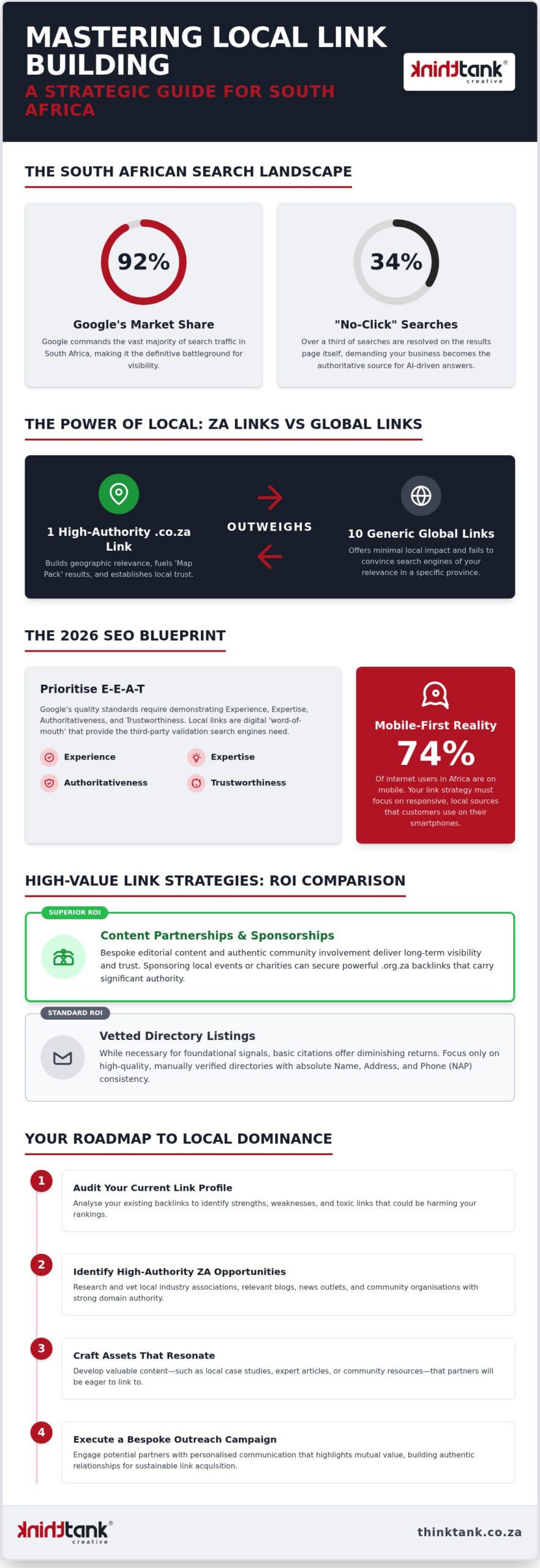
With Google commanding a 92.11% market share in South Africa, it is a sobering reality that 34% of standard searches now result in no click at all. This shift towards AI-integrated search means that simply having a website is no longer enough; you must become the authoritative source that engines trust above all others. You likely find it exhausting to compete with international brands that possess massive budgets, especially when generic global link-building services fail to move the needle in our unique local market.

We are here to transform that challenge into your competitive advantage by helping you master the specific local link building strategies south africa requires to dominate search results. This guide provides a strategic roadmap for securing high-authority ZA backlinks, leveraging hyperlocal signals, and aligning your digital presence with the value-driven behaviour of South African consumers. We will detail how to build authentic partnerships that elevate your domain authority and ensure your business remains the first choice for local customers. By the end of this guide, you will have the tools to outpace national competitors and secure a position of prominence in the 2026 digital ecosystem.

Key Takeaways

  • Understand why .co.za domains and geographic relevance are the cornerstone of search authority in the South African digital landscape.
  • Discover how to implement the most effective local link building strategies south africa offers by prioritising high-authority industry associations over outdated directory listings.
  • Learn why bespoke editorial content delivers a superior return on investment compared to basic citations, ensuring long-term visibility and trust.
  • Master a clear roadmap for your outreach campaign, from auditing your link profile to crafting assets that truly resonate with your target audience.
  • Explore how an integrated approach that combines SEO with expert design can scale your authority whilst we handle the heavy lifting.

Elevate your brand by understanding the specific mechanics of geographic authority. In the South African context, local link building isn't just about volume; it's about anchoring your digital presence within the .co.za ecosystem. To understand the fundamental principles, one should first grasp what is link building in its broadest sense. For service businesses, this means securing citations and mentions from regional directories, local news outlets, and industry-specific associations that signal relevance to Google's South African algorithms.

These signals are the primary fuel for the "Map Pack" results. Whilst a high-authority link from a US-based tech blog might boost your global domain rating, it does little to convince Google that you're the best provider in your specific province. Local links provide the proximity data necessary to outrank national competitors for service-based keywords, ensuring your business appears exactly when and where the searcher needs you.

To better understand how these strategies function in practice, watch this helpful video:

The Link-to-Lead Connection

Trust is the currency of the South African digital market. When a potential client sees your business mentioned by a reputable local industry body, it bridges the gap between a search result and a qualified lead. A single link from a relevant ZA trade guild is worth ten generic global links because it confirms your operational legitimacy within our borders. In 2026, local SEO relevance is defined by the density of high-quality, geographically specific signals that validate a business's physical and professional presence in South Africa.

The 2026 Local SEO Landscape in South Africa

The search environment has evolved to prioritise E-E-A-T (Experience, Expertise, Authoritativeness, and Trustworthiness) above all else. Local links serve as digital word-of-mouth, providing the third-party validation that AI-driven search engines require to recommend your services. With Africa holding the highest share of mobile internet users at 74% as of early 2026, mobile-first indexing is a non-negotiable reality. Your local link building strategies south africa must focus on responsive, local sources that ZA users visit on their smartphones. This synergy between local authority and mobile accessibility ensures your brand remains visible where your customers are actually looking.

Success in the local digital ecosystem depends on the calibre of your associations. Whilst many SEO providers still rely on bulk directory submissions, the 2026 search landscape demands a more refined approach. You must look for platforms that possess genuine regional authority and high engagement. This precision ensures your local link building strategies south africa focus on quality rather than sheer volume, which is essential for maintaining a clean and powerful backlink profile.

Vetted South African Directories

Selecting the right directories is a meticulous process. We prioritise platforms that require manual verification, as these are viewed more favourably by search algorithms. A critical component of this process is ensuring absolute NAP consistency. Your business Name, Address, and Phone number must be identical across every listing to avoid confusing search engines. At ThinkTank Creative, we focus on a curated selection of authoritative ZA directories, ensuring each placement strengthens your geographic relevance rather than diluting it with low-quality signals.

Strategic Partnerships and Sponsorships

Authentic community involvement provides some of the most potent link opportunities available. Sponsoring national events or local charities often leads to highly coveted .org.za backlinks, which carry significant trust signals. These relationships go beyond simple transactions; they represent a collaborative effort to grow the local economy. You might also consider earning local SEO backlinks through partnerships with non-competing service businesses or industry-specific associations like SACCI. These connections act as a digital endorsement, telling both users and search engines that your brand is a pillar of the South African business community.

Beyond traditional listings, leveraging local media through strategic PR can secure mentions on high-traffic news sites. Often, these publications talk about your brand without providing a direct link. Identifying these "unlinked mentions" and requesting a formal backlink is a sophisticated way to reclaim lost authority. If you find the technical nuances of these outreach campaigns overwhelming, our team can help you organise a bespoke SEO strategy that aligns with your specific growth objectives. By collaborating with influencers and industry leaders, we ensure your brand transformation is supported by a network of excellence.

Directory Listings vs. Content Partnerships: Which Delivers Better ROI?

Maximise your marketing spend by distinguishing between foundational visibility and strategic authority. Whilst basic directory listings provide a necessary base for NAP consistency, they rarely offer the transformative growth required to dominate competitive sectors. Content partnerships, by contrast, demand a higher initial investment but yield a far superior return through sustained referral traffic and compound SEO value. Mastering the local link building strategies south africa requires for 2026 involves prioritising editorial relevance over mere existence.

Evaluating the effort-to-reward ratio is essential for any service-based enterprise. In-house teams often struggle with the time-intensive nature of outreach; this makes an "all-rounder" agency a more cost-effective choice for those seeking professional execution without the overhead. Editorial links possess a longevity that directory citations simply cannot match. A well-placed guest contribution on a reputable South African industry site continues to pass authority for years, whereas directories often become cluttered or lose their editorial oversight. You must also remain vigilant against "link farms" specifically targeting the South African market. These low-quality networks offer cheap, bulk links that lead to severe search penalties and long-term brand damage.

The Case for Editorial Content

High-quality copywriting serves as the ultimate magnet for organic link acquisition. By producing original South African industry reports or visually compelling infographics, you create assets that other professionals naturally want to cite. This methodology aligns perfectly with our broader vision for Search Engine Optimisation in South Africa: The 2026 Strategic Guide, where content and authority work in synergy. To ensure these assets consistently attract attention and endorsements, it is equally important to create a content marketing plan that structures your editorial output around genuine audience value and measurable SEO goals. When your brand provides genuine value through expert insights, the links follow as a natural endorsement of your expertise, elevating your domain authority within the South African digital ecosystem.

Managing Your Link Profile

Maintaining a diverse and healthy link profile is a continuous commitment. It's not enough to simply acquire links; you must actively monitor for toxic entries that could compromise your ZA rankings. We recommend a methodical approach to competitor analysis to identify untapped opportunities within the local landscape. By observing where your successful peers are mentioned, you can refine your own outreach strategy to ensure your brand remains at the forefront of the digital ecosystem. This proactive management protects your investment whilst positioning you for consistent, long-term growth. We do it all so you don't have to, ensuring your link profile remains a powerful asset rather than a liability.

Local Link Building Strategies South Africa: The 2026 Strategic Guide

A Step-by-Step Guide to Executing Your Local Outreach Campaign

Transform your strategic vision into a tangible reality through a disciplined execution process. Every successful campaign begins with a meticulous audit of your current backlink profile to identify authority gaps and hidden opportunities. Once you understand your standing, you can move to prospecting for high-relevance South African domains that align with your industry values. This methodical approach ensures your local link building strategies south africa are built on a foundation of data rather than guesswork. By following a structured roadmap, you move from a high-level concept to a concrete acquisition of authority.

Phase 1: Research and Asset Creation

Compelling outreach requires assets that other professionals feel proud to share. We utilise our proven 5-stage design process; planning, design, program, development, and support; to craft visual link magnets that resonate with the South African audience. Professional logo and corporate identity design are critical here. They establish the immediate credibility needed to bypass the initial scepticism of webmasters. Understanding what makes a good logo design is an essential part of this process, as a professionally crafted visual identity signals trustworthiness to both webmasters and potential link partners before they even read your content. A high-quality asset is only effective if the destination is seamless. This is why we emphasise Improving Website User Experience: 2026 Strategic Guide as a prerequisite for any outreach effort. When your site reflects bespoke craftsmanship, partners are far more likely to link to your content. Equally important is ensuring your site loads swiftly for every visitor; understanding how to fix a slow loading WordPress site is a critical technical step that prevents high bounce rates from undermining the authority your links work hard to build.

Phase 2: Personalised Outreach

Connection is the heartbeat of the South African business community. You must avoid generic templates at all costs. South African webmasters value personalised communication that demonstrates a genuine understanding of their platform and audience. Our collaborative approach focuses on building a journey of imagination with potential partners, framing the link as a mutual opportunity for growth rather than a simple transaction. It's about precision and synergy. You should track every interaction and refine your pitch based on real-world feedback. This iterative process ensures your outreach remains fluid and effective. If you are ready to elevate your brand through expert execution, start your collaborative journey with ThinkTank Creative today. We do it all so you don't have to, allowing you to focus on your core business whilst we secure your digital authority.

Relationship management is the final, essential step. Don't let the conversation end once the link is live. Following up and maintaining these connections can lead to future collaborations and a steady stream of referral traffic. Meticulous attention to these professional relationships mirrors the stability of a long-standing enterprise, ensuring your link-building efforts contribute to a sustainable and elite digital presence.

Scaling Your Digital Authority with ThinkTank Creative's Integrated SEO

Elevate your brand by moving beyond isolated tactics and embracing a comprehensive digital ecosystem. At ThinkTank Creative, we understand that successful local link building strategies south africa require more than just securing a mention; they demand a robust technical and creative foundation. By integrating link acquisition into a broader digital strategy, we ensure that every backlink serves as a catalyst for overall brand transformation. Our approach is not merely about rankings but about creating a sustainable presence that commands respect within the South African market. We do it all so you don't have to, allowing you to focus on your core operations whilst we manage the complexities of your digital growth.

Benefit from our all-rounder agency capability, which has been refined over 25 years of experience since our founding in 2001. We utilise a proven 5-stage development process; planning, design, program, development, and support; to ensure your website is technically optimised to handle the high-traffic influx that authoritative links provide. This methodical cadence ensures that when a national publication or industry body links to your site, the user experience is flawless. Ongoing maintenance and support are critical components of our service, protecting your SEO rankings against the ever-evolving search landscape and ensuring your investment continues to yield results.

Beyond the Link: A Holistic Marketing Approach

Amplify your authority by synchronising your link-building efforts with professional social media marketing and email marketing. When we create bespoke content that earns links, we also distribute it across channels to maximise visibility and engagement. Great marketing effectively makes your customers look smart, encouraging them to share your insights and earn you natural endorsements. This synergy is a core part of our Lead Generation Strategies for South African Businesses: The 2026 Strategic Framework, where every touchpoint is designed to foster trust and drive conversions. Complementing this approach, learning how to get more Google reviews in South Africa is an equally powerful way to build the social proof that reinforces your link-building authority and drives local search visibility.

Partnering for Long-Term Growth

Embark on a collaborative journey of imagination where your brand's potential is limited only by our collective creativity. The ThinkTank mission centres on constant communication and innovative problem-solving, positioning us as your strategic partner rather than a mere vendor. We invite you to discuss your unique objectives with our award-winning in-house team. An estimated cost for a customised South African SEO campaign is provided after a thorough initial discussion to ensure the strategy meets your specific needs. If you are ready to dominate the local search results and outpace your competitors, contact ThinkTank Creative to elevate your national visibility and secure your place as an industry leader.

Elevate Your National Visibility Through Strategic Authority

Mastering the digital ecosystem requires a shift from generic volume to precise, geographic relevance. You now have the roadmap to identify high-authority ZA opportunities and understand why editorial partnerships deliver a superior return on investment compared to basic citations. Implementing these local link building strategies south africa demands a blend of technical precision and creative storytelling that resonates with our unique market. It's about building a legacy of trust that search engines cannot ignore.

Since 2001, ThinkTank Creative has empowered businesses with 25 years of expertise in the South African landscape. Our award-winning in-house design and development team is ready to transform your digital presence through an integrated, all-rounder approach. We do it all so you don't have to, ensuring your brand's growth is both steady and sustainable. Partner with ThinkTank Creative for a comprehensive SEO strategy and begin your collaborative journey toward market leadership today. Your brand's transformation is within reach; let's build something exceptional together.

Frequently Asked Questions

What is the most effective local link building strategy for South African businesses?

Editorial content partnerships are the most effective way to secure high-authority backlinks. By creating bespoke reports or infographics that provide genuine value, you encourage natural endorsements from reputable South African industry bodies. This method ensures your local link building strategies south africa are built on trust and relevance rather than temporary volume. It's a collaborative approach that transforms your digital footprint into a position of market leadership.

Are .co.za domains better for SEO than .com domains in South Africa?

Yes, .co.za domains are generally superior for local SEO because they provide a clear geographic signal to search engines. Whilst a .com domain can rank nationally, the .co.za extension reinforces your commitment to the South African market and aligns with the search behaviour of local users. This relevance is a cornerstone of our 5-stage development process, ensuring your site is perfectly anchored within the regional digital ecosystem.

How long does it take to see results from a local link building campaign?

You should expect to see measurable shifts in visibility within three to six months of starting a consistent campaign. SEO is a methodical journey that requires patience and strategic depth rather than instant gratification. The timeline varies based on your existing domain authority and the competitive landscape of your specific industry. We provide ongoing support and maintenance to ensure these rankings remain stable once they're achieved.

Do I need to pay for links in South Africa?

You don't need to pay for links, and doing so often carries significant risk of search penalties. We focus on earned media and authentic relationship building which provides a much higher return on investment. Whilst some niche directories may have a nominal listing fee, the most powerful links come from genuine community involvement and high-quality content. We manage this entire outreach process so you don't have to worry about technical violations.

How many links do I need to rank on the first page of Google ZA?

There is no magic number of links required to reach the first page of Google ZA. Search rankings are determined by the quality and relevance of your link profile compared to your direct competitors. A single link from a high-authority South African news site often carries more weight than fifty low-quality directory listings. Our focus is always on precision and excellence to ensure your link profile outpaces national competitors.

Can social media links improve my local SEO rankings?

Social media links don't pass direct link juice because they are typically no-follow, but they're vital for brand signals. High engagement on social platforms drives referral traffic and increases brand awareness, which can lead to natural backlinks from other bloggers and journalists. Integrating your social strategy with your SEO efforts creates a synergy that amplifies your overall digital authority and improves your visibility for service-based keywords.

What is the difference between a citation and a backlink?

A citation is a mention of your business Name, Address, and Phone number (NAP), whilst a backlink is a clickable hyperlink to your website. Citations are foundational for local map rankings and help establish geographic trust. Backlinks are the primary drivers of domain authority and organic search placement. Both are essential components of the local link building strategies south africa businesses need to dominate the 2026 search landscape.

How do I know if a South African website is a good link prospect?

A good link prospect is a website that's both relevant to your industry and possesses a healthy, active audience in South Africa. You should look for sites with high editorial standards and a history of providing expert content. Avoid platforms that look like link farms or have excessive outbound links to unrelated industries. We meticulously audit every potential partner to ensure they align with your brand's journey of growth and excellence.

Core Web Vitals for South African Websites: The 2026 Strategic Guide

Why does your website feel lightning-fast on your office fibre connection whilst Google's reports insist you are failing the latest performance benchmarks? For many local businesses, the disconnect between personal experience and search engine data is a source of immense frustration. Mastering core web vitals for south african websites in 2026 requires more than just technical tweaks; it demands a strategic alignment with how 51.7 million South Africans actually navigate the digital world, often on mobile devices with fluctuating network speeds. You likely feel the sting of high mobile bounce rates and inconsistent rankings, even though you have invested heavily in your digital presence. It is exhausting to keep up with shifting metrics like Interaction to Next Paint (INP) when you just want to focus on your core business.

This guide provides a clear, actionable roadmap to help you pass Google's thresholds, ensuring your brand remains visible and competitive. We will explore the technical signals that define success in our unique market, from MTN's 91.11 Mbps average speeds to the data sensitivity of the 69% of users who connect via smartphones. Since 2001, ThinkTank Creative has been dedicated to delivering "great marketing that makes the customer look smart." We believe in a collaborative approach that transforms technical hurdles into growth opportunities. By the end of this guide, you will have the strategic depth needed to elevate your user experience and convert more visitors into loyal clients.

Key Takeaways

  • Master the refined 2026 standards for Largest Contentful Paint, Interaction to Next Paint, and Cumulative Layout Shift to secure your site’s search authority.
  • Learn how to optimise core web vitals for south african websites by accounting for the specific network variability and data costs that define our mobile-first market.
  • Understand the vital distinction between simulated lab tests and real-world field data to ensure your performance scores reflect actual user experiences on local networks.
  • Transition to a design-first performance strategy that prioritises critical CSS and above-the-fold rendering for seamless browsing on both mobile and fibre connections.
  • Leverage a professional five-stage development framework to harmonise technical excellence with a user-centric design that drives measurable business growth and brand trust.

What are Core Web Vitals and Why Do They Matter in 2026?

Digital excellence in the local market is no longer a luxury; it's a technical requirement. Core Web Vitals are the primary set of signals Google uses to quantify real-world user experience. These metrics serve as a standardised framework for measuring how users perceive the speed, responsiveness, and visual stability of your pages. For those seeking to optimise core web vitals for south african websites, understanding these signals is the difference between a high-performing asset and a digital ghost town. In 2026, these metrics are central to what makes a good business website because they align technical performance with human behaviour.

The landscape shifted significantly when Google replaced First Input Delay (FID) with Interaction to Next Paint (INP) in March 2024. Whilst FID only measured the delay of the very first interaction, INP captures the latency of all interactions throughout a user's entire visit. This change reflects a more holistic view of responsiveness. If your site feels sluggish when a user clicks a menu or filters a product list, your INP score will suffer. This technical friction can suppress your rankings whilst competitors with smoother interfaces climb higher in the search results.

The Three Pillars of User Experience

Google focuses on three specific metrics to determine if a page provides a "good" experience. Each one addresses a different aspect of how a visitor interacts with your content:

The SEO and Business Connection

Performance scores directly influence how Google prioritises your content. There is a documented link between poor vitals and high bounce rates amongst South African users, who often face high data costs and variable network conditions. When a site takes too long to render or feels unresponsive, users simply leave. This doesn't just hurt your SEO; it erodes brand trust. Since 2001, ThinkTank Creative has championed the idea that "great marketing makes the customer look smart," and nothing achieves this better than a website that respects the user's time and data. Failing these vitals means you're essentially handing market share to more agile competitors who have prioritised their technical health.

The South African Context: Network Variability and Data Costs

South Africa's digital environment is defined by its contradictions. Whilst 99.5% of the population has 4G/LTE coverage, only 17.4% of households enjoy fixed home broadband. This means the vast majority of your audience interacts with your brand via a smartphone, often whilst balancing the high cost of mobile data. With a 2GB package costing approximately R152, users are naturally protective of their data usage. If your site is bloated with unoptimised assets, you aren't just losing a visitor; you're costing them money. Optimising core web vitals for south african websites requires a deep respect for these economic realities.

Network performance varies wildly across the country. A user on MTN might experience download speeds of 91.11 Mbps, while someone on the Rain network averages just 22.27 Mbps. These disparities directly impact your field data. Google's real-world measurements will reflect these slower connections, potentially dragging down your scores even if your site feels fast on a high-speed fibre link. Establishing local hosting is the essential first step on any technical seo checklist for small business, as it reduces the physical distance data must travel between the server and the user.

Designing for the National Network Reality

Efficiency is the cornerstone of a successful South African web strategy. Minimising the initial payload size ensures that your site remains accessible to data-conscious consumers. Your Time to First Byte (TTFB) is a critical metric here; it sets the ceiling for your LCP score by determining how quickly the server responds to a request. To bridge the gap for users across different provinces, implementing a Content Delivery Network (CDN) can help distribute content more effectively. South African websites must prioritise lightweight architecture to accommodate diverse network conditions.

The Cost of Performance Neglect

Ignoring these technical signals has a direct impact on your bottom line. Slow sites significantly increase the website total cost of ownership south africa, as you end up paying for high-traffic marketing campaigns that fail to convert due to poor usability. When a mobile user encounters a sluggish checkout process, they don't wait; they abandon their cart. This hidden revenue loss can be devastating for growing enterprises. If you want to ensure your site is built to withstand these local challenges, our team can help you refine your digital infrastructure for maximum impact.

Measuring Your Success: Lab Data vs. Field Data

Performance data is often misunderstood by business owners who rely solely on synthetic tests. To master core web vitals for south african websites, you must distinguish between lab data and field data. Lab data provides a controlled, synthetic environment to test specific optimisations, whilst field data captures the actual, messy experience of your visitors. Google uses field data, specifically the Chrome User Experience Report (CrUX), to determine your search rankings. This data is collected from real users over a rolling 28-day window, reflecting the true diversity of devices and network conditions across South Africa.

A website might pass a lab test with flying colours but fail for real visitors. This disconnect happens because a lab test is a snapshot taken under ideal conditions, often on a high-speed connection. In contrast, your real-world visitors might be accessing your site on a mid-range smartphone whilst commuting or using a congested 4G tower. Setting realistic performance benchmarks for 2026 requires looking past the "perfect" lab score and focusing on the aggregate experience of your actual audience. If your field data shows a fail, Google considers your site a poor experience, regardless of what your developer's local machine suggests.

Essential Tools for Performance Auditing

Google PageSpeed Insights remains the most effective starting point for any performance audit. It is a unique tool because it displays both lab and field data side-by-side, allowing you to see the gap between simulation and reality. For a broader view, the Search Console Core Web Vitals report is indispensable for identifying sitewide issues that affect groups of pages. When our team needs to deep-dive into specific technical bottlenecks, we use Lighthouse. This tool allows us to simulate throttled mobile networks, providing the granular detail needed to iterate on code changes before they are deployed to your live environment.

Interpreting the Results

Identifying the specific elements that trigger a poor LCP or CLS score requires a methodical approach. A failing LCP is frequently caused by a large hero image that hasn't been properly compressed or a server that takes too long to respond to the initial request. CLS issues are often more subtle, typically caused by images without defined dimensions or late-loading fonts that push text down the screen. Success is measured at the 75th percentile; this means Google only grants a "Good" rating if 75% of your real-world visitors have a positive experience. This statistical reality is why how to maintain a wordpress website is so critical. Consistent, professional monitoring ensures that new content or plugin updates do not cause your field data to trend downwards over time.

Core Web Vitals for South African Websites: The 2026 Strategic Guide

Strategic Optimisation: A Design-First Approach

High-performance digital experiences begin on the drawing board, not in the server room. To truly master core web vitals for south african websites, you must treat performance as a core design principle rather than a post-launch patch. This design-first approach involves prioritising critical CSS, which ensures that the "above the fold" content renders instantly for the user whilst the rest of the page loads in the background. By utilising modern image formats like WebP or AVIF, you can significantly reduce payload sizes without sacrificing visual quality. It's a delicate balance; you want a site that looks bespoke and professional but operates with the lean efficiency of a race car. Reducing third-party script bloat is equally essential. Every external tracker or widget adds latency, so we advocate for a meticulous audit of what's truly necessary for your business objectives.

Visual Stability and Content Hierarchy

Visual stability is the hallmark of a polished user interface. To eliminate Cumulative Layout Shift (CLS), you must set explicit width and height dimensions for all images and advertisement slots. This simple step ensures the browser can reserve the correct amount of space whilst the asset downloads, preventing that jarring "jump" that leads to accidental clicks. Typography also plays a role. If your custom fonts load too late, the text will shift once they appear. We organise font delivery to ensure a seamless transition between system fonts and your brand's unique typefaces. A clean, professional layout doesn't just look better; it creates a predictable environment where users feel in control.

Interactivity and the Path to Conversion

Responsiveness defines the user's perception of your brand's competence. With the transition to Interaction to Next Paint (INP), you must optimise how your site handles JavaScript execution. If a user taps a mobile menu and nothing happens for half a second, they lose confidence. We ensure that mobile navigation is "thumb-friendly" and responsive, providing immediate visual feedback for every interaction. This technical precision is especially vital for e-commerce website development south africa, where every millisecond of delay correlates to lost revenue. If you're ready to build a site that marries elite aesthetics with technical excellence, we invite you to partner with our creative team to elevate your digital presence.

Engineering Performance: The ThinkTank 5-Stage Process

Transformation requires a partner who understands the long-term evolution of the digital space. Since our founding in 2001, ThinkTank Creative has refined a methodology that removes the burden of technical complexity from business owners. We operate with a clear philosophy: "We Do It All So You Don’t Have To." By leveraging an award-winning in-house team, we ensure that the pursuit of core web vitals for south african websites is a seamless part of your brand's growth rather than an exhausting technical hurdle. Our role is to act as your strategic visionary, turning high-level concepts into high-performance digital assets.

Our structured 5-stage development process is designed to eliminate the guesswork from site performance. We don't believe in templated solutions; instead, we focus on bespoke craftsmanship that aligns with your specific commercial objectives. This end-to-end approach ensures that every technical signal is optimised for the unique conditions of the South African market, from the initial research phase through to final deployment.

The Development Roadmap for High Performance

Success is built during the Planning and Design phase, where we establish the technical foundation for your vitals. We map out the content hierarchy to ensure that Largest Contentful Paint (LCP) and Cumulative Layout Shift (CLS) are managed from the very first wireframe. During the Program and Development stage, our team focuses on coding for speed, security, and SEO. We prioritise clean, efficient code that minimises browser work, which is essential for passing the Interaction to Next Paint (INP) metric. Finally, the Testing and Launch phase involves rigorous validation across all South African network types. We simulate various connection speeds to ensure your site performs flawlessly for users on both high-speed fibre and mobile data.

Beyond the Launch: Ongoing Excellence

Maintaining a "Green" status in Google's reports isn't a one-off achievement. Continuous maintenance and support are required to ensure that as your content grows and web standards evolve, your performance doesn't degrade. We remain deeply invested in our clients' journeys, providing the meticulous care needed to sustain organic visibility. Because every brand transformation is unique, we provide a tailored estimated cost for our services after a thorough strategic discussion. This allows us to align our expertise with your specific vision. We invite you to embark on a journey of imagination with us, where we elevate your digital presence and ensure your website remains a powerful tool for conversion and growth.

Secure Your Strategic Advantage in the South African Market

Mastering core web vitals for south african websites is no longer just a technical checkbox; it's a fundamental requirement for brand survival. By prioritising field data over lab simulations and embracing a design-first philosophy, you ensure that your digital presence remains resilient against network variability and data cost sensitivities. This strategic alignment doesn't just satisfy Google's algorithms; it respects your users' time and resources, fostering deeper trust and higher conversion rates whilst keeping you ahead of the competition.

Since 2001, our award-winning in-house team has helped businesses navigate the complexities of the digital landscape with 25 years of excellence. We invite you to elevate your website performance with ThinkTank Creative through our structured 5-stage development process. This methodical approach ensures that every aspect of your site, from initial research to post-launch support, is engineered for precision and growth. Let's work together to transform your technical signals into a lasting competitive edge. Your journey toward a faster, more engaging website starts here.

Frequently Asked Questions

Do Core Web Vitals actually affect my Google rankings in South Africa?

Core Web Vitals are a confirmed ranking signal that directly influences your position in Google's search results. In a competitive digital landscape, these metrics act as a tie-breaker between sites with similar content quality. Failing to meet the thresholds can lead to suppressed visibility whilst competitors who prioritise user experience rise. It is essential to understand that core web vitals for south african websites represent Google's commitment to rewarding sites that provide a stable, responsive experience.

What is the most important Core Web Vital metric to fix first?

Largest Contentful Paint (LCP) is often the most critical metric to address first because it dictates a user's initial perception of speed. If your main content takes longer than 2.5 seconds to load, visitors are likely to abandon your site before it even becomes interactive. By focusing on LCP, you immediately improve the loading experience for the 69% of South Africans who access the internet via smartphones on variable network speeds.

How does Interaction to Next Paint (INP) differ from the old FID?

Interaction to Next Paint (INP) provides a more comprehensive view of responsiveness than the retired First Input Delay (FID). Whilst FID only measured the latency of a user's very first interaction, INP evaluates every interaction, such as clicks or taps, throughout the entire visit. This shift ensures that your site remains snappy and responsive from the moment a user arrives until they complete their journey, providing a more accurate reflection of real-world usability.

Can my web hosting provider fix my Core Web Vitals automatically?

A hosting provider can only address server-side performance, such as Time to First Byte (TTFB). Whilst fast local hosting is a vital foundation, it cannot automatically resolve issues like unoptimised images, bloated JavaScript, or layout shifts caused by your site's code. Achieving "Good" scores requires a holistic approach that combines high-performance infrastructure with meticulous front-end engineering and design, ensuring that your core web vitals for south african websites are truly optimised.

Is it possible to pass Core Web Vitals on a WordPress website?

It is entirely possible to pass these thresholds on a WordPress site, provided you maintain a lean architecture. Success depends on selecting high-performance themes and avoiding the common pitfall of plugin bloat, which can significantly degrade your scores. By implementing server-side caching, optimising your database, and using modern image formats, you can transform a standard WordPress installation into a high-speed asset that meets all of Google's latest user-experience standards.

How much does it cost to optimise a website for Core Web Vitals?

The investment required for performance optimisation depends on the current technical state and complexity of your digital presence. Because every project presents unique challenges, we provide a tailored estimated cost only after a comprehensive strategic discussion. This ensures that our collaborative efforts are aligned with your brand's specific goals. Investing in professional optimisation typically pays for itself through improved organic visibility and a website that converts a higher percentage of visitors.

Why does my site pass on desktop but fail on mobile devices?

Mobile failure often occurs because smartphones have less processing power than desktop computers and frequently operate on slower, less stable network connections. Google uses mobile-first indexing, meaning your mobile scores are the primary driver of your ranking success. If your site is not specifically engineered for mobile efficiency, the extra work required to render complex layouts or execute heavy scripts will cause your performance metrics to plummet in real-world field data.

How often should I check my website’s performance reports?

We recommend reviewing your performance reports at least once a month to catch any regressions caused by new content or software updates. Google's field data operates on a rolling 28-day window, so consistent monitoring allows you to respond quickly to any downward trends. Regular audits ensure that your site remains in the "Green" zone, protecting your search authority and ensuring a consistently excellent experience for your South African audience.