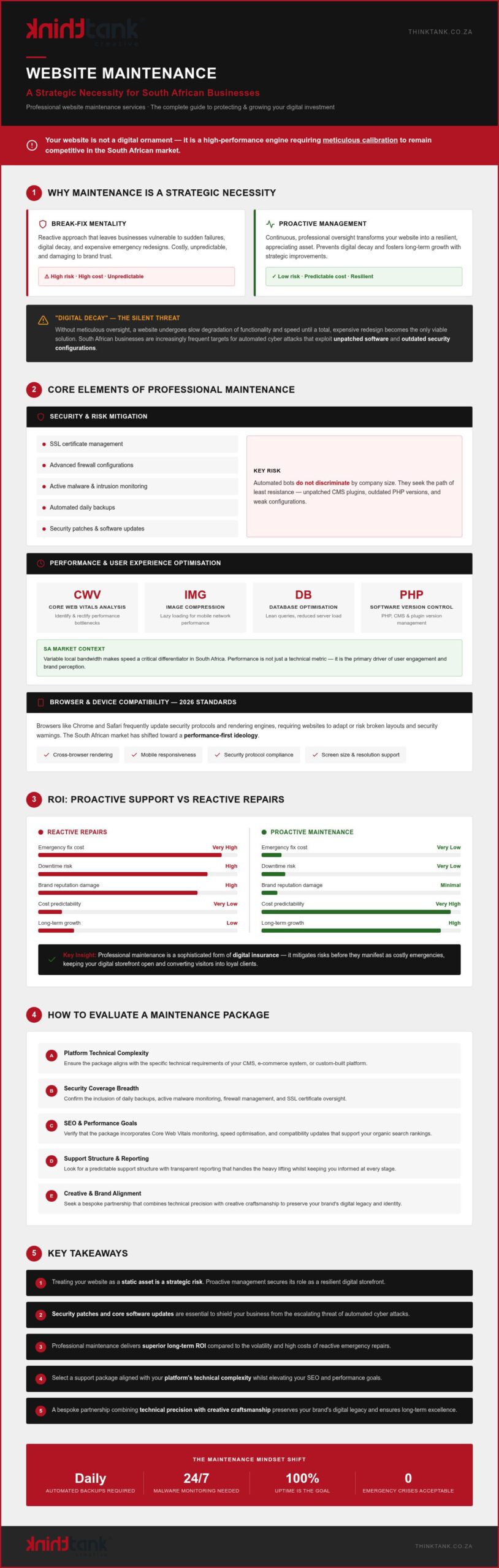
South Africa Web Maintenance Packages: 2026 Comparison
A package name can sound comprehensive without making clear who is responsible when your website needs attention. A search for website maintenance packages south africa businesses can rely on may bring up similar descriptions, yet the scope of updates, backups, security checks and ongoing support can differ. It’s reasonable to want reassurance that important tasks won’t be overlooked, and to know what falls outside the agreement.
The right choice isn’t necessarily the package with the longest list of features. It’s the support arrangement with clear responsibilities that fits your website and business needs. This guide explains the main areas of ongoing website care and how to compare options without assuming every provider includes the same work.
You’ll find practical questions to ask about maintenance tasks, support boundaries, communication and costs, so you can assess what’s covered before you commit. We’ll also look at how post-launch support fits into your website’s wider lifecycle, helping you choose an approach with greater clarity.
Key Takeaways
- Website maintenance packages south africa businesses compare can differ in scope, so look beyond the package name to understand the actual responsibilities.
- Ask whether updates, security, backups, monitoring, content changes and technical support are included or excluded.
- Compare providers side by side, considering communication and reporting as well as the work covered.
- Assess your website’s needs and the impact of downtime, outdated content or faulty forms before deciding what support makes sense.
- ThinkTank Creative provides website maintenance and support alongside website design and development. Estimated costs are discussed in relation to your needs and timeline.
Website maintenance packages in South Africa: what ongoing support is for
A website launch is a milestone, not the end of its lifecycle. Website maintenance is post-launch care that helps keep a site functional and suited to its purpose. It’s different from building new features or redesigning pages, although maintenance may reveal when a larger development project is needed.
Even a website that appears to work can benefit from planned oversight. Software changes, and a form, booking path or other feature may need attention if it no longer behaves as expected. The practical question is not simply whether a provider offers a package, but what responsibilities the package clearly describes.
This short video offers another perspective on website maintenance packages:
What does website maintenance usually mean?
Think of maintenance as a set of responsibilities to discuss, not a standard checklist guaranteed by a package label. Ask whether the proposed scope covers software updates, security checks, backups, monitoring, content changes or technical support, and how often each task is carried out. These are useful comparison criteria, not confirmed inclusions in every provider’s offer. The right scope depends on your site’s platform, complexity and role in the business.
Routine care also has boundaries. A small text correction may be treated differently from a redesign, a new booking function or other feature development. Broader marketing work is separate too. Clarifying these distinctions helps prevent a mismatch between your expectations and the agreement. In software, maintenance can involve corrective, adaptive, perfective and preventive work; see this overview of ongoing support for the underlying concepts.
Why does a business website need ongoing support?
Websites rely on software components that can change over time. An update or an alteration to a connected service may affect how a page or feature works, so review and testing can help identify problems before they disrupt visitors. For example, a contact form that stops sending enquiries may quietly interrupt an important business interaction.
Planned oversight gives a business a way to check that its site continues to serve its purpose, rather than waiting for a visitor to report a fault. Ask providers how they identify issues, what happens when work falls outside routine maintenance, and how they communicate their findings. Clear answers make it easier to compare website maintenance packages south africa businesses are considering, based on documented responsibilities rather than package names alone.
What should website maintenance packages cover? Compare the service scope
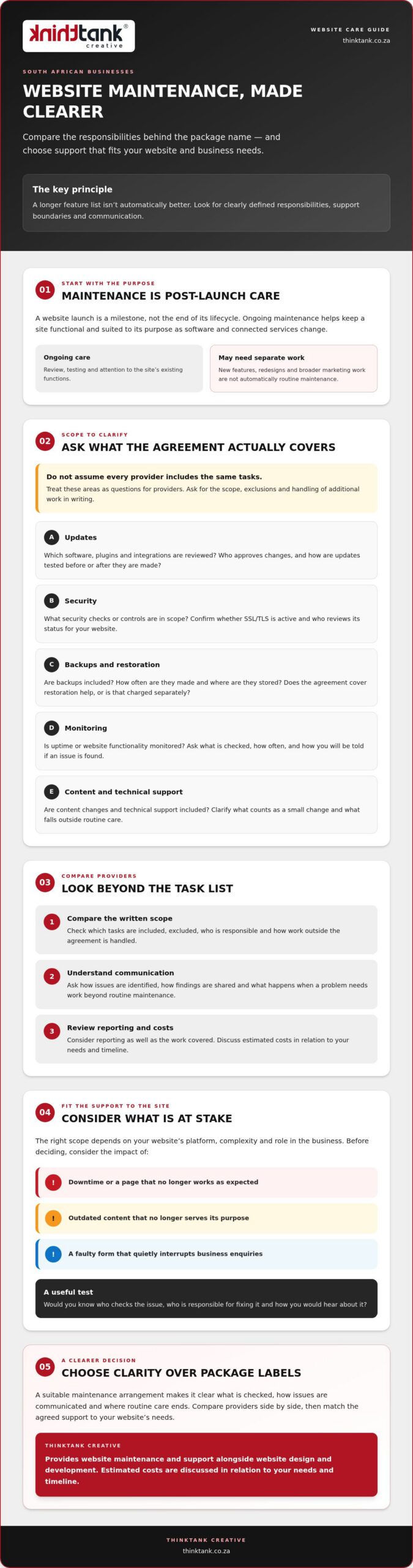
A useful package makes responsibilities clear. Use the categories below as questions for providers, not as a checklist that every website maintenance package in South Africa automatically includes. Ask for the answers in writing, including what’s excluded and how additional work is handled.
Which technical tasks should you ask about?
- Updates: Which software, plugins and integrations are reviewed? Who approves updates, and how are they tested before or after changes are made?
- Security: What checks or security controls are included in the proposed scope? Confirm whether SSL/TLS is active and who reviews its status for your specific website. CISA’s guidance on website security best practices discusses measures such as scanning and patching, which may be useful topics to raise with a provider.
- Backups and restoration: Are backups included, how often are they made, and where are they stored? If something goes wrong, does the agreement include help restoring the website, or is that charged separately?
- Monitoring: Is uptime or website functionality monitored? Ask what is checked, how often, and how you’ll be told if an issue is found.
Don’t settle for a broad promise to “keep the site updated”. Find out who is responsible for each task, what testing takes place and what restoration assistance covers. The answers should suit your site’s platform and the way your business uses it.
How are support and content changes handled?
Clarify how to submit a request, how progress is tracked and who communicates with you. Ask whether small content edits, such as updating a paragraph or replacing an image, are within the agreed scope or need a separate arrangement. Establish what response arrangements apply, including how issues are prioritised and handled. Never assume round-the-clock emergency support is included.
Draw a clear line between routine maintenance and work that changes the site’s structure or capabilities. A new booking feature, a significant redesign or a development project may need separate planning, testing and approval. Likewise, technical support for the website should not be assumed to include broader marketing work.
These distinctions help you compare website maintenance packages south africa businesses may consider without relying on tier names or feature lists alone. A provider’s written scope should explain what happens regularly, what happens when a problem is identified and what falls outside the agreement. If you’re exploring ongoing website maintenance and support, ThinkTank Creative’s website maintenance and support offering is one option to discuss in relation to your site’s requirements.
How to compare website maintenance packages and providers
Compare the work, not the label. A “standard” or “premium” package doesn’t tell you who does what, how requests are handled or which tasks will cost extra. For website maintenance packages south africa businesses are assessing, a side-by-side comparison brings these differences into view before you choose.
Use the same criteria for each provider. Your comparison can include:
- Scope: What routine tasks are included, and how often are they carried out?
- Exclusions: Which fixes, content changes or development requests need a separate agreement?
- Communication: Who is your contact, how do you submit requests and how will progress be shared?
- Reporting: What updates or records will you receive about completed work and identified issues?
- Fit: Does the provider support your specific platform, integrations and business-critical functions?
Look for precise, written answers. If a description promises “ongoing care” but doesn’t explain the tasks, ask for clarification rather than filling in the gaps yourself.
What questions should you ask before choosing a provider?
Ask who carries out the work and how proposed changes are reviewed before implementation. Confirm how requests are logged, whether you approve changes in advance, how progress updates are shared and what follow-up looks like if an issue remains. Request written confirmation of inclusions, exclusions and work that would be scoped separately. This gives both your team and the provider a shared reference point.
How do platform and business needs affect the choice?
Start with an inventory of your website platform, integrations and essential functions. If you use WordPress, for example, ask which WordPress-specific tasks the provider supports. Don’t assume that mentioning the platform means every relevant task is covered. A simple information site and a website with complex integrations may need different support priorities.
Set your criteria around the consequences a problem could have for your business, rather than an assumed industry standard. If online enquiries are central, ask how the provider would assess and communicate an issue with your enquiry process. If your site relies on an integration, confirm that the provider understands its role and limitations.
Your website’s original design and development decisions can also shape its ongoing support needs. A custom website design guide can provide useful context for understanding how platform and feature choices affect future care. To discuss website design and development alongside ongoing support, explore ThinkTank Creative’s website services.
How to choose a website maintenance package for your South African business
Choose support around the work your website needs to do. A simple assessment can help you turn a general sense of risk into a clear brief, making it easier to compare website maintenance packages south africa businesses may consider.
How can you assess your website’s maintenance needs?
Start by listing your website platform, connected integrations, forms and functions that your business relies on. Note recurring issues and tasks that currently have no clear owner. For example, if customers use a form to enquire, record it as a business-critical function and identify how you would know if it stopped working.
Then separate continuity from improvement. Keeping existing functions working is different from refreshing content, adding a feature or redesigning a page. Rank your priorities by the effect an issue could have on visitors and daily operations. A visitor journey or website user experience guide can also help you consider how people find key information and complete important actions. This perspective can help distinguish essential functions from optional enhancements.
What should a written maintenance agreement clarify?
Before support begins, make sure the agreement identifies the website covered and sets out task boundaries, communication channels and approval responsibilities. Confirm who can provide access, who owns the relevant accounts and how access will be managed. Agree how changes are reviewed before implementation, and how completed work or discovered issues will be reported.
Be specific about what happens if a request falls outside the agreed scope. Ask how additional work will be described, approved and costed. ThinkTank Creative provides an estimated cost after discussing requirements and timeline, rather than presenting a fixed maintenance price.
Review any security or compliance commitments carefully. Ask what the provider means in practical terms, which responsibilities belong to your business and which relate to the support arrangement. Check legal or regulatory statements against current authoritative guidance relevant to your circumstances. Don’t rely on a vague promise of “compliance” as a substitute for clear responsibilities.
Finally, compare providers against the priorities you’ve documented. A dependable fit is one where the scope aligns with your website, exclusions are understandable and communication arrangements are clear. If you’re ready to discuss your website’s requirements and ongoing support, contact ThinkTank Creative about website maintenance.
ThinkTank Creative website maintenance and support: plan the next step
Good support starts with a clear understanding of how your website works and what your business needs it to do. ThinkTank Creative provides website maintenance and support alongside website design and development, connecting post-launch care with the broader website lifecycle. Its website process includes planning, design, development, testing, launch, training and support, with service continuing after project completion.
This context can make a conversation about website maintenance packages south africa more useful. Rather than assuming a package includes particular tasks, outline your needs and discuss the scope, communication and support arrangement that may suit your website.
What can you discuss with ThinkTank Creative?
Prepare a concise picture of your website before the conversation. Note its platform, key functions, known issues and current support arrangements. Then identify which ongoing tasks matter most to your business and which requests, such as a redesign or new functionality, may need to be scoped as separate development work.
Share your priorities and timeline openly. This gives both sides a foundation for discussing practical requirements and how communication may work. ThinkTank Creative describes its approach as collaborative, with ongoing service after project completion. Its guiding message is: “We Do It All So You Don’t Have To”.
How do you move from comparison to a support conversation?
Bring your comparison notes, a list of essential website functions and the questions you still need answered. Ask what responsibilities could be covered, what would fall outside the proposed scope, how requests and approvals would be handled, and how post-launch support could fit alongside your wider website needs. These details turn a general enquiry into a focused discussion without presuming unconfirmed package features or response times.
Cost is part of that discussion, not a figure to assume from a package label. ThinkTank Creative provides an estimated cost after discussing your requirements and timeline; no fixed maintenance price or specific package inclusions are confirmed here. Share the context needed to understand the work, then clarify the estimate and scope together.
If you’re ready to explore an ongoing support arrangement for your website, discuss your website support needs with ThinkTank Creative.
Choose support that keeps your website moving forward
The strongest website maintenance packages south africa businesses consider are defined by clear responsibilities, not impressive-sounding labels. Compare what’s included, what sits outside the scope and how communication is handled. Then choose support that reflects your website’s role and the issues that matter most to your business.
ThinkTank Creative was founded in 2001 and provides ongoing service after project completion. Its website design and development service includes testing, launch, training and support, connecting the initial build with the next stage of your website’s life. The specific maintenance scope and estimated cost are discussed in relation to your needs and timeline.
Bring your priorities and questions to that conversation, and take the next step towards a support arrangement that fits. Discuss your website maintenance and support needs with ThinkTank Creative. Clear expectations and a collaborative approach can give your website a considered foundation for what comes next.
Frequently Asked Questions
What do website maintenance packages usually include?
Website maintenance packages can cover different tasks, so check the provider’s written scope rather than assuming a standard set of inclusions. Ask whether software updates, security checks, backups, monitoring, content changes and technical support are included, and how each is handled. Confirm what falls outside the agreement, such as new functionality or redesign work. For website maintenance packages south africa businesses are comparing, clear responsibilities matter more than the package name.
How often should a business website be maintained?
There’s no single schedule that suits every business website. The appropriate frequency depends on the platform, integrations, how the site is used and the support tasks agreed with your provider. Ask how often each task will be carried out, and who will review the site’s key functions. A site that supports important customer actions may need different oversight from a basic information site. Agree the schedule in writing and review it as your needs change.
Can I maintain my business website myself?
Yes, you may be able to handle some website care yourself if you have the knowledge, time and access required. First, identify the platform and tasks involved, then make sure you understand how changes will be checked and what to do if something goes wrong. If updates, integrations or technical issues feel beyond your capability, consider discussing support with a provider. You can also agree which responsibilities stay with your team and which need professional assistance.
What happens if a website breaks during maintenance?
Ask the provider what happens if a change causes a problem before maintenance begins. Clarify how the issue will be reported, who investigates it, whether restoration assistance is included and what work may require separate approval. Don’t assume a backup or recovery service is part of the arrangement unless it’s confirmed in writing. If you manage changes yourself, understand how you can reverse them or seek help. Response arrangements and support boundaries should be clear.
Are website maintenance and website redesign the same thing?
No. Maintenance is ongoing care for a website after launch, whilst a redesign changes its visual presentation, structure or user experience more substantially. Routine support may involve reviewing existing functions, depending on the agreed scope; new features or significant layout changes may require separate development work. If your website no longer meets your business needs, discuss whether ongoing maintenance is sufficient or a redesign should be planned as a distinct project.
How do I compare website maintenance providers in South Africa?
Compare providers using the same written criteria: tasks included, exclusions, platform and integration support, communication, reporting and how additional work is agreed. Ask who carries out and reviews changes, how requests are managed and what response arrangements apply. Check that the proposed scope fits your website’s role and complexity, rather than relying on package labels. Discuss your requirements and timeline before deciding, and make sure any cost is presented as an estimate based on that discussion.