Brand Style Guide Essentials: The 2026 Strategic Checklist for National Consistency

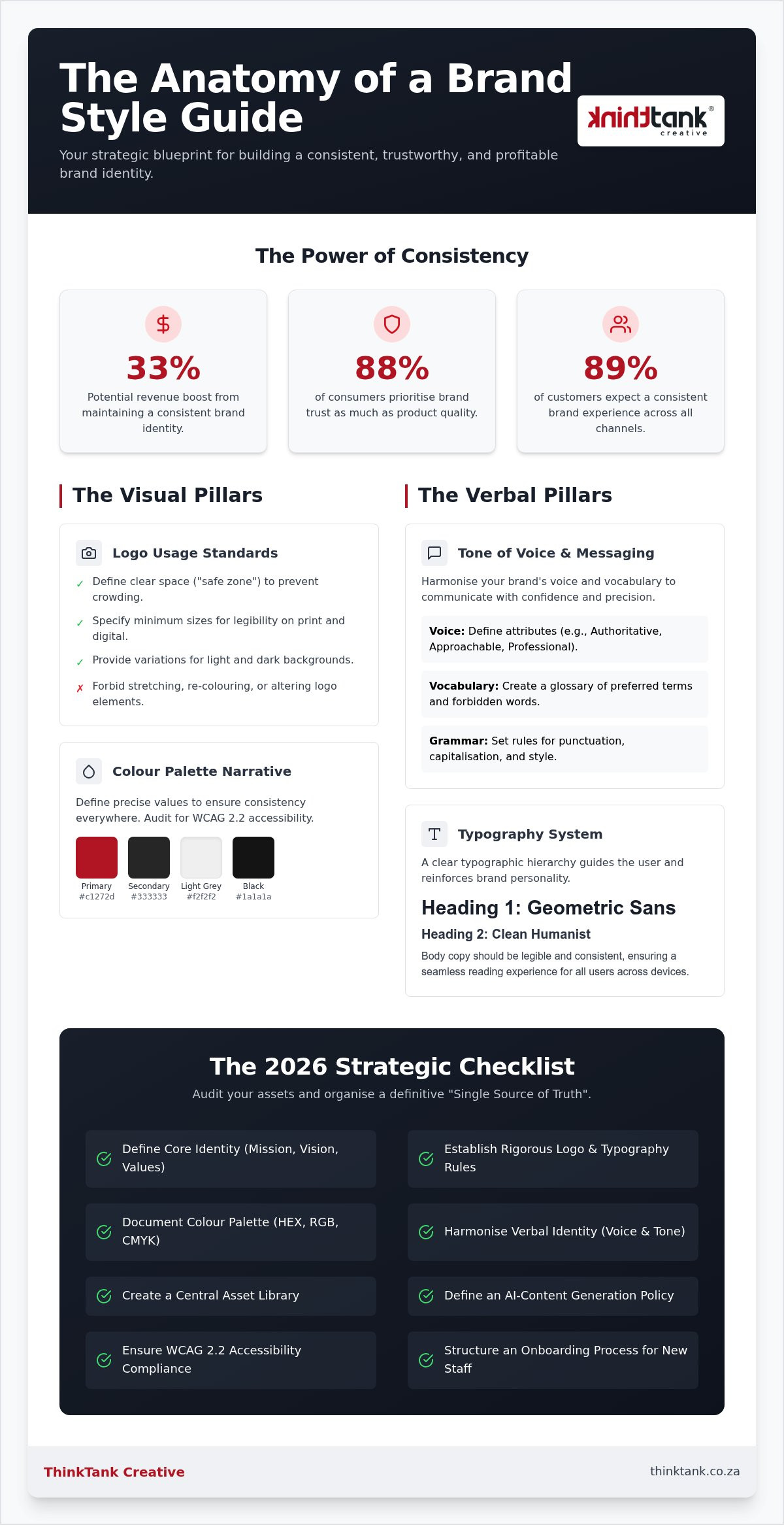
Did you know that maintaining a consistent brand identity can boost your revenue by as much as 33%? In a market where 88% of consumers prioritise trust as much as quality, your visual and verbal coherence isn't just a design choice; it's a vital financial driver. It's frustrating when different departments use conflicting logos or when the wrong colours appear in your print marketing. By mastering the brand style guide essentials, you transform your identity from a collection of assets into a strategic engine for growth that eliminates confusion and builds lasting authority.

You likely already recognise that a strong brand is built on reliability, yet achieving that uniformity across every department often feels like chasing a moving target. We're here to help you bridge that gap. This article provides a definitive roadmap to define your core identity, ensuring your business maintains a coherent and trustworthy presence at every digital and physical touchpoint. We'll explore a strategic checklist for 2026, covering everything from WCAG 2.2 accessibility standards and AI-content policies to the latest typography trends and the serene Cloud Dancer colour palette.

Key Takeaways

  • Discover why a comprehensive style guide serves as the strategic "DNA" of your corporate identity, building the consumer trust essential for long-term revenue growth.
  • Master the brand style guide essentials by establishing rigorous standards for logo usage and typography to ensure visual excellence across all physical and digital touchpoints.
  • Develop a sophisticated verbal identity that harmonises your brand's "voice" and vocabulary, allowing your team to communicate with confidence and precision.
  • Utilise our 2026 strategic checklist to audit your current assets and organise them into a definitive "Single Source of Truth" for seamless internal and external collaboration.
  • Learn how a structured implementation process protects your brand's integrity whilst simplifying the onboarding of new staff and creative partners.

Why a Brand Style Guide is a Non-Negotiable Business Asset

Think of your brand style guide as the strategic DNA of your corporate identity. It's the definitive blueprint that ensures every interaction, whether it's a social media update or a high-end brochure, feels like it belongs to the same family. Without this framework, businesses often fall victim to brand fragmentation. This occurs when different platforms look like they belong to entirely different companies, causing immediate cognitive dissonance for your customers. When 89.4% of customers expect a consistent brand experience across all channels, fragmentation is a risk you simply shouldn't take.

Maintaining these brand style guide essentials builds deep-seated trust. It reduces friction whilst customers navigate your digital space, ensuring your core values remain clear and undiluted. Beyond the external benefits, a guide empowers your internal team to produce high-quality work with increased velocity. By codifying your standards, you remove the guesswork, allowing marketers and designers to create content faster and more accurately. Whilst every brand transformation project is unique, we provide estimated costs after a thorough discussion of your specific requirements, ensuring the final asset is as bespoke as your business.

Protecting Your Brand Equity in a Digital-First World

A comprehensive style guide prevents the slow erosion of your visual impact over time. In our digital-first environment, your brand must remain instantly recognisable amongst a crowded marketplace. This consistency also aids search engine visibility, as a unified identity reinforces user recognition and encourages repeat engagement. Brand equity is the cumulative value of a recognisable identity that translates into consumer preference and long-term business stability.

The "All-Rounder" Advantage: Consistency Across Media

Bridging the gap between high-quality printing solutions and sophisticated digital interfaces requires a meticulous, multi-disciplinary approach. Your social media presence must speak the same language as your corporate profile, ensuring a seamless transition for the user at every touchpoint. Just as Wikipedia's Manual of Style provides a rigorous framework for verbal clarity and tone, your guide ensures your brand voice remains steady across every medium. This synergy starts with a solid foundation. Understanding what makes a good logo design is the critical first step in building a resilient corporate identity that stands the test of time.

The Visual Pillars: Core Brand Style Guide Essentials

Visual identity serves as the immediate visual shorthand for your brand's reputation. Establishing brand style guide essentials ensures that this shorthand remains clear, professional, and impactful across every application. A logo is often the first point of contact; however, its power is easily diluted by improper usage. Your guide must strictly forbid alterations such as stretching, "creative" recolouring, or the removal of key elements. By mandating minimum sizes for both print and digital formats, you ensure legibility remains constant, regardless of the medium. Our 5-stage design process prioritises these rules early, ensuring your identity is resilient from the moment of its creation.

Logo Anatomy and Usage Standards

Effective design requires breathing room to maintain its visual impact. We define a "safe zone" or padding around the logo to prevent it from being crowded by text or other graphic elements. This meticulous attention to detail extends to secondary marks and favicons, which are critical components of custom website design. Your document should also provide specific variations for placement on dark versus light backgrounds, ensuring your mark always maintains its visual authority without losing contrast or clarity.

Mastering the Colour Narrative

Colour is a powerful tool that influences customer behaviour and emotional response. To achieve national consistency, you must define your palette using HEX, RGB, and CMYK values. This precision ensures that the vibrant blue on your website perfectly matches the ink on your business cards or large-scale printing solutions. We also recommend auditing these choices against WCAG 2.2 accessibility standards to ensure contrast ratios are inclusive for all users. Looking at U.S. government style guides offers excellent examples of how complex organisations manage these technical requirements at scale whilst maintaining a friendly, accessible persona.

Typography and imagery provide the final layers of your visual personality. Select primary and secondary fonts that balance distinct character with high readability across different screens. Your imagery standards should define the "vibe" of photography, whilst custom iconography should follow a consistent line weight and style to ensure synergy. If you're ready to refine your visual presence, our specialists can help you develop a bespoke corporate identity that resonates with your audience and reflects your strategic vision.

Defining Your Verbal Identity: Messaging and Tone

Verbal identity is the heartbeat of your brand, yet it remains one of the most overlooked brand style guide essentials in the corporate world. Whilst many organisations obsess over hex codes and logo clear space, they often neglect the words that actually build the relationship. Your brand personality must be defined with precision. Are you the "Authoritative Expert" who leads with data, or the "Approachable Partner" who prioritises collaboration? At ThinkTank, we embody the "Strategic Visionary"—a persona that is elite in execution yet warm in professional relationships. This clarity allows us to champion our "We Do It All So You Don't Have To" philosophy, reassuring clients that their entire digital footprint is in expert hands.

A vocabulary list is a vital tool for maintaining this consistency. It establishes the specific words you use frequently to build authority and the terms you strictly avoid to prevent confusion. This level of detail ensures your messaging remains coherent across every touchpoint. For inspiration on how to codify these rules at scale, the U.S. government style guides demonstrate how even the most complex entities can maintain a unified verbal identity. By documenting these messaging standards, you ensure your mission statement isn't just a sentence on a wall, but a living part of your corporate behaviour.

Crafting a Consistent Brand Voice

Your brand voice is a constant, whilst your tone should be variable based on the context. A formal business proposal requires a steady, reassuring cadence that suggests thoroughness and strategic depth. Conversely, a casual social media post might adopt a more fluid, conversational energy. The goal is to translate complex technical jargon into clear, customer-focused benefits. Ultimately, great marketing makes the customer look smart by providing them with the clear messaging they need to make confident decisions. This approach moves the reader from a high-level concept to a concrete understanding of the value you provide.

Editorial Standards and Grammar

Precision in grammar and formatting reflects the stability of a long-standing enterprise. For South African audiences, adhering to British English spelling—such as "colour" and "organise"—is essential for national resonance. Your guide should also specify date formats, currency representation (ZAR), and capitalisation rules to ensure total alignment across all platforms. These editorial standards work in tandem with the professional logo design process, ensuring that your corporate stationery and digital assets project a polished, unified front. Whilst we provide estimated costs after a thorough discussion of your needs, the value of this verbal consistency is immediate and profound.
Brand Style Guide Essentials: The 2026 Strategic Checklist for National Consistency

The Ultimate Brand Style Guide Checklist for 2026

Transforming your brand from a loose collection of ideas into a disciplined corporate powerhouse requires a methodical approach. This checklist outlines the brand style guide essentials necessary for a future-proof identity in 2026. Auditing your current assets is the first priority. You must identify every instance where a logo is misused or a colour is off-brand to understand the scope of your transformation. Once the audit is complete, codify your logo usage, typography, and colour rules into a single, accessible document. This serves as your team's definitive source of truth.

Efficiency is the natural byproduct of a well-documented brand. By creating templates for common assets, you empower your staff to produce high-quality content without needing constant oversight. This reduces the risk of "creative" departures that dilute your visual impact. Whilst we provide estimated costs for these strategic projects after a thorough discussion of your needs, the long-term savings in production time and brand clarity are substantial.

Technical Specifications for Multi-Channel Use

Precision in file formats ensures your brand remains sharp across all platforms. Your guide should mandate SVG files for web use to maintain scalability, whilst high-resolution PDFs remain the standard for printing solutions. As mobile-first browsing dominates, responsive logo versions are no longer optional. You need simplified marks that remain legible on small screens without losing their essence. Additionally, document the standards for "leave-behind" print marketing collateral to ensure your physical presence is as polished as your digital interface. Exploring print marketing ideas for local businesses is one of the most effective ways to ensure your physical touchpoints command the same authority as your digital presence. Applying the latest business card design tips 2026 is one of the most effective ways to ensure your physical touchpoints command the same authority as your digital presence.

Imagery and Iconography Guidelines

Visual assets must evoke a specific emotional "mood" that aligns with your corporate identity. Whether you opt for candid, high-energy photography or serene, minimalist compositions, the subjects and lighting must feel intentional. Rules for iconography are equally critical. Specify the exact line weights, corner radii, and colour applications for your custom icons to prevent visual clutter. This level of detail ensures that every graphic element works in synergy to elevate your brand's authority. If you are ready to consolidate your identity, our team can help you design a bespoke corporate identity that commands attention across the South African market.

Implementation: Bringing Your Identity to Life

Launching a refined corporate identity requires more than just a static document; it demands a cultural shift within your organisation. To ensure long-term success, you must centralise your brand assets in a cloud-based repository that serves as the "Single Source of Truth" for every department. This prevents the use of outdated versions and ensures that brand style guide essentials are always accessible to your creative team. When every staff member and external agency can find the correct files instantly, you eliminate the friction that leads to brand inconsistency.

Training is the vital human element of this implementation. Host a dedicated workshop to walk your team through the new standards, explaining the strategic reasoning behind each decision. This collaborative approach turns the guide from a restrictive set of rules into a shared vision for excellence. Furthermore, your digital presence requires constant vigilance. Ongoing website maintenance and support ensure that as new pages or features are added, they strictly adhere to the established styles, preventing the "brand creep" that often occurs over time. By reviewing and fine-tuning the guide as your business evolves, you maintain a dynamic identity that remains relevant in a shifting market.

The ThinkTank Creative 5-Stage Design Framework

Our award-winning team utilises a proven 5-stage design process to build resilient identities: Research, Design, Choices, Presentation, and Fine-Tuning. This methodology begins with deep research, where we encourage challenging interaction and debate to uncover the true essence of your business. We don't believe in templated solutions. Instead, we act as a bespoke creative partner, moving your brand from a high-level concept to a concrete, future-proof identity that reflects 25 years of experience in the South African market. This meticulous approach ensures that every visual and verbal element is grounded in strategic depth.

From Guide to Growth: Your Next Steps

A robust style guide is the essential foundation for effective lead generation strategies. When your identity is coherent and professional, your marketing efforts become significantly more persuasive and trustworthy. If you're ready to elevate your corporate presence and protect your brand equity, we invite you to request a consultation for a comprehensive corporate identity redesign. We provide an estimated cost for our services following a thorough discussion of your specific needs, ensuring our partnership is built on transparency, synergy, and a shared commitment to high-quality outcomes.

Elevate Your Identity for the Next Era of Growth

Mastering the brand style guide essentials is the definitive step toward transforming your business from a fragmented collection of assets into a unified, authoritative presence. By codifying your visual and verbal standards, you eliminate the friction that erodes customer trust and internal efficiency. A well-maintained guide ensures that your message remains resilient across every touchpoint, from high-quality printing solutions to sophisticated digital interfaces. It's about creating a legacy of consistency that scales with your ambition.

ThinkTank Creative has been at the forefront of this evolution since 2001. As a comprehensive all-rounder agency, our award-winning design team brings 25 years of experience to every project, ensuring your corporate identity is both bespoke and future-proof. We believe in a collaborative journey that prioritises your unique strategic goals. Whilst we provide estimated costs after a thorough discussion of your requirements, the value of a coherent brand is immediate and enduring. We invite you to start your brand transformation with ThinkTank Creative and build a foundation for sustainable success. Your brand's potential is limitless when every detail is aligned.

Frequently Asked Questions

What is the difference between a brand style guide and a brand identity?

A brand identity is the complete collection of visual and verbal elements that define your business, whilst a style guide is the definitive manual that documents how to use them. Think of the identity as the personality and the guide as the strategic blueprint that ensures everyone communicates that personality consistently. Without a guide, your identity risks becoming fragmented across different platforms, leading to customer confusion and a loss of trust.

How long does it typically take to create a professional brand style guide?

The timeline for a professional guide varies based on the complexity of your corporate identity and the scope of your assets. At ThinkTank Creative, we utilise a rigorous 5-stage design process, moving from research and strategy through to final delivery and support. This methodical approach usually spans several weeks to ensure every detail is refined and bespoke. We provide a tailored estimated cost and timeline after a thorough discussion of your requirements.

Do small businesses really need a full brand style guide?

Every business, regardless of size, benefits from documenting their brand style guide essentials to build immediate credibility. For a small enterprise, consistency is the fastest way to appear established and trustworthy amongst larger competitors. It prevents expensive mistakes, such as printing incorrect colours or using low-resolution logos, and ensures that your first impression is always professional and aligned with your long-term growth strategy and vision.

How often should we update our brand style guide?

You should review your guide annually to ensure it remains aligned with your business objectives and current digital standards. A more comprehensive update is typically required every two to three years to incorporate evolving trends, such as 2026's focus on WCAG 2.2 accessibility or new AI-content policies. Regular maintenance prevents your brand from feeling dated and ensures your team remains energised by a forward-looking identity that adapts to the shifting marketplace.

What are the most common mistakes in a brand style guide?

One of the most frequent errors is focusing exclusively on visuals whilst neglecting the verbal identity and brand voice. Other common pitfalls include failing to define "safe zones" for logo usage or providing vague instructions that lead to "creative" departures by different departments. A successful guide must be meticulous and prescriptive, leaving no room for ambiguity that could dilute your visual impact or confuse your audience across different digital and physical touchpoints.

Can I create a brand style guide myself or should I hire an agency?

Whilst basic tools exist for DIY projects, partnering with an agency like ThinkTank Creative provides the strategic depth and award-winning expertise needed for a resilient identity. Our team has 25 years of experience in the South African market, offering an "all-rounder" perspective that covers everything from printing solutions to custom website design. This collaborative approach ensures your guide is a bespoke asset that reflects your unique value rather than a generic template.

How does a style guide help with digital marketing and SEO?

Consistency leads to improved brand recognition, which directly influences user engagement and conversion rates in digital marketing. When your social media, email campaigns, and website "speak the same language," you build the trust necessary for successful lead generation. From an SEO perspective, unified standards for imagery, alt text, and messaging ensure your brand appears robust and authoritative to both users and search engine algorithms, enhancing your overall visibility.

What is the "ZAR" focus in a South African brand style guide?

A South African focus ensures your brand resonates with a national audience by adhering to local editorial standards and market expectations. This includes using British English spelling—such as "colour" and "organise"—and correctly representing the ZAR currency in all corporate stationery and digital assets. By documenting these specific nuances, you project a professional image that respects the cultural and linguistic expectations of your clients across the country, fostering deeper local connections.
What Makes a Good Business Website? The 2026 Strategic Success Framework

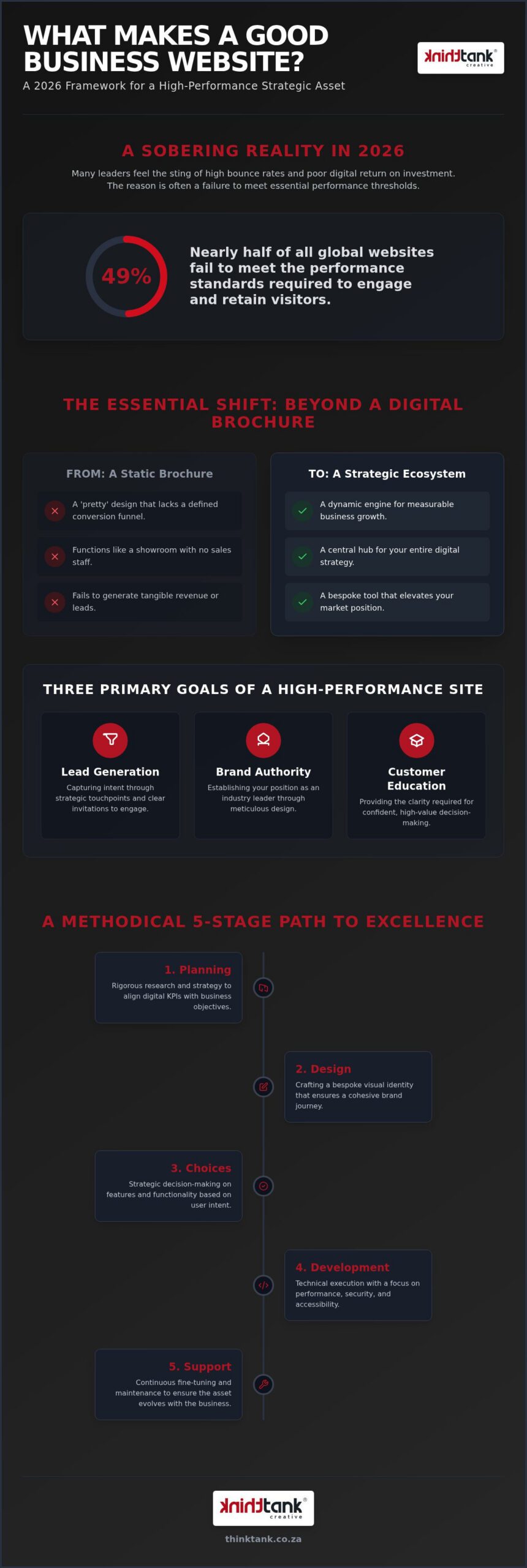
Did you know that nearly half of all global websites fail to meet the essential performance thresholds required to engage visitors in 2026? It's a sobering reality for many leaders who feel the sting of high bounce rates and the nagging fear that their digital investment isn't yielding a tangible return. You deserve a platform that acts as a silent partner in your growth, yet the path to understanding what makes a good business website often feels obscured by technical jargon and shifting search engine demands.

We'll move beyond the surface level to reveal the essential elements that transform a basic site into a high-performance strategic asset. This article provides a clear framework for website evaluation, details the measurable ROI of professional craftsmanship, and ensures your digital presence is fully optimised for the mobile-dominant reality of the modern market. By aligning sophisticated design with technical precision, you can finally build a site that reflects your true brand authority and resonates with your audience's behaviour. We invite you to discover how a methodical approach to development can elevate your business from a simple online presence to a position of industry leadership.

Key Takeaways

  • Understand why a high-performance site must function as a strategic ecosystem rather than a static brochure to drive measurable business growth.
  • Learn how the synergy between bespoke design and corporate identity, delivered through a rigorous five-stage development process, establishes immediate brand authority.
  • Discover exactly what makes a good business website in 2026 by prioritising technical precision, including site speed and security, to engage visitors across all devices.
  • Gain insights into crafting persuasive content and clear calls to action that guide users seamlessly from their initial curiosity to a confirmed conversion.
  • Recognise that a successful digital presence requires continuous fine-tuning and maintenance to ensure your asset evolves alongside your strategic objectives.

Defining the Strategic Purpose: Beyond the Digital Brochure

Command attention by transforming your digital presence from a static page into a dynamic engine for growth. A website isn't merely a digital business card; it's a strategic ecosystem where your brand identity meets the specific needs of your audience. When business owners ask what makes a good business website, they often prioritise aesthetics over function. A 'pretty' site that lacks a defined conversion funnel is essentially a beautiful showroom with no sales staff. It might attract attention, but it won't drive revenue.

We've observed that whilst good marketing makes the company look smart, great marketing makes the customer look smart. This philosophy shifts the focus from your internal achievements to your client's external success. A high-performance site serves as a sophisticated hub for three primary goals:

By positioning yourself as a partner in your customer's journey, you build a foundation of trust that outlasts a single transaction. This collaborative approach ensures your digital assets grow alongside your enterprise, moving beyond the limitations of a basic brochure to become a bespoke tool for market elevation.

To achieve this level of synergy, you must move beyond the surface level of design. True digital transformation requires a methodical alignment between your overarching business vision and the technical execution of your site. It involves a deep understanding of how visitors interact with your brand and what specific actions you want them to take. By treating your website as a living component of your business, you create a platform that is both elite in its execution and warm in its professional relationships.

Aligning Website Goals with Business Objectives

Every digital interaction should mirror a tangible business objective. If you aim to scale operations, your digital KPIs must track outcomes like lead captures or resource downloads. This synergy starts with a rigorous Research & Strategy phase. Modern Web development ensures your site remains the central hub of your digital strategy, pulling social media and organic search into one cohesive, high-performance environment.

Understanding User Intent and Journey

Your favourite customers land on your home page seeking a resolution to a challenge. They don't have the patience to navigate complex menus or decipher vague messaging. Creating a path of least resistance from click to enquiry is what distinguishes a high-performance asset. User intent is the bridge between a visitor's problem and your solution. By understanding these drivers, you can organise content to meet users exactly where they are. This clarity is essential for what makes a good business website in 2026.

User Experience and Visual Identity: Crafting a Cohesive Brand Journey

Elevate your brand by ensuring your digital presence is more than just a collection of pages. It must be a seamless extension of your physical business. This synergy between custom website design in South Africa and your corporate identity is a fundamental pillar of what makes a good business website. If your website looks like a generic template whilst your physical collateral feels bespoke, you create a jarring experience that erodes trust. A polished, invitation-based design approach ensures that every visitor feels welcomed into an elite professional environment.

We've refined a methodical 5-stage development process to ensure this level of excellence. It begins with Planning and moves through Design, Choices, Development, and finally Support. This structured methodology allows for meticulous attention to detail, ensuring that the strategic reasoning behind every visual element is grounded in your business goals. By following this path, we transform a basic site into a high-performance asset that resonates with your audience's behaviour and expectations.

The Marriage of Branding and Web Design

Your website should be the digital embodiment of your established logo and corporate identity designs. Maintaining visual consistency across all digital and print marketing collateral reinforces your professional standing and builds immediate recognition. Our award-winning design team prioritises both visualisation and usability, ensuring that the site isn't just attractive but also highly functional. High-quality graphics and professional logo design act as visual shorthand for your reliability, telling your story before a single word is read. If you're looking to refine your brand's digital journey, exploring our approach to creative design and corporate identity can provide the strategic clarity you need.

Intuitive Navigation and UX Hierarchy

Organise your information so visitors never have to struggle to find what they need. Strategic use of white space and uncluttered layouts are essential for modern professional aesthetics, as they allow your core message to breathe. During the "Choices" stage of our process, we present design directions that prioritise the path of least resistance, ensuring a steady, reassuring cadence for the user. This involves implementing a clear visual hierarchy that guides the eye to your most important message. Adhering to the Web Content Accessibility Guidelines (WCAG) ensures that this journey is inclusive for all users, regardless of their physical abilities. This level of thoroughness is a key component of what makes a good business website in 2026, as it mirrors the stability and reliability of a long-standing enterprise.

Technical Excellence: Performance, Security, and National Accessibility

Command the digital space by ensuring your site's architecture is as robust as its visual identity. In the South African context, where connection speeds vary significantly across different regions, technical precision is a non-negotiable component of what makes a good business website. A site that fails to load efficiently on a mobile device whilst a user is on the move isn't just a frustration; it's a lost opportunity for brand growth. We've found that technical foundations often dictate the ceiling of your digital success, serving as the silent engine behind every conversion.

Mobile-first design has transitioned from a recommendation to an absolute standard for any national audience. As of late 2026, mobile devices account for 59.6% of global web traffic, making it the primary lens through which your brand is viewed. Integrating technical SEO for small business ensures that this mobile experience is discoverable, bridging the gap between your services and the users searching for them. This meticulous approach aligns with the key components of a successful business website, where performance and visibility work in perfect synergy.

Loading Speed and Core Web Vitals

Slow loading times directly erode your search engine rankings and increase bounce rates, particularly amongst users with limited data or slower connections. To maintain your competitive edge, we focus on optimising images and scripts to meet Google's rigorous performance metrics. Core Web Vitals are the technical heartbeat of user satisfaction. Your Largest Contentful Paint (LCP) should occur under 2.0 seconds, whilst your Interaction to Next Paint (INP) must remain below 200 milliseconds to ensure a responsive, high-quality experience across all devices. For a comprehensive understanding of how these benchmarks apply locally, our guide to core web vitals for South African websites provides the strategic clarity needed to pass Google's thresholds in 2026.

Security and Legal Compliance (POPI Act)

Protecting your digital assets requires more than a simple SSL certificate; it demands a commitment to secure coding and robust testing during the development phase. In 2026, implementing HTTP Strict Transport Security (HSTS) is essential to force secure connections and mitigate emerging risks. Beyond technical safety, ensuring your business website remains compliant with the South African Protection of Personal Information (POPI) Act is a legal and ethical imperative. This involves clear data handling procedures and a transparent privacy policy that reflects your brand's integrity. Our ongoing support and maintenance services provide the steady, reassuring cadence needed to defend against threats, ensuring your site remains a dependable pillar of your brand's stability.

What Makes a Good Business Website? The 2026 Strategic Success Framework

Content and Conversion: Turning Visitors into Loyal Customers

Transform your digital presence from a silent observer into an active participant in your sales process. High-quality content is the catalyst that converts passive interest into decisive action. When evaluating what makes a good business website, the ability to communicate value with nuanced clarity is paramount. It is not just about filling pages with text; it's about crafting a narrative that resonates with your audience's specific challenges. By integrating sophisticated search engine optimisation, you ensure that this message reaches the right people at the right time, moving them through a purposeful journey of discovery.

Credibility is built through evidence and synergy. We utilise social proof, such as customer testimonials and detailed case studies, to reinforce your brand authority. For instance, our work with the TaxShop franchise, featuring Lebo the Accountant, demonstrates how a strategic digital presence can unify a national brand whilst maintaining a personal, approachable touch. This balance of elite execution and relatable success stories is a hallmark of great marketing that makes the customer look smart. It establishes a sense of quiet assurance in your expertise, encouraging potential clients to choose your services over a competitor's generic offering.

Strategic Copywriting for Engagement

Shift your perspective from "we do X" to "we solve your problem Y" in every line of your copy. Professional copywriting is a critical component of the production phase, ensuring your voice remains consistent across all digital and print collateral. We balance keyword density with natural, imaginative storytelling to keep visitors engaged without sacrificing search visibility. This bespoke approach ensures your messaging feels tailored rather than templated, reflecting the high-quality outcomes your business provides. Great copy acts as a guide, leading the reader from a high-level concept to a concrete understanding of your value.

Conversion Rate Optimisation (CRO) Tactics

Place your calls to action (CTAs) strategically throughout the user journey rather than hiding them on a contact page. These persuasive prompts should tell the user exactly what to do next, providing a steady, reassuring cadence that suggests thoroughness. We use custom video posts and promotional branded material to increase time-on-site and deepen engagement. Readily accessible contact information remains the simplest but most vital conversion tool in your arsenal. If you're ready to elevate your digital presence, our team can help you organise your website and marketing strategy for maximum impact. This methodical focus on user engagement is a core part of what makes a good business website in 2026.

The Post-Launch Lifecycle: Maintenance and Strategic Evolution

Secure your long-term digital success by acknowledging that a website is never truly "finished". It's a living ecosystem that requires constant fine-tuning and revision to remain effective in an ever-shifting market. When considering what makes a good business website, many leaders overlook the necessity of technical upkeep, yet this is where the true value of your investment is preserved. Neglecting this leads to technical debt, where outdated plugins or unoptimised code erode the user experience you worked so hard to build. By maintaining a WordPress website with precision, you protect your brand's stability and ensure a seamless journey for every visitor.

Understanding the website total cost of ownership is vital for any strategic leader who views their site as a high-performance asset. A website is an investment in your brand's future, and like any elite tool, it requires regular attention to maintain its ROI. ThinkTank Creative provides ongoing service and support after project completion, positioning ourselves as a partner in your growth rather than just a vendor. This collaborative relationship ensures your digital presence evolves alongside your brand, adapting to new market possibilities and user behaviours. We do it all so you don't have to, allowing you to lead your business whilst we handle the meticulous technical details.

The 5-Stage Development Process

Our methodology moves through five distinct stages: Planning, Design, Program, Development, and finally, Testing and Launch. Whilst the initial build is exciting, the "Delivery & Support" phase is the most critical for long-term ROI. It's during this time that feedback loops and meticulous testing ensure the final product exceeds expectations. This steady, purposeful approach creates a sense of reliability, mirroring the stability of a long-standing enterprise whilst maintaining the fluid energy of a creative agency. This thoroughness is a key factor in what makes a good business website over the span of years, not just months.

Measuring Success with Analytics

Command your market by using data to inform your next strategic move. Setting up robust reporting and analytics allows you to track user behaviour and the success of your digital marketing campaigns with nuanced clarity. This data provides the strategic reasoning needed to refine your SEO and PPC efforts, ensuring every Rand spent is an investment in growth. Constant communication with your agency partner is essential to interpret these metrics and adjust your digital presence accordingly. By aligning your digital strategy with real-world performance, you move from high-level concepts to concrete, measurable success.

Elevate Your Digital Presence for 2026 and Beyond

A high-performance website is the cornerstone of your brand's digital evolution. We've explored how technical precision, cohesive visual identity, and a results-driven content strategy define what makes a good business website in today's competitive landscape. By shifting your focus from a static digital brochure to a dynamic strategic ecosystem, you position your business for sustainable growth and industry leadership.

Since 2001, ThinkTank Creative has been dedicated to this level of excellence. Our award-winning design team employs a meticulous 5-stage development process to ensure every project is tailored to your specific objectives. We believe that great marketing makes your customer look smart, and we're here to provide the elite execution required to achieve that goal. It's a journey we take together, ensuring your digital asset reflects your true brand authority and resonates with your audience's behaviour.

You don't have to navigate these complexities alone. Partner with ThinkTank Creative for a strategic website redesign and discover the potential of a truly bespoke digital experience. We do it all so you don't have to, allowing your brand to thrive with quiet assurance and measurable impact.

Frequently Asked Questions

How much does a good business website cost in South Africa?

Professional website costs in South Africa vary significantly based on the complexity and strategic requirements of your project. Factors such as bespoke design, e-commerce functionality, and integration with existing corporate identity systems influence the final investment. We provide estimated costs after a thorough discussion of your objectives, ensuring that your quote reflects the high-quality outcomes you expect. This tailored approach avoids the limitations of templated solutions and focuses on long-term value.

How long does it take to design and develop a professional website?

The timeline for designing and developing a professional website depends on the scope of work and the depth of the initial strategy. A methodical five-stage process, from planning to support, typically spans several weeks to a few months. This duration allows for meticulous attention to detail during the design and testing phases. By taking a steady, purposeful approach, we ensure that the final product is a robust strategic asset that exceeds your growth expectations.

Do I really need a professional agency, or is a DIY builder enough?

Whilst DIY builders provide a basic online presence, they often fail to deliver the strategic reasoning and technical precision that define what makes a good business website. A professional agency offers an award-winning design team and a comprehensive development process that aligns your site with your brand authority. This elite execution ensures your platform is optimised for conversion and performance, providing a level of bespoke craftsmanship that templated builders simply cannot replicate.

Is search engine optimisation (SEO) included in a new website build?

Technical SEO is integrated into our initial development phase to ensure your site's architecture is search-engine friendly from the moment it launches. This includes optimising core web vitals, site structure, and mobile responsiveness. Whilst these foundations are essential for visibility, long-term search engine optimisation is an ongoing strategic service. It focuses on content creation and authority building to maintain your rankings and drive consistent traffic in a competitive national market.

What is the POPI Act, and how does it affect my business website?

The Protection of Personal Information (POPI) Act is a critical South African regulation that dictates how businesses handle personal data. Your website must comply by featuring a clear privacy policy and obtaining user consent for data collection. We ensure your site's technical framework supports these legal requirements, protecting your business from potential fines. Adhering to these standards is an essential part of building trust and demonstrating professional integrity to your digital audience.

What is website maintenance, and why is it necessary after launch?

Website maintenance involves the continuous fine-tuning of your site's software, security, and performance metrics after the initial launch. This process is vital for preventing technical debt and ensuring your digital asset remains secure against emerging threats. Regular updates keep your site compatible with modern browser standards and mobile devices. By prioritising maintenance, you protect the long-term ROI of your project and maintain a steady, reassuring cadence of reliability for your visitors.

Can I update the content on my website myself once it is live?

You can certainly update your website content yourself through a user-friendly content management system. We provide the guidance required to help you manage your blog posts, service details, and imagery with confidence. This collaborative approach allows you to keep your messaging fresh and relevant to your audience's needs. Whilst you handle the front-end updates, our team remains available to manage the complex technical support and maintenance required for sustained high performance.

How do I know if my current website needs a redesign?

Your website likely needs a redesign if it suffers from high bounce rates, slow loading speeds, or a layout that feels cluttered on mobile devices. If your current platform fails to reflect your brand's growth or no longer converts visitors into loyal customers, a strategic overhaul is necessary. Understanding what makes a good business website allows you to evaluate your current site against modern performance standards and ensure your digital presence remains an elite asset.